
HDU 5489 Difference of Clustering 图论
Difference of Clustering
A clustering algorithm takes many member entities as input and partition them into clusters. In this problem, a member entity must be clustered into exactly one cluster. However, we don’t have any pre-knowledge of the clusters, so different algorithms may produce different number of clusters as well as different cluster IDs. One thing we are sure about is that the memberIDs are stable, which means that the same member ID across different algorithms indicates the same member entity.
To compare two clustering algorithms, we care about three kinds of relationship between the old clusters and the new clusters: split, merge and 1:1. Please refer to the figure below.
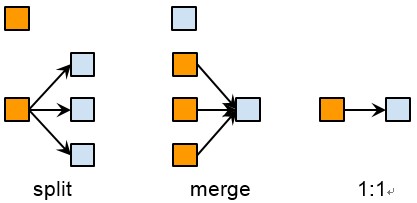
Let’s explain them with examples. Say in the old result, m0, m1, m2 are clustered into one cluster c0, but in the new result, m0 and m1 are clustered into c0, but m2 alone is clustered into c1. We denote the relationship like the following:
● In the old, c0 = [m0, m1, m2]
● In the new, c0 = [m0, m1], c1 = [m2]
There is no other members in the new c0 and c1. Then we say the old c0 is split into new c0 and new c1. A few more examples:
● In the old, c0 = [m0, m1, m2]
● In the new, c0 = [m0, m1, m2].
This is 1:1.
● In the old, c0 = [m0, m1], c1 = [m2]
● In the new, c0 = [m0, m1, m2]
This is merge. Please note, besides these relationship, there is another kind called “n:n”:
● In the old, c0 = [m0, m1], c1 = [m2, m3]
● In the new, c0 = [m0, m1, m2], c1 = [m3]
We don’t care about n:n.
In this problem, we will give you two sets of clustering results, each describing the old and the new. We want to know the total number of splits, merges, and 1:1 respectively.
Each test case starts with a line containing an integer N indicating the number of member entities (0≤N≤106 ). In the following N lines, the i-th line contains two integers c1 and c2, which means that the member entity with ID i is partitioned into cluster c1 and cluster c2 by the old algorithm and the new algorithm respectively. The cluster IDs c1 and c2 can always fit into a 32-bit signed integer.
3
0 0
0 0
0 1
4
0 0
0 0
1 1
1 1
Case #2: 0 0 2
///

#include<iostream>

#include<cstdio>

#include<cstring>

#include<string>

#include<algorithm>

#include<queue>

#include<cmath>

#include<map>

#include<bitset>

#include<set>

#include<vector>

using namespace std ;

typedef __int64 ll;

#define mem(a) memset(a,0,sizeof(a))

#define meminf(a) memset(a,127,sizeof(a));

#define memfy(a)  memset(a,-1,sizeof(a));

#define TS printf("111111\n");

#define FOR(i,a,b) for( int i=a;i<=b;i++)

#define FORJ(i,a,b) for(int i=a;i>=b;i--)

#define READ(a,b,c) scanf("%d%d%d",&a,&b,&c)

#define mod 1000000007

#define inf 100000000

inline ll read()

{

    ll x=,f=;

    char ch=getchar();

    while(ch<''||ch>'')

    {

        if(ch=='-')f=-;

        ch=getchar();

    }

    while(ch>=''&&ch<='')

    {

        x=x*+ch-'';

        ch=getchar();

    }

    return x*f;

}

//****************************************

#define maxn 1000000+6

struct ss

{

    int to,next;

} e[maxn];

struct node

{

    int x,index;//0,1;

};

int head[maxn],n,a,b,t,in[maxn][],A,B,C;

map<pair<int ,int >,int  >mp;

map<int ,int >vis,vis2;

map<int ,vector<int > >mpp,mpp2;

vector<int >V1,V2;

vector<int >::iterator it;;

int main()

{

    int T=read();

    int oo=;

    while(T--)

    {

        // init();

        scanf("%d",&n);

        mp.clear();

        V1.clear();

        V2.clear();

        mpp2.clear();

        mpp.clear();

        vis.clear();

        vis2.clear();

        int k=;

        FOR(i,,n)

        {

            scanf("%d%d",&a,&b);

            if(mp[make_pair(a,b)])continue;

            mpp[a].push_back(b);

            mpp2[b].push_back(a);

            if(!vis[a])

            V1.push_back(a);

            if(!vis2[b])

            V2.push_back(b);

            vis[a]=;

            vis2[b]=;

            mp[make_pair(a,b)]=;

        }

        A=;

        B=;

        C=;

        int sum;

        for(int i=; i<V1.size(); i++)

        {

            sum=;

            for(it=mpp[V1[i]].begin(); it!=mpp[V1[i]].end(); it++)

            {

                sum+=mpp2[*it].size();

            }

            if(sum==mpp[V1[i]].size())

            {

                if(sum==)

                    C++;

                else

                {

                    A++;

                }

            }

        }

        for(int i=; i<V2.size(); i++)

        {

            sum=;

            for(it=mpp2[V2[i]].begin(); it!=mpp2[V2[i]].end(); it++)

            {

                sum+=mpp[*it].size();

            }

            if(sum==mpp2[V2[i]].size())

            {  //cout<<mpp[V2[i]].size()<<endl;

                if(sum==)

                    C++;

                else

                {

                    B++;

                }

            }

        }

        printf("Case #%d: ",oo++);

        cout<<A<<" "<<B<<" "<<C/<<endl;

    }

    return ;

}
代码
HDU 5489 Difference of Clustering 图论的更多相关文章
- HDU 5486 Difference of Clustering 图论
题目链接: http://acm.hdu.edu.cn/showproblem.php?pid=5486 题意: 给你每个元素一开始所属的集合和最后所属的集合,问有多少次集合的分离操作,并操作和不变操 ...
- HDU 5486 Difference of Clustering 暴力模拟
Difference of Clustering HDU - 5486 题意:有n个实体,新旧两种聚类算法,每种算法有很多聚类,在同一算法里,一个实体只属于一个聚类,然后有以下三种模式. 第一种分散, ...
- HDU 5487 Difference of Languages(BFS)
HDU 5487 Difference of Languages 这题从昨天下午2点开始做,到现在才AC了.感觉就是好多题都能想出来,就是写完后debug很长时间,才能AC,是不熟练的原因吗?但愿孰能 ...
- 2015合肥网络赛 HDU 5489 Removed Interval LIS+线段树(树状数组)
HDU 5489 Removed Interval 题意: 求序列中切掉连续的L长度后的最长上升序列 思路: 从前到后求一遍LIS,从后往前求一遍LDS,然后枚举切开的位置i,用线段树维护区间最大值, ...
- hdu 4715 Difference Between Primes
题目连接 http://acm.hdu.edu.cn/showproblem.php?pid=4715 Difference Between Primes Description All you kn ...
- HDU 5489 Removed Interval (LIS变形)
题目链接:http://acm.hdu.edu.cn/showproblem.php?pid=5489 给你n个数,要删去其中连续的L个,问你删去之后的LIS最大是多少? 我们先预处理出以i下标为开头 ...
- HDU 5936 Difference 【中途相遇法】(2016年中国大学生程序设计竞赛(杭州))
Difference Time Limit: 6000/3000 MS (Java/Others) Memory Limit: 65536/65536 K (Java/Others)Total ...
- 【二分】【最长上升子序列】HDU 5489 Removed Interval (2015 ACM/ICPC Asia Regional Hefei Online)
题目链接: http://acm.hdu.edu.cn/showproblem.php?pid=5489 题目大意: 一个N(N<=100000)个数的序列,要从中去掉相邻的L个数(去掉整个区间 ...
- HDU 5487 Difference of Languages
Difference of Languages Time Limit: 1000ms Memory Limit: 32768KB This problem will be judged on HDU. ...
随机推荐
- JAVA 学习笔记 - 基础语法1
1. 类的定义 public class 与 class的区别 一个java文件只有一个public class, 而且类名必须与文件名一致. 一个java文件可以有多个class定义,javac ...
- HDU_1074_Doing Homework_状态压缩dp
链接:http://acm.hdu.edu.cn/showproblem.php?pid=1074 Doing Homework Time Limit: 2000/1000 MS (Java/Othe ...
- Masonry 原理与使用说明
原理: 1)约束生成:MASConstraintMaker: 2)缺省补齐: - (void)setSecondViewAttribute:(id)secondViewAttribute { if ( ...
- Window提高_3.1练习_双进程守护
双进程守护 当打开一个进程A的时候,此进程检测是否存在进程B,如果不存在就创建进程B. 进程B的作用是检测进程A是否被关闭,如果被关闭了,就再创建一个进程A. 双进程守护A.exe代码如下: #inc ...
- Vue指令5:v-if
条件判断(v-if\v-else) v-if 指令将根据表达式的真假值(true 或 false )来决定是否插入 元素. <div id="app"> <ul ...
- 梦想CAD控件网页版文字样式
增加文字样式 用户可以增加文字样式到数据库,并设置其字体等属性,具体实现js代码如下: function CreateText(){ //返回控件的数据库对象 var database =mxOcx. ...
- 00HyperText Markup Language
HyperText Markup Language HTML超文本标记语言是一种用于创建网页的标准标记语言用于显示网页内容,HTML运行在浏览器上,由浏览器来解析,您可以使用 HTML 来建立自己的 ...
- jenkins部署遇到离线问题如何解决
部署jenkins页面时遇到离线问题如何解决 部署jenkins遇到一个问题,然后告诉我你的jenkins已经离线,什么鬼,后来找了很多博客 后来自己终于验证成功了,也分享给大家,只需把https改为 ...
- springcloud中feign接值问题
很多时候使用feign都接收不到传过来的数据,一般情况如下! 如果是基本数据类型的话,使用@RequestParam @RequestMapping(value = "/selectDeta ...
- page对象的使用及常见方法
page对象的使用及常见方法 制作人:全心全意 page对象代表JSP本身,只有在JSP页面内才是合法的.page对象本质上是包含当前Servlet接口引用的变量,可以看作是this关键字的别名. p ...