
HDU 3260/POJ 3827 Facer is learning to swim(DP+搜索)(2009 Asia Ningbo Regional)
Description
In the new game, a robot named "Facer" is swimming in a pool. The pool can be considered as a vertical N x M grid. The coordinates of the top-left cell is (1,1), and the coordinates of the bottom-right cell is (N, M). Cells in the top rows are called "surface cells", and all other cells are called "under water cells".
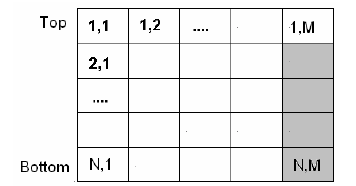 Figure 1. The swimming pool. Shadowed cells are poisonous.Facer starts swimming from the top-left cell (1,1) and must arrive at the top-right cell (1, M). He has a constant horizontal speed of 1 per second, and a vertical speed of v per second. v is always integer and can be changed. If v is positive, it means Facer is moving down; and if v is negative, it means Facer is moving up. So if Facer is at cell (x, y) now, he will arrive at cell (x + v, y + 1) after a second. Be careful that if x + v > N, Facer will get to cell (N, y + 1) because he cannot move down anymore and of course if x + v < 1, Facer will get to cell (1, y + 1) because he cannot fly. Please remember that all the ``under water cells" in the right-most column are poisonous. If Facer goes into those cells, he will die.
 The capacity of Facer's oxygen bottle is limited, and when Facer gets into a surface cell, the oxygen bottle is refilled automatically. Facer has to refill his oxygen bottle every K seconds, which means that during the time between two refillings, Facer can only pass at most K - 1 under water cells in the horizontal direction.
In every cell, there is either a "speed changing machine" or a "money box" (can't be both). Every speed changing machine has a value T and every money box has a value P.
You have got enough number of devices called "speedo". Every speedo has a value Q which is 1 or -1. You can put your speedos in any cells, but you can put at most one speedo in a cell.
When Facer reaches a cell, the speed changing machine of value T in that cell (if there is one) will change his vertical speed by T, and the speedo of value Q in that cell (if there is one) will change his vertical speed by Q. For example, if Facer's vertical speed is v when he arrives at a cell with a speed changing machine of value T and a speedo of value Q, his vertical speed will be changed to v + T + Q immediately. There are three more things you need to know about speed changing:
- All speed changing machines in the surface cells can't work.
- When reaching a surface cell without a speedo, Facer's vertical speed becomes zero immediately; and when reaching a surface cell with a speedo of value Q, Facer's vertical speed becomes Q immediately.
- When reaching a bottom cell, though Facer can't go down any more, his vertical speed will NOT be changed unless there is a speedo or a speed changing machine in that cell. It's maybe sound a little bit weird but Facer really is such a weird guy.
When arriving at a cell with a money box of value P, Facer gets P dollars (In fact, if P is negative, Facer loses |P| dollars). Facer's total amount of money can be negative -- that means Facer owes some money to the pool's owner.
You task is deploying your speedos in a smart way before Facer starts swimming, so Facer can get money as much as possible when he arrives at cell (1, M). Facer's initial vertical speed is zero and if you put a speedo in the cell (1,1), it will change Facer's initial vertical speed.
Input
The first line contains three integers N,M and K ( 1 <= N <= 100, 1 <= M <= 1000, 1 <= K <= 10), tells the size of the pool and Facer must refill the oxygen bottle every K seconds.
Following are N lines describing the cells by top to bottom order. Each line contains M elements, separated by blanks, telling the information about the cells of a row, by left to right order. There are only two kinds of elements:
- a char "v" followed by an integer T, meaning that there is a "speed changing machine" of value T (-20 <= T <= 20) in the correspondent cell.
- a char "$" followed by an integer P, meaning that there is a "money box" of value P (-1000000 <= P <= 1000000) in the correspondent cell.
Output
题目大意:一个N*M的游泳池,要从(1, 1)游到(1, M),每个格子有变速器和钱(都可能为负),到了钱的地方可以拿到那些钱,到了变速器的地方速度就会加上那个变速器的速度。横向速度恒定为1,纵向速度可以改变,每次可以随意+1、-1或不变,变速器影响的也是纵向的速度。每K秒要到水面呼吸一次,求游到(1, M)的最大钱数。其他细节见题目。
思路:首先朴素的DP(如dp[N, M, V, K]的那种)是没法过的,时间复杂度太大了。另辟蹊径,注意到K很小,只有10,而且每次到水面速度会变为0,那么可以利用这一点,dp[i]表示到(1, i)时取得的最大金钱,然后对(1, i)爆搜K步,每次时间复杂度为O(3^K),总复杂度为O(M * 3^K),也不过6 * 10^7。
PS:这题坑爹的地方比较多,来一一细说。
1、每个格子的P (-1000000 <= P <= 1000000),乘个1000绝对爆32位整数,但是人人都用int我也用了int,不知道大家有没看到答案在32位以内反正我是没看到。
2、题目原句:and when reaching a surface cell with a speedo of value Q, Facer's vertical speed becomes Q immediately.
3、翻译一下:当到达水平而且那个格子有一个变速器Q,那么速度变为Q(不知道有没翻译错)
4、按这个说法,如果我所有格子都是V20,就不一定有答案了,题目是没说没答案怎么处理的……
5、重点是我按上面的说法做AC不了,改成到达水面之后速度为0不管那个格子有木有变速器就能AC,WA了几次之后对拍别人的AC代码发现的。
6、然后我看到了这句:All speed changing machines in the surface cells can't work。我承认我没认真看题但也不带这样坑我的啊……
代码(POJ 1219MS):
 #include <cstdio>

 #include <algorithm>

 #include <cstring>

 #include <iostream>

 using namespace std;

 typedef long long LL;

 const int MAXN = ;

 const int MAXM = ;

 const int INF = 0x3fff3fff;

 int dp[MAXM];

 int mat[MAXN][MAXM];

 bool money[MAXN][MAXM];

 int n, m, k;

 void dfs(int from, int ti, int tj, int spd, int sum) {

     if(ti < ) ti = ;

     if(ti > n) ti = n;

     if(ti ==  && from != tj) {

         if(dp[tj] < sum) dp[tj] = sum;

         return ;

     }

     if(tj - from == k || tj == m) return ;

     if(money[ti][tj]) sum += mat[ti][tj];

     else if(ti != ) spd += mat[ti][tj];

     dfs(from, ti + spd - , tj + , spd - , sum);

     dfs(from, ti + spd    , tj + , spd    , sum);

     dfs(from, ti + spd + , tj + , spd + , sum);

 }

 void solve() {

     dp[] = ;

     for(int i = ; i <= m; ++i) dp[i] = -INF;

     for(int i = ; i < m; ++i) {

         if(dp[i] == -INF) continue;

         dfs(i, , i, , dp[i]);

     }

     //for(int i = 1; i <= m; ++i) printf("%d\n", dp[i] + money[1][i] * mat[1][i]);

     if(money[][m]) dp[m] += mat[][m];

     printf("%d\n", dp[m]);

 }

 char lastch = ' ';

 inline char readchar() {

     while(lastch != 'v' && lastch != '$')

         lastch = getchar();

     return lastch;

 }

 inline int readint() {

     int g = , l;

     while(!isdigit(lastch) && lastch != '-') lastch = getchar();

     if(lastch == '-') {

         l = -;

         lastch = getchar();

     }

     else l = ;

     while(isdigit(lastch)) {

         g = g *  + lastch - '';

         lastch = getchar();

     }

     return g * l;

 }

 int main() {

     while(true) {

         n = readint(); m = readint(); k = readint();

         if(n + m + k == ) break;

         char c;

         for(int i = ; i <= n; ++i) {

             for(int j = ; j <= m; ++j) {

                 //scanf(" %c%d", &c, &mat[i][j]);

                 c = readchar();

                 mat[i][j] = readint();

                 money[i][j] = (c == '$');

             }

         }

         solve();

     }

 }
代码(POJ 1922MS):
 #include <cstdio>

 #include <algorithm>

 #include <cstring>

 #include <iostream>

 using namespace std;

 typedef long long LL;

 const int MAXN = ;

 const int MAXM = ;

 const int INF = 0x3fff3fff;

 int dp[MAXM];

 int mat[MAXN][MAXM];

 bool money[MAXN][MAXM];

 int n, m, k;

 void dfs(int from, int ti, int tj, int spd, int sum) {

     if(ti < ) ti = ;

     if(ti > n) ti = n;

     if(ti ==  && from != tj) {

         if(dp[tj] < sum) dp[tj] = sum;

         return ;

     }

     if(tj - from == k || tj == m) return ;

     if(money[ti][tj]) sum += mat[ti][tj];

     else if(ti != ) spd += mat[ti][tj];

     dfs(from, ti + spd - , tj + , spd - , sum);

     dfs(from, ti + spd    , tj + , spd    , sum);

     dfs(from, ti + spd + , tj + , spd + , sum);

 }

 void solve() {

     dp[] = ;

     for(int i = ; i <= m; ++i) dp[i] = -INF;

     for(int i = ; i < m; ++i) {

         if(dp[i] == -INF) continue;

         dfs(i, , i, , dp[i]);

     }

     if(money[][m]) dp[m] += mat[][m];

     printf("%d\n", dp[m]);

 }

 int main() {

     while(scanf("%d%d%d", &n, &m, &k) != EOF) {

         if(n + m + k == ) break;

         char c;

         for(int i = ; i <= n; ++i) {

             for(int j = ; j <= m; ++j) {

                 scanf(" %c%d", &c, &mat[i][j]);

                 money[i][j] = (c == '$');

             }

         }

         solve();

     }

 }
HDU 3260/POJ 3827 Facer is learning to swim(DP+搜索)(2009 Asia Ningbo Regional)的更多相关文章
- HDU 3265/POJ 3832 Posters(扫描线+线段树)(2009 Asia Ningbo Regional)
Description Ted has a new house with a huge window. In this big summer, Ted decides to decorate the ...
- HDU 3264/POJ 3831 Open-air shopping malls(计算几何+二分)(2009 Asia Ningbo Regional)
Description The city of M is a famous shopping city and its open-air shopping malls are extremely at ...
- HDU 3262/POJ 3829 Seat taking up is tough(模拟+搜索)(2009 Asia Ningbo Regional)
Description Students often have problems taking up seats. When two students want the same seat, a qu ...
- HDU 3268/POJ 3835 Columbus’s bargain(最短路径+暴力枚举)(2009 Asia Ningbo Regional)
Description On the evening of 3 August 1492, Christopher Columbus departed from Palos de la Frontera ...
- HDU 3269 P2P File Sharing System(模拟)(2009 Asia Ningbo Regional Contest)
Problem Description Peer-to-peer(P2P) computing technology has been widely used on the Internet to e ...
- hdu 4081 Qin Shi Huang's National Road System(最小生成树+dp)2011 Asia Beijing Regional Contest
同样是看别人题解才明白的 题目大意—— 话说秦始皇统一六国之后,打算修路.他要用n-1条路,将n个城市连接起来,并且使这n-1条路的距离之和最短.最小生成树是不是?不对,还有呢.接着,一个自称徐福的游 ...
- HDU 3126 Nova [2009 Asia Wuhan Regional Contest Online]
标题效果 有着n巫妖.m精灵.k木.他们都有自己的位置坐标表示.冷却时间,树有覆盖范围. 假设某个巫妖攻击精灵的路线(他俩之间的连线)经过树的覆盖范围,表示精灵被树挡住巫妖攻击不到.求巫妖杀死所有精灵 ...
- hdu 3123 GCC (2009 Asia Wuhan Regional Contest Online)
GCC Time Limit: 1000/1000 MS (Java/Others) Memory Limit: 131072/131072 K (Java/Others) Total Subm ...
- HDU 3699 A hard Aoshu Problem(暴力枚举)(2010 Asia Fuzhou Regional Contest)
Description Math Olympiad is called “Aoshu” in China. Aoshu is very popular in elementary schools. N ...
随机推荐
- JavaScript Event Loop和微任务、宏任务
为什么JavaScript是单线程? JavaScript的一大特点就是单线程, 同一时间只能做一件事情,主要和它的用途有关, JavaScript主要是控制和用户的交互以及操作DOM.注定它是单线程 ...
- chromium之task
// A task is a generic runnable thingy, usually used for running code on a // different thread or fo ...
- (Linux学习笔记一:压缩)[20180209]
学习笔记一:压缩 2015年2月5日 上午 10:23 压缩命令 压缩文件的扩展名大多是*.tar.*.tar.gz.*.tgz.*.gz.*.Z.*.bz2 常见的压缩命令gzip与bzip2,其中 ...
- AJAX 动态加载后台数据 绑定select
<select id="select"> <!--下拉框数据动态加载--> </select> js:(使用jquery) $(document ...
- java集合基础篇 简单总结
昨天晚上看了编程思想4的持有对象,所以把学到看到的一些记记背背的方面给总结一下. java的容器主要分为两类,一个是实现了接口Collection的一类,还有一个是实现了Map接口的一类. 继承Col ...
- Python学习 :装饰器
装饰器(函数) 装饰器作为一个函数,可以为其他函数在不修改原函数代码的前提下添加新的功能 装饰器的返回值是一个函数对象.它经常用于有切面需求的场景,比如:插入日志.性能测试.事务处理.缓存.权限校验等 ...
- linux运维视频教程
视频教程:https://www.bilibili.com/video/av31023006/?p=2 1.文件系统 文件系统树形结构: 对于linux系统的user和application来说,并不 ...
- Python学习:6.python内置函数
Python内置函数 python内置函数,是随着python解释器运行而创建的函数,不需要重新定义,可以直接调用,那python的内置函数有哪些呢,接下来我们就了解一下python的内置函数,这些内 ...
- 从Github开源项目《云阅》所学到的知识
感谢开源,感谢大神,才让我们这些菜鸟成长! 附上云阅开源项目地址:点我吧. 1.轮播图的实现. 现在的APP基本都会实现这个功能吧,然后一直都找不到好的第三方库,能够满足各种需求.然而碰到了这个开源库 ...
- 使用putty远程登录Ubuntu时,报Network error:Connection refused错误及解决
putty远程登录Ubuntu,弹出Network error:Connection refused的错误提示框,就是因为Ubuuntu没有安装ssh服务. 执行命令: sudo apt instal ...