
Teamwork[HDU4494]
Teamwork
Time Limit: 2000/1000 MS (Java/Others) Memory Limit: 65535/65535 K (Java/Others)
Total Submission(s): 497 Accepted Submission(s): 258
Problem Description
Some locations in city A has been destroyed in the fierce battle. So the government decides to send some workers to repair these locations. There are m kinds of workers that were trained for different skills. Each location need some number of some kinds of workers and has a schedule that at what time can the repair begins, and the time cost of repair. Any job cannot begin until all the workers required arrived.
For example, location 1 needs 2 workers of type 1 and 3 workers of type 2, and the beginning time and time cost is 100 minute and 90 minute correspondingly, then 5 workers that satisfy the requirement should arrive before 100 minute, start working at 100 minute and get the job done at 190 minute. Notice that two different types of workers cannot replace each other, so with 3 workers of type 1 and only 2 workers of type 2, this job cannot be done.
Workers can go from one location to another after their jobs are done. You can take the Euclidean distance between locations as the time workers need to travel between them. Each worker should be sent from a depot initially at 0 minute. Now your task is to determine the minimum number of workers needed to be sent from depot so that all the jobs can be done.
Input
There are multiple test cases, the integer on the first line T (T<25) indicates the number of test cases.
Each test case begins with two integers n (<=150), the number of location(including the depot) and m(<=5), the number of different skills.
The next line gives two integers x0, y0 indicates the coordinate of depot.
Then follows n - 1 lines begins with 4 integer numbers: xi, yi, bi(bi>0), pi(pi>0), (xi, yi) gives the coordinate of the i-th location, bi gives the beginning time and pi gives the time cost. The rest of the line gives m non-negative integers v1, v2, ..., vm, of which the i-th number indicates the the number of workers of type i needed (for all vi, 0<=vi<10, each location at least requires one worker).
All integers are less than 1000000 (106).
Output
For each test cases output one line, the minimum workers to be sent. It is guaranteed that there's always a feasible solution that all the jobs can be done.
Sample Input
2
4 1
0 0
0 1 1 1 3
1 1 3 3 4
1 0 10 1 5
4 1
0 0
0 1 1 1 3
1 1 3 3 4
1 0 3 1 5
Sample Output
5
9
一开始不会,在网上找了一下,看到有一个博客里是这么说的:
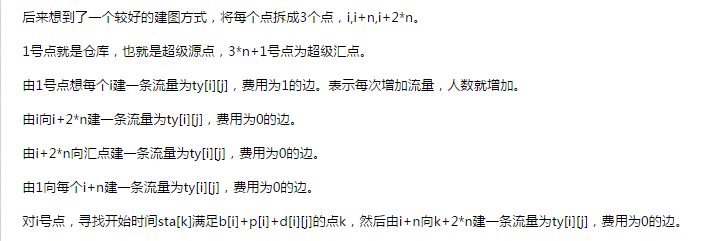
没看明白他是什么意思,为什么要把一个点分成3个点。我拿第一组示例输入画了一下图:

1是源点,3n+1是汇点,中间的3列是拆分之后的3组点。关键看第三列的点,它的流量有两个来源,一是从源点派出,费用是1,代表这部分工人是另行派出的;二是从其他节点派出,费用是0,代表这部分工人是完成其他任务后转来的。
顺便,从图里可以看出,确实不用分成3个点,第一列完全没必要。这道题整理了一个最小费用流的模板--->
#include<iostream>

#include<cstring>

#include<cstring>

#include<cmath>

#include<cstdio>

using namespace std;

const int Maxn = ;

int n, m, k;

int sta[Maxn], en[Maxn], ty[Maxn][];

double d[Maxn][Maxn];

struct Point {

    double x, y;

} p[Maxn];

double DIS(Point a, Point b) {

    return sqrt((a.x - b.x) * (a.x - b.x) + (a.y - b.y) * (a.y - b.y));

}

//ALGORITHM MINCOSTFLOW ->

#define ALGORITHM_MINCOSTFLOW_MAXN 600

#define ALGORITHM_MINCOSTFLOW_MAXM 360000

#define ALGORITHM_MINCOSTFLOW_INF 0X7FFFFFFF

struct ALGORITHM_MINCOSTFLOW_Edge {

    int v;

    int val;

    int cost;

    int next;

} ALGORITHM_MINCOSTFLOW_edge[ALGORITHM_MINCOSTFLOW_MAXM];

int ALGORITHM_MINCOSTFLOW_head[ALGORITHM_MINCOSTFLOW_MAXN];

int ALGORITHM_MINCOSTFLOW_countedge;

int ALGORITHM_MINCOSTFLOW_pre[ALGORITHM_MINCOSTFLOW_MAXN];

int ALGORITHM_MINCOSTFLOW_pos[ALGORITHM_MINCOSTFLOW_MAXN];

int ALGORITHM_MINCOSTFLOW_dis[ALGORITHM_MINCOSTFLOW_MAXN];

int ALGORITHM_MINCOSTFLOW_que[ALGORITHM_MINCOSTFLOW_MAXM];

bool ALGORITHM_MINCOSTFLOW_vis[ALGORITHM_MINCOSTFLOW_MAXN];

void ALGORITHM_MINCOSTFLOW_addedge(int u, int v, int val, int cost) {

    ALGORITHM_MINCOSTFLOW_edge[ALGORITHM_MINCOSTFLOW_countedge].v = v;

    ALGORITHM_MINCOSTFLOW_edge[ALGORITHM_MINCOSTFLOW_countedge].val = val;

    ALGORITHM_MINCOSTFLOW_edge[ALGORITHM_MINCOSTFLOW_countedge].cost = cost;

    ALGORITHM_MINCOSTFLOW_edge[ALGORITHM_MINCOSTFLOW_countedge].next = ALGORITHM_MINCOSTFLOW_head[u];

    ALGORITHM_MINCOSTFLOW_head[u] = ALGORITHM_MINCOSTFLOW_countedge++;

    ALGORITHM_MINCOSTFLOW_edge[ALGORITHM_MINCOSTFLOW_countedge].v = u;

    ALGORITHM_MINCOSTFLOW_edge[ALGORITHM_MINCOSTFLOW_countedge].val = ;

    ALGORITHM_MINCOSTFLOW_edge[ALGORITHM_MINCOSTFLOW_countedge].cost = -cost;

    ALGORITHM_MINCOSTFLOW_edge[ALGORITHM_MINCOSTFLOW_countedge].next = ALGORITHM_MINCOSTFLOW_head[v];

    ALGORITHM_MINCOSTFLOW_head[v] = ALGORITHM_MINCOSTFLOW_countedge++;

}

void ALGORITHM_MINCOSTFLOW_clear() {

    memset(ALGORITHM_MINCOSTFLOW_head, -, sizeof(ALGORITHM_MINCOSTFLOW_head));

    ALGORITHM_MINCOSTFLOW_countedge = ;

}

bool ALGORITHM_MINCOSTFLOW_spfa(int s, int t) {

    memset(ALGORITHM_MINCOSTFLOW_pre, -, sizeof(ALGORITHM_MINCOSTFLOW_pre));

    memset(ALGORITHM_MINCOSTFLOW_vis, , sizeof(ALGORITHM_MINCOSTFLOW_vis));

    int Head, tail;

    Head = tail = ;

    for (int i = ; i < ALGORITHM_MINCOSTFLOW_MAXN; i++) {

        ALGORITHM_MINCOSTFLOW_dis[i] = ALGORITHM_MINCOSTFLOW_INF;

    }

    ALGORITHM_MINCOSTFLOW_que[tail++] = s;

    ALGORITHM_MINCOSTFLOW_pre[s] = s;

    ALGORITHM_MINCOSTFLOW_dis[s] = ;

    ALGORITHM_MINCOSTFLOW_vis[s] = ;

    while (Head != tail) {

        int now = ALGORITHM_MINCOSTFLOW_que[Head++];

        ALGORITHM_MINCOSTFLOW_vis[now] = ;

        for (int i = ALGORITHM_MINCOSTFLOW_head[now]; i != -; i = ALGORITHM_MINCOSTFLOW_edge[i].next) {

            int adj = ALGORITHM_MINCOSTFLOW_edge[i].v;

            if (ALGORITHM_MINCOSTFLOW_edge[i].val >  && ALGORITHM_MINCOSTFLOW_dis[now] + ALGORITHM_MINCOSTFLOW_edge[i].cost < ALGORITHM_MINCOSTFLOW_dis[adj]) {

                ALGORITHM_MINCOSTFLOW_dis[adj] = ALGORITHM_MINCOSTFLOW_dis[now] + ALGORITHM_MINCOSTFLOW_edge[i].cost;

                ALGORITHM_MINCOSTFLOW_pre[adj] = now;

                ALGORITHM_MINCOSTFLOW_pos[adj] = i;

                if (!ALGORITHM_MINCOSTFLOW_vis[adj]) {

                    ALGORITHM_MINCOSTFLOW_vis[adj] = ;

                    ALGORITHM_MINCOSTFLOW_que[tail++] = adj;

                }

            }

        }

    }

    return ALGORITHM_MINCOSTFLOW_pre[t] != -;

}

int ALGORITHM_MINCOSTFLOW_MinCostFlow(int s, int t) {

    int cost = , flow = ;

    while (ALGORITHM_MINCOSTFLOW_spfa(s, t)) {

        int f = ALGORITHM_MINCOSTFLOW_INF;

        for (int i = t; i != s; i = ALGORITHM_MINCOSTFLOW_pre[i])

            if (ALGORITHM_MINCOSTFLOW_edge[ALGORITHM_MINCOSTFLOW_pos[i]].val < f) {

                f = ALGORITHM_MINCOSTFLOW_edge[ALGORITHM_MINCOSTFLOW_pos[i]].val;

            }

        flow += f;

        cost += ALGORITHM_MINCOSTFLOW_dis[t] * f;

        for (int i = t; i != s; i = ALGORITHM_MINCOSTFLOW_pre[i]) {

            ALGORITHM_MINCOSTFLOW_edge[ALGORITHM_MINCOSTFLOW_pos[i]].val -= f;

            ALGORITHM_MINCOSTFLOW_edge[ALGORITHM_MINCOSTFLOW_pos[i] ^ ].val += f;

        }

    }

    return cost;

}

// <- ALGORITHM MINCOSTFLOW

void build(int type) {

    int i, j;

    ALGORITHM_MINCOSTFLOW_clear();

    for (i = ; i <= n; i++) {

        ALGORITHM_MINCOSTFLOW_addedge(, i +  * n, ty[i][type], );

        ALGORITHM_MINCOSTFLOW_addedge(, i + n, ty[i][type], );

        ALGORITHM_MINCOSTFLOW_addedge(i +  * n,  * n + , ty[i][type], );

        for (j = ; j <= n; j++) {

            if (sta[i] + en[i] + d[i][j] <= sta[j]) {

                ALGORITHM_MINCOSTFLOW_addedge(i + n, j +  * n, ty[i][type], );

            }

        }

    }

}

int solve() {

    int i, j, u, v;

    int ans = ;

    for (i = ; i <= m; i++) {

        build(i);

        ans += ALGORITHM_MINCOSTFLOW_MinCostFlow(,  * n + );

    }

    return ans;

}

int main() {

    int i, j, u, v, c, t;

    scanf("%d", &t);

    while (t--) {

        ALGORITHM_MINCOSTFLOW_clear();

        scanf("%d%d", &n, &m);

        scanf("%lf%lf", &p[].x, &p[].y);

        for (i = ; i <= n; i++) {

            scanf("%lf%lf%d%d", &p[i].x, &p[i].y, &sta[i], &en[i]);

            for (j = ; j <= m; j++) {

                scanf("%d", &ty[i][j]);

            }

        }

        for (i = ; i <= n; i++) {

            for (j = i + ; j <= n; j++) {

                d[i][j] = d[j][i] = DIS(p[i], p[j]);

            }

        }

        printf("%d\n", solve());

    }

    return ;

}
Teamwork[HDU4494]的更多相关文章
- hdu 4494 Teamwork 最小费用最大流
Teamwork Time Limit: 20 Sec Memory Limit: 256 MB 题目连接 http://acm.hdu.edu.cn/showproblem.php?pid=4494 ...
- Scrum And Teamwork
Scrum Learning 概念 Scrum是迭代式增量软件开发过程,通常用于敏捷软件开发.Scrum包括了一系列实践和预定义角色的过程骨架.Scrum中的主要角色包括同项目经理类似的Scrum主管 ...
- GIT TEAMWORK
Learn GIT TEAMWORK generalizations Congratulations, you now know enough to start collaborating on Gi ...
- CSUOJ 1525 Algebraic Teamwork
Problem A Algebraic Teamwork The great pioneers of group theory and linear algebra want to cooperate ...
- P5124 Teamwork(DP)
题目: P5124 [USACO18DEC]Teamwork 解析: 动态规划,设\(f[i]\)表示到第\(i\)位的最大值,我们枚举i之前的j个位置\((j<k)\),记录一下这\(j+1\ ...
- 2019 GDUT Rating Contest I : Problem B. Teamwork
题面: 传送门 B. Teamwork Input file: standard input Output file: standard output Time limit: 1 second Memor ...
- Teamwork——Week4 团队分工和预估项目时间
由于我们给每个组员预估的每天用在该团队项目的时间为2h左右,因此我们的时间计算也已2h为基数.下面就是我们的团队分工和预估项目时间. 任务编号 实现人员 任务详细描述 预估时间 任务0 全体组员 看学 ...
- Teamwork——Week 4 Daily Scrum Meeting#1 2013.10.23
一.会议议题 1)根据确立的项目题目,进一步明确PM,DEV,TEST的工作. 2)确定团队分工和预估项目时间. 3)完成项目架构NABC模型. 4)确定第一轮开发团队分工 二.会议时间 2013年1 ...
- Teamwork——Week4 团队项目之NABC
项目框架——NABC模型 一.N(Need需求) 我们组主要的用户对象是第三小组——UI小组的同学们,因此我们的用户需求就是他们的数据需求. 1)提供给UI小组整理好的数据库,和前一组讨论好数据结构. ...
随机推荐
- 面向对象的小demo
两个类如下 package cao.com.duixiang; import java.util.Arrays; public class OtherTest { //求max public int ...
- android的JNI 、 NDK 学习!
转载的! Java Native Interface (JNI)标准是java平台的一部分,它允许Java代码和其他语言写的代码进行交互.JNI 是本地编程接口,它使得在 Java 虚拟机 (VM) ...
- DB2 Z/os Load utility 使用
Use the LOAD online utility to load one or more tables of a table space. The LOAD utility loads reco ...
- Ionic2 Tutorial
build your first app Now that you have Ionic and its dependencies installed, you can build your firs ...
- MVC缓存01,使用控制器缓存或数据层缓存
对一些浏览频次多.数据量大的数据,使用缓存会比较好,而对一些浏览频次低,或内容因用户不同的,不太适合使用缓存. 在控制器层面,MVC为我们提供了OutputCacheAttribute特性:在数据 ...
- mysql基础一
一.概述 1.什么是数据库 ? 答:数据的仓库,如:在ATM的示例中我们创建了一个 db 目录,称其为数据库 2.什么是 MySQL.Oracle.SQLite.Access.MS SQL Serve ...
- TortoiseSVN常用批处理命令 分类: C# 2014-08-09 11:31 648人阅读 评论(1) 收藏
TortoiseSVN作为源代码管理软件,估计用过的都会说好,在Windows下,配合批处理命令,往往可以事半功倍,整理了下常用的批处理命令: (将下面的内容修改后,保存为*.bat文件执行即可) : ...
- C# IIS应用程序池辅助类 分类: C# Helper 2014-07-19 09:50 249人阅读 评论(0) 收藏
using System.Collections.Generic; using System.DirectoryServices; using System.Linq; using Microsoft ...
- Linux發送郵件
1.直接使用shell當編輯器 [root@phburdb1 mail]# mail -s "Hello World" juncai.chen@innolux.comHello j ...
- php抓取网页信息
index.php <?php include_once 'simple_html_dom.php'; //获取html数据转化为对象 $html = file_get_html('http:/ ...