
CVPR 2016 paper reading (6)
1. Neuroaesthetics in fashion: modeling the perception of fashionability, Edgar Simo-Serra, Sanja Fidler, Francesc Moreno-Noguer, Raquel Urtasun, in CVPR 2015.
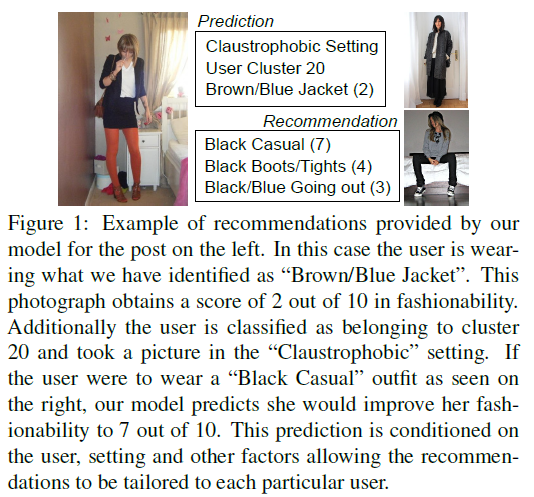
Goal: learn and predict how fashionable a person looks on a photograph, and suggest subtle improvements that user could make to improve her/his appeal.
This paper proposes a Conditional Random Field model that jointly reasons about several fashionability factors such as the type of outfit (全套装备) and garments (衣服) the user is wearing, the type of the user, the photograph's setting (e.g., the scenery behind the user), and the fashionability score.
Importantly, the proposed model is able to give rich feed back to the user, conveying which garments or even scenery she/he should change in order to improve fashionability.
This paper collects a novel dataset that consists of 144,169 user posts from a clothing-oriented social website chictopia.com. In a post, a user publishes one to six photographs of her/himself wearing a new outfit. Generally each photograph shows a different angle of the user or zoons in on different garments. User sometimes also add a description of the outfit, and/or tags of the types and colors of the garments they are wearing.
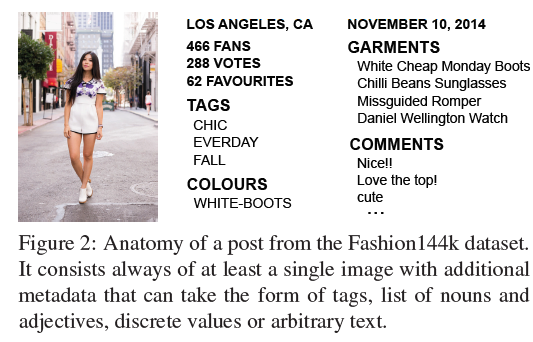
Discovering fashion from weak data:
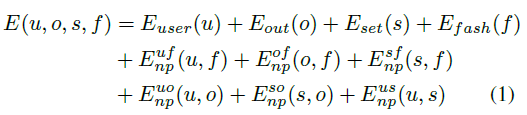
The energy of the CRF as a sum of energies encoding unaries for each variable as well as non-parametric pairwise pothentials which reflect the correlations between the different random variables:
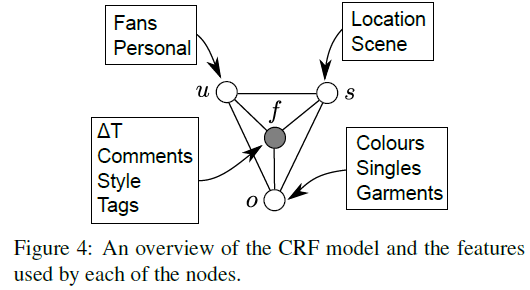
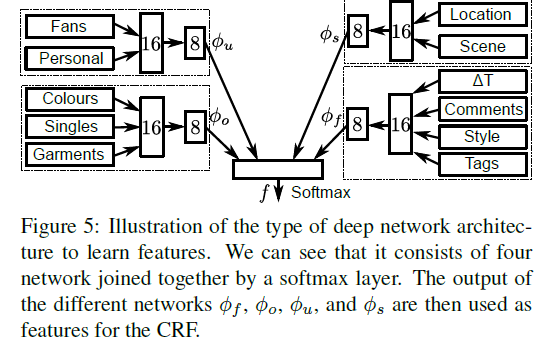
User specific features:
- the logarithm of the number of fans
- use rekognition to compute attributes of all the images of each post, keep the features for the image with the highest score.
Then compute the unary potentials as the output of a small neural network, produce an 8-D feature map.

Outfit features:
bag-of-words approach on the "garments" and "colours" meta-data

Setting features:
- the output of a pre-trained scene classifier (multi-layer perceptron, whose input is CNN feature)
- user-provided location: look up the latitude and longitude of the user-provided location, project all the values on the unit sphere, and add some small Guassian noise. Then perform unsupervised clustering using the geodesic distances, and use the geodesic distance from each cluster center as a feature.

Fashion:
- delta time: the time between the creation of the post and when the post was crawled as a feature
- bag-of-words on the "tag"
- comments: parse the comments with the sentiment-analysis model, which can predict how positive a review is on a 1- 5 scale, sum the scores for each post.
- style: style classifier pretrained on Flickr80K.

Correlations:
use a non-parametric function for each pairwise and let the CRF learn the correlations:

Similarly for the other pairwise potentials.
Learn and Inference:
First jointly train the deep networks that are used for feature extraction to predict fashionablity, and estimate the initial latent states using clustering.
Then learn the CRF model using the primal-dual method.
CVPR 2016 paper reading (6)的更多相关文章
- CVPR 2016 paper reading (2)
1. Sketch me that shoe, Qian Yu, Feng Liu, Yi-Zhe Song, Tao Xiang, Timothy M. Hospedales, Cheng Chan ...
- CVPR 2016 paper reading (3)
DeepFashion: Powering Robust Clothes Recognition and Retrieval with Rich Annotations, Ziwei Liu, Pin ...
- 浅析"Sublabel-Accurate Relaxation of Nonconvex Energies" CVPR 2016 Best Paper Honorable Mention
今天作了一个paper reading,感觉论文不错,马克一下~ CVPR 2016 Best Paper Honorable Mention "Sublabel-Accurate Rela ...
- (转)CVPR 2016 Visual Tracking Paper Review
CVPR 2016 Visual Tracking Paper Review 本文摘自:http://blog.csdn.net/ben_ben_niao/article/details/52072 ...
- Paper Reading: In Defense of the Triplet Loss for Person Re-Identification
In Defense of the Triplet Loss for Person Re-Identification 2017-07-02 14:04:20 This blog comes ...
- Paper Reading: Stereo DSO
开篇第一篇就写一个paper reading吧,用markdown+vim写东西切换中英文挺麻烦的,有些就偷懒都用英文写了. Stereo DSO: Large-Scale Direct Sparse ...
- 深度视觉盛宴——CVPR 2016
小编按: 计算机视觉和模式识别领域顶级会议CVPR 2016于六月末在拉斯维加斯举行.微软亚洲研究院在此次大会上共有多达15篇论文入选,这背后也少不了微软亚洲研究院的实习生的贡献.大会结束之后,小编第 ...
- Paper Reading - Deep Visual-Semantic Alignments for Generating Image Descriptions ( CVPR 2015 )
Link of the Paper: https://arxiv.org/abs/1412.2306 Main Points: An Alignment Model: Convolutional Ne ...
- Paper Reading - Mind’s Eye: A Recurrent Visual Representation for Image Caption Generation ( CVPR 2015 )
Link of the Paper: https://ieeexplore.ieee.org/document/7298856/ A Correlative Paper: Learning a Rec ...
随机推荐
- D3基础---简介和数据
D3.js是一种数据操作类型的javascript库(也可视其为插件):结合HTML,SVG和CSS,D3可以图形化的,生动的展现数据. d3获取:http://d3js.org/ 在代码文件中引入D ...
- gc原理小结
一.相关概念 基本回收算法 1. 引用计数(Reference Counting) 比较古老的回收算法.原理是此对象有一个引用,即增加一个计数,删除一个引用则减少一个计数.垃圾回收时,只用收集计数为0 ...
- 互联网轻量级框架SSM-查缺补漏第六天【级联+延迟加载特辑】
简言:本来这是昨天看的,但是因为想好好写一下[级联]这个东西,所以就看完之后今天来整理一下. 级联 1. 什么是级联 级联是一个数据库实体的概念.比如教师就需要存在学生与之对应,这样就有教师学生表,一 ...
- oracle中,改变表名和字段名的大小写
1.将表名和字段名改为大写 见--http://www.cnblogs.com/wenboge/articles/4121331.html 2.将表名和字段名改为小写 ①改表名为小写 begin f ...
- mysql三表联合查询
-- SELECT d.userId, d.userPhoNum, a.orderId, a.productType, b.courseId, b.courseName, c.payJe -- FRO ...
- 终止ajax请求
在做搜索功能时,文本框输入文本就得请求一次数据,如果上一次的请求还没回又请求了就导致数据错误和无用的数据请求. 我们需要输入文本时候判断上一次的ajax请求是否完毕,若还没完毕就终止本次请求. 对于j ...
- JavaScript String对象常用方法
length 返回字符串的长度(字符数) var str='Hello World!'; str.length; charAt() 返回指定位置的字符,第一个字符位置为0 var str='Hello ...
- Python入门教程
http://www.cnblogs.com/vamei/archive/2012/09/13/2682778.html
- Java基础_day01
一.JRE和JDK的安装, JRE —— Java 运行环境 Java runtime environment 包含Java虚拟机和Java程序的核心类库. ...
- 【Python】内置方法pop
此时 a,b 指向的地址所存的内容均被更改