
golang数据结构和算法之DoublyLinkedList双向链表
双向链表比起单向链表,
多了一个向前指向的指针,
所以在增删查改时,要同时照顾到两个指针的指向。
DoublyLinkedList.go
package DoublyLinkedList

//双向链表
type Node struct {
	data int
	next *Node
	prev *Node
}

type DoublyLinkedList struct {
	head *Node
	tail *Node
}

func (list *DoublyLinkedList) InsertFirst(i int) {
	data := &Node{data: i}
	if list.head != nil {
		list.head.prev = data
		data.next = list.head
	}
	list.head = data
}

func (list *DoublyLinkedList) InsertLast(i int) {
	data := &Node{data: i}
	if list.head == nil {
		list.head = data
		list.tail = data
		return
	}
	if list.tail != nil {
		list.tail.next = data
		data.prev = list.tail
	}
	list.tail = data
}

func (list *DoublyLinkedList) RemoveByValue(i int) bool {
	if list.head == nil {
		return false
	}

	if list.head.data == i {
		list.head = list.head.next
		list.head.prev = nil
		return true
	}
	if list.tail.data == i {
		list.tail = list.tail.prev
		list.tail.next = nil
		return true
	}
	current := list.head
	for current.next != nil {
		if current.next.data == i {
			if current.next.next != nil {
				current.next.next.prev = current
			}
			current.next = current.next.next
			return true
		}
		current = current.next
	}
	return false
}

func (list *DoublyLinkedList) RemoveByIndex(i int) bool {
	if list.head == nil {
		return false
	}
	if i < 0 {
		return false
	}

	if i == 0 {
		list.head.prev = nil
		list.head = list.head.next
		return true
	}
	current := list.head
	for u := 1; u < i; u++ {
		if current.next.next == nil {
			return false
		}
		current = current.next
	}
	if current.next.next != nil {
		current.next.next.prev = current
	}
	current.next = current.next.next
	return true
}

func (list *DoublyLinkedList) SearchValue(i int) bool {
	if list.head == nil {
		return false
	}
	current := list.head
	for current != nil {
		if current.data == i {
			return true
		}
		current = current.next
	}
	return false
}

func (list *DoublyLinkedList) GetFirst() (int, bool) {
	if list.head == nil {
		return 0, false
	}
	return list.head.data, true
}

func (list *DoublyLinkedList) GetLast() (int, bool) {
	if list.head == nil {
		return 0, false
	}
	current := list.head
	for current.next != nil {
		current = current.next
	}
	return current.data, true
}

func (list *DoublyLinkedList) GetSize() int {
	count := 0
	current := list.head
	for current != nil {
		count += 1
		current = current.next
	}
	return count
}

func (list *DoublyLinkedList) GetItemFromStart() []int {
	var items []int
	current := list.head
	for current != nil {
		items = append(items, current.data)
		current = current.next
	}
	return items
}

func (list *DoublyLinkedList) GetItemFromEnd() []int {
	var items []int
	current := list.tail
	for current != nil {
		items = append(items, current.data)
		current = current.prev
	}
	return items
}
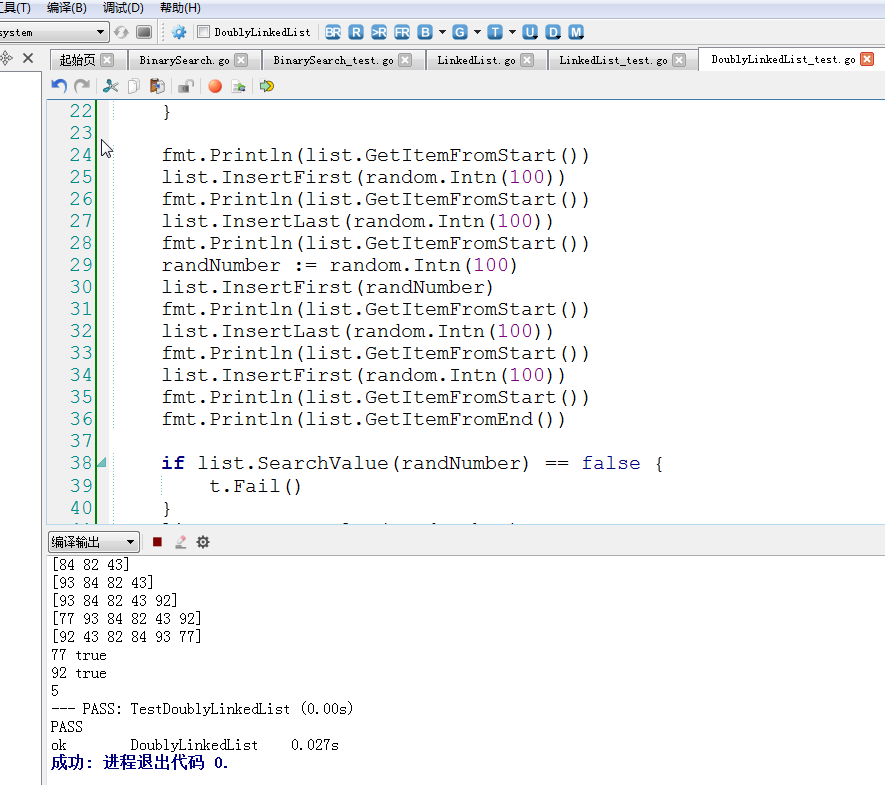
DoublyLinkedList_test.go
package DoublyLinkedList

//使用随机数作测试
import (
	"fmt"
	"math/rand"
	"testing"
	"time"
)

func TestDoublyLinkedList(t *testing.T) {

	random := rand.New(rand.NewSource(time.Now().UnixNano()))
	headNode := &Node{
		data: random.Intn(100),
		next: nil,
		prev: nil,
	}
	list := &DoublyLinkedList{
		head: headNode,
		tail: headNode,
	}

	fmt.Println(list.GetItemFromStart())
	list.InsertFirst(random.Intn(100))
	fmt.Println(list.GetItemFromStart())
	list.InsertLast(random.Intn(100))
	fmt.Println(list.GetItemFromStart())
	randNumber := random.Intn(100)
	list.InsertFirst(randNumber)
	fmt.Println(list.GetItemFromStart())
	list.InsertLast(random.Intn(100))
	fmt.Println(list.GetItemFromStart())
	list.InsertFirst(random.Intn(100))
	fmt.Println(list.GetItemFromStart())
	fmt.Println(list.GetItemFromEnd())

	if list.SearchValue(randNumber) == false {
		t.Fail()
	}
	list.RemoveByValue(randNumber)
	if list.SearchValue(randNumber) == true {
		t.Fail()
	}
	fmt.Println(list.GetFirst())
	fmt.Println(list.GetLast())
	fmt.Println(list.GetSize())

}
golang数据结构和算法之DoublyLinkedList双向链表的更多相关文章
- golang数据结构和算法之BinarySearch二分查找法
基础语法差不多了, 就需要系统的撸一下数据结构和算法了. 没找到合适的书, 就参考github项目: https://github.com/floyernick/Data-Structures-and ...
- 数据结构与算法-python描述-双向链表
# coding:utf-8 # 双向链表的相关操作: # is_empty() 链表是否为空 # length() 链表长度 # travel() 遍历链表 # add(item) 链表头部添加 # ...
- golang数据结构和算法之QueueLinkedList链表队列
队列和堆栈不一样的地方在于进出顺序: 堆栈是后进先出, 队列是先进先出. QueueLinkedList.go package QueueLinkedList type Node struct { d ...
- golang数据结构和算法之StackLinkedList链表堆栈
会了上一个,这个就差不离了. StackLinkedList.go package StackLinkedList type Node struct { data int next *Node } t ...
- golang数据结构和算法之StackArray数组堆栈
用数组实现的堆栈, 另一种,是用链表实现的堆栈, 在各种不同的编程语言上, 实现都是类似的. StackArray.go package StackArray //基于数组实现的堆栈 const ar ...
- golang数据结构和算法之LinkedList链表
差不多自己看懂了,可以自己写测试了.:) LinkedList.go package LinkedList //"fmt" type Node struct { data int ...
- golang数据结构和算法之CircularBuffer环形缓冲队列
慢慢练语法和思路, 想说的都在代码及注释里. CircularBuffer package CircularBuffer const arraySize = 10 type CircularBuffe ...
- 数据结构与算法 Big O 备忘录与现实
不论今天的计算机技术变化,新技术的出现,所有都是来自数据结构与算法基础.我们需要温故而知新. 算法.架构.策略.机器学习之间的关系.在过往和技术人员交流时,很多人对算法和架构之间的关系感 ...
- 数据结构和算法(Golang实现)(15)常见数据结构-列表
列表 一.列表 List 我们又经常听到列表 List数据结构,其实这只是更宏观的统称,表示存放数据的队列. 列表List:存放数据,数据按顺序排列,可以依次入队和出队,有序号关系,可以取出某序号的数 ...
随机推荐
- 打包Python文件为exe
pip install pyinstaller 然后就在终端里执行命令 cd 到目标文件的目录下 执行 pyinstaller -F ***.py 即可生成exe
- Day15 - Python基础15 模块学习-selectors
本节内容 1:Python/selectors模块 2:selsect实例 1:Python/selectors模块及队列 selectors模块是可以实现IO多路复用机制: 它具有根据平台选出最佳 ...
- css 两行、多行超出后用省略号...表示
.item-name { letter-spacing: ; overflow: hidden; display: -webkit-box; text-overflow: ellipsis; -web ...
- HttpClient基本功能的使用 Get方式
一.GET 方法 使用 HttpClient 需要以下 6 个步骤: 1. 创建 HttpClient 的实例 2. 创建某种连接方法的实例,在这里是 GetMethod.在 ...
- 纠错:Feign 没用 短连接
Feign 默认不是 短连接 疯狂创客圈 Java 高并发[ 亿级流量聊天室实战]实战系列 [博客园总入口 ] 疯狂创客圈(笔者尼恩创建的高并发研习社群)Springcloud 高并发系列文章,将为大 ...
- SQL Server设置数据库为状态为只读
问题描述: 有时候我们为了防止连接数据库再链接插入数据,就可以把库设置为只读模式 灰色后面显示只读说明已经是只读状态了 1.设置为只读状态 USE [master] GO ALTER DATABASE ...
- Java中的集合-您必须知道的13件事
Java Collections Framework是Java编程语言的核心部分之一.集合几乎用于任何编程语言中.大多数编程语言都支持各种类型的集合,例如List, Set, Queue, Stack ...
- IT兄弟连 HTML5教程 HTML5的基本语法 如何选择开发工具
如何选择开发工具 有许多可以编辑网页的软件,事实上你不需要用任何专门的软件来建立HTML页面,你所需要的只是一个文本编辑器(或字处理器),如Office Word.记事本.写字板等.制作页面初学者通常 ...
- 解决 layui 弹出层(弹框)一闪而过就消失的问题 (转载)
转载: 原文链接:https://blog.csdn.net/qq_20594019/article/details/83956532 本人遇到问题:使用layer.open()弹出页面层,出现弹框闪 ...
- Android应用图标尺寸以及drawable(ldpi、mdpi、hdpi、xhdpi、xxhdpi)
应用图标: L DPI ( Low Density Screen,120 DPI ),其图标大小为 36 x 36 px M DPI ( Medium Density Screen, 160 DPI ...