
讲讲Handler+Looper+MessageQueue 关系
Handler+Looper+MessageQueue这三者的关系其实就是Android的消息机制。这块内容相比开发人员都不陌生,在面试中,或者日常开发中都会碰到,今天就来讲这三者的关系。
概述:
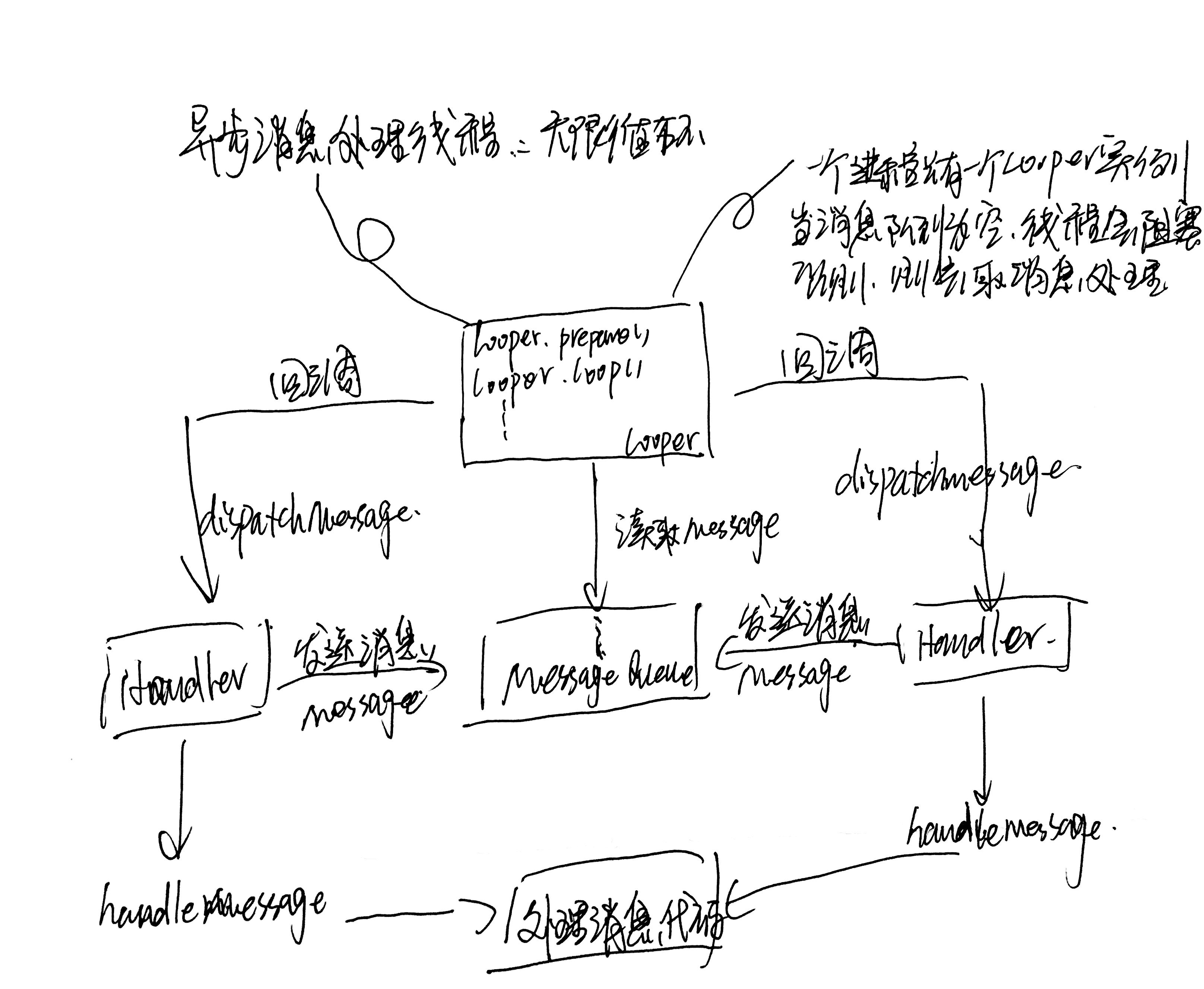
Handler 、 Looper 、Message 这三者都与Android异步消息处理线程相关的概念。那么什么叫异步消息处理线程呢?
关系图:
先给出这三者之间的关系图
原因:
Looper类
Looper扮演的角色就是消息循环,不断从MessageQueue中查看是否有新消息,如果有新消息到来就会立刻处理,否则就一直祖塞在那里,在它的构造方法,默认会创建一个MessageQueue的消息队列,然后将当前线程的对象保存起来。
private Looper(boolean quitAllowed) {

        mQueue = new MessageQueue(quitAllowed);

        mRun = true;

        mThread = Thread.currentThread();

}
对于Looper主要是prepare()和loop()两个方法,首先看prepare()方法。
public static final void prepare() {

        if (sThreadLocal.get() != null) {

            throw new RuntimeException("Only one Looper may be created per thread");

        }

        sThreadLocal.set(new Looper(true));

}
sThreadLocal是一个ThreadLocal对象,可以在一个线程中存储变量。可以看到,在第5行,将一个Looper的实例放入了ThreadLocal,并且2-4行判断了sThreadLocal是否为null,否则抛出异常。这也就说明了Looper.prepare()方法不能被调用两次,同时也保证了一个线程中只有一个Looper实例
然后我们看loop()方法:
public static void loop() {

        final Looper me = myLooper();

        if (me == null) {

            throw new RuntimeException("No Looper; Looper.prepare() wasn't called on this thread.");

        }

        final MessageQueue queue = me.mQueue;

        // Make sure the identity of this thread is that of the local process,

        // and keep track of what that identity token actually is.

        Binder.clearCallingIdentity();

        final long ident = Binder.clearCallingIdentity();

        for (;;) {

            Message msg = queue.next(); // might block

            if (msg == null) {

                // No message indicates that the message queue is quitting.

                return;

            }

            // This must be in a local variable, in case a UI event sets the logger

            Printer logging = me.mLogging;

            if (logging != null) {

                logging.println(">>>>> Dispatching to " + msg.target + " " +

                        msg.callback + ": " + msg.what);

            }

            msg.target.dispatchMessage(msg);

            if (logging != null) {

                logging.println("<<<<< Finished to " + msg.target + " " + msg.callback);

            }

            // Make sure that during the course of dispatching the

            // identity of the thread wasn't corrupted.

            final long newIdent = Binder.clearCallingIdentity();

            if (ident != newIdent) {

                Log.wtf(TAG, "Thread identity changed from 0x"

                        + Long.toHexString(ident) + " to 0x"

                        + Long.toHexString(newIdent) + " while dispatching to "

                        + msg.target.getClass().getName() + " "

                        + msg.callback + " what=" + msg.what);

            }

            msg.recycle();

        }

}
方法直接返回了sThreadLocal存储的Looper实例,如果me为null则抛出异常,也就是说looper方法必须在prepare方法之后运行。
拿到该looper实例中的mQueue(消息队列)
就进入了我们所说的无限循环。
取出一条消息,如果没有消息则阻塞。
使用调用 msg.target.dispatchMessage(msg);把消息交给msg的target的dispatchMessage方法去处理。Msg的target是什么呢?其实就是handler对象,下面会进行分析。
释放消息占据的资源。
Looper主要作用:
1、 与当前线程绑定,保证一个线程只会有一个Looper实例,同时一个Looper实例也只有一个MessageQueue。
2、 loop()方法,不断从MessageQueue中去取消息,交给消息的target属性的dispatchMessage去处理。
好了,我们的异步消息处理线程已经有了消息队列(MessageQueue),也有了在无限循环体中取出消息的哥们,现在缺的就是发送消息的对象了,于是乎:Handler登场了。
Handler类
public Handler() {

        this(null, false);

}

public Handler(Callback callback, boolean async) {

        if (FIND_POTENTIAL_LEAKS) {

            final Class<? extends Handler> klass = getClass();

            if ((klass.isAnonymousClass() || klass.isMemberClass() || klass.isLocalClass()) &&

                    (klass.getModifiers() & Modifier.STATIC) == 0) {

                Log.w(TAG, "The following Handler class should be static or leaks might occur: " +

                    klass.getCanonicalName());

            }

        }

        mLooper = Looper.myLooper();

        if (mLooper == null) {

            throw new RuntimeException(

                "Can't create handler inside thread that has not called Looper.prepare()");

        }

        mQueue = mLooper.mQueue;

        mCallback = callback;

        mAsynchronous = async;

    }
通过Looper.myLooper()获取了当前线程保存的Looper实例,然后在19行又获取了这个Looper实例中保存的MessageQueue(消息队列),这样就保证了handler的实例与我们Looper实例中MessageQueue关联上了。
然后看我们最常用的sendMessage方法
 public final boolean sendMessage(Message msg)

    {

        return sendMessageDelayed(msg, 0);

    }

   public final boolean sendEmptyMessageDelayed(int what, long delayMillis) {

        Message msg = Message.obtain();

        msg.what = what;

        return sendMessageDelayed(msg, delayMillis);

    }

 public final boolean sendMessageDelayed(Message msg, long delayMillis)

    {

        if (delayMillis < 0) {

            delayMillis = 0;

        }

        return sendMessageAtTime(msg, SystemClock.uptimeMillis() + delayMillis);

    }

 public boolean sendMessageAtTime(Message msg, long uptimeMillis) {

        MessageQueue queue = mQueue;

        if (queue == null) {

            RuntimeException e = new RuntimeException(

                    this + " sendMessageAtTime() called with no mQueue");

            Log.w("Looper", e.getMessage(), e);

            return false;

        }

        return enqueueMessage(queue, msg, uptimeMillis);

    }
最后调用了sendMessageAtTime,在此方法内部有直接获取MessageQueue然后调用了enqueueMessage方法,我们再来看看此方法:
 private boolean enqueueMessage(MessageQueue queue, Message msg, long uptimeMillis) {

        msg.target = this;

        if (mAsynchronous) {

            msg.setAsynchronous(true);

        }

        return queue.enqueueMessage(msg, uptimeMillis);

    }
enqueueMessage中首先为meg.target赋值为this,如果大家还记得Looper的loop方法会取出每个msg然后交给msg,target.dispatchMessage(msg)去处理消息,也就是把当前的handler作为msg的target属性。最终会调用queue的enqueueMessage的方法,也就是说handler发出的消息,最终会保存到消息队列中去。
现在已经很清楚了Looper会调用prepare()和loop()方法,在当前执行的线程中保存一个Looper实例,这个实例会保存一个MessageQueue对象,然后当前线程进入一个无限循环中去,不断从MessageQueue中读取Handler发来的消息。然后再回调创建这个消息的handler中的dispathMessage方法,下面我们赶快去看一看这个方法:
public void dispatchMessage(Message msg) {

        if (msg.callback != null) {

            handleCallback(msg);

        } else {

            if (mCallback != null) {

                if (mCallback.handleMessage(msg)) {

                    return;

                }

            }

            handleMessage(msg);

        }

    }

  /**

     * Subclasses must implement this to receive messages.

     */

    public void handleMessage(Message msg) {

    }
可以看到这是一个空方法,为什么呢,因为消息的最终回调是由我们控制的,我们在创建handler的时候都是复写handleMessage方法,然后根据msg.what进行消息处理。
1、首先Looper.prepare()在本线程中保存一个Looper实例,然后该实例中保存一个MessageQueue对象;因为Looper.prepare()在一个线程中只能调用一次,所以MessageQueue在一个线程中只会存在一个。
2、Looper.loop()会让当前线程进入一个无限循环,不端从MessageQueue的实例中读取消息,然后回调msg.target.dispatchMessage(msg)方法。
3、Handler的构造方法,会首先得到当前线程中保存的Looper实例,进而与Looper实例中的MessageQueue想关联。
4、Handler的sendMessage方法,会给msg的target赋值为handler自身,然后加入MessageQueue中。
5、在构造Handler实例时,我们会重写handleMessage方法,也就是msg.target.dispatchMessage(msg)最终调用的方法。
Handler Post
看代码
 public final boolean post(Runnable r)

    {

       return  sendMessageDelayed(getPostMessage(r), 0);

    }

  private static Message getPostMessage(Runnable r) {

        Message m = Message.obtain();

        m.callback = r;

        return m;

    }

 public final boolean sendMessageDelayed(Message msg, long delayMillis)

    {

        if (delayMillis < 0) {

            delayMillis = 0;

        }

        return sendMessageAtTime(msg, SystemClock.uptimeMillis() + delayMillis);

    }

 public boolean sendMessageAtTime(Message msg, long uptimeMillis) {

        MessageQueue queue = mQueue;

        if (queue == null) {

            RuntimeException e = new RuntimeException(

                    this + " sendMessageAtTime() called with no mQueue");

            Log.w("Looper", e.getMessage(), e);

            return false;

        }

        return enqueueMessage(queue, msg, uptimeMillis);

    }
可以看到,在getPostMessage中,得到了一个Message对象,然后将我们创建的Runable对象作为callback属性,赋值给了此message.
注:产生一个Message对象,可以new ,也可以使用Message.obtain()方法;两者都可以,但是更建议使用obtain方法,因为Message内部维护了一个Message池用于Message的复用,避免使用new 重新分配内存。最终和handler.sendMessage一样,调用了sendMessageAtTime,然后调用了enqueueMessage方法,给msg.target赋值为handler,最终加入MessagQueue.
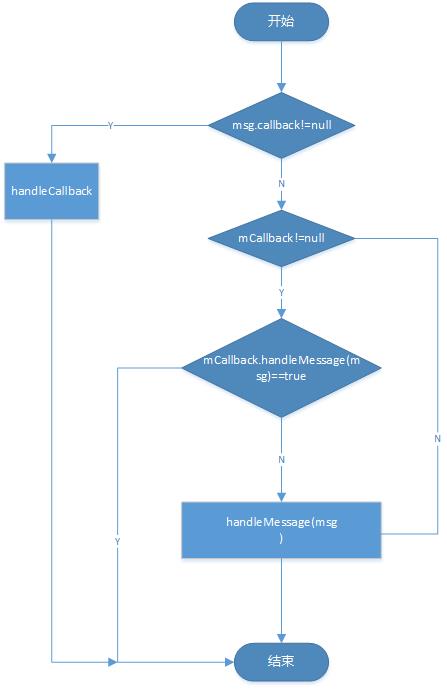
可以看到,这里msg的callback和target都有值,那么会执行哪个呢?
dispatchMessage方法
 public void dispatchMessage(Message msg) {

        if (msg.callback != null) {

            handleCallback(msg);

        } else {

            if (mCallback != null) {

                if (mCallback.handleMessage(msg)) {

                    return;

                }

            }

            handleMessage(msg);

        }

    }
Handler使用流程图:
阅读扩展

讲讲Handler+Looper+MessageQueue 关系的更多相关文章
- Handler Looper MessageQueue 之间的关系
Handler Looper MessageQueue 之间的关系 handler在安卓开发中常用于更新界面ui,以及其他在主线程中的操作.内部结构大概图为: 1.handler持有一个Looper对 ...
- Handler+Looper+MessageQueue深入详解
概述:Android中的异步处理机制由四部分组成:Handler+Looper+MessageQueue+message,用于实现线程间的通信. 用到的概念: Handler: 主要作用是发送消息和处 ...
- Handler,Looper,MessageQueue流程梳理
目的:handle的出现主要是为了解决线程间通讯. 举个例子,android是不允许在主线程中访问网络,因为这样会阻塞主线程,影响性能,所以访问网络都是放在子线程中执行,对于网络返回的结果则需要显示在 ...
- android学习11——Handler,Looper,MessageQueue工作原理
Message是Handler接收和处理的消息对象. 每个线程只能拥有一个Looper.它的loop方法读取MessageQueue中的消息,读到消息之后就把消息交给发送该消息的Handler进行处理 ...
- Android异步处理三:Handler+Looper+MessageQueue深入详解
在<Android异步处理一:使用Thread+Handler实现非UI线程更新UI界面>中,我们讲到使用Thread+Handler的方式来实现界面的更新,其实是在非UI线程发送消息到U ...
- Handler Looper 解析
文章讲述Looper/MessageQueue/Handler/HandlerThread相关的技能和使用方法. 什么是Looper?Looper有什么作用? Looper是用于给线程(Thread) ...
- Android消息机制:Looper,MessageQueue,Message与handler
Android消息机制好多人都讲过,但是自己去翻源码的时候才能明白. 今天试着讲一下,因为目标是讲清楚整体逻辑,所以不追究细节. Message是消息机制的核心,所以从Message讲起. 1.Mes ...
- Android Handler处理机制 ( 三 ) ——Handler,Message,Looper,MessageQueue
在android中提供了一种异步回调机制Handler,使用它,我们可以在完成一个很长时间的任务后做出相应的通知 handler基本使用: 在主线程中,使用handler很简单,new一个Handle ...
- 解析Android消息处理机制:Handler/Thread/Looper & MessageQueue
解析Android消息处理机制 ——Handler/Thread/Looper & MessageQueue Keywords: Android Message HandlerThread L ...
随机推荐
- 编码符_new
begin#6BE3803ED5339EBA1028EF9FC2BBD85F196391DFC603EAE8B10BA25D0B69029667A9BD2D914CE59A26EF5ECF370D5C ...
- Oracle基本数据字典:v$database、v$instance、v$version、dba_objects
v$database: 视图结构: SQL> desc v$database; Name Null? Type - ...
- gulp插件(gulp-jmbuild),用于WEB前端构建
源码地址:https://github.com/jiamao/gulp-jmbuild https://github.com/jiamao/gulp-jmbuild gulp-jmbuild gulp ...
- [后端人员耍前端系列]KnockoutJs篇:使用KnockoutJs+Bootstrap实现分页
一.引言 由于最近公司的系统需要改版,改版的新系统我打算使用KnockoutJs来制作Web前端.在做的过程中,遇到一个问题——如何使用KnockoutJs来完成分页的功能.在前一篇文章中并没有介绍使 ...
- UWP?UWP! - Build 2015有些啥?(2)
UWP?UWP! - Build 2015有些啥? Build 2015圆满落幕了,不知大家有多少人刷夜看了直播呢?不管怎么说,想必各位都很好奇在这场微软开发者盛宴上,Microsoft又发布了什么令 ...
- Java IO3:字节流
流类 Java的流式输入/输出是建立在四个抽象类的基础上的:InputStream.OutputStream.Reader.Writer.它们用来创建具体的流式子类.尽管程序通过具体子类执行输入/输出 ...
- Wix 安装部署教程(十五) --CustomAction的七种用法
在WIX中,CustomAction用来在安装过程中执行自定义行为.比如注册.修改文件.触发其他可执行文件等.这一节主要是介绍一下CustomAction的7种用法. 在此之前要了解InstallEx ...
- java提高篇(一)-----理解java的三大特性之封装
从大二接触java开始,到现在也差不多三个年头了.从最基础的HTML.CSS到最后的SSH自己都是一步一个脚印走出来的,其中开心过.失落过.寂寞过.虽然是半道出家但是经过自己的努力也算是完成了“学业” ...
- 统计第一个空字符前面的字符长度(java实现)
举例来说:char buf[] = {'a','b','c','d','e','f','\0','x','y','z'}当输入N=10或20,期待输出是6:当输入N=3或5,期待输出是3或5. pac ...
- js模版引擎handlebars.js实用教程——each-基本循环使用方法
返回目录 <!DOCTYPE html> <html> <head> <META http-equiv=Content-Type content=" ...