
The Bottom of a Graph(tarjan + 缩点)
| Time Limit: 3000MS | Memory Limit: 65536K | |
| Total Submissions: 9139 | Accepted: 3794 |
Description
Let n be a positive integer, and let p=(e1,...,en) be a sequence of length n of edges ei∈E such that ei=(vi,vi+1) for a sequence of vertices (v1,...,vn+1). Then p is called a path from vertex v1 to vertex vn+1in G and we say that vn+1 is reachable from v1, writing (v1→vn+1).
Here are some new definitions. A node v in a graph G=(V,E) is called a sink, if for every node w in G that is reachable from v, v is also reachable from w. The bottom of a graph is the subset of all nodes that are sinks, i.e., bottom(G)={v∈V|∀w∈V:(v→w)⇒(w→v)}. You have to calculate the bottom of certain graphs.
Input
Output
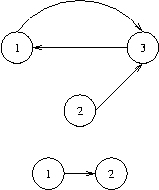
Sample Input
3 3

1 3 2 3 3 1

2 1

1 2

0
Sample Output
1 3

2
Source
参考代码这里:http://blog.csdn.net/ehi11/article/details/7884851
缩点:(这个概念也是看了别人的理解)先求有向图的强连通分量 , 如果几个点同属于一个强连通 , 那就给它们标上相同的记号 , 这样这几个点的集合就形成了一个缩点。
题目大意:求出度为0的强连通分量
 #include<stdio.h>

 #include<queue>

 #include<string.h>

 using namespace std;

 const int M =  ;

 int n , m ;

 int stack [M] , top =  , index = ;

 bool instack [M] ;

 int dfn[M] , low[M] ;

 int cnt =  ;

 vector <int> e[M] ;

 int belong[M] ;

 int out[M] ;

 void init (int n)

 {

     top =  ;

     cnt =  ;

     index =  ;

     memset (stack , - , sizeof(stack)) ;

     memset (instack ,  , sizeof(instack)) ;

     memset (dfn , - , sizeof(dfn)) ;

     memset (low , - , sizeof(low)) ;

     for (int i =  ; i <= n ; i++)

         e[i].clear () ;

     memset (belong , - , sizeof(belong)) ;

     memset (out ,  , sizeof(out)) ;

 }

 void tarjan (int u)

 {

     int v ;

     dfn[u] = low[u] = index++ ;

     instack[u] = true ;

     stack[++top] = u ;

     for (int i =  ; i < e[u].size () ; i++) {

         v = e[u][i] ;

         if (dfn[v] == -) {

             tarjan (v) ;

             low[u] = min (low[u] , low[v]) ;

         }

         else if (instack[v])

             low[u] = min (low[u] , dfn[v]) ;

     }

     if (low[u] == dfn[u]) {

         cnt++ ;

         do {

             v = stack[top--] ;

             instack[v] = false ;

             belong[v] = cnt ;

         } while (u != v) ;

     }

 }

 int main ()

 {

    //freopen ("a.txt" , "r" , stdin) ;

     int u , v ;

     while (~ scanf ("%d" ,&n)) {

         if (n == )

             break ;

         init (n) ;

         scanf ("%d" , &m) ;

         while (m--) {

             scanf ("%d%d" , &u , &v) ;

             e[u].push_back (v) ;

         }

         for (int i =  ; i <= n ; i++) {

             if (dfn[i] == -)

                 tarjan (i) ;

         }

         for (int i =  ; i <= n ; i++) {

             for (int j =  ; j < e[i].size () ; j++) {

                 if (belong [i] != belong[e[i][j]])

                     out[belong[i]] ++;

             }

         }

         int k =  ;

         for (int i =  ; i <= n ; i++) {

             if (out[belong[i]] == ) {

                 if (k++)

                     printf (" ") ;

                 printf ("%d" , i) ;

             }

         }

         puts ("") ;

     }

     return  ;

 }
The Bottom of a Graph(tarjan + 缩点)的更多相关文章
- POJ2533&&SP1799 The Bottom of a Graph(tarjan+缩点)
POJ2553 SP1799 我们知道单独一个强连通分量中的所有点是满足题目要求的 但如果它连出去到了其他点那里,要么成为新的强连通分量,要么失去原有的符合题目要求的性质 所以只需tarjan缩点求出 ...
- POJ 2553 The Bottom of a Graph Tarjan找环缩点(题解解释输入)
Description We will use the following (standard) definitions from graph theory. Let V be a nonempty ...
- POJ 2553 The Bottom of a Graph (Tarjan)
The Bottom of a Graph Time Limit: 3000MS Memory Limit: 65536K Total Submissions: 11981 Accepted: ...
- poj--2553--The Bottom of a Graph (scc+缩点)
The Bottom of a Graph Time Limit : 6000/3000ms (Java/Other) Memory Limit : 131072/65536K (Java/Oth ...
- [poj 2553]The Bottom of a Graph[Tarjan强连通分量]
题意: 求出度为0的强连通分量. 思路: 缩点 具体有两种实现: 1.遍历所有边, 边的两端点不在同一强连通分量的话, 将出发点所在强连通分量出度+1. #include <cstdio> ...
- POJ 2553 The Bottom of a Graph TarJan算法题解
本题分两步: 1 使用Tarjan算法求全部最大子强连通图.而且标志出来 2 然后遍历这些节点看是否有出射的边,没有的顶点所在的子强连通图的全部点,都是解集. Tarjan算法就是模板算法了. 这里使 ...
- poj 2553 The Bottom of a Graph(强连通分量+缩点)
题目地址:http://poj.org/problem?id=2553 The Bottom of a Graph Time Limit: 3000MS Memory Limit: 65536K ...
- poj 2553 The Bottom of a Graph【强连通分量求汇点个数】
The Bottom of a Graph Time Limit: 3000MS Memory Limit: 65536K Total Submissions: 9641 Accepted: ...
- 【图论】The Bottom of a Graph
[POJ2553]The Bottom of a Graph Time Limit: 3000MS Memory Limit: 65536K Total Submissions: 11182 ...
随机推荐
- Javascript 里的 in
写js的时候需要遍历一个对象的属性,把属性名和属性值都提出来,之前没遇到这种需求,查了一下可以用for in的方式. var obj = { "key1":"value1 ...
- Bootstrap系列 -- 31.嵌套分组
我们常把下拉菜单和普通的按钮组排列在一起,实现类似于导航菜单的效果.使用的时候,只需要把当初制作下拉菜单的“dropdown”的容器换成“btn-group”,并且和普通的按钮放在同一级 <di ...
- Bootstrap系列 -- 25. 下拉菜单分割线
在Bootstrap框架中的下拉菜单还提供了下拉分隔线,假设下拉菜单有两个组,那么组与组之间可以通过添加一个空的<li>,并且给这个<li>添加类名“divider”来实现添加 ...
- codevs 1690 开关灯 线段树水题
没什么好说的,标记put表示开关是否开着. #include<cstdio> #include<cstring> #include<algorithm> using ...
- WebLogic10安装图文教程
一 WebLogic安装 1. 打开WebLogic安装程序:oepe11_wls1031.exe(我们选用的是WebLogic 10.3g).如图1-1所示: 2. 进入WebLogic安装的欢迎 ...
- 阿里云搭建基于PPTP的VPN(Windows Server 2008)
由于阿里云在网络上分为两张网卡,一张内网,另一张是外网,所以在搭建PPTP的VPN时需要特殊处理. 实现步骤: 通过以上配置即可拨号成功 下面是通过NFS策略进行控制访问 完成后,即可拨号上网. 下 ...
- sql server规范
常见的字段类型选择 1.字符类型建议采用varchar/nvarchar数据类型 2.金额货币建议采用money数据类型 3.科学计数建议采用numeric数据类型 4.自增长标识建议采用bigint ...
- 轻量级应用开发之(06)Autolayout自动布局1
一 什么是Autolayout Autolayout是一种“自动布局”技术,专门用来布局UI界面的. 自IOS7 (Xcode 5)开始,Autolayout的开发效率得到很大的提高. 苹果官方也推荐 ...
- IOS基础之(十四) KVO/KVC
资料参考: http://www.cnblogs.com/kenshincui/p/3871178.html http://www.cnblogs.com/stoic/archive/2012/07/ ...
- 代码重构-4 通用方法 用 static
只要没有用到 this.变量/方法 的,都可以用static 原代码: private string GetPeriodDesc(int lotteryPeriod) { return EnumHe ...