
Adaptive gradient descent without descent
概
本文提出了一种自适应步长的梯度下降方法(以及多个变种方法), 并给了收敛性分析.
主要内容
主要问题:
\min_x \: f(x).
\]
局部光滑的定义:
若可微函数\(f(x)\)在任意有界区域内光滑,即
\]
其中\(\mathcal{C}\)有界.
本文的一个基本假设是函数\(f(x)\)凸且局部光滑.
算法1 AdGD

定理1 ADGD-L
定理1. 假设\(f: \mathbb{R}^d \rightarrow \mathbb{R}\) 为凸函数且局部光滑. 则由算法1生成的序列\((x^k)\)收敛到(1)的最优解, 且
\]
其中\(\hat{x}^k := \frac{\sum_{i=1}^k \lambda_i x^i + \lambda_1 \theta_1 x^1}{S_k}\), \(S_k:= \sum_{i=1}^k \lambda_i + \lambda_1 \theta\).
算法2
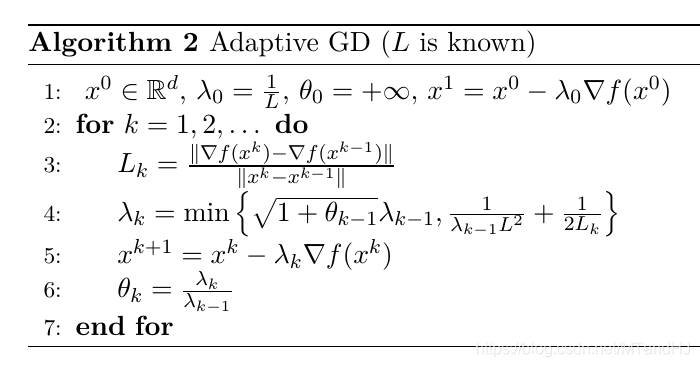
在\(L\)已知的情况下, 我们可以对算法1进行改进.
定理2
定理2 假设\(f\)凸且\(L\)光滑, 则由算法(2)生成的序列\((x^k)\)同样使得
\]
成立.
算法3 ADGD-accel
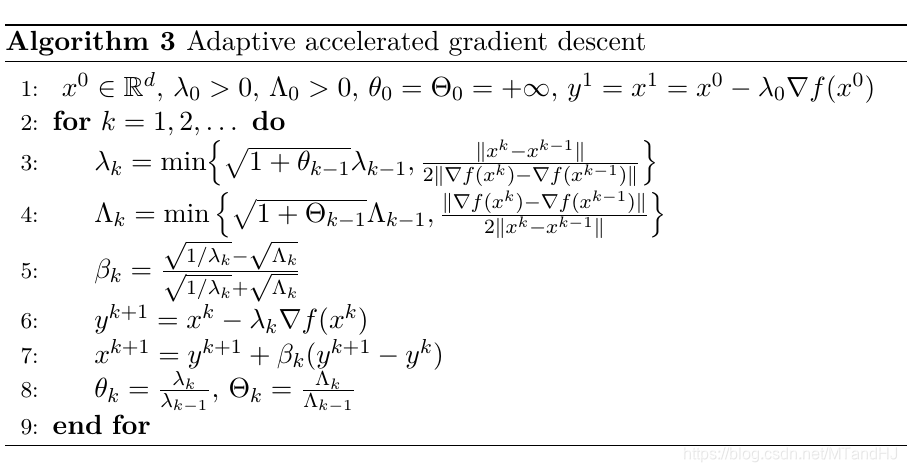
这部分没有理论证明, 是作者基于Nesterov中的算法进行的改进.
算法4 Adaptive SGD
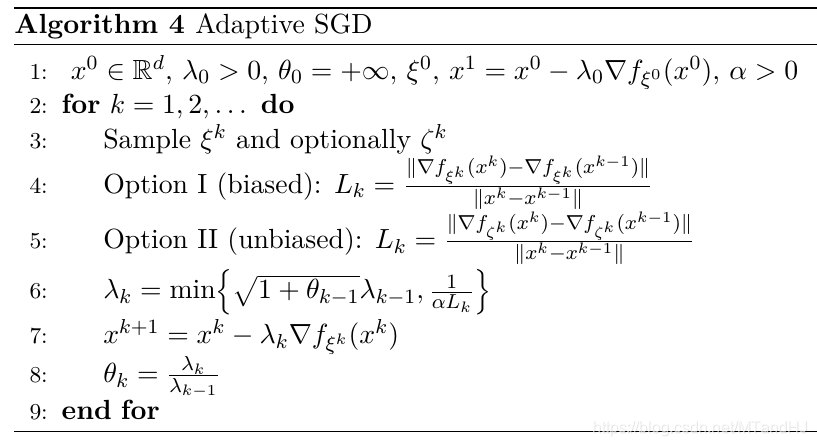
这个算法是对SGD的一个改进.
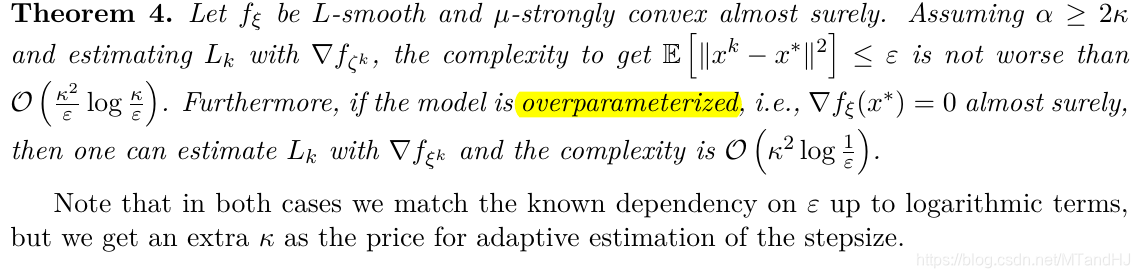
定理4
代码
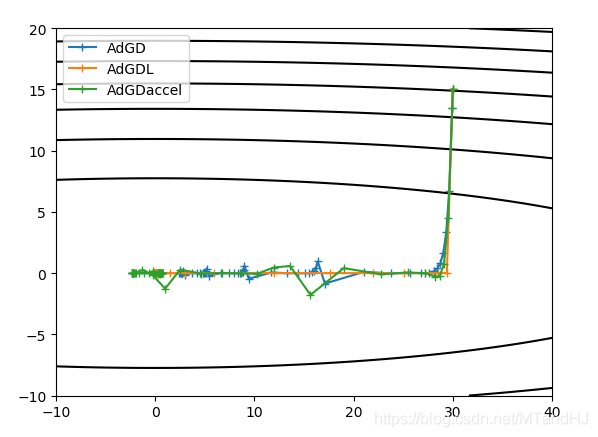
\(f(x, y) = x^2+50y^2\), 起点为\((30, 15)\).
"""

adgd.py

"""

import numpy as np

import matplotlib.pyplot as plt

State = "Test"

class FuncMissingError(Exception): pass

class StateNotMatchError(Exception): pass

class AdGD:

    def __init__(self, x0, stepsize0, grad, func=None):

        self.func_grad = grad

        self.func = func

        self.points = [x0]

        self.points.append(self.calc_one(x0, self.calc_grad(x0),

                                         stepsize0))

        self.prestepsize = stepsize0

        self.theta = None

    def calc_grad(self, x):

        self.pregrad = self.func_grad(x)

        return self.pregrad

    def calc_one(self, x, grad, stepsize):

        return x - stepsize * grad

    def calc_stepsize(self, grad, pregrad):

        part2 = (

            np.linalg.norm(self.points[-1]

                          - self.points[-2]) /

            (np.linalg.norm(grad - pregrad) * 2)

        )

        if not self.theta:

            return part2

        else:

            part1 = np.sqrt(self.theta + 1) * self.prestepsize

            return min(part1, part2)

    def update_theta(self, stepsize):

        self.theta = stepsize / self.prestepsize

        self.prestepsize = stepsize

    def step(self):

        pregrad = self.pregrad

        prex = self.points[-1]

        grad = self.calc_grad(prex)

        stepsize = self.calc_stepsize(grad, pregrad)

        nextx = self.calc_one(prex, grad, stepsize)

        self.points.append(nextx)

        self.update_theta(stepsize)

    def multi_steps(self, times):

        for k in range(times):

            self.step()

    def plot(self):

        if self.func is None:

            raise FloatingPointError("func is not defined...")

        if State != "Test":

            raise StateNotMatchError()

        xs = np.array(self.points)

        x = np.linspace(-40, 40, 1000)

        y = np.linspace(-20, 20, 500)

        fig, ax = plt.subplots()

        X, Y = np.meshgrid(x, y)

        ax.contour(X, Y, self.func([X, Y]), colors='black')

        ax.plot(xs[:, 0], xs[:, 1], "+-")

        plt.show()

class AdGDL(AdGD):

    def __init__(self, x0, L, grad, func=None):

        super(AdGDL, self).__init__(x0, 1 / L, grad, func)

        self.lipschitz = L

    def calc_stepsize(self, grad, pregrad):

        lk = (

            np.linalg.norm(grad - pregrad) /

            np.linalg.norm(self.points[-1]

                          - self.points[-2])

        )

        part2 = 1 / (self.prestepsize * self.lipschitz ** 2) \

                 + 1 / (2 * lk)

        if not self.theta:

            return part2

        else:

            part1 = np.sqrt(self.theta + 1) * self.prestepsize

            return min(part1, part2)

class AdGDaccel(AdGD):

    def __init__(self, x0, stepsize0, convex0, grad, func=None):

        super(AdGDaccel, self).__init__(x0, stepsize0, grad, func)

        self.preconvex = convex0

        self.Theta = None

        self.prey = self.points[-1]

    def calc_convex(self, grad, pregrad):

        part2 = (

            (np.linalg.norm(grad - pregrad) * 2) /

                np.linalg.norm(self.points[-1]

                        - self.points[-2])

        ) / 2

        if not self.Theta:

            return part2

        else:

            part1 = np.sqrt(self.Theta + 1) * self.preconvex

            return min(part1, part2)

    def calc_beta(self, stepsize, convex):

        part1 = 1 / stepsize

        part2 = convex

        return (part1 - part2) / (part1 + part2)

    def calc_more(self, y, beta):

        nextx = y + beta * (y - self.prey)

        self.prey = y

        return nextx

    def update_Theta(self, convex):

        self.Theta = convex / self.preconvex

        self.preconvex = convex

    def step(self):

        pregrad = self.pregrad

        prex = self.points[-1]

        grad = self.calc_grad(prex)

        stepsize = self.calc_stepsize(grad, pregrad)

        convex = self.calc_convex(grad, pregrad)

        beta = self.calc_beta(stepsize, convex)

        y = self.calc_one(prex, grad, stepsize)

        nextx = self.calc_more(y, beta)

        self.points.append(nextx)

        self.update_theta(stepsize)

        self.update_Theta(convex)
config.json:
{

  "AdGD": {

    "stepsize0": 0.001

  },

  "AdGDL": {

    "L": 100

  },

  "AdGDaccel": {

    "stepsize0": 0.001,

    "convex0": 2.0

  }

}
"""

测试代码

"""

import numpy as np

import matplotlib.pyplot as plt

import json

from adgd import AdGD, AdGDL, AdGDaccel

with open("config.json", encoding="utf-8") as f:

    configs = json.load(f)

partial_x = lambda x: 2 * x

partial_y = lambda y: 100 * y

grad = lambda x: np.array([partial_x(x[0]),

                              partial_y(x[1])])

func = lambda x: x[0] ** 2 + 50 * x[1] ** 2

fig, ax = plt.subplots()

x = np.linspace(-10, 40, 500)

y = np.linspace(-10, 20, 500)

X, Y = np.meshgrid(x, y)

ax.contour(X, Y, func([X, Y]), colors='black')

def process(methods, times=50):

    for method in methods:

        method.multi_steps(times)

def initial(methods, **kwargs):

    instances = []

    for method in methods:

        config = configs[method.__name__]

        config.update(kwargs)

        instances.append(method(**config))

    return instances

def plot(methods):

    for method in methods:

        xs = np.array(method.points)

        ax.plot(xs[:, 0], xs[:, 1], "+-", label=method.__class__.__name__)

    plt.legend()

    plt.show()

x0 = np.array([30., 15.])

methods = [AdGD, AdGDL, AdGDaccel]

instances = initial(methods, x0=x0, grad=grad, func=func)

process(instances)

plot(instances)
Adaptive gradient descent without descent的更多相关文章
- 【转】Caffe初试(九)solver及其设置
solver算是caffe的核心的核心,它协调着整个模型的运作.caffe程序运行必带的一个参数就是solver配置文件.运行代码一般为 #caffe train --solver=*_solver. ...
- 【深度学习】之Caffe的solver文件配置(转载自csdn)
原文: http://blog.csdn.net/czp0322/article/details/52161759 今天在做FCN实验的时候,发现solver.prototxt文件一直用的都是mode ...
- Caffe学习系列(7):solver及其配置
solver算是caffe的核心的核心,它协调着整个模型的运作.caffe程序运行必带的一个参数就是solver配置文件.运行代码一般为 # caffe train --solver=*_slover ...
- tensorflow 学习(一)
改系列只为记录我学习 udacity 中深度学习课程!! 1. 整个课程分为四个部分,如上图所示. 第一部分将研究逻辑分类器,随机优化以及实际数据训练. 第二部分我们将学习一个深度网络,和使用正则化技 ...
- caffe中各层的作用:
关于caffe中的solver: cafffe中的sover的方法都有: Stochastic Gradient Descent (type: "SGD"), AdaDelta ( ...
- Caffe学习系列(8):solver优化方法
上文提到,到目前为止,caffe总共提供了六种优化方法: Stochastic Gradient Descent (type: "SGD"), AdaDelta (type: &q ...
- Caffe学习系列(二)Caffe代码结构梳理,及相关知识点归纳
前言: 通过检索论文.书籍.博客,继续学习Caffe,千里之行始于足下,继续努力.将自己学到的一些东西记录下来,方便日后的整理. 正文: 1.代码结构梳理 在终端下运行如下命令,可以查看caffe代码 ...
- 深度学习——优化器算法Optimizer详解(BGD、SGD、MBGD、Momentum、NAG、Adagrad、Adadelta、RMSprop、Adam)
在机器学习.深度学习中使用的优化算法除了常见的梯度下降,还有 Adadelta,Adagrad,RMSProp 等几种优化器,都是什么呢,又该怎么选择呢? 在 Sebastian Ruder 的这篇论 ...
- 【深度学习】深入理解优化器Optimizer算法(BGD、SGD、MBGD、Momentum、NAG、Adagrad、Adadelta、RMSprop、Adam)
在机器学习.深度学习中使用的优化算法除了常见的梯度下降,还有 Adadelta,Adagrad,RMSProp 等几种优化器,都是什么呢,又该怎么选择呢? 在 Sebastian Ruder 的这篇论 ...
随机推荐
- 日常Java 2021/10/4
读取控制台输入 将System.in包装在BufferedReader对象中来创建一个字符流 BufferedReader b = new BufferedReader(new InputStream ...
- 一次“不负责任”的 K8s 网络故障排查经验分享
作者 | 骆冰利 来源 | Erda 公众号 某天晚上,客户碰到了这样的问题:K8s 集群一直扩容失败,所有节点都无法正常加入集群.在经过多番折腾无解后,客户将问题反馈到我们这里,希望得到技术支持 ...
- Shell学习(六)——条件判断总结
Shell学习(六)--条件判断总结 [1]https://www.cnblogs.com/zhw-626/p/8528001.html [2]https://www.cnblogs.com/yizh ...
- spring boot-jpa整合QueryDSL来简化复杂操作
spring boot-jpa整合QueryDSL来简化复杂操作 SpringDataJPA+QueryDSL玩转态动条件/投影查询
- 二叉树——Java实现
1 package struct; 2 3 interface Tree{ 4 //插入元素 5 void insert(int value); 6 //中序遍历 7 void inOrder(); ...
- Output of C++ Program | Set 6
Predict the output of below C++ programs. Question 1 1 #include<iostream> 2 3 using namespace ...
- vue实现input输入框的模糊查询
最近在用uni-app做一个项目,使用的框架还是vue,想了好久才做出来 . HTML代码部分 <input type="text" focus class="s ...
- spring的不同事务传播行为和用途。
1.PROPAGATION_REQUIRED:如果当前没有事务,就创建一个事务,如果当前存在事务,就加入该事务,该设置是最常用的设置. 2.PROPAGATION_SUPPORTS:支持当前事务,如果 ...
- Spring Boot项目的不同启动方式
方式一: 直接通过IntelliJ IDEA启动,直接执行Spring Boot项目的main()方法. 方法二: 将项目打包成jar包,首先需要在pom.xml文件的根节点下添加如下配置: < ...
- 06 - Vue3 UI Framework - Dialog 组件
做完按钮之后,我们应该了解了遮罩层的概念,接下来我们来做 Dialog 组件! 返回阅读列表点击 这里 需求分析 默认是不可见的,在用户触发某个动作后变为可见 自带白板卡片,分为上中下三个区域,分别放 ...