
HDU-3839-Ancient Messages(DFS)
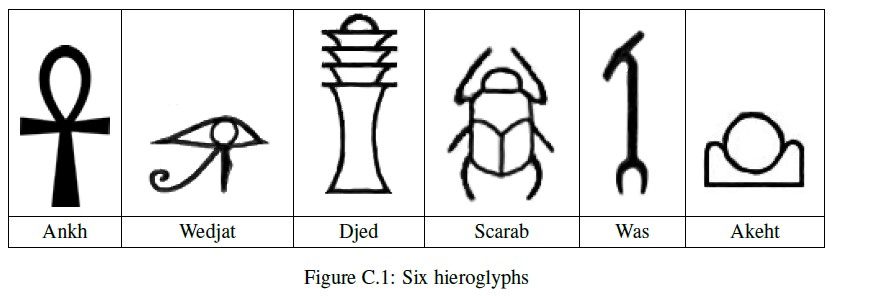
hieroglyphs and their names. In this problem, you will write a program to recognize these six characters.
of black pixels (represented by 1) and white pixels (represented by 0). In the input data, each scan line is encoded in hexadecimal notation. For example, the sequence of eight pixels 10011100 (one black pixel, followed by two white pixels, and so on) would
be represented in hexadecimal notation as 9c. Only digits and lowercase letters a through f are used in the hexadecimal encoding. The first line of each test case contains two integers, H and W: H (0 < H <= 200) is the number of scan lines in the image. W
(0 < W <= 50) is the number of hexadecimal characters in each line. The next H lines contain the hexadecimal characters of the image, working from top to bottom. Input images conform to the following rules:
- The image contains only hieroglyphs shown in Figure C.1.
- Each image contains at least one valid hieroglyph.
- Each black pixel in the image is part of a valid hieroglyph.
- Each hieroglyph consists of a connected set of black pixels and each black pixel has at least one other black pixel on its top, bottom, left, or right side.
- The hieroglyphs do not touch and no hieroglyph is inside another hieroglyph.
- Two black pixels that touch diagonally will always have a common touching black pixel.
- The hieroglyphs may be distorted but each has a shape that is topologically equivalent to one of the symbols in Figure C.11.
The last test case is followed by a line containing two zeros.
1Two figures are topologically equivalent if each can be transformed into the other by stretching without tearing.
Ankh: A
Wedjat: J
Djed: D
Scarab: S
Was: W
Akhet: K
In each output string, print the codes in alphabetic order. Follow the format of the sample output.
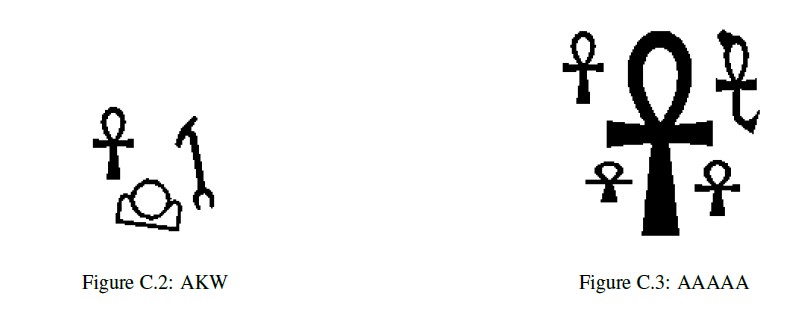
The sample input contains descriptions of test cases shown in Figures C.2 and C.3. Due to space constraints not all of the sample input can be shown on this page.
100 25

0000000000000000000000000

0000000000000000000000000

 ...(50 lines omitted)...

00001fe0000000000007c0000

00003fe0000000000007c0000

 ...(44 lines omitted)...

0000000000000000000000000

0000000000000000000000000

150 38

00000000000000000000000000000000000000

00000000000000000000000000000000000000

    ...(75 lines omitted)...

0000000003fffffffffffffffff00000000000

0000000003fffffffffffffffff00000000000

    ...(69 lines omitted)...

00000000000000000000000000000000000000

00000000000000000000000000000000000000

0 0
Case 1: AKW

Case 2: AAAAA
思路:依据圈的数量来识别。
#include <cstdio>

#include <algorithm>

using namespace std;

char ts[201],mes[6]={'W','A','K','J','S','D'},ans[10];

bool vis[205][205];

int n,m,mp[205][205],nxt[4][2]={{1,0},{0,1},{-1,0},{0,-1}},num;

void dfs(int x,int y)

{

    int i;

    for(i=0;i<4;i++)

    {

        x+=nxt[i][0];

        y+=nxt[i][1];

        if(x>=0 && x<n && y>=0 && y<m && !vis[x][y] && !mp[x][y])

        {

            vis[x][y]=1;

            dfs(x,y);

        }

        x-=nxt[i][0];

        y-=nxt[i][1];

    }

}

void dfs3(int x,int y)

{

    int i;

    for(i=0;i<4;i++)

    {

        x+=nxt[i][0];

        y+=nxt[i][1];

        if(x>=0 && x<n && y>=0 && y<m && !vis[x][y] && !mp[x][y])

        {

            vis[x][y]=1;

            dfs3(x,y);

        }

        x-=nxt[i][0];

        y-=nxt[i][1];

    }

}

void dfs2(int x,int y)

{

    int i;

    for(i=0;i<4;i++)

    {

        x+=nxt[i][0];

        y+=nxt[i][1];

        if(x>=0 && x<n && y>=0 && y<m && !vis[x][y])

        {

            if(mp[x][y])

            {

                vis[x][y]=1;

                dfs2(x,y);

            }

            else

            {

                vis[x][y]=1;

                num++;

                dfs3(x,y);

            }

        }

        x-=nxt[i][0];

        y-=nxt[i][1];

    }

}

int main()

{

    int i,j,t,casenum=1,cnt;

    while(~scanf("%d%d",&n,&m) && n)

    {

        n++;

        m*=4;

        m++;

        for(i=0;i<=n;i++) for(j=0;j<=m;j++) vis[i][j]=0;

        for(i=1;i<n;i++)

        {

            gets(ts);

            if(!ts[0])

            {

                i--;

                continue;

            }

            for(j=0;ts[j];j++)

            {

                if(ts[j]>='a' && ts[j]<='f')

                {

                    t=ts[j]-'a'+10;

                    mp[i][j*4+1]=t/8;

                    mp[i][j*4+2]=t%8/4;

                    mp[i][j*4+3]=t%4/2;

                    mp[i][j*4+4]=t%2/1;

                }

                else

                {

                    t=ts[j]-'0';

                    mp[i][j*4+1]=t/8;

                    mp[i][j*4+2]=t%8/4;

                    mp[i][j*4+3]=t%4/2;

                    mp[i][j*4+4]=t%2/1;

                }

            }

        }

        for(i=0;i<=m;i++) mp[n][i]=0;

        for(i=0;i<=n;i++) mp[i][m]=0;

        n++;

        m++;

        vis[0][0]=1;

        dfs(0,0);

        cnt=0;

        for(i=0;i<n;i++)

        {

            for(j=0;j<m;j++)

            {

                if(mp[i][j] && !vis[i][j])

                {

                    num=0;

                    vis[i][j]=1;

                    dfs2(i,j);

                    ans[cnt++]=mes[num];

                }

            }

        }

        sort(ans,ans+cnt);

        ans[cnt]=0;

        printf("Case %d: ",casenum++);

        puts(ans);

    }

}
版权声明:本文博客原创文章,博客,未经同意,不得转载。
HDU-3839-Ancient Messages(DFS)的更多相关文章
- HDU 3839 Ancient Messages(DFS)
In order to understand early civilizations, archaeologists often study texts written in ancient lang ...
- hdu 3839 Ancient Messages (dfs )
题目大意:给出一幅画,找出里面的象形文字. 要你翻译这幅画,把象形文字按字典序输出. 思路:象形文字有一些特点,分别有0个圈.1个圈.2个圈...5个圈.然后dfs或者bfs,就像油井问题一样,找出在 ...
- K - Ancient Messages(dfs求联通块)
K - Ancient Messages Time Limit:3000MS Memory Limit:0KB 64bit IO Format:%lld & %llu Subm ...
- HDOJ(HDU).2660 Accepted Necklace (DFS)
HDOJ(HDU).2660 Accepted Necklace (DFS) 点我挑战题目 题意分析 给出一些石头,这些石头都有自身的价值和重量.现在要求从这些石头中选K个石头,求出重量不超过W的这些 ...
- HDOJ(HDU).1045 Fire Net (DFS)
HDOJ(HDU).1045 Fire Net [从零开始DFS(7)] 点我挑战题目 从零开始DFS HDOJ.1342 Lotto [从零开始DFS(0)] - DFS思想与框架/双重DFS HD ...
- HDOJ(HDU).1241 Oil Deposits(DFS)
HDOJ(HDU).1241 Oil Deposits(DFS) [从零开始DFS(5)] 点我挑战题目 从零开始DFS HDOJ.1342 Lotto [从零开始DFS(0)] - DFS思想与框架 ...
- HDOJ(HDU).1035 Robot Motion (DFS)
HDOJ(HDU).1035 Robot Motion [从零开始DFS(4)] 点我挑战题目 从零开始DFS HDOJ.1342 Lotto [从零开始DFS(0)] - DFS思想与框架/双重DF ...
- HDU 1501 Zipper 【DFS+剪枝】
HDU 1501 Zipper [DFS+剪枝] Problem Description Given three strings, you are to determine whether the t ...
- HDU 1401 Solitaire 双向DFS
HDU 1401 Solitaire 双向DFS 题意 给定一个\(8*8\)的棋盘,棋盘上有4个棋子.每一步操作可以把任意一个棋子移动到它周围四个方向上的空格子上,或者可以跳过它四个方向上的棋子(就 ...
- ACM: HDU 2563 统计问题-DFS+打表
HDU 2563 统计问题 Time Limit:1000MS Memory Limit:32768KB 64bit IO Format:%I64d & %I64u HDU 2 ...
随机推荐
- ios开发缓存处理类NSCash类的了解与使用
一:NSCash的基本了解 #import "ViewController.h" @interface ViewController ()<NSCacheDelegate&g ...
- php 中英文字符串截取,字符串长度
在做PHP开发的时候,由于我国的语言环境问题,所以我们常常需要对中文进行处理.在PHP中,我们都知道有专门的mb_substr和mb_strlen函数,可以对中文进行截取和计算长度,但是,由于这些函数 ...
- jquery 点击其他地方
<script type="text/javascript"> function stopPropagation(e) { if (e.stopPropagation) ...
- 数据库使用truncate清理非常多表时碰到外键约束时怎么高速解决
问题处理思路: 1. 先将数据库中涉及到外键约束的表置为无效状态 2.待清除全然部表数据后再将外键约束的表置为可用状态 详细实现脚本: declare begin for vv_sql in (SEL ...
- 30行js rem弹性布局适配所有分辨率
<script> /* # 按照宽高比例设定html字体, width=device-width initial-scale=1版 # @pargam win 窗口window对象 # @ ...
- AndroidClipSquare安卓实现方形头像裁剪
安卓实现方形头像裁剪 实现思路.界面可见区域为2层View 最顶层的View是显示层,主要绘制半透明边框区域和白色裁剪区域,代码比較easy. 第二层继承ImageView,使用ImageView的M ...
- NOIP模拟 - 莫队
题目描述 给定一个元素个数为 n 的整数数组 a 和 Q 个问题,每个问题有 x,y 两个参数,请统计共有多少个整数 K 满足 K 在 a[x]-a[y] 中出现了恰好 K 次. 输入格式 第一行两个 ...
- 基于Linux应用层的6LOWPAN物联网网关及实现方法
本发明涉及一种基于Linux应用层的6LOWPAN物联网网关及实现方法,所述物联网网关包括开发平台以及无线射频模块,其实现方法是:所述6LOWPAN物联网网关的以太网网口收到访问6LOWPAN无线传感 ...
- 【BZOJ 1037】[ZJOI2008]生日聚会Party
[题目链接]:http://www.lydsy.com/JudgeOnline/problem.php?id=1037 [题意] [题解] /* 设f[i][j][k][l] 表示前i个人中,有j个男 ...
- 将oracle从数据库32位平台迁移到64位置
客户32位置oracle数据库系统的磁盘损坏,幸运的是,oracle数据库完美无损.客户数据库迁移到新购设备.新设备的内存64G,制REDHAT 6.2 64位置,直接拷贝数据文件肯定是不.由于ora ...