
eclipse与hadoop集成,运行wordCount1
搭好了hadoop集群之后,就该使用它了
第一步:下载hadoop eclipse的插件,将它放到eclipse\plugins的目录下,然后重启eclipse,点击windows->show view->Other->MapReduceTool如下图:

双击Map/Reduce Locations,右键新建一个Map/Reduce Locations,编辑如下图:

设置好以后,新建一个map/reduce项目,要求hadoop的安装位置,直接定位到安装位置即可,然后再使用运行一个简单的统计字符串的脚本,
代码如下:
package mr.java;

import java.io.*;

import org.apache.hadoop.conf.Configuration;

import org.apache.hadoop.fs.Path;

import org.apache.hadoop.io.IntWritable;

import org.apache.hadoop.io.Text;

import org.apache.hadoop.mapreduce.Job;

import org.apache.hadoop.mapreduce.Mapper;

import org.apache.hadoop.mapreduce.Reducer;

import org.apache.hadoop.mapreduce.lib.input.FileInputFormat;

import org.apache.hadoop.mapreduce.lib.output.FileOutputFormat;

//import org.apache.hadoop.yarn.conf.YarnConfiguration;

public class WordCount1

{

    public static class WordCountMapper

    extends Mapper<Object,Text,Text,IntWritable>

   {

       private final static IntWritable one = new IntWritable(1);

       private Text word = new Text();

       public void map(Object key,Text value,Context context)

        throws IOException, InterruptedException {

     String[] words = value.toString().split(" ");

     for (String str: words)

           {

          word.set(str);

          context.write(word,one);

        }

       }

    }

   public static class WordCountReducer

   extends Reducer<Text,IntWritable,Text,IntWritable> {

     public void reduce(Text key,Iterable<IntWritable> values,Context context)

     throws IOException, InterruptedException {

          int total=0;

        for (IntWritable val : values){

            total++;

         }

      context.write(key, new IntWritable(total));

       }

     }

    public static void main (String[] args) throws Exception{

        Configuration conf = new Configuration();

        //conf.set("fs.defaultFS", "hdfs://192.168.18.110:9000");

        //conf.set("mapreduce.framework.name", "yarn");

        //conf.set("yarn.resourcemanager.address", "192.168.18.110:8032");

        //conf.set("yarn.resourcemanager.hostname", "192.168.18.110");

        //conf.set("mapred.jar","C:/Users/Administrator/Desktop/mapred.jar");

        //conf.set("mapred.remote.os", "Linux");

        //conf.set("mapreduce.app-submission.cross-platform", "true");

        System.setProperty("hadoop.home.dir", "E:/软件1/大数据/hadoop-2.6.4生态圈软件包/hadoop-2.6.4/hadoop-2.6.4");

    //conf.set("mapred.jar","wc1.jar");

    //Job job = new Job(conf, "word count");

    Job job = Job.getInstance(conf);

    job.setJobName("word count");

    job.setJarByClass(WordCount1.class);

    job.setMapperClass(WordCountMapper.class);

    job.setReducerClass(WordCountReducer.class);

    job.setOutputKeyClass(Text.class);

    job.setOutputValueClass(IntWritable.class);

    FileInputFormat.addInputPath(job, new Path(args[0]));

    FileOutputFormat.setOutputPath(job, new Path(args[1]));

    System.exit(job.waitForCompletion(true) ? 0 : 1);

 }

}
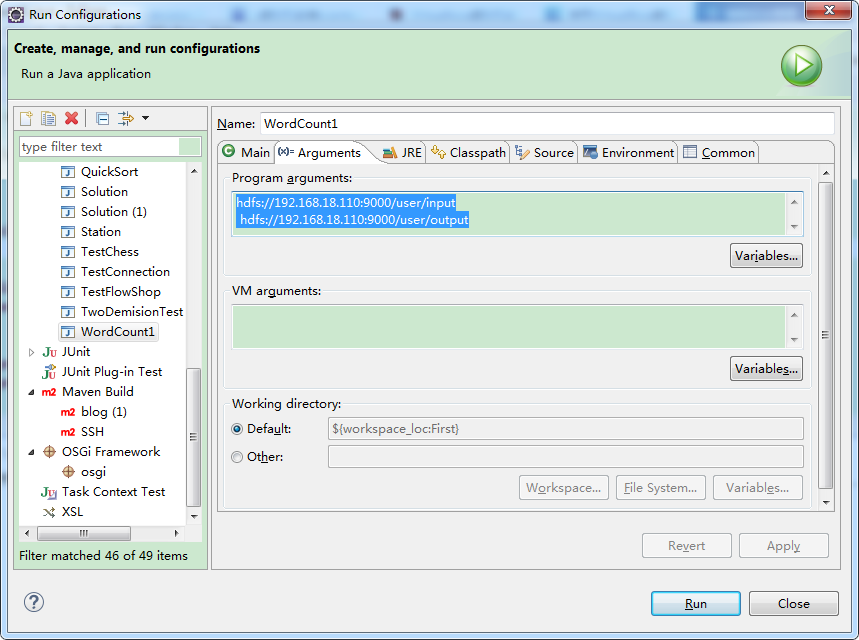
不过还需要上传文件,在root文件夹下新建一个user,在user文件夹下新建一个input文件夹,将写好的文件上传,在右键run as ->configurration添加如下操作:
你以为这样就完了,还要设置,在工程中新建两个包名:org.apache.hadoop.io.nativeio和org.apache.hadoop.mapred在第一个包里加上这个类:、
/**
* Licensed to the Apache Software Foundation (ASF) under one
* or more contributor license agreements. See the NOTICE file
* distributed with this work for additional information
* regarding copyright ownership. The ASF licenses this file
* to you under the Apache License, Version 2.0 (the
* "License"); you may not use this file except in compliance
* with the License. You may obtain a copy of the License at
*
* http://www.apache.org/licenses/LICENSE-2.0
*
* Unless required by applicable law or agreed to in writing, software
* distributed under the License is distributed on an "AS IS" BASIS,
* WITHOUT WARRANTIES OR CONDITIONS OF ANY KIND, either express or implied.
* See the License for the specific language governing permissions and
* limitations under the License.
*/
package org.apache.hadoop.io.nativeio; import java.io.File;
import java.io.FileDescriptor;
import java.io.FileInputStream;
import java.io.FileOutputStream;
import java.io.IOException;
import java.io.RandomAccessFile;
import java.lang.reflect.Field;
import java.nio.ByteBuffer;
import java.nio.MappedByteBuffer;
import java.nio.channels.FileChannel;
import java.util.Map;
import java.util.concurrent.ConcurrentHashMap; import org.apache.hadoop.classification.InterfaceAudience;
import org.apache.hadoop.classification.InterfaceStability;
import org.apache.hadoop.conf.Configuration;
import org.apache.hadoop.fs.CommonConfigurationKeys;
import org.apache.hadoop.fs.HardLink;
import org.apache.hadoop.io.IOUtils;
import org.apache.hadoop.io.SecureIOUtils.AlreadyExistsException;
import org.apache.hadoop.util.NativeCodeLoader;
import org.apache.hadoop.util.Shell;
import org.apache.hadoop.util.PerformanceAdvisory;
import org.apache.commons.logging.Log;
import org.apache.commons.logging.LogFactory; import sun.misc.Unsafe; import com.google.common.annotations.VisibleForTesting; /**
* JNI wrappers for various native IO-related calls not available in Java.
* These functions should generally be used alongside a fallback to another
* more portable mechanism.
*/
@InterfaceAudience.Private
@InterfaceStability.Unstable
public class NativeIO {
public static class POSIX {
// Flags for open() call from bits/fcntl.h
public static final int O_RDONLY = 00;
public static final int O_WRONLY = 01;
public static final int O_RDWR = 02;
public static final int O_CREAT = 0100;
public static final int O_EXCL = 0200;
public static final int O_NOCTTY = 0400;
public static final int O_TRUNC = 01000;
public static final int O_APPEND = 02000;
public static final int O_NONBLOCK = 04000;
public static final int O_SYNC = 010000;
public static final int O_ASYNC = 020000;
public static final int O_FSYNC = O_SYNC;
public static final int O_NDELAY = O_NONBLOCK; // Flags for posix_fadvise() from bits/fcntl.h
/* No further special treatment. */
public static final int POSIX_FADV_NORMAL = 0;
/* Expect random page references. */
public static final int POSIX_FADV_RANDOM = 1;
/* Expect sequential page references. */
public static final int POSIX_FADV_SEQUENTIAL = 2;
/* Will need these pages. */
public static final int POSIX_FADV_WILLNEED = 3;
/* Don't need these pages. */
public static final int POSIX_FADV_DONTNEED = 4;
/* Data will be accessed once. */
public static final int POSIX_FADV_NOREUSE = 5; /* Wait upon writeout of all pages
in the range before performing the
write. */
public static final int SYNC_FILE_RANGE_WAIT_BEFORE = 1;
/* Initiate writeout of all those
dirty pages in the range which are
not presently under writeback. */
public static final int SYNC_FILE_RANGE_WRITE = 2; /* Wait upon writeout of all pages in
the range after performing the
write. */
public static final int SYNC_FILE_RANGE_WAIT_AFTER = 4; private static final Log LOG = LogFactory.getLog(NativeIO.class); private static boolean nativeLoaded = false;
private static boolean fadvisePossible = true;
private static boolean syncFileRangePossible = true; static final String WORKAROUND_NON_THREADSAFE_CALLS_KEY =
"hadoop.workaround.non.threadsafe.getpwuid";
static final boolean WORKAROUND_NON_THREADSAFE_CALLS_DEFAULT = true; private static long cacheTimeout = -1; private static CacheManipulator cacheManipulator = new CacheManipulator(); public static CacheManipulator getCacheManipulator() {
return cacheManipulator;
} public static void setCacheManipulator(CacheManipulator cacheManipulator) {
POSIX.cacheManipulator = cacheManipulator;
} /**
* Used to manipulate the operating system cache.
*/
@VisibleForTesting
public static class CacheManipulator {
public void mlock(String identifier, ByteBuffer buffer,
long len) throws IOException {
POSIX.mlock(buffer, len);
} public long getMemlockLimit() {
return NativeIO.getMemlockLimit();
} public long getOperatingSystemPageSize() {
return NativeIO.getOperatingSystemPageSize();
} public void posixFadviseIfPossible(String identifier,
FileDescriptor fd, long offset, long len, int flags)
throws NativeIOException {
NativeIO.POSIX.posixFadviseIfPossible(identifier, fd, offset,
len, flags);
} public boolean verifyCanMlock() {
return NativeIO.isAvailable();
}
} /**
* A CacheManipulator used for testing which does not actually call mlock.
* This allows many tests to be run even when the operating system does not
* allow mlock, or only allows limited mlocking.
*/
@VisibleForTesting
public static class NoMlockCacheManipulator extends CacheManipulator {
public void mlock(String identifier, ByteBuffer buffer,
long len) throws IOException {
LOG.info("mlocking " + identifier);
} public long getMemlockLimit() {
return 1125899906842624L;
} public long getOperatingSystemPageSize() {
return 4096;
} public boolean verifyCanMlock() {
return true;
}
} static {
if (NativeCodeLoader.isNativeCodeLoaded()) {
try {
Configuration conf = new Configuration();
workaroundNonThreadSafePasswdCalls = conf.getBoolean(
WORKAROUND_NON_THREADSAFE_CALLS_KEY,
WORKAROUND_NON_THREADSAFE_CALLS_DEFAULT); initNative();
nativeLoaded = true; cacheTimeout = conf.getLong(
CommonConfigurationKeys.HADOOP_SECURITY_UID_NAME_CACHE_TIMEOUT_KEY,
CommonConfigurationKeys.HADOOP_SECURITY_UID_NAME_CACHE_TIMEOUT_DEFAULT) *
1000;
LOG.debug("Initialized cache for IDs to User/Group mapping with a " +
" cache timeout of " + cacheTimeout/1000 + " seconds."); } catch (Throwable t) {
// This can happen if the user has an older version of libhadoop.so
// installed - in this case we can continue without native IO
// after warning
PerformanceAdvisory.LOG.debug("Unable to initialize NativeIO libraries", t);
}
}
} /**
* Return true if the JNI-based native IO extensions are available.
*/
public static boolean isAvailable() {
return NativeCodeLoader.isNativeCodeLoaded() && nativeLoaded;
} private static void assertCodeLoaded() throws IOException {
if (!isAvailable()) {
throw new IOException("NativeIO was not loaded");
}
} /** Wrapper around open(2) */
public static native FileDescriptor open(String path, int flags, int mode) throws IOException;
/** Wrapper around fstat(2) */
private static native Stat fstat(FileDescriptor fd) throws IOException; /** Native chmod implementation. On UNIX, it is a wrapper around chmod(2) */
private static native void chmodImpl(String path, int mode) throws IOException; public static void chmod(String path, int mode) throws IOException {
if (!Shell.WINDOWS) {
chmodImpl(path, mode);
} else {
try {
chmodImpl(path, mode);
} catch (NativeIOException nioe) {
if (nioe.getErrorCode() == 3) {
throw new NativeIOException("No such file or directory",
Errno.ENOENT);
} else {
LOG.warn(String.format("NativeIO.chmod error (%d): %s",
nioe.getErrorCode(), nioe.getMessage()));
throw new NativeIOException("Unknown error", Errno.UNKNOWN);
}
}
}
} /** Wrapper around posix_fadvise(2) */
static native void posix_fadvise(
FileDescriptor fd, long offset, long len, int flags) throws NativeIOException; /** Wrapper around sync_file_range(2) */
static native void sync_file_range(
FileDescriptor fd, long offset, long nbytes, int flags) throws NativeIOException; /**
* Call posix_fadvise on the given file descriptor. See the manpage
* for this syscall for more information. On systems where this
* call is not available, does nothing.
*
* @throws NativeIOException if there is an error with the syscall
*/
static void posixFadviseIfPossible(String identifier,
FileDescriptor fd, long offset, long len, int flags)
throws NativeIOException {
if (nativeLoaded && fadvisePossible) {
try {
posix_fadvise(fd, offset, len, flags);
} catch (UnsupportedOperationException uoe) {
fadvisePossible = false;
} catch (UnsatisfiedLinkError ule) {
fadvisePossible = false;
}
}
} /**
* Call sync_file_range on the given file descriptor. See the manpage
* for this syscall for more information. On systems where this
* call is not available, does nothing.
*
* @throws NativeIOException if there is an error with the syscall
*/
public static void syncFileRangeIfPossible(
FileDescriptor fd, long offset, long nbytes, int flags)
throws NativeIOException {
if (nativeLoaded && syncFileRangePossible) {
try {
sync_file_range(fd, offset, nbytes, flags);
} catch (UnsupportedOperationException uoe) {
syncFileRangePossible = false;
} catch (UnsatisfiedLinkError ule) {
syncFileRangePossible = false;
}
}
} static native void mlock_native(
ByteBuffer buffer, long len) throws NativeIOException; /**
* Locks the provided direct ByteBuffer into memory, preventing it from
* swapping out. After a buffer is locked, future accesses will not incur
* a page fault.
*
* See the mlock(2) man page for more information.
*
* @throws NativeIOException
*/
static void mlock(ByteBuffer buffer, long len)
throws IOException {
assertCodeLoaded();
if (!buffer.isDirect()) {
throw new IOException("Cannot mlock a non-direct ByteBuffer");
}
mlock_native(buffer, len);
} /**
* Unmaps the block from memory. See munmap(2).
*
* There isn't any portable way to unmap a memory region in Java.
* So we use the sun.nio method here.
* Note that unmapping a memory region could cause crashes if code
* continues to reference the unmapped code. However, if we don't
* manually unmap the memory, we are dependent on the finalizer to
* do it, and we have no idea when the finalizer will run.
*
* @param buffer The buffer to unmap.
*/
public static void munmap(MappedByteBuffer buffer) {
if (buffer instanceof sun.nio.ch.DirectBuffer) {
sun.misc.Cleaner cleaner =
((sun.nio.ch.DirectBuffer)buffer).cleaner();
cleaner.clean();
}
} /** Linux only methods used for getOwner() implementation */
private static native long getUIDforFDOwnerforOwner(FileDescriptor fd) throws IOException;
private static native String getUserName(long uid) throws IOException; /**
* Result type of the fstat call
*/
public static class Stat {
private int ownerId, groupId;
private String owner, group;
private int mode; // Mode constants
public static final int S_IFMT = 0170000; /* type of file */
public static final int S_IFIFO = 0010000; /* named pipe (fifo) */
public static final int S_IFCHR = 0020000; /* character special */
public static final int S_IFDIR = 0040000; /* directory */
public static final int S_IFBLK = 0060000; /* block special */
public static final int S_IFREG = 0100000; /* regular */
public static final int S_IFLNK = 0120000; /* symbolic link */
public static final int S_IFSOCK = 0140000; /* socket */
public static final int S_IFWHT = 0160000; /* whiteout */
public static final int S_ISUID = 0004000; /* set user id on execution */
public static final int S_ISGID = 0002000; /* set group id on execution */
public static final int S_ISVTX = 0001000; /* save swapped text even after use */
public static final int S_IRUSR = 0000400; /* read permission, owner */
public static final int S_IWUSR = 0000200; /* write permission, owner */
public static final int S_IXUSR = 0000100; /* execute/search permission, owner */ Stat(int ownerId, int groupId, int mode) {
this.ownerId = ownerId;
this.groupId = groupId;
this.mode = mode;
} Stat(String owner, String group, int mode) {
if (!Shell.WINDOWS) {
this.owner = owner;
} else {
this.owner = stripDomain(owner);
}
if (!Shell.WINDOWS) {
this.group = group;
} else {
this.group = stripDomain(group);
}
this.mode = mode;
} @Override
public String toString() {
return "Stat(owner='" + owner + "', group='" + group + "'" +
", mode=" + mode + ")";
} public String getOwner() {
return owner;
}
public String getGroup() {
return group;
}
public int getMode() {
return mode;
}
} /**
* Returns the file stat for a file descriptor.
*
* @param fd file descriptor.
* @return the file descriptor file stat.
* @throws IOException thrown if there was an IO error while obtaining the file stat.
*/
public static Stat getFstat(FileDescriptor fd) throws IOException {
Stat stat = null;
if (!Shell.WINDOWS) {
stat = fstat(fd);
stat.owner = getName(IdCache.USER, stat.ownerId);
stat.group = getName(IdCache.GROUP, stat.groupId);
} else {
try {
stat = fstat(fd);
} catch (NativeIOException nioe) {
if (nioe.getErrorCode() == 6) {
throw new NativeIOException("The handle is invalid.",
Errno.EBADF);
} else {
LOG.warn(String.format("NativeIO.getFstat error (%d): %s",
nioe.getErrorCode(), nioe.getMessage()));
throw new NativeIOException("Unknown error", Errno.UNKNOWN);
}
}
}
return stat;
} private static String getName(IdCache domain, int id) throws IOException {
Map<Integer, CachedName> idNameCache = (domain == IdCache.USER)
? USER_ID_NAME_CACHE : GROUP_ID_NAME_CACHE;
String name;
CachedName cachedName = idNameCache.get(id);
long now = System.currentTimeMillis();
if (cachedName != null && (cachedName.timestamp + cacheTimeout) > now) {
name = cachedName.name;
} else {
name = (domain == IdCache.USER) ? getUserName(id) : getGroupName(id);
if (LOG.isDebugEnabled()) {
String type = (domain == IdCache.USER) ? "UserName" : "GroupName";
LOG.debug("Got " + type + " " + name + " for ID " + id +
" from the native implementation");
}
cachedName = new CachedName(name, now);
idNameCache.put(id, cachedName);
}
return name;
} static native String getUserName(int uid) throws IOException;
static native String getGroupName(int uid) throws IOException; private static class CachedName {
final long timestamp;
final String name; public CachedName(String name, long timestamp) {
this.name = name;
this.timestamp = timestamp;
}
} private static final Map<Integer, CachedName> USER_ID_NAME_CACHE =
new ConcurrentHashMap<Integer, CachedName>(); private static final Map<Integer, CachedName> GROUP_ID_NAME_CACHE =
new ConcurrentHashMap<Integer, CachedName>(); private enum IdCache { USER, GROUP } public final static int MMAP_PROT_READ = 0x1;
public final static int MMAP_PROT_WRITE = 0x2;
public final static int MMAP_PROT_EXEC = 0x4; public static native long mmap(FileDescriptor fd, int prot,
boolean shared, long length) throws IOException; public static native void munmap(long addr, long length)
throws IOException;
} private static boolean workaroundNonThreadSafePasswdCalls = false; public static class Windows {
// Flags for CreateFile() call on Windows
public static final long GENERIC_READ = 0x80000000L;
public static final long GENERIC_WRITE = 0x40000000L; public static final long FILE_SHARE_READ = 0x00000001L;
public static final long FILE_SHARE_WRITE = 0x00000002L;
public static final long FILE_SHARE_DELETE = 0x00000004L; public static final long CREATE_NEW = 1;
public static final long CREATE_ALWAYS = 2;
public static final long OPEN_EXISTING = 3;
public static final long OPEN_ALWAYS = 4;
public static final long TRUNCATE_EXISTING = 5; public static final long FILE_BEGIN = 0;
public static final long FILE_CURRENT = 1;
public static final long FILE_END = 2; public static final long FILE_ATTRIBUTE_NORMAL = 0x00000080L; /** Wrapper around CreateFile() on Windows */
public static native FileDescriptor createFile(String path,
long desiredAccess, long shareMode, long creationDisposition)
throws IOException; /** Wrapper around SetFilePointer() on Windows */
public static native long setFilePointer(FileDescriptor fd,
long distanceToMove, long moveMethod) throws IOException; /** Windows only methods used for getOwner() implementation */
private static native String getOwner(FileDescriptor fd) throws IOException; /** Supported list of Windows access right flags */
public static enum AccessRight {
ACCESS_READ (0x0001), // FILE_READ_DATA
ACCESS_WRITE (0x0002), // FILE_WRITE_DATA
ACCESS_EXECUTE (0x0020); // FILE_EXECUTE private final int accessRight;
AccessRight(int access) {
accessRight = access;
} public int accessRight() {
return accessRight;
}
}; /** Windows only method used to check if the current process has requested
* access rights on the given path. */
private static native boolean access0(String path, int requestedAccess); /**
* Checks whether the current process has desired access rights on
* the given path.
*
* Longer term this native function can be substituted with JDK7
* function Files#isReadable, isWritable, isExecutable.
*
* @param path input path
* @param desiredAccess ACCESS_READ, ACCESS_WRITE or ACCESS_EXECUTE
* @return true if access is allowed
* @throws IOException I/O exception on error
*/
public static boolean access(String path, AccessRight desiredAccess)
throws IOException {
return true;
//return access0(path, desiredAccess.accessRight());
} /**
* Extends both the minimum and maximum working set size of the current
* process. This method gets the current minimum and maximum working set
* size, adds the requested amount to each and then sets the minimum and
* maximum working set size to the new values. Controlling the working set
* size of the process also controls the amount of memory it can lock.
*
* @param delta amount to increment minimum and maximum working set size
* @throws IOException for any error
* @see POSIX#mlock(ByteBuffer, long)
*/
public static native void extendWorkingSetSize(long delta) throws IOException; static {
if (NativeCodeLoader.isNativeCodeLoaded()) {
try {
initNative();
nativeLoaded = true;
} catch (Throwable t) {
// This can happen if the user has an older version of libhadoop.so
// installed - in this case we can continue without native IO
// after warning
PerformanceAdvisory.LOG.debug("Unable to initialize NativeIO libraries", t);
}
}
}
} private static final Log LOG = LogFactory.getLog(NativeIO.class); private static boolean nativeLoaded = false; static {
if (NativeCodeLoader.isNativeCodeLoaded()) {
try {
initNative();
nativeLoaded = true;
} catch (Throwable t) {
// This can happen if the user has an older version of libhadoop.so
// installed - in this case we can continue without native IO
// after warning
PerformanceAdvisory.LOG.debug("Unable to initialize NativeIO libraries", t);
}
}
} /**
* Return true if the JNI-based native IO extensions are available.
*/
public static boolean isAvailable() {
return NativeCodeLoader.isNativeCodeLoaded() && nativeLoaded;
} /** Initialize the JNI method ID and class ID cache */
private static native void initNative(); /**
* Get the maximum number of bytes that can be locked into memory at any
* given point.
*
* @return 0 if no bytes can be locked into memory;
* Long.MAX_VALUE if there is no limit;
* The number of bytes that can be locked into memory otherwise.
*/
static long getMemlockLimit() {
return isAvailable() ? getMemlockLimit0() : 0;
} private static native long getMemlockLimit0(); /**
* @return the operating system's page size.
*/
static long getOperatingSystemPageSize() {
try {
Field f = Unsafe.class.getDeclaredField("theUnsafe");
f.setAccessible(true);
Unsafe unsafe = (Unsafe)f.get(null);
return unsafe.pageSize();
} catch (Throwable e) {
LOG.warn("Unable to get operating system page size. Guessing 4096.", e);
return 4096;
}
} private static class CachedUid {
final long timestamp;
final String username;
public CachedUid(String username, long timestamp) {
this.timestamp = timestamp;
this.username = username;
}
}
private static final Map<Long, CachedUid> uidCache =
new ConcurrentHashMap<Long, CachedUid>();
private static long cacheTimeout;
private static boolean initialized = false; /**
* The Windows logon name has two part, NetBIOS domain name and
* user account name, of the format DOMAIN\UserName. This method
* will remove the domain part of the full logon name.
*
* @param Fthe full principal name containing the domain
* @return name with domain removed
*/
private static String stripDomain(String name) {
int i = name.indexOf('\\');
if (i != -1)
name = name.substring(i + 1);
return name;
} public static String getOwner(FileDescriptor fd) throws IOException {
ensureInitialized();
if (Shell.WINDOWS) {
String owner = Windows.getOwner(fd);
owner = stripDomain(owner);
return owner;
} else {
long uid = POSIX.getUIDforFDOwnerforOwner(fd);
CachedUid cUid = uidCache.get(uid);
long now = System.currentTimeMillis();
if (cUid != null && (cUid.timestamp + cacheTimeout) > now) {
return cUid.username;
}
String user = POSIX.getUserName(uid);
LOG.info("Got UserName " + user + " for UID " + uid
+ " from the native implementation");
cUid = new CachedUid(user, now);
uidCache.put(uid, cUid);
return user;
}
} /**
* Create a FileInputStream that shares delete permission on the
* file opened, i.e. other process can delete the file the
* FileInputStream is reading. Only Windows implementation uses
* the native interface.
*/
public static FileInputStream getShareDeleteFileInputStream(File f)
throws IOException {
if (!Shell.WINDOWS) {
// On Linux the default FileInputStream shares delete permission
// on the file opened.
//
return new FileInputStream(f);
} else {
// Use Windows native interface to create a FileInputStream that
// shares delete permission on the file opened.
//
FileDescriptor fd = Windows.createFile(
f.getAbsolutePath(),
Windows.GENERIC_READ,
Windows.FILE_SHARE_READ |
Windows.FILE_SHARE_WRITE |
Windows.FILE_SHARE_DELETE,
Windows.OPEN_EXISTING);
return new FileInputStream(fd);
}
} /**
* Create a FileInputStream that shares delete permission on the
* file opened at a given offset, i.e. other process can delete
* the file the FileInputStream is reading. Only Windows implementation
* uses the native interface.
*/
public static FileInputStream getShareDeleteFileInputStream(File f, long seekOffset)
throws IOException {
if (!Shell.WINDOWS) {
RandomAccessFile rf = new RandomAccessFile(f, "r");
if (seekOffset > 0) {
rf.seek(seekOffset);
}
return new FileInputStream(rf.getFD());
} else {
// Use Windows native interface to create a FileInputStream that
// shares delete permission on the file opened, and set it to the
// given offset.
//
FileDescriptor fd = NativeIO.Windows.createFile(
f.getAbsolutePath(),
NativeIO.Windows.GENERIC_READ,
NativeIO.Windows.FILE_SHARE_READ |
NativeIO.Windows.FILE_SHARE_WRITE |
NativeIO.Windows.FILE_SHARE_DELETE,
NativeIO.Windows.OPEN_EXISTING);
if (seekOffset > 0)
NativeIO.Windows.setFilePointer(fd, seekOffset, NativeIO.Windows.FILE_BEGIN);
return new FileInputStream(fd);
}
} /**
* Create the specified File for write access, ensuring that it does not exist.
* @param f the file that we want to create
* @param permissions we want to have on the file (if security is enabled)
*
* @throws AlreadyExistsException if the file already exists
* @throws IOException if any other error occurred
*/
public static FileOutputStream getCreateForWriteFileOutputStream(File f, int permissions)
throws IOException {
if (!Shell.WINDOWS) {
// Use the native wrapper around open(2)
try {
FileDescriptor fd = NativeIO.POSIX.open(f.getAbsolutePath(),
NativeIO.POSIX.O_WRONLY | NativeIO.POSIX.O_CREAT
| NativeIO.POSIX.O_EXCL, permissions);
return new FileOutputStream(fd);
} catch (NativeIOException nioe) {
if (nioe.getErrno() == Errno.EEXIST) {
throw new AlreadyExistsException(nioe);
}
throw nioe;
}
} else {
// Use the Windows native APIs to create equivalent FileOutputStream
try {
FileDescriptor fd = NativeIO.Windows.createFile(f.getCanonicalPath(),
NativeIO.Windows.GENERIC_WRITE,
NativeIO.Windows.FILE_SHARE_DELETE
| NativeIO.Windows.FILE_SHARE_READ
| NativeIO.Windows.FILE_SHARE_WRITE,
NativeIO.Windows.CREATE_NEW);
NativeIO.POSIX.chmod(f.getCanonicalPath(), permissions);
return new FileOutputStream(fd);
} catch (NativeIOException nioe) {
if (nioe.getErrorCode() == 80) {
// ERROR_FILE_EXISTS
// 80 (0x50)
// The file exists
throw new AlreadyExistsException(nioe);
}
throw nioe;
}
}
} private synchronized static void ensureInitialized() {
if (!initialized) {
cacheTimeout =
new Configuration().getLong("hadoop.security.uid.cache.secs",
4*60*60) * 1000;
LOG.info("Initialized cache for UID to User mapping with a cache" +
" timeout of " + cacheTimeout/1000 + " seconds.");
initialized = true;
}
} /**
* A version of renameTo that throws a descriptive exception when it fails.
*
* @param src The source path
* @param dst The destination path
*
* @throws NativeIOException On failure.
*/
public static void renameTo(File src, File dst)
throws IOException {
if (!nativeLoaded) {
if (!src.renameTo(dst)) {
throw new IOException("renameTo(src=" + src + ", dst=" +
dst + ") failed.");
}
} else {
renameTo0(src.getAbsolutePath(), dst.getAbsolutePath());
}
} public static void link(File src, File dst) throws IOException {
if (!nativeLoaded) {
HardLink.createHardLink(src, dst);
} else {
link0(src.getAbsolutePath(), dst.getAbsolutePath());
}
} /**
* A version of renameTo that throws a descriptive exception when it fails.
*
* @param src The source path
* @param dst The destination path
*
* @throws NativeIOException On failure.
*/
private static native void renameTo0(String src, String dst)
throws NativeIOException; private static native void link0(String src, String dst)
throws NativeIOException; /**
* Unbuffered file copy from src to dst without tainting OS buffer cache
*
* In POSIX platform:
* It uses FileChannel#transferTo() which internally attempts
* unbuffered IO on OS with native sendfile64() support and falls back to
* buffered IO otherwise.
*
* It minimizes the number of FileChannel#transferTo call by passing the the
* src file size directly instead of a smaller size as the 3rd parameter.
* This saves the number of sendfile64() system call when native sendfile64()
* is supported. In the two fall back cases where sendfile is not supported,
* FileChannle#transferTo already has its own batching of size 8 MB and 8 KB,
* respectively.
*
* In Windows Platform:
* It uses its own native wrapper of CopyFileEx with COPY_FILE_NO_BUFFERING
* flag, which is supported on Windows Server 2008 and above.
*
* Ideally, we should use FileChannel#transferTo() across both POSIX and Windows
* platform. Unfortunately, the wrapper(Java_sun_nio_ch_FileChannelImpl_transferTo0)
* used by FileChannel#transferTo for unbuffered IO is not implemented on Windows.
* Based on OpenJDK 6/7/8 source code, Java_sun_nio_ch_FileChannelImpl_transferTo0
* on Windows simply returns IOS_UNSUPPORTED.
*
* Note: This simple native wrapper does minimal parameter checking before copy and
* consistency check (e.g., size) after copy.
* It is recommended to use wrapper function like
* the Storage#nativeCopyFileUnbuffered() function in hadoop-hdfs with pre/post copy
* checks.
*
* @param src The source path
* @param dst The destination path
* @throws IOException
*/
public static void copyFileUnbuffered(File src, File dst) throws IOException {
if (nativeLoaded && Shell.WINDOWS) {
copyFileUnbuffered0(src.getAbsolutePath(), dst.getAbsolutePath());
} else {
FileInputStream fis = null;
FileOutputStream fos = null;
FileChannel input = null;
FileChannel output = null;
try {
fis = new FileInputStream(src);
fos = new FileOutputStream(dst);
input = fis.getChannel();
output = fos.getChannel();
long remaining = input.size();
long position = 0;
long transferred = 0;
while (remaining > 0) {
transferred = input.transferTo(position, remaining, output);
remaining -= transferred;
position += transferred;
}
} finally {
IOUtils.cleanup(LOG, output);
IOUtils.cleanup(LOG, fos);
IOUtils.cleanup(LOG, input);
IOUtils.cleanup(LOG, fis);
}
}
} private static native void copyFileUnbuffered0(String src, String dst)
throws NativeIOException;
}
还有log4j.properties
log4j.rootLogger=DEBUG,CONSOLE,DATABASE,FILE

log4j.addivity.org.apache=true

log4j.appender.CONSOLE=org.apache.log4j.ConsoleAppender

log4j.appender.CONSOLE.Threshold=INFO

log4j.appender.CONSOLE.Target=System.out

log4j.appender.CONSOLE.Encoding=GBK

log4j.appender.CONSOLE.layout=org.apache.log4j.PatternLayout

log4j.appender.CONSOLE.layout.ConversionPattern=[framework] %d - %c -%-4r [%t] %-5p %c %x - %m%n

log4j.appender.DATABASE=org.apache.log4j.jdbc.JDBCAppender

log4j.appender.DATABASE.URL=jdbc:oracle:thin:@90.0.12.20:1521:ORCL

log4j.appender.DATABASE.driver=oracle.jdbc.driver.OracleDriver

log4j.appender.DATABASE.user=Nation

log4j.appender.DATABASE.password=1

log4j.appender.CONSOLE.Threshold=WARN

log4j.appender.DATABASE.sql=INSERT INTO LOG4J(stamp,thread, infolevel,class,messages) VALUES ('%d{yyyy-MM-dd HH:mm:ss}', '%t', '%p', '%l', '%m')

# INSERT INTO LOG4J (Message) VALUES ('[framework] %d - %c -%-4r [%t] %-5p %c %x - %m%n')

log4j.appender.DATABASE.layout=org.apache.log4j.PatternLayout

log4j.appender.DATABASE.layout.ConversionPattern=[framework] %d - %c -%-4r [%t] %-5p %c %x - %m%n

log4j.appender.A1=org.apache.log4j.DailyRollingFileAppender

log4j.appender.A1.File=C:/log4j/log

log4j.appender.A1.Encoding=GBK

log4j.appender.A1.Threshold=DEBUG

log4j.appender.A1.DatePattern='.'yyyy-MM-dd

log4j.appender.A1.layout=org.apache.log4j.PatternLayout

log4j.appender.A1.layout.ConversionPattern=%d{ABSOLUTE} %5p %c{1}:%L : %m%n

log4j.appender.FILE=org.apache.log4j.FileAppender

log4j.appender.FILE.File=C:/log4j/file.log

log4j.appender.FILE.Append=false

log4j.appender.FILE.Encoding=GBK

log4j.appender.FILE.layout=org.apache.log4j.PatternLayout

log4j.appender.FILE.layout.ConversionPattern=[framework] %d - %c -%-4r [%t] %-5p %c %x - %m%n

log4j.appender.ROLLING_FILE=org.apache.log4j.RollingFileAppender

log4j.appender.ROLLING_FILE.Threshold=ERROR

log4j.appender.ROLLING_FILE.File=rolling.log

log4j.appender.ROLLING_FILE.Append=true

log4j.appender.CONSOLE_FILE.Encoding=GBK

log4j.appender.ROLLING_FILE.MaxFileSize=10KB

log4j.appender.ROLLING_FILE.MaxBackupIndex=1

log4j.appender.ROLLING_FILE.layout=org.apache.log4j.PatternLayout

log4j.appender.ROLLING_FILE.layout.ConversionPattern=[framework] %d - %c -%-4r [%t] %-5p %c %x - %m%n

log4j.appender.im = net.cybercorlin.util.logger.appender.IMAppender

log4j.appender.im.host = mail.cybercorlin.net

log4j.appender.im.username = username

log4j.appender.im.password = password

log4j.appender.im.recipient = corlin@cybercorlin.net

log4j.appender.im.layout=org.apache.log4j.PatternLayout

log4j.appender.im.layout.ConversionPattern =[framework] %d - %c -%-4r [%t] %-5p %c %x - %m%n

log4j.appender.SOCKET=org.apache.log4j.RollingFileAppender

log4j.appender.SOCKET.RemoteHost=localhost

log4j.appender.SOCKET.Port=5001

log4j.appender.SOCKET.LocationInfo=true

# Set up for Log Facter 5

log4j.appender.SOCKET.layout=org.apache.log4j.PatternLayout

log4j.appender.SOCET.layout.ConversionPattern=[start]%d{DATE}[DATE]%n%p[PRIORITY]%n%x[NDC]%n%t[THREAD]%n%c[CATEGORY]%n%m[MESSAGE]%n%n

# Log Factor 5 Appender

log4j.appender.LF5_APPENDER=org.apache.log4j.lf5.LF5Appender

log4j.appender.LF5_APPENDER.MaxNumberOfRecords=2000

log4j.appender.MAIL=org.apache.log4j.net.SMTPAppender

log4j.appender.MAIL.Threshold=FATAL

log4j.appender.MAIL.BufferSize=10

log4j.appender.MAIL.From=web@www.wuset.com

log4j.appender.MAIL.SMTPHost=www.wusetu.com

log4j.appender.MAIL.Subject=Log4J Message

log4j.appender.MAIL.To=web@www.wusetu.com

log4j.appender.MAIL.layout=org.apache.log4j.PatternLayout

log4j.appender.MAIL.layout.ConversionPattern=[framework] %d - %c -%-4r [%t] %-5p %c %x - %m%n
在地二个包里加上YARNRunner.java文件:
/**

* Licensed to the Apache Software Foundation (ASF) under one

* or more contributor license agreements.  See the NOTICE file

* distributed with this work for additional information

* regarding copyright ownership.  The ASF licenses this file

* to you under the Apache License, Version 2.0 (the

* "License"); you may not use this file except in compliance

* with the License.  You may obtain a copy of the License at

*

*     http://www.apache.org/licenses/LICENSE-2.0

*

* Unless required by applicable law or agreed to in writing, software

* distributed under the License is distributed on an "AS IS" BASIS,

* WITHOUT WARRANTIES OR CONDITIONS OF ANY KIND, either express or implied.

* See the License for the specific language governing permissions and

* limitations under the License.

*/

package org.apache.hadoop.mapred;

import java.io.IOException;

import java.nio.ByteBuffer;

import java.util.ArrayList;

import java.util.Collection;

import java.util.HashMap;

import java.util.HashSet;

import java.util.List;

import java.util.Map;

import java.util.Vector;

import org.apache.commons.logging.Log;

import org.apache.commons.logging.LogFactory;

import org.apache.hadoop.classification.InterfaceAudience.Private;

import org.apache.hadoop.conf.Configuration;

import org.apache.hadoop.fs.FileContext;

import org.apache.hadoop.fs.FileStatus;

import org.apache.hadoop.fs.Path;

import org.apache.hadoop.fs.UnsupportedFileSystemException;

import org.apache.hadoop.io.DataOutputBuffer;

import org.apache.hadoop.io.Text;

import org.apache.hadoop.ipc.ProtocolSignature;

import org.apache.hadoop.mapreduce.Cluster.JobTrackerStatus;

import org.apache.hadoop.mapreduce.ClusterMetrics;

import org.apache.hadoop.mapreduce.Counters;

import org.apache.hadoop.mapreduce.JobContext;

import org.apache.hadoop.mapreduce.JobID;

import org.apache.hadoop.mapreduce.JobStatus;

import org.apache.hadoop.mapreduce.MRJobConfig;

import org.apache.hadoop.mapreduce.QueueAclsInfo;

import org.apache.hadoop.mapreduce.QueueInfo;

import org.apache.hadoop.mapreduce.TaskAttemptID;

import org.apache.hadoop.mapreduce.TaskCompletionEvent;

import org.apache.hadoop.mapreduce.TaskReport;

import org.apache.hadoop.mapreduce.TaskTrackerInfo;

import org.apache.hadoop.mapreduce.TaskType;

import org.apache.hadoop.mapreduce.TypeConverter;

import org.apache.hadoop.mapreduce.protocol.ClientProtocol;

import org.apache.hadoop.mapreduce.security.token.delegation.DelegationTokenIdentifier;

import org.apache.hadoop.mapreduce.v2.LogParams;

import org.apache.hadoop.mapreduce.v2.api.MRClientProtocol;

import org.apache.hadoop.mapreduce.v2.api.protocolrecords.GetDelegationTokenRequest;

import org.apache.hadoop.mapreduce.v2.jobhistory.JobHistoryUtils;

import org.apache.hadoop.mapreduce.v2.util.MRApps;

import org.apache.hadoop.security.Credentials;

import org.apache.hadoop.security.SecurityUtil;

import org.apache.hadoop.security.UserGroupInformation;

import org.apache.hadoop.security.authorize.AccessControlList;

import org.apache.hadoop.security.token.Token;

import org.apache.hadoop.yarn.api.ApplicationConstants;

import org.apache.hadoop.yarn.api.ApplicationConstants.Environment;

import org.apache.hadoop.yarn.api.records.ApplicationAccessType;

import org.apache.hadoop.yarn.api.records.ApplicationId;

import org.apache.hadoop.yarn.api.records.ApplicationReport;

import org.apache.hadoop.yarn.api.records.ApplicationSubmissionContext;

import org.apache.hadoop.yarn.api.records.ContainerLaunchContext;

import org.apache.hadoop.yarn.api.records.LocalResource;

import org.apache.hadoop.yarn.api.records.LocalResourceType;

import org.apache.hadoop.yarn.api.records.LocalResourceVisibility;

import org.apache.hadoop.yarn.api.records.ReservationId;

import org.apache.hadoop.yarn.api.records.Resource;

import org.apache.hadoop.yarn.api.records.URL;

import org.apache.hadoop.yarn.api.records.YarnApplicationState;

import org.apache.hadoop.yarn.conf.YarnConfiguration;

import org.apache.hadoop.yarn.exceptions.YarnException;

import org.apache.hadoop.yarn.factories.RecordFactory;

import org.apache.hadoop.yarn.factory.providers.RecordFactoryProvider;

import org.apache.hadoop.yarn.security.client.RMDelegationTokenSelector;

import org.apache.hadoop.yarn.util.ConverterUtils;

import com.google.common.annotations.VisibleForTesting;

/**

 * This class enables the current JobClient (0.22 hadoop) to run on YARN.

 */

@SuppressWarnings("unchecked")

public class YARNRunner implements ClientProtocol {

  private static final Log LOG = LogFactory.getLog(YARNRunner.class);

  private final RecordFactory recordFactory = RecordFactoryProvider.getRecordFactory(null);

  private ResourceMgrDelegate resMgrDelegate;

  private ClientCache clientCache;

  private Configuration conf;

  private final FileContext defaultFileContext;

  /**

   * Yarn runner incapsulates the client interface of

   * yarn

   * @param conf the configuration object for the client

   */

  public YARNRunner(Configuration conf) {

   this(conf, new ResourceMgrDelegate(new YarnConfiguration(conf)));

  }

  /**

   * Similar to {@link #YARNRunner(Configuration)} but allowing injecting

   * {@link ResourceMgrDelegate}. Enables mocking and testing.

   * @param conf the configuration object for the client

   * @param resMgrDelegate the resourcemanager client handle.

   */

  public YARNRunner(Configuration conf, ResourceMgrDelegate resMgrDelegate) {

   this(conf, resMgrDelegate, new ClientCache(conf, resMgrDelegate));

  }

  /**

   * Similar to {@link YARNRunner#YARNRunner(Configuration, ResourceMgrDelegate)}

   * but allowing injecting {@link ClientCache}. Enable mocking and testing.

   * @param conf the configuration object

   * @param resMgrDelegate the resource manager delegate

   * @param clientCache the client cache object.

   */

  public YARNRunner(Configuration conf, ResourceMgrDelegate resMgrDelegate,

      ClientCache clientCache) {

    this.conf = conf;

    try {

      this.resMgrDelegate = resMgrDelegate;

      this.clientCache = clientCache;

      this.defaultFileContext = FileContext.getFileContext(this.conf);

    } catch (UnsupportedFileSystemException ufe) {

      throw new RuntimeException("Error in instantiating YarnClient", ufe);

    }

  }

  @Private

  /**

   * Used for testing mostly.

   * @param resMgrDelegate the resource manager delegate to set to.

   */

  public void setResourceMgrDelegate(ResourceMgrDelegate resMgrDelegate) {

    this.resMgrDelegate = resMgrDelegate;

  }

  @Override

  public void cancelDelegationToken(Token<DelegationTokenIdentifier> arg0)

      throws IOException, InterruptedException {

    throw new UnsupportedOperationException("Use Token.renew instead");

  }

  @Override

  public TaskTrackerInfo[] getActiveTrackers() throws IOException,

      InterruptedException {

    return resMgrDelegate.getActiveTrackers();

  }

  @Override

  public JobStatus[] getAllJobs() throws IOException, InterruptedException {

    return resMgrDelegate.getAllJobs();

  }

  @Override

  public TaskTrackerInfo[] getBlacklistedTrackers() throws IOException,

      InterruptedException {

    return resMgrDelegate.getBlacklistedTrackers();

  }

  @Override

  public ClusterMetrics getClusterMetrics() throws IOException,

      InterruptedException {

    return resMgrDelegate.getClusterMetrics();

  }

  @VisibleForTesting

  void addHistoryToken(Credentials ts) throws IOException, InterruptedException {

    /* check if we have a hsproxy, if not, no need */

    MRClientProtocol hsProxy = clientCache.getInitializedHSProxy();

    if (UserGroupInformation.isSecurityEnabled() && (hsProxy != null)) {

      /*

       * note that get delegation token was called. Again this is hack for oozie

       * to make sure we add history server delegation tokens to the credentials

       */

      RMDelegationTokenSelector tokenSelector = new RMDelegationTokenSelector();

      Text service = resMgrDelegate.getRMDelegationTokenService();

      if (tokenSelector.selectToken(service, ts.getAllTokens()) != null) {

        Text hsService = SecurityUtil.buildTokenService(hsProxy

            .getConnectAddress());

        if (ts.getToken(hsService) == null) {

          ts.addToken(hsService, getDelegationTokenFromHS(hsProxy));

        }

      }

    }

  }

  @VisibleForTesting

  Token<?> getDelegationTokenFromHS(MRClientProtocol hsProxy)

      throws IOException, InterruptedException {

    GetDelegationTokenRequest request = recordFactory

      .newRecordInstance(GetDelegationTokenRequest.class);

    request.setRenewer(Master.getMasterPrincipal(conf));

    org.apache.hadoop.yarn.api.records.Token mrDelegationToken;

    mrDelegationToken = hsProxy.getDelegationToken(request)

        .getDelegationToken();

    return ConverterUtils.convertFromYarn(mrDelegationToken,

        hsProxy.getConnectAddress());

  }

  @Override

  public Token<DelegationTokenIdentifier> getDelegationToken(Text renewer)

      throws IOException, InterruptedException {

    // The token is only used for serialization. So the type information

    // mismatch should be fine.

    return resMgrDelegate.getDelegationToken(renewer);

  }

  @Override

  public String getFilesystemName() throws IOException, InterruptedException {

    return resMgrDelegate.getFilesystemName();

  }

  @Override

  public JobID getNewJobID() throws IOException, InterruptedException {

    return resMgrDelegate.getNewJobID();

  }

  @Override

  public QueueInfo getQueue(String queueName) throws IOException,

      InterruptedException {

    return resMgrDelegate.getQueue(queueName);

  }

  @Override

  public QueueAclsInfo[] getQueueAclsForCurrentUser() throws IOException,

      InterruptedException {

    return resMgrDelegate.getQueueAclsForCurrentUser();

  }

  @Override

  public QueueInfo[] getQueues() throws IOException, InterruptedException {

    return resMgrDelegate.getQueues();

  }

  @Override

  public QueueInfo[] getRootQueues() throws IOException, InterruptedException {

    return resMgrDelegate.getRootQueues();

  }

  @Override

  public QueueInfo[] getChildQueues(String parent) throws IOException,

      InterruptedException {

    return resMgrDelegate.getChildQueues(parent);

  }

  @Override

  public String getStagingAreaDir() throws IOException, InterruptedException {

    return resMgrDelegate.getStagingAreaDir();

  }

  @Override

  public String getSystemDir() throws IOException, InterruptedException {

    return resMgrDelegate.getSystemDir();

  }

  @Override

  public long getTaskTrackerExpiryInterval() throws IOException,

      InterruptedException {

    return resMgrDelegate.getTaskTrackerExpiryInterval();

  }

  @Override

  public JobStatus submitJob(JobID jobId, String jobSubmitDir, Credentials ts)

  throws IOException, InterruptedException {

    addHistoryToken(ts);

    // Construct necessary information to start the MR AM

    ApplicationSubmissionContext appContext =

      createApplicationSubmissionContext(conf, jobSubmitDir, ts);

    // Submit to ResourceManager

    try {

      ApplicationId applicationId =

          resMgrDelegate.submitApplication(appContext);

      ApplicationReport appMaster = resMgrDelegate

          .getApplicationReport(applicationId);

      String diagnostics =

          (appMaster == null ?

              "application report is null" : appMaster.getDiagnostics());

      if (appMaster == null

          || appMaster.getYarnApplicationState() == YarnApplicationState.FAILED

          || appMaster.getYarnApplicationState() == YarnApplicationState.KILLED) {

        throw new IOException("Failed to run job : " +

            diagnostics);

      }

      return clientCache.getClient(jobId).getJobStatus(jobId);

    } catch (YarnException e) {

      throw new IOException(e);

    }

  }

  private LocalResource createApplicationResource(FileContext fs, Path p, LocalResourceType type)

      throws IOException {

    LocalResource rsrc = recordFactory.newRecordInstance(LocalResource.class);

    FileStatus rsrcStat = fs.getFileStatus(p);

    rsrc.setResource(ConverterUtils.getYarnUrlFromPath(fs

        .getDefaultFileSystem().resolvePath(rsrcStat.getPath())));

    rsrc.setSize(rsrcStat.getLen());

    rsrc.setTimestamp(rsrcStat.getModificationTime());

    rsrc.setType(type);

    rsrc.setVisibility(LocalResourceVisibility.APPLICATION);

    return rsrc;

  }

  public ApplicationSubmissionContext createApplicationSubmissionContext(

      Configuration jobConf,

      String jobSubmitDir, Credentials ts) throws IOException {

    ApplicationId applicationId = resMgrDelegate.getApplicationId();

    // Setup resource requirements

    Resource capability = recordFactory.newRecordInstance(Resource.class);

    capability.setMemory(

        conf.getInt(

            MRJobConfig.MR_AM_VMEM_MB, MRJobConfig.DEFAULT_MR_AM_VMEM_MB

            )

        );

    capability.setVirtualCores(

        conf.getInt(

            MRJobConfig.MR_AM_CPU_VCORES, MRJobConfig.DEFAULT_MR_AM_CPU_VCORES

            )

        );

    LOG.debug("AppMaster capability = " + capability);

    // Setup LocalResources

    Map<String, LocalResource> localResources =

        new HashMap<String, LocalResource>();

    Path jobConfPath = new Path(jobSubmitDir, MRJobConfig.JOB_CONF_FILE);

    URL yarnUrlForJobSubmitDir = ConverterUtils

        .getYarnUrlFromPath(defaultFileContext.getDefaultFileSystem()

            .resolvePath(

                defaultFileContext.makeQualified(new Path(jobSubmitDir))));

    LOG.debug("Creating setup context, jobSubmitDir url is "

        + yarnUrlForJobSubmitDir);

    localResources.put(MRJobConfig.JOB_CONF_FILE,

        createApplicationResource(defaultFileContext,

            jobConfPath, LocalResourceType.FILE));

    if (jobConf.get(MRJobConfig.JAR) != null) {

      Path jobJarPath = new Path(jobConf.get(MRJobConfig.JAR));

      LocalResource rc = createApplicationResource(

          FileContext.getFileContext(jobJarPath.toUri(), jobConf),

          jobJarPath,

          LocalResourceType.PATTERN);

      String pattern = conf.getPattern(JobContext.JAR_UNPACK_PATTERN,

          JobConf.UNPACK_JAR_PATTERN_DEFAULT).pattern();

      rc.setPattern(pattern);

      localResources.put(MRJobConfig.JOB_JAR, rc);

    } else {

      // Job jar may be null. For e.g, for pipes, the job jar is the hadoop

      // mapreduce jar itself which is already on the classpath.

      LOG.info("Job jar is not present. "

          + "Not adding any jar to the list of resources.");

    }

    // TODO gross hack

    for (String s : new String[] {

        MRJobConfig.JOB_SPLIT,

        MRJobConfig.JOB_SPLIT_METAINFO }) {

      localResources.put(

          MRJobConfig.JOB_SUBMIT_DIR + "/" + s,

          createApplicationResource(defaultFileContext,

              new Path(jobSubmitDir, s), LocalResourceType.FILE));

    }

    // Setup security tokens

    DataOutputBuffer dob = new DataOutputBuffer();

    ts.writeTokenStorageToStream(dob);

    ByteBuffer securityTokens  = ByteBuffer.wrap(dob.getData(), 0, dob.getLength());

    // Setup the command to run the AM

    List<String> vargs = new ArrayList<String>(8);

    vargs.add("$JAVA_HOME/bin/java");

    // TODO: why do we use 'conf' some places and 'jobConf' others?

    long logSize = jobConf.getLong(MRJobConfig.MR_AM_LOG_KB,

        MRJobConfig.DEFAULT_MR_AM_LOG_KB) << 10;

    String logLevel = jobConf.get(

        MRJobConfig.MR_AM_LOG_LEVEL, MRJobConfig.DEFAULT_MR_AM_LOG_LEVEL);

    int numBackups = jobConf.getInt(MRJobConfig.MR_AM_LOG_BACKUPS,

        MRJobConfig.DEFAULT_MR_AM_LOG_BACKUPS);

    MRApps.addLog4jSystemProperties(logLevel, logSize, numBackups, vargs, conf);

    // Check for Java Lib Path usage in MAP and REDUCE configs

    warnForJavaLibPath(conf.get(MRJobConfig.MAP_JAVA_OPTS,""), "map",

        MRJobConfig.MAP_JAVA_OPTS, MRJobConfig.MAP_ENV);

    warnForJavaLibPath(conf.get(MRJobConfig.MAPRED_MAP_ADMIN_JAVA_OPTS,""), "map",

        MRJobConfig.MAPRED_MAP_ADMIN_JAVA_OPTS, MRJobConfig.MAPRED_ADMIN_USER_ENV);

    warnForJavaLibPath(conf.get(MRJobConfig.REDUCE_JAVA_OPTS,""), "reduce",

        MRJobConfig.REDUCE_JAVA_OPTS, MRJobConfig.REDUCE_ENV);

    warnForJavaLibPath(conf.get(MRJobConfig.MAPRED_REDUCE_ADMIN_JAVA_OPTS,""), "reduce",

        MRJobConfig.MAPRED_REDUCE_ADMIN_JAVA_OPTS, MRJobConfig.MAPRED_ADMIN_USER_ENV);

    // Add AM admin command opts before user command opts

    // so that it can be overridden by user

    String mrAppMasterAdminOptions = conf.get(MRJobConfig.MR_AM_ADMIN_COMMAND_OPTS,

        MRJobConfig.DEFAULT_MR_AM_ADMIN_COMMAND_OPTS);

    warnForJavaLibPath(mrAppMasterAdminOptions, "app master",

        MRJobConfig.MR_AM_ADMIN_COMMAND_OPTS, MRJobConfig.MR_AM_ADMIN_USER_ENV);

    vargs.add(mrAppMasterAdminOptions);

    // Add AM user command opts

    String mrAppMasterUserOptions = conf.get(MRJobConfig.MR_AM_COMMAND_OPTS,

        MRJobConfig.DEFAULT_MR_AM_COMMAND_OPTS);

    warnForJavaLibPath(mrAppMasterUserOptions, "app master",

        MRJobConfig.MR_AM_COMMAND_OPTS, MRJobConfig.MR_AM_ENV);

    vargs.add(mrAppMasterUserOptions);

    if (jobConf.getBoolean(MRJobConfig.MR_AM_PROFILE,

        MRJobConfig.DEFAULT_MR_AM_PROFILE)) {

      final String profileParams = jobConf.get(MRJobConfig.MR_AM_PROFILE_PARAMS,

          MRJobConfig.DEFAULT_TASK_PROFILE_PARAMS);

      if (profileParams != null) {

        vargs.add(String.format(profileParams,

            ApplicationConstants.LOG_DIR_EXPANSION_VAR + Path.SEPARATOR

                + TaskLog.LogName.PROFILE));

      }

    }

    vargs.add(MRJobConfig.APPLICATION_MASTER_CLASS);

    vargs.add("1>" + ApplicationConstants.LOG_DIR_EXPANSION_VAR +

        Path.SEPARATOR + ApplicationConstants.STDOUT);

    vargs.add("2>" + ApplicationConstants.LOG_DIR_EXPANSION_VAR +

        Path.SEPARATOR + ApplicationConstants.STDERR);

    Vector<String> vargsFinal = new Vector<String>(8);

    // Final command

    StringBuilder mergedCommand = new StringBuilder();

    for (CharSequence str : vargs) {

      mergedCommand.append(str).append(" ");

    }

    vargsFinal.add(mergedCommand.toString());

    LOG.debug("Command to launch container for ApplicationMaster is : "

        + mergedCommand);

    // Setup the CLASSPATH in environment

    // i.e. add { Hadoop jars, job jar, CWD } to classpath.

    Map<String, String> environment = new HashMap<String, String>();

    MRApps.setClasspath(environment, conf);

    // Shell

    environment.put(Environment.SHELL.name(),

        conf.get(MRJobConfig.MAPRED_ADMIN_USER_SHELL,

            MRJobConfig.DEFAULT_SHELL));

            replaceEnvironment(environment);

    // Add the container working directory in front of LD_LIBRARY_PATH

    MRApps.addToEnvironment(environment, Environment.LD_LIBRARY_PATH.name(),

        MRApps.crossPlatformifyMREnv(conf, Environment.PWD), conf);

    // Setup the environment variables for Admin first

    MRApps.setEnvFromInputString(environment,

        conf.get(MRJobConfig.MR_AM_ADMIN_USER_ENV,

            MRJobConfig.DEFAULT_MR_AM_ADMIN_USER_ENV), conf);

    // Setup the environment variables (LD_LIBRARY_PATH, etc)

    MRApps.setEnvFromInputString(environment,

        conf.get(MRJobConfig.MR_AM_ENV), conf);

    // Parse distributed cache

    MRApps.setupDistributedCache(jobConf, localResources);

    Map<ApplicationAccessType, String> acls

        = new HashMap<ApplicationAccessType, String>(2);

    acls.put(ApplicationAccessType.VIEW_APP, jobConf.get(

        MRJobConfig.JOB_ACL_VIEW_JOB, MRJobConfig.DEFAULT_JOB_ACL_VIEW_JOB));

    acls.put(ApplicationAccessType.MODIFY_APP, jobConf.get(

        MRJobConfig.JOB_ACL_MODIFY_JOB,

        MRJobConfig.DEFAULT_JOB_ACL_MODIFY_JOB));

    // Setup ContainerLaunchContext for AM container

    ContainerLaunchContext amContainer =

        ContainerLaunchContext.newInstance(localResources, environment,

          vargsFinal, null, securityTokens, acls);

    Collection<String> tagsFromConf =

        jobConf.getTrimmedStringCollection(MRJobConfig.JOB_TAGS);

    // Set up the ApplicationSubmissionContext

    ApplicationSubmissionContext appContext =

        recordFactory.newRecordInstance(ApplicationSubmissionContext.class);

    appContext.setApplicationId(applicationId);                // ApplicationId

    appContext.setQueue(                                       // Queue name

        jobConf.get(JobContext.QUEUE_NAME,

        YarnConfiguration.DEFAULT_QUEUE_NAME));

    // add reservationID if present

    ReservationId reservationID = null;

    try {

      reservationID =

          ReservationId.parseReservationId(jobConf

              .get(JobContext.RESERVATION_ID));

    } catch (NumberFormatException e) {

      // throw exception as reservationid as is invalid

      String errMsg =

          "Invalid reservationId: " + jobConf.get(JobContext.RESERVATION_ID)

              + " specified for the app: " + applicationId;

      LOG.warn(errMsg);

      throw new IOException(errMsg);

    }

    if (reservationID != null) {

      appContext.setReservationID(reservationID);

      LOG.info("SUBMITTING ApplicationSubmissionContext app:" + applicationId

          + " to queue:" + appContext.getQueue() + " with reservationId:"

          + appContext.getReservationID());

    }

    appContext.setApplicationName(                             // Job name

        jobConf.get(JobContext.JOB_NAME,

        YarnConfiguration.DEFAULT_APPLICATION_NAME));

    appContext.setCancelTokensWhenComplete(

        conf.getBoolean(MRJobConfig.JOB_CANCEL_DELEGATION_TOKEN, true));

    appContext.setAMContainerSpec(amContainer);         // AM Container

    appContext.setMaxAppAttempts(

        conf.getInt(MRJobConfig.MR_AM_MAX_ATTEMPTS,

            MRJobConfig.DEFAULT_MR_AM_MAX_ATTEMPTS));

    appContext.setResource(capability);

    appContext.setApplicationType(MRJobConfig.MR_APPLICATION_TYPE);

    if (tagsFromConf != null && !tagsFromConf.isEmpty()) {

      appContext.setApplicationTags(new HashSet<String>(tagsFromConf));

    }

    return appContext;

  }

  @Override

  public void setJobPriority(JobID arg0, String arg1) throws IOException,

      InterruptedException {

    resMgrDelegate.setJobPriority(arg0, arg1);

  }

  @Override

  public long getProtocolVersion(String arg0, long arg1) throws IOException {

    return resMgrDelegate.getProtocolVersion(arg0, arg1);

  }

  @Override

  public long renewDelegationToken(Token<DelegationTokenIdentifier> arg0)

      throws IOException, InterruptedException {

    throw new UnsupportedOperationException("Use Token.renew instead");

  }

  @Override

  public Counters getJobCounters(JobID arg0) throws IOException,

      InterruptedException {

    return clientCache.getClient(arg0).getJobCounters(arg0);

  }

  @Override

  public String getJobHistoryDir() throws IOException, InterruptedException {

    return JobHistoryUtils.getConfiguredHistoryServerDoneDirPrefix(conf);

  }

  @Override

  public JobStatus getJobStatus(JobID jobID) throws IOException,

      InterruptedException {

    JobStatus status = clientCache.getClient(jobID).getJobStatus(jobID);

    return status;

  }

  @Override

  public TaskCompletionEvent[] getTaskCompletionEvents(JobID arg0, int arg1,

      int arg2) throws IOException, InterruptedException {

    return clientCache.getClient(arg0).getTaskCompletionEvents(arg0, arg1, arg2);

  }

  @Override

  public String[] getTaskDiagnostics(TaskAttemptID arg0) throws IOException,

      InterruptedException {

    return clientCache.getClient(arg0.getJobID()).getTaskDiagnostics(arg0);

  }

  @Override

  public TaskReport[] getTaskReports(JobID jobID, TaskType taskType)

  throws IOException, InterruptedException {

    return clientCache.getClient(jobID)

        .getTaskReports(jobID, taskType);

  }

  private void killUnFinishedApplication(ApplicationId appId)

      throws IOException {

    ApplicationReport application = null;

    try {

      application = resMgrDelegate.getApplicationReport(appId);

    } catch (YarnException e) {

      throw new IOException(e);

    }

    if (application.getYarnApplicationState() == YarnApplicationState.FINISHED

        || application.getYarnApplicationState() == YarnApplicationState.FAILED

        || application.getYarnApplicationState() == YarnApplicationState.KILLED) {

      return;

    }

    killApplication(appId);

  }

  private void killApplication(ApplicationId appId) throws IOException {

    try {

      resMgrDelegate.killApplication(appId);

    } catch (YarnException e) {

      throw new IOException(e);

    }

  }

  private boolean isJobInTerminalState(JobStatus status) {

    return status.getState() == JobStatus.State.KILLED

        || status.getState() == JobStatus.State.FAILED

        || status.getState() == JobStatus.State.SUCCEEDED;

  }

  @Override

  public void killJob(JobID arg0) throws IOException, InterruptedException {

    /* check if the status is not running, if not send kill to RM */

    JobStatus status = clientCache.getClient(arg0).getJobStatus(arg0);

    ApplicationId appId = TypeConverter.toYarn(arg0).getAppId();

    // get status from RM and return

    if (status == null) {

      killUnFinishedApplication(appId);

      return;

    }

    if (status.getState() != JobStatus.State.RUNNING) {

      killApplication(appId);

      return;

    }

    try {

      /* send a kill to the AM */

      clientCache.getClient(arg0).killJob(arg0);

      long currentTimeMillis = System.currentTimeMillis();

      long timeKillIssued = currentTimeMillis;

      while ((currentTimeMillis < timeKillIssued + 10000L)

          && !isJobInTerminalState(status)) {

        try {

          Thread.sleep(1000L);

        } catch (InterruptedException ie) {

          /** interrupted, just break */

          break;

        }

        currentTimeMillis = System.currentTimeMillis();

        status = clientCache.getClient(arg0).getJobStatus(arg0);

        if (status == null) {

          killUnFinishedApplication(appId);

          return;

        }

      }

    } catch(IOException io) {

      LOG.debug("Error when checking for application status", io);

    }

    if (status != null && !isJobInTerminalState(status)) {

      killApplication(appId);

    }

  }

  @Override

  public boolean killTask(TaskAttemptID arg0, boolean arg1) throws IOException,

      InterruptedException {

    return clientCache.getClient(arg0.getJobID()).killTask(arg0, arg1);

  }

  @Override

  public AccessControlList getQueueAdmins(String arg0) throws IOException {

    return new AccessControlList("*");

  }

  @Override

  public JobTrackerStatus getJobTrackerStatus() throws IOException,

      InterruptedException {

    return JobTrackerStatus.RUNNING;

  }

  @Override

  public ProtocolSignature getProtocolSignature(String protocol,

      long clientVersion, int clientMethodsHash) throws IOException {

    return ProtocolSignature.getProtocolSignature(this, protocol, clientVersion,

        clientMethodsHash);

  }

  @Override

  public LogParams getLogFileParams(JobID jobID, TaskAttemptID taskAttemptID)

      throws IOException {

    return clientCache.getClient(jobID).getLogFilePath(jobID, taskAttemptID);

  }

  private static void warnForJavaLibPath(String opts, String component,

      String javaConf, String envConf) {

    if (opts != null && opts.contains("-Djava.library.path")) {

      LOG.warn("Usage of -Djava.library.path in " + javaConf + " can cause " +

               "programs to no longer function if hadoop native libraries " +

               "are used. These values should be set as part of the " +

               "LD_LIBRARY_PATH in the " + component + " JVM env using " +

               envConf + " config settings.");

    }

  }

  public void close() throws IOException {

    if (resMgrDelegate != null) {

      resMgrDelegate.close();

      resMgrDelegate = null;

    }

    if (clientCache != null) {

      clientCache.close();

      clientCache = null;

    }

  }

  private void replaceEnvironment(Map<String, String> environment) {

        String tmpClassPath = environment.get("CLASSPATH");

        tmpClassPath=tmpClassPath.replaceAll(";", ":");

        tmpClassPath=tmpClassPath.replaceAll("%PWD%", "\\$PWD");

        tmpClassPath=tmpClassPath.replaceAll("%HADOOP_MAPRED_HOME%", "\\$HADOOP_MAPRED_HOME");

        tmpClassPath= tmpClassPath.replaceAll("\\\\", "/" );

        environment.put("CLASSPATH",tmpClassPath);

    }

}
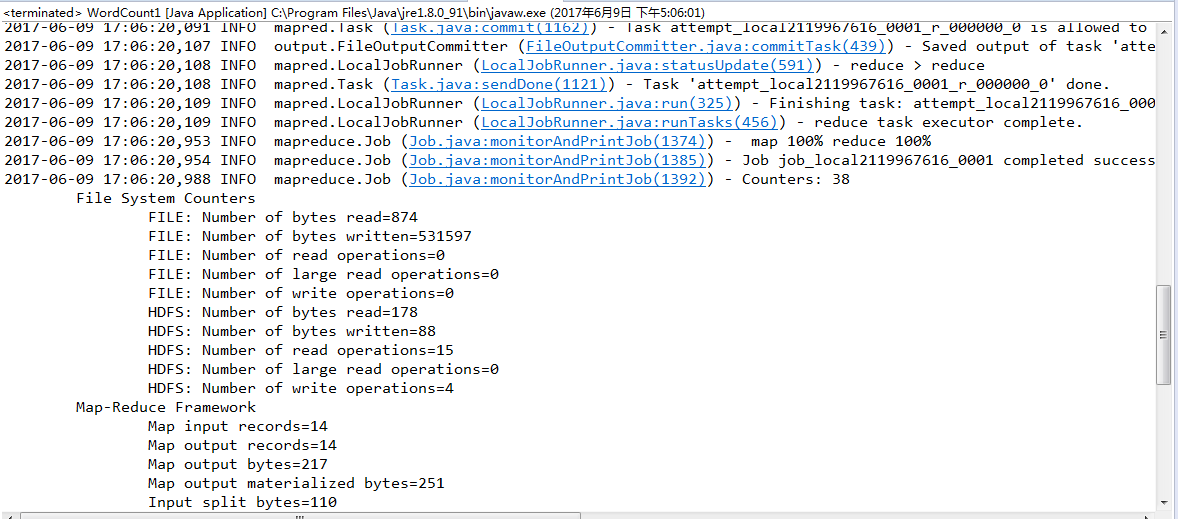
最后再放一张成功结果图:
eclipse与hadoop集成,运行wordCount1的更多相关文章
- 在ubuntu下使用Eclipse搭建Hadoop开发环境
一.安装准备1.JDK版本:jdk1.7.0(jdk-7-linux-i586.tar.gz)2.hadoop版本:hadoop-1.1.1(hadoop-1.1.1.tar.gz)3.eclipse ...
- Hadoop3 在eclipse中访问hadoop并运行WordCount实例
前言: 毕业两年了,之前的工作一直没有接触过大数据的东西,对hadoop等比较陌生,所以最近开始学习了.对于我这样第一次学的人,过程还是充满了很多疑惑和不解的,不过我采取的策略是还是先让环 ...
- MapReduce编程入门实例之WordCount:分别在Eclipse和Hadoop集群上运行
上一篇博文如何在Eclipse下搭建Hadoop开发环境,今天给大家介绍一下如何分别分别在Eclipse和Hadoop集群上运行我们的MapReduce程序! 1. 在Eclipse环境下运行MapR ...
- Spark:利用Eclipse构建Spark集成开发环境
前一篇文章“Apache Spark学习:将Spark部署到Hadoop 2.2.0上”介绍了如何使用Maven编译生成可直接运行在Hadoop 2.2.0上的Spark jar包,而本文则在此基础上 ...
- 基于Eclipse的Hadoop应用开发环境配置
基于Eclipse的Hadoop应用开发环境配置 我的开发环境: 操作系统ubuntu11.10 单机模式 Hadoop版本:hadoop-0.20.1 Eclipse版本:eclipse-java- ...
- eclipse连hadoop2.x运行wordcount 转载
转载地址:http://my.oschina.net/cjun/blog/475576 一.新建java工程,并且导入hadoop相关jar包 此处可以直接创建mapreduce项目就可以,不用下面折 ...
- Linux下使用Eclipse开发Hadoop应用程序
在前面一篇文章中介绍了如果在完全分布式的环境下搭建Hadoop0.20.2,现在就再利用这个环境完成开发. 首先用hadoop这个用户登录linux系统(hadoop用户在前面一篇文章中创建的),然后 ...
- Windows下Eclipse连接hadoop
2015-3-27 参考: http://www.cnblogs.com/baixl/p/4154429.html http://blog.csdn.net/u010911997/article/de ...
- 获取hadoop的源码和通过eclipse关联hadoop的源码
一.获取hadoop的源码 首先通过官网下载hadoop-2.5.2-src.tar.gz的软件包,下载好之后解压发现出现了一些错误,无法解压缩, 因此有部分源码我们无法解压 ,因此在这里我讲述一下如 ...
随机推荐
- Jedis操作Redis--Key操作
/** * Key(键) * DEL,DUMP,EXISTS,EXPIRE,EXPIREAT,KEYS,MIGRATE,MOVE,OBJECT,PERSIST,PEXPIRE,PEXPIREAT,PT ...
- Docker容器技术的核心
容器技术的核心 所谓容器,其实是由Linux Namespace.Linux Cgroups和rootfs三种技术构建出来的进程的隔离环境 对于Docker项目来说,其实最核心就是为待创建的用户进程: ...
- NLP(十五) 聊天机器人
对话引擎 1.了解目标用户 2.理解用于沟通得语言 3.了解用户的意图 4.应答用户,并给出进一步线索 NLTK中的引擎 eliza,iesha,rude,suntsu,zen import nltk ...
- dmg文件转iso格式
1. 简介 dmg是MAC苹果机上的压缩镜像文件,相当于在Windows上常见的iso文件. dmg格式在苹果机上可以直接运行加载,在Windows平台上需要先转换为iso格式. 2. 转换工具 本文 ...
- Request请求的应用
1.通过request获得请求行 获得客户端的请求方式:String getMethod() 获得请求的资源: String getRequestURI() StringBuffer getReq ...
- 深入vue源码,了解vue的双向数据绑定原理
大家都知道vue是一种MVVM开发模式,数据驱动视图的前端框架,并且内部已经实现了双向数据绑定,那么双向数据绑定是怎么实现的呢? 先手动撸一个最最最简单的双向数据绑定 <div> < ...
- GA,RC,Alpha,Beta,Final等软件版本名词释义
对应上图的表格如下: 名词 说明 Alpha α是希腊字母的第一个,表示最早的版本,内部测试版,一般不向外部发布,bug会比较多,功能也不全,一般只有测试人员使用. Beta β是希腊字母的第二个,公 ...
- Linux入门基础之 中
五.Linux 下获取帮助 没必要记住所有东西 Linux 提供了极为详细的帮助工具及文档,一定要养成查帮助文档的习惯,可以大大减少需要记忆的东西并且提高效率 5.1.HELP 几乎所有命令都可以使用 ...
- EditPlus5.0破解激活
永久激活用户名激活码: 用户名:Vovan注册码:3AG46-JJ48E-CEACC-8E6EW-ECUAW 然后重启软件即可
- Spring Cloud官方文档中文版-服务发现:Eureka客户端
官方文档地址为:http://cloud.spring.io/spring-cloud-static/Dalston.SR2/#_spring_cloud_netflix 文中例子我做了一些测试在:h ...