
[概念理解] UML类建模
Class Diagram
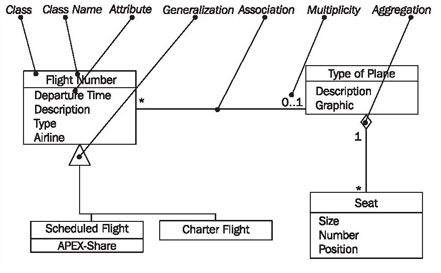
In class diagrams, as shown in Figure 4.30, we work with the following elements:
Class
A class represents a relevant concept from the domain, a set of persons, objects, or ideas that are depicted in the IT system:
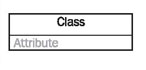
Examples of classes are passengers, planes, or tickets.
Attribute
An attribute of a class represents a characteristic of a class that is of interest for the user of the IT system:
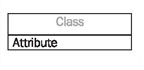
Characteristics of interest of a passenger, for example, are name and age.
Generalization
Generalization is a relationship between two classes: a general class and a special class:

Refer to Generalization, Specialization, and Inheritance.
Association
An association represents a relationship between two classes:
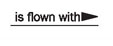
An association indicates that objects of one class have a relationship with objects of another class, in which this connection has a specifically defined meaning (for example, "is flown with").
Multiplicity
A multiplicity allows for statements about the number of objects that are involved in an association:
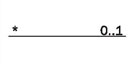
Also see Figure 4.32.
Aggregation
An aggregation is a special case of an association (see above) meaning "consists of":
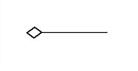
The diamond documents this meaning; a caption is unnecessary.
Reading Class Diagrams
Figure 4.31 shows a class diagram from our case study with the classes customer, ticket, and coupon, their attributes, and their associations:
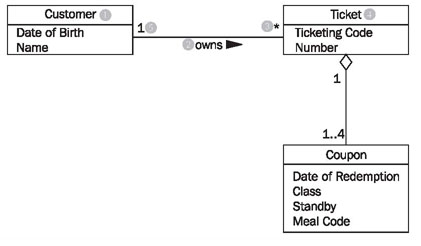
Looking at the class diagram in Figure 4.31, you can read the association between the classes customer and ticket as follows:
- One (this sentence always begins with "one") object of the first class has an association with a number of objects of the second class.
The appropriate values from the diagram have to be inserted into this first abstract formulation, which can be universally applied. The name of one class is customer (1); the name of the other class is ticket (4). The name of the association is owns (2):
- A customer (1) owns (2) * (3) ticket (4).
If the asterisk is exchanged with its meaning, a regular English sentence is created:
- A customer (1) owns (2) zero, one or several (3) ticket(s) (4).
Since associations usually are not directional, meaning usually go both directions, our association also has a meaning in the other direction:
- A ticket (4) is owned by (2) exactly one (5) customer (1).
The small triangle next to the name of the association (2) indicates in which direction the name of the association holds true. We can read all the associations in the class diagram in this way.
The specification of the number of objects of the second class (you always start with one object of the first class) is called the multiplicity. The course of action should always be according to the same pattern:
First, a statement of the lower limit (minimum number) followed by two periods (..) and a statement of the upper limit (maximum number).
Figure 4.32 shows the most common possibilities:
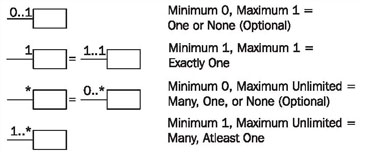
However, in UML it is also possible to insert any values as the lower and upper limits, e.g., 2 .. 4 or 6 .. *.
The association's name is necessary for understanding the domain meaning of the association. In contrast to the association itself, which applies to both directions, the name of the association applies to only one direction, which is indicated by a black triangle. If the association is not labeled, its meaning has to be derived from the domain context, or it takes on a general meaning such as has or belongs to. In case of doubt it is better to label associations too much than too little. Many diagrams that we have encountered in our practical experience were incomprehensible because associations were not labeled.
Associations can also be viewed as the implementation of static business rules (see Static and Dynamic Business Rules). Statements such as "a ticket belongs to exactly one customer" are documented in the class diagram by associations.
Roles are another possible way in UML to give relationships between classes a domain meaning. In this way, we can state what role an object of one class plays for the objects of another class:
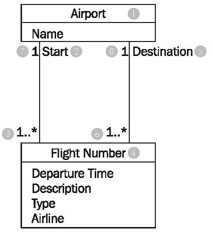
Looking at the class diagram in Figure 4.33, we can read the left association with roles between the classes flight number and airport as follows:
- An airport (1) is a start (location) (2) for one or more (3) flightnumbers (4).
There is another association between the two classes flight number and airport:
- An airport (1) is a destination (5) for one or more flight numbers (4).
These two associations also have inversions, even though roles are only stated for one direction:
- A flight number (4) has as start (location) (2) exactly one (7) airport (1).
- A flight number (4) has as destination (5) exactly one (8) airport (1).
This records that a certain flight number has a departure airport and a destination airport. An example of a flight number is LX317, a daily flight of the Swiss airline Crossair from London to Zurich.
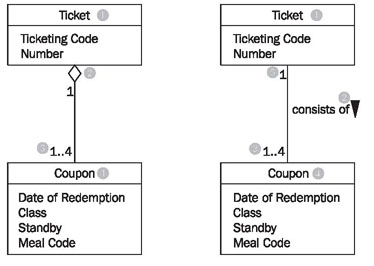
Among the many domain meanings that an association can have there is one that can be signified with UML by its own symbol: the whole-part relationship or aggregation. This type of relationship is always used when objects of one class are a part of objects of another class.
In the class diagram in Figure 4.34 aggregation is used on the left side (the white diamond), which can be read as follows:
- A ticket (1) consists of (2) 1 to 4 (3) coupons (4).
or the other way around:
- A coupon (4) is part of (2) exactly one (5) ticket (1).
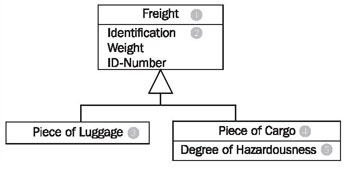
The example without a diamond, but with a name for the association, has exactly the same meaning! The last missing element of UML that we use to model class diagrams is generalization/specialization, which serves to depict the relationship between a superclass and a subclass. The generalization/specialization in Figure 4.35 can be read from top to bottom or bottom to top. If you begin at the top, you find a class Freight (1) with the attributes: Identification, Weight, and ID-number (2). This class has two specializations, Piece of Luggage (3) and Piece of Cargo (4). The class Piece of Cargo has an additional attribute: Degree of Hazardousness (5).
If you begin at the bottom you will find the classes Piece of Luggage (3) and Piece of Cargo(4). These have a superclass, the class Freight (1), which contains the shared attributes (and functions) of the subclasses.
[概念理解] UML类建模的更多相关文章
- UML类建模(强烈推荐-思路很清晰)
UML类建模(强烈推荐-思路很清晰) 2016年10月23日 15:17:47 mbshqqb 阅读数:2315 标签: uml面向对象设计模式 更多 个人分类: 面向对象程序设计 UML的构造快 ...
- UML类图关系大全
UML类图关系大全 1.关联 双向关联: C1-C2:指双方都知道对方的存在,都可以调用对方的公共属性和方法.在GOF的设计模式书上是这样描述的:虽然在分析阶段这种关系是适用的,但我们觉得它对于描述设 ...
- UML类图关系大全【转】
UML类图关系大全 1.关联 双向关联:C1-C2:指双方都知道对方的存在,都可以调用对方的公共属性和方法. 在GOF的设计模式书上是这样描述的:虽然在分析阶段这种关系是适用的,但我们觉得它对于描述设 ...
- Java 大黑话讲解设计模式 -- UML类图
目录 1.啥是UML类图? 2.UML类图有啥用? 3.正式理解UML类图 4.使用idea画第一个UML类图 5.类之间的关系图[必须牢记] 6.类之间的关系 6.1.依赖 6.2.泛化 6.3.实 ...
- UML类图关系全面剖析
UML的类图关系分为: 关联.聚合/组合.依赖.泛化(继承).而其中关联又分为双向关联.单向关联.自身关联:下面就让我们一起来看看这些关系究竟是什么,以及它们的区别在哪里. 1.关联 双向关联:C1- ...
- UML类图关系-转
1.关联 双向关联: C1-C2:指双方都知道对方的存在,都可以调用对方的公共属性和方法. 在GOF的设计模式书上是这样描述的:虽然在分析阶段这种关系是适用的,但我们觉得它对于描述设计模式内的类关系来 ...
- UML类图关系大全-转
1.关联 双向关联: C1-C2:指双方都知道对方的存在,都可以调用对方的公共属性和方法. 在GOF的设计模式书上是这样描述的:虽然在分析阶段这种关系是适用的,但我们觉得它对于描述设计模式内的类关系来 ...
- UML类图关系表示
UML 之 C++类图关系全面剖析 分类: 软件设计与架构2008-10-16 08:52 5165人阅读 评论(3) 收藏 举报 umlc++borderclasscblog UML的类图关系分为: ...
- 我对uml类图关系的理解
uml类图的关系: 泛化关系也就是继承. 实现关系就是一个类实现另外一个接口. 依赖关系就是一个类使用了另外一个类,是一种使用关系,在这个类的某个服务中需要另外一个类来协助. 关联关系就是一类拥有另外 ...
随机推荐
- My Friends
HMQ's blog RMY's blog Shq's blog wjyyy‘s blog
- [POJ] 2223 Muddy Fields
Time Limit: 1000MS Memory Limit: 65536K Total Submissions: 11490 Accepted: 4270 Description Rain has ...
- python 2018/8/25
# 含多空格字符串的分割 hello = "hello python hello"print(a.split(" ")) # ['hello', 'python ...
- 我的Python分析成长之路1
Python是什么? ...
- 【HIHOCODER 1601】 最大得分(01背包)
描述 小Hi和小Ho在玩一个游戏.给定一个数组A=[A1, A2, ... AN],小Hi可以指定M个不同的值S1,S2, S3 ... SM,这样他的总得分是 ΣSi × count(Si).(co ...
- Codeforces 879C/878A - Short Program
传送门:http://codeforces.com/contest/879/problem/C 本题是一个位运算问题——位运算的等价变换. 假设位运算符“&”“|”“^”是左结合的,且优先级相 ...
- 初识Web框架
一.Web框架本质 Python的Web框架分为两类: 通过socket自己写程序,自己处理请求: 基于Wsgi(Web Server Gateway Interface:Web服务网关接口),处理请 ...
- 65.什么是IOC?【从零开始学Spring Boot】
[从零开始学习Spirng Boot-常见异常汇总] 这个小节吧,是无意当中看了一篇文章,觉得介绍的特别好,引用到我的博客中,让大家也乐下.那么他是怎么解说IOC的呢?看如下: 套用好莱坞的一句名言就 ...
- CodeForces 610B-Vika and Squares,有坑点,不是很难~~
B. Vika and Squares time limit per test 2 seconds memory limit per test 256 megabytes input standard ...
- 【树形DP】codeforces K. Send the Fool Further! (medium)
http://codeforces.com/contest/802/problem/K [题意] 给定一棵树,Heidi从根结点0出发沿着边走,每个结点最多经过k次,求这棵树的最大花费是多少(同一条边 ...