
SRS之SrsRtmpServer::connect_app详解
1. connect('live')
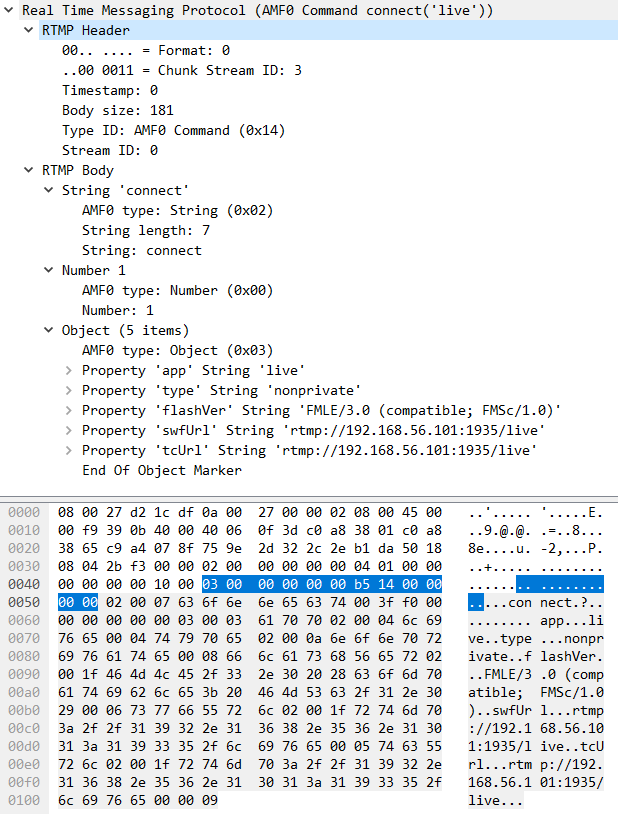
2. SrsRtmpServer::connect_app
位于 srs_rtmp_stack.cpp。在 SRS 的 RTMP 连接处理线程 conn 中,当与客户端 handshake 完成后,即调用该函数接收客户端第一个 RTMP 消息:connect。如上图.
int SrsRtmpServer::connect_app(SrsRequest* req)

{

    int ret = ERROR_SUCCESS;

    SrsCommonMessage* msg = NULL;

    SrsConnectAppPacket* pkt = NULL;

    /* 通过 SrsConnectAppPacket 指定接收并解析的 RTMP 消息,解析成功后,则通过

     * pkt 返回,这里成功的话,pkt 指向 SrsConnectAppPacket,里面包含解析后的数据 */

    if ((ret = expect_message<SrsConnectAppPacket>(&msg, &pkt)) != ERROR_SUCCESS) {

        srs_error("expect connect app message failed. ret=%d", ret);

        return ret;

    }

    SrsAutoFree(SrsCommonMessage, msg);

    SrsAutoFree(SrsConnectAppPacket, pkt);

    srs_info("get connect app message");

    SrsAmf0Any* prop = NULL;

    if ((prop = pkt->command_object->ensure_property_string("tcUrl")) == NULL) {

        ret = ERROR_RTMP_REQ_CONNECT;

        srs_error("invalid request, must specifies the tcUrl. ret=%d", ret);

        return ret;

    }

    req->tcUrl = prop->to_str();

    if ((prop = pkt->command_object->ensure_property_string("pageUrl")) != NULL) {

        req->pageUrl = prop->to_str();

    }

    if ((prop = pkt->command_object->ensure_property_string("swfUrl")) != NULL) {

        req->swfUrl = prop->to_str();

    }

    if ((prop = pkt->commnad_object->ensure_property_number("objectEncoding")) != NULL) {

        req->objectEncoding = prop->to_number();

    }

    if (pkt->args) {

        srs_freep(req->args);

        req->args = pkt->args->copy()->to_object();

        srs_info("copy edge traverse to origin auth args.");

    }

    srs_info("get connect app message params success.");

    /* 解析 tcUrl ,解析的值保存在 schema,host,vhost 等等中 */

    srs_discovery_tc_url(req->tcUrl,

        req->schema, req->host, req->vhost, req->app, req->port,

        req->param);

    /* 去掉不相关的字符,如空格等 */

    req->strip();

    return ret;

}
2.1 SrsRtmpServer: expect_message
位于srs_rtmp_stack.hpp。
这是一个定义在 SrsRtmpServer 类中的模板函数。该函数指定了一个期待接收的消息,若接收到的是其他消息则丢弃,直到获取到指定的消息为止。
/**

 * expect a specified message, drop others until got specified one.

 * @pmsg, user must free it. NULL if not success.

 * @ppacket, user must free it, which decode from payload of message. NULL if not success.

 * @remark, only when success, user can use and must free the pmsg and ppacket.

 * for example:

 *      SrsCommonMessage* msg = NULL;

 *      SrsConnectAppResPacket* pkt = NULL;

 *      if ((ret = server->expect_message<SrsConnectAppResPacket>(protocol, &msg, &pkt))

 *          != ERROR_SUCCESS) {

 *          return ret;

 *      }

 *      // use then free msg and pkt

 *      srs_freep(msg);

 *      srs_freep(pkt);

 * user should never recv message and covert it, use this method instead.

 * if need to set timeout, use set timeout of SrsProtocol.

 */

template<class T>

int expect_message(SrsCommmonMessage** pmsg, T** ppacket)

{

    return protocol->expect_message<T>(pmsg, ppacket);

}
接着调用 SrsProtocol 类定义的同名模板函数 expect_message.
在分析 SrsProtocol: expect_message 之前,先看 SrsRtmpServer 类中类型为 SrsProtocol 类的成员 protocol 是如何构造的。
2.1.1 SrsProtocol 的构造函数:
位于 srs_rtmp_stack.hpp。
SrsProtocol 类提供了 RTMP 消息协议服务,从 RTMP chunk stream 中接收 RTMP 消息,或者通过 RTMP chunk stream 发送 RTMP 消息。
/**

 * @io: 构造时传入的是 SrsStSocket 类的指针,ISrsProtocolReaderWriter 类

 * 是 SrsStSocket 类的父类.

 */

SrsProtocol::SrsProtocol(ISrsProtocolReaderWriter* io)

{

    /* 缓存从 io 中接收到的rtmp消息数据,并为 stream 提供服务,

     * 默认分配大小为 128K */

    in_buffer = new SrsFastBuffer();

    skt = io;

    /* 初始化块的大小,这里为 128 */

    in_chunk_size = SRS_CONSTS_RTMP_PROTOCOL_CHUNK_SIZE;

    out_chunk_size = SRS_CONSTS_RTMP_PROTOCOL_CHUNK_SIZE;

    /* out_iovs: cache for multiple messages send. */

    nb_out_iovs = SRS_CONSTS_IOVS_MAX;

    out_iovs = (iovec*)malloc(sizeof(iovec) * nb_out_iovs);

    // each chunk consumers at least 2 iovs

    srs_assert(nb_out_iovs >= 2);

    /* 标志位,是否警示用户增长 c0c3 头缓存 */

    warned_c0c3_cache_dry = false;

    /* 标志位,当接收到消息的时候是否自动响应 */

    auto_response_when_recv = true;

    /* 是否打印调试信息 */

    shuw_debug_info = true;

    /* 缓存的大小是由对方设置的 */

    in_buffer_length = 0;

    cs_cache = NULL;

    if (SRS_PERF_CHUNK_STREAM_CACHE > 0) {

        /* 构造 SRS_PERF_CHUNK_STREAM_CACHE 个 块流缓存SrsChunkStream  */

        cs_cache = new SrsChunkStream*[SRS_PERF_CHUNK_STREAM_CACHE];

    }

    /* 接收到的 RTMP 块流也许是交错的,因此使用 SrsChunkStream 来缓存输入的 RTMP 块流 */

    for (int cid = 0; cid < SRS_PERF_CHUNK_STREAM_CACHE; cid++) {

        SrsChunkStream* cs = new SrsChunkStream(cid);

        // set the perfer cid of chunk,

        // which will copy to the message received.

        cs->header.perfer_cid = cid;

        cs_cache[cid] = cs;

    }

}
2.1.2 SrsFastBuffer 构造函数
SrsFastBuffer 类为协议提供字节缓存,将从 socket 接收到的数据存放到该类中,然后解码为 RTMP 消息。
用法:
ISrsBufferReader* r = ......;

SrsFastBuffer* fb = ......;

fb->grow(r, 1024);

char* header = fb->read_slice(100);

char* payload = fb->read_payload(924);
构造函数具体代码如下:
// the default recv buffer size, 128KB.

#define SRS_DEFAULT_RECV_BUFFER_SIZE 131072

/**

 * SrsFastBuffer:

 *

 * the buffer provices bytes cache for protocol. generally,

 * protocol recv data from socket, put into buffer, decode to RTMP message.

 * Usage:

 *     ISrsBufferReader* r = ...;

 *     SrsFastBuffer* fb = ......;

 *     fb->grow(r, 1024);

 *     char* header = fb->read_slice(100);

 *     char* payload = fb->read_payload(924);

 */

SrsFastBuffer::SrsFastBuffer()

{

#ifdef SRS_PERF_MERGED_READ

    merged_read = false;

    _handler = NULL;

#endif

    /* 设置默认接收缓存的大小,128K */

    nb_buffer = SRS_DEFAULT_RECV_BUFFER_SIZE;

    buffer = (char*)malloc(nb_buffer);

    p = end = buffer;

}
2.1.3 SrsChunkStream 构造函数
接收到的 RTMP 块流也许不是顺序的,是交错的,因此,使用 SrsChunkStream 类去缓存接收到的 RTMP chunk streams。
/**

 * incoming chunk stream maybe interlaced,

 * use the chunk stream to cache the input RTMP chunk streams.

 */

SrsChunkStream::SrsChunkStream(int _cid)

{

    /* 代表基本头中的 chunk type,即fmt */

    fmt = 0;

    /* 初始化当前 SrsChunkStream 所属的块流 */

    cid = _cid;

    /* 标志位,表示 chunk 的消息头中是否有扩展时间戳 */

    extended_timestamp = false;

    /* 读取到的部分/完整的消息 */

    msg = NULL;

    /* 解码的消息计数值,用来鉴别该 chunk stream 是否是新的 */

    msg_count = 0;

}
2.2 SrsProtocol: expect_message
该函数是一个模板函数,通过指定接收的期待接收的类来接收相应 RTMP 消息,如调用时指定 T 为 SrsConnectAppPacket,第二个参数 ppacket 为 SrsConnectAppPacket,则表示本次期望接收到的消息为客户端发送的 connect 命令消息。
/**

 * expect a specified message, drop others until got specified one.

 * @pmsg, user must free it. NULL if not success.

 * @ppacket, user must free it, which decode from payload of message. NULL if not success.

 * @remark, only when success, user can use and must free the pmsg and ppacket.

 * for exampel:

 *     SrsCommomMessage* msg = NULL;

 *     SrsConnectAppResPacket* pkt = NULL;

 *     if ((ret = protocol->expect_message<SrsConnectAppResPacket>(protocol, &msg, &pkt))

 *         != ERROR_SUCCESS) {

 *         return ret;

 *     }

 *     // use then free msg and pkt

 *     srs_freep(msg);

 *     srs_freep(pkt);

 * user should never recv message and convert it, use this method instead.

 * if need to set timeout, use set timeout of SrsProtocol.

 */

template<class T>

int expect_message(SrsCommonMessage** pmsg, T** ppacket)

{

    *pmsg = NULL;

    *ppacket = NULL;

    int ret = ERROR_SUCCESS;

    while (true) {

        SrsCommonMessage* msg = NULL;

        /* 开始接收客户端发送的 RTMP 消息 */

        if ((ret = recv_message(&msg)) != ERROR_SUCCESS) {

            if (ret != ERROR_SOCKET_TIMEOUT && !srs_is_client_gracefully_close(ret)) {

                srs_error("recv message failed. ret=%d", ret);

            }

            return ret;

        }

        srs_verbose("recv message success.");

        SrsPacket* packet = NULL;

        /* 该函数会先读取消息的名称,然后根据该名称构建对应的类,如 SrsConnectAppPacket,

         * 该类通过 packet 返回,接着调用该类实现的 decode 函数来解析数据.

         * 因此,返回的 packet 其实是指向它的子类,如 SrsConnectAppPacket */

        if ((ret = decode_message(msg, &packet)) != ERROR_SUCCESS) {

            srs_error("decode message failed. ret=%d", ret);

            srs_freep(msg);

            srs_freep(packet);

            return ret;

        }

        /**

         * dynamic_cast:

         *     将基类的指针或引用安全地转换成派生类的指针或引用,并用派生类的指针或引用

         * 调用非虚函数。如果是基类指针或引用调用的是虚函数无需转换就能在运行时调用派生类

         * 的虚函数。

         * @remark,当将 dynamic_cast 用于某种类型的指针或引用时,只有该类含有虚函数时,才能

         * 进行这种转换。否则,编译器会报错。

         */

        T* pkt = dynamic_cast<T*>(packet);

        if (!pkt) {

            srs_info("drop message(type=%d, size=%d, time=%"PRId64", sid=%d).",

                msg->header.message_type, msg->header.payload_length,

                msg->header.timestamp, msg->header.stream_id);

            srs_freep(msg);

            srs_freep(packet);

            continue;

        }

        *pmsg = msg;

        *ppacket = pkt;

        break;

    }

    return ret;

}
2.2.1 SrsProtocol::recv_message
位于 srs_rtmp_stack.cpp。
/**

 * recv a RTMP message, which is bytes oriented.

 * user can use decode_message to get the decoded RTMP packet.

 * @param pmsg, set the received message,

 *      always NULL if errno,

 *      NULL for unknown packet but return success.

 *      never NULL if decode success.

 * @remark, drop message when msg is empty or payload length is empty.

 */

int SrsProtocol::recv_message(SrsCommonMessage** pmsg)

{

    *pmsg = NULL;

    int ret = ERROR_SUCCESS;

    while (true) {

        SrsCommonMessage* msg = NULL;

        /* 每调用该函数就读取一个 chunk,直到获取到完整的 message 为止,此时

         * 该完整的 message 通过 msg 返回 */

        if ((ret = recv_interlaced_message(&msg)) != ERROR_SUCCESS) {

            if (ret != ERROR_SOCKET_TIMEOUT && !srs_is_client_gracefully_close(ret)) {

                srs_error("recv interlaced message failed. ret=%d", ret);

            }

            srs_freep(msg);

            return ret;

        }

        srs_verbose("entire msg received");

        /* 若没有获取到完整的 message,则继续读 */

        if (!msg) {

            srs_info("got empty message without error.");

            continue;

        }

        if (msg->size <= 0 || msg->header.payload_length <= 0) {

            srs_trace("ignore empty message(type=%d, size=%d, time=%"PRId64", sid=%d).",

                msg->header.message_type, msg->header.payload_length,

                msg->header.timestamp, msg->header.stream_id);

            srs_freep(msg);

            continue;

        }

        /* 执行到这里表示已经获取到一个完整的 message */

        if ((ret = on_recv_message(msg)) != ERROR_SUCCESS) {

            srs_error("hook the received msg failed. ret=%d", ret);

            srs_freep(msg);

            return ret;

        }

        srs_verbose("got a msg, cid=%d, type=%d, size=%d, time=%"PRId64,

            msg->header.perfer_cid, msg->header.message_type, msg->header.payload_length,

            msg->header.timestamp);

        *pmsg = msg;

        break;

    }

    return ret;

}
2.2.2 SrsProtocol::recv_interlaced_message
位于 srs_rtmp_stack.cpp。
/**

 * how many chunk stream to cache, [0, N].

 * to improve about 10% performance when chunk size small, and 5% for large chunk.

 * @see https://github.com/ossrs/srs/issues/249: cache the chunk headers info to

 *      improve performance

 * @remark 0 to disable the chunk stream cache.

 */

#define SRS_PERF_CHUNK_STREAM_CACHE 16

/**

 * recv bytes oriented RTMP message from protocol stack.

 * return error if error occur and never set the pmsg,

 * return success amd pmsg set to NULL if no entire message got,

 * return success and pmsg set to entire message if got one.

 */

int SrsProtocol::recv_interlaced_message(SrsCommonMessage** pmsg)

{

    int ret = ERROR_SUCCESS;

    // chunk stream basic header.

    char fmt = 0;

    int cid = 0;

    /* 读取 RTMP chunk stream 的基本头 */

    if ((ret = read_basic_header(fmt, cid)) != ERROR_SUCCESS) {

        if (ret != ERROR_SOCKET_TIMEOUT && !srs_is_client_gracefully_close(ret)) {

            srs_error("read basic header failed. ret=%d", ret);

        }

        return ret;

    }

    srs_verbose("read basic header success. fmt=%d, cid=%d", fmt, cid);

    // the cid must not negative.

    srs_assert(cid >= 0);

    // get the cached chunk stream.

    SrsChunkStream* chunk = NULL;

    // use chunk stream cache to get the chunk info.

    // @see https://github.com/ossrs/srs/issues/249: cache the chunk headers info

    //      to improve performance

    if (cid < SRS_PERF_CHUNK_STREAM_CACHE) {

        // chunk stream cache hit.

        srs_verbose("cs-cache hit, cid=%d", cid);

        // already init, use it directly

        /* 从已经分配好 SRS_PERF_CHUNK_STREAM_CACHE 个的 cs_cache 数组中

         * 取出一个 cid 对应位置的 SrsChunkStream */

        chunk = cs_cache[cid];

        srs_verbose("cached chunk stream: fmt=%d, cid=%d, size=%d, "

                    "message(type=%d, size=%d, time=%"PRId64", sid=%d)",

            chunk->fmt, chunk->cid, (chunk->msg? chunk->msg->size : 0),

            chunk->header.message_type, chunk->header.payload_length,

            chunk->header.timestamp, chunk->header.stream_id);

    } else {

        // chunk stream cache miss, use map.

        /* 先从 map 类型的容器 chunk_streams 中查找该 cid 对应的 SrsChunkStream 是否存在 */

        if (chunk_streams.find(cid) == chunk_streams.end()) {

            /* 根据 cid 重新构建一个 SrsChunkStream,并将其放入到 map 容器 chunk_streams 中 */

            chunk = chunk_streams[cid] = new SrsChunkStream(cid);

            // set the perfer cid of chunk,

            // which will copy to the message received.

            chunk->header.perfer_cid = cid;

            srs_verbose("cache new chunk stream: fmt=%d, cid=%d", fmt, cid);

        } else {

            chunk = chunk_streams[cid];

            srs_verbose("cached chunk stream: fmt=%d, cid=%d, size=%d, "

                        "message(type=%d, size=%d, time=%"PRId64", sid=%d)",

                chunk->fmt, chunk->cid, (chunk->msg? chunk->msg->size : 0),

                chunk->header.message_type, chunk->header.payload_length,

                chunk->header.timestamp, chunk->header.stream_id);

        }

    }

    // chunk stream message header

    if ((ret = read_message_header(chunk, fmt)) != ERROR_SUCCESS) {

        if (ret != ERROR_SOCKET_TIMEOUT && !srs_is_client_gracefully_close(ret)) {

            srs_error("read message header failed. ret=%d", ret);

        }

        return ret;

    }

    srs_verbose("read message header success. "

            "fmt=%d, ext_time=%d, size=%d, message(type=%d, size=%d, "

            "time=%"PRId64", sid=%d)",

            fmt, chunk->extended_timestamp, (chunk->msg? chunk->msg->size : 0),

            chunk->header.message_type, chunk->header.payload_length,

            chunk->header.timestamp, chunk->header.stream_id);

    // read msg payload from chunk stream.

    SrsCommonMessage* msg = NULL;

    if ((ret = read_message_payload(chunk, &msg)) != ERROR_SUCCESS) {

        if (ret != ERROR_SOCKET_TIMEOUT && !srs_is_client_gracefully_close(ret)) {

            srs_error("read message payload failed. ret=%d", ret);

        }

        return ret;

    }

    // not got an entire RTMP message, try next chunk.

    if (!msg) {

        srs_verbose("get partial message success. size=%d, "

                    "message(type=%d, size=%d, time=%"PRId64", sid=%d)",

                (msg? msg->size : (chunk->msg? chunk->msg->size : 0)),

                chunk->header.message_type, chunk->header.payload_length,

                chunk->header.timestamp, chunk->header.stream_id);

        return ret;

    }

    /* 得到完整的 message */

    *pmsg = msg;

    srs_info("get entire message success. size=%d, message(type=%d, "

             "size=%d, time=%"PRId64", sid=%d)",

            (msg? msg->size : (chunk->msg? chunk->msg->size : 0)),

            chunk->header.message_type, chunk->header.payload_length,

            chunk->header.timestamp, chunk->header.stream_id);

    return ret;

}
2.2.3 SrsProtocol::read_basic_header
读取 RTMP chunk stream 的基本头。
/**

 * Chunk Basic Header

 * The Chunk Basic Header encodes the chunk stream ID and the chunk

 * type(represented by fmt field in the figure below). Chunk type

 * determines the format of the encoded message header. Chunk Basic

 * Header field may be 1, 2, or 3 bytes, depending on the chunk stream

 * ID.

 *

 * The bits 0-5 (least significant) in the chunk basic header represent

 * the chunk stream ID.

 *

 * Chunk stream IDs 2-63 can be encoded in the 1-byte version of this

 * field.

 *    0 1 2 3 4 5 6 7

 *   +-+-+-+-+-+-+-+-+

 *   |fmt|   cs id   |

 *   +-+-+-+-+-+-+-+-+

 *   Figure 6 Chunk basic header 1

 *

 * Chunk stream IDs 64-319 can be encoded in the 2-byte version of this

 * field. ID is computed as (the second byte + 64).

 *   0                   1

 *   0 1 2 3 4 5 6 7 8 9 0 1 2 3 4 5

 *   +-+-+-+-+-+-+-+-+-+-+-+-+-+-+-+-+

 *   |fmt|    0      | cs id - 64    |

 *   +-+-+-+-+-+-+-+-+-+-+-+-+-+-+-+-+

 *   Figure 7 Chunk basic header 2

 *

 * Chunk stream IDs 64-65599 can be encoded in the 3-byte version of

 * this field. ID is computed as ((the third byte)*256 + the second byte

 * + 64).

 *    0 1 2 3 4 5 6 7 8 9 0 1 2 3 4 5 6 7 8 9 0 1 2 3

 *   +-+-+-+-+-+-+-+-+-+-+-+-+-+-+-+-+-+-+-+-+-+-+-+-+

 *   |fmt|     1     |         cs id - 64            |

 *   +-+-+-+-+-+-+-+-+-+-+-+-+-+-+-+-+-+-+-+-+-+-+-+-+

 *   Figure 8 Chunk basic header 3

 *

 * cs id: 6 bits

 * fmt: 2 bits

 * cs id - 64: 8 or 16 bits

 *

 * Chunk stream IDs with values 64-319 could be represented by both 2-byte

 * version and 3-byte version of this field.

 */

int SrsProtocol::read_basic_header(char& fmt, int& cid)

{

    int ret = ERROR_SUCCESS;

    /* 当前用户需要从SrsFastBuffer中读取 1 字节的数据,但SrsFastBuffer中已有大于或等于

     * 1 字节的数据时,直接返回,否则需要从 socket 中读取数据,将读取到的数据存放到

     * SrsFastBuffer中(实际上该SrsFastBuffer从 socket 中的读取数据大小为当前缓存的

     * 空闲空间大小) */

    if ((ret = in_buffer->grow(skt, 1)) != ERROR_SUCCESS) {

        if (ret != ERROR_SOCKET_TIMEOUT && !srs_is_client_gracefully_close(ret)) {

            srs_error("read 1bytes basic header failed. required_size=%d, ret=%d", 1, ret);

        }

        return ret;

    }

    /* 从SrsFastBuffer中读取 1 字节的数据 */

    fmt = in_buffer->read_1byte();

    cid = fmt & 0x3f;

    fmt = (fmt >> 6) & 0x03;

    // 2-63, 1B chunk header

    if (cid > 1) {

        srs_verbose("basic header parsed. fmt=%d, cid=%d", fmt, cid);

        return ret;

    }

    // 64-319, 2B chunk header

    if (cid == 0) {

        /* 若 cid 为 0,则表明basic header为 2 字节 */

        if ((ret = in_buffer->grow(skt, 1)) != ERROR_SUCCESS) {

            if (ret != ERROR_SOCKET_TIMEOUT && !srs_is_client_gracefully_close(ret)) {

                srs_error("read 2bytes basic header failed. required_size=%d, ret=%d",

                          1, ret);

            }

            return ret;

        }

        cid = 64;

        cid += (u_int8_t)in_buffer->read_1byte();

        srs_verbose("2bytes basic header parsed. fmt=%d, cid=%d", fmt, cid);

    // 64-65599, 3B chunk header

    } else if (cid == 1) {

        if ((ret = in_buffer->grow(skt, 2)) != ERROR_SUCCESS) {

            if (ret != ERROR_SOCKET_TIMEOUT && !srs_is_client_gracefully_close(ret)) {

                srs_error("read 3bytes basic header failed. required_size=%d, ret=%d",

                          2, ret);

            }

            return ret;

        }

        cid = 64;

        cid += (u_int8_t)in_buffer->read_1byte();

        cid += ((u_int8_t)in_buffer->read_1byte()) * 256;

        srs_verbose("3bytes basic header parsed. fmt=%d, cid=%d", fmt, cid);

    } else {

        srs_error("invalid path, impossible basic header.");

        srs_assert(false);

    }

    return ret;

}
2.2.4 SrsFastBuffer::grow
由前面调用可知,传入的 reader 参数(派生类 -> 父类):SrsStSocket -> ISrsProtocolReaderWriter -> ISrsProtocolReader
and ISrsProtocolWriter.
/**

 * grow buffer to the required size, loop to read from skt to fill.

 * @param reader, read more bytes from reader to fill the buffer to required size.

 * @param required_size, loop to fill to ensure buffer size to required.

 * @return an int error code, error if required_size negative.

 * @remark, we actually maybe read more than required_size, maybe 4K for example.

 */

int SrsFastBuffer::grow(ISrsBufferReader* reader, int required_size)

{

    int ret = ERROR_SUCCESS;

    // already got required size of bytes.

    if (end - p >= required_size) {

        return ret;

    }

    // must be positive.

    srs_assert(required_size > 0);

    /**

     * p: ptr to the current read position.

     * end: ptr to the content end.

     * buffer: ptr to the buffer,buffer <= p <= end <= buffer + nb_buffer

     * nb_buffer: the size of buffer

     */

    /* 计算当前缓存中空闲空间的大小 */

    // the free space of buffer,

    //     buffer = consumed_bytes + exists_bytes + free_space.

    int nb_free_space = (int)(buffer + nb_buffer - end);

    // the bytes already in buffer

    int nb_exists_bytes = (int)(end - p);

    srs_assert(nb_exists_bytes >= 0);

    /* 当没有空闲缓存时调整缓存的大小 */

    // resize the space when no left space.

    if (nb_free_space < required_size - nb_exists_bytes) {

        srs_verbose("move fast buffer %d bytes", nb_exists_bytes);

        /* 当缓存中没有需要读取的数据时,复位该缓存 */

        // reset or move to get more space.

        if (!nb_exists_bytes) {

            // reset when buffer is empty.

            p = end = buffer;

            srs_verbose("all consumed, reset fast buffer");

        /* 否则,若缓存中有未读取的数据,则将这些数据移到缓存的前面 */

        } else if (nb_exists_bytes < nb_buffer && p > buffer) {

            // move the left bytes to start of buffer.

            // @remark Only move memory when space is enough, or failed at next check.

            // @see https://github.com/ossrs/srs/issues/848

            buffer = (char*)memmove(buffer, p, nb_exists_bytes);

            p = buffer;

            end = p + nb_exists_bytes;

        }

        /* 检查当调整完缓存的大小后,空闲空间的大小是否足够存放请求的数据大小,若不足,则返回错误 */

        // check whether enough free space in buffer.

        nb_free_space = (int) (buffer + nb_buffer - end);

        if (nb_free_space < required_size - nb_exists_bytes) {

            ret = ERROR_READER_BUFFER_OVERFLOW;

            srs_error("buffer overflow, required=%d, max=%d, left=%d, ret=%d",

                required_size, nb_buffer, nb_free_space, ret);

            return ret;

        }

    }

    /* 检查空闲缓存足够时,则开始读取数据 */

    // buffer is ok, read required size of bytes.

    while (end - p < required_size) {

        ssize_t nread;

        /* 调用子类 SrsStSocket 的 read 函数读取数据 */

        if ((ret = reader->read(end, nb_free_space, &nread)) != ERROR_SUCCESS) {

            return ret;

        }

        /* 暂不分析 */

#ifdef SRS_PERF_MERGED_READ

        /**

         * to improve read performance, merge some packets then read,

         * when it on and read small bytes, we sleep to wait more data.

         * that is, we merge some data to read together.

         * @see https://github.com/ossrs/srs/issues/241

         */

        if (merged_read && _handler) {

            _handler->on_read(nread);

        }

#endif

        // we just move the ptr to next.

        srs_assert((int)nread > 0);

        end += nread;

        nb_free_space -= nread;

    }

    return ret;

}
2.2.5 SrsStSocket::read
int SrsStSocket::read(void* buf, size_t size, ssize_t* nread)

{

    int ret = ERROR_SUCCESS;

    /* 该函数在一个 while 循环中首先尝试读取 size 字节的数据,若能读取到,则直接返回。

     * 否则,调用 st_netfd_poll 将当前线程添加到 IO 队列中,并设置监听条件为 POLLIN,

     * 直到读取到指定的数据为止 */

    ssize_t nb_read = st_read(stfd, buf, size, recv_timeout);

    if (nread) {

        *nread = nb_read;

    }

    // On success a non-negative integer indicating the number of bytes actually

    // read is returned (a value of 0 means the network connection is closed or

    // end of file is reached). Otherwise, a value of -1 is returned and errno

    // is set to indicate the error.

    if (nb_read <= 0) {

        // @see https://github.com/ossrs/srs/issues/200

        if (nb_read < 0 && errno == ETIME) {

            return ERROR_SOCKET_TIMEOUT;

        }

        if (nb_read == 0) {

            errno = ECONNRESET;

        }

        return ERROR_SOCKET_READ;

    }

    recv_bytes += nb_read;

    return ret;

}
2.2.6 SrsProtocol::read_message_header
/**
* Chunks of Type 0 are 11 bytes long. This type MUST be used at the
* start of a chunk stream, and whenever the stream timestamp goes
* backward (e.g., because of a backward seek).
*/
#define RTMP_FMT_TYPE0 0
/**
* Chunks of Type 1 are 7 bytes long. The message stream ID is not
* included; this chunk takes the same stream ID as the preceding chunk.
* Streams with variable-sized messages (for example, many video
* formats) SHOULD use this format for the first chunk of each new
* message after the first.
*/
#define RTMP_FMT_TYPE1 1
/**
* parse the message header.
* 3bytes: timestamp delta, fmt=0,1,2
* 3bytes: payload length, fmt=0,1
* 1byte: message type, fmt=0,1
* 4bytes: stream id, fmt=0
* where:
* fmt=0, 0x0X
* fmt=1, 0x4X
* fmt=2, 0x8X
* fmt=3, 0xCX
*
* read the chunk message header(timestamp, payload_length, message_type, stream_id)
* from chunk stream and save to SrsChunkStream.
*/
int SrsProtocol::read_message_header(SrsChunkStream* chunk, char fmt)
{
int ret = ERROR_SUCCESS;
/**
* we should not assert anything about fmt, for the first packet.
* (when first packet, the chunk->msg is NULL).
* the fmt maybe 0/1/2/3, the FMLE will send a 0xC4 for some audio packet.
* the previous packet is:
* 04 // fmt=0, cid=4
* 00 00 1a // timestamp=26
* 00 00 9d // payload_length=157
* 08 // message_type=8(audio)
* 01 00 00 00 // stream_id=1
* the current packet maybe:
* c4 // fmt=3, cid=4
* it's ok, for the packet is audio, and timestamp delta is 26.
* the current packet must be parsed as:
* fmt=0, cid=4
* timestamp=26+26=52
* payload_length=157
* message_type=8(audio)
* stream_id=1
* so we must update the timestamp even fmt=3 for first packet.
*/
// fresh packet used to update the timestamp even fmt=3 for first packet.
// fresh packet always means the chunk is the first one of message.
bool is_first_chunk_of_msg = !chunk->msg;
/* 若当前chunk是消息中的第一个chunk时,当前的chunk的fmt必须是0 */
// but, we can ensure that when a chunk stream is fresh,
// the fmt must be 0, a new stream.
if (chunk->msg_count == 0 && fmt != RTMP_FMT_TYPE0) {
// for librtmp, if ping, it will send a fresh stream with fmt=1,
// 0x42 where: fmt=1, cid=2, protocol control user-control message
// 0x00 0x00 0x00 where: timestamp=0
// 0x00 0x00 0x06 where: payload_length=6
// 0x04 where: message_type=4(protocol control user-control message)
// 0x00 0x06 where: event Ping(0x06)
// 0x00 0x00 0x0d 0x0f where: event data 4bytes ping timestamp.
// @see: https://github.com/ossrs/srs/issues/98
if (chunk->cid == RTMP_CID_ProtocolControl && fmt == RTMP_FMT_TYPE1) {
srs_warn("accept cid=2, fmt=1 to make librtmp happy.");
} else {
// must be a RTMP protocol level error.
ret = ERROR_RTMP_CHUNK_START;
srs_error("chunk stream is fresh, fmt must be %d, "
"actual is %d. cid=%d, ret=%d",
RTMP_FMT_TYPE0, fmt, chunk->cid, ret);
return ret;
}
}
// when exists cache msg, means got an partial message,
// the fmt must not be type0 which means new message.
if (chunk->msg && fmt == RTMP_FMT_TYPE0) {
ret = ERROR_RTMP_CHUNK_START;
srs_error("chunk stream exists, "
"fmt must not be %d, actual is %d. ret=%d", RTMP_FMT_TYPE0, fmt, ret);
return ret;
}
// create msg when new chunk stream start
if (!chunk->msg) {
/* 若当前的chunk是块流的第一个块时,构造一个新的 SrsCommonMessage */
chunk->msg = new SrsCommonMessage();
srs_verbose("create message for new chunk, fmt=%d, cid=%d", fmt, chunk->cid);
}
// read message header from socket to buffer.
static char mh_sizes[] = {11, 7, 3, 0};
int mh_size = mg_sizes[(int)fmt];
srs_verbose("calc chunk message header size. fmt=%d, mh_size=%d", fmt, mh_size);
if (mh_size > 0 && (ret = in_buffer->grow(skt, mh_size)) != ERROR_SUCCESS) {
if (ret != ERROR_SOCKET_TIMEOUT && !srs_is_client_gracefully_close(ret)) {
srs_error("read %dbytes message header failed. ret=%d", mh_size, ret);
}
return ret;
}
/**
* parse the message header.
* 3bytes: timestamp delta, fmt=0,1,2
* 3bytes: payload length, fmt=0,1
* 1bytes: message type, fmt=0,1
* 4bytes: stream id, fmt=0
* where:
* fmt=0, 0x0X
* fmt=1, 0x4X
* fmt=2, 0x8X
* fmt=3, 0xCX
*/
// see also: ngx_rtmp_recv
if (fmt <= RTMP_FMT_TYPE2) {
char* p = in_buffer->read_slice(mh_size);
char* pp = (char*)&chunk->header.timestamp_delta;
pp[2] = *p++;
pp[1] = *p++;
pp[0] = *p++;
pp[3] = 0;
// fmt: 0
// timestamp: 3 bytes
// IF the timestamp is greater than or equal to 16777215
// (hexadecimal 0x00ffffff), this value MUST be 16777215, and the
// 'extended timestamp header' MUST be present. Otherwise, this
// value SHULD be the entire timestamp.
//
// fmt: 1 or 2
// timestamp delta: 3 bytes
// If the delta is greater than or equal to 16777215 (hexadecimal
// 0x00ffffff), this value MUST be 16777215, and the 'extended
// timestamp header' MUST be present. Otherwise, this value SHOULD be
// the entire delta.
chunk->extended_timestamp = (chunk->header.timestamp_delta >=
RTMP_EXTENDED_TIMESTAMP);
if (!chunk->extended_timestamp) {
/*
* Extended timestamp: 0 or 4 bytes
* This field MUST be sent when the normal timestamp is set to
* 0xffffff, it MUST NOT be sent if the normal timestamp is set to
* anything else. So for values less than 0xffffff the normal
* timestamp field SHOULD be used in which case the extended timestamp
* MUST NOT be present. For values greater than or equal to 0xffffff
* the normal timestamp field MUST NOT be used and MUST be set to
* 0xffffff and the extended timestamp MUST be sent.
*/
if (fmt == RTMP_FMT_TYPE0) {
/*
* Type 0
* For a type-0 chunk, the absolute timestamp of the message is sent
* here.
*/
chunk->header.timestamp = chunk->header.timestamp_delta;
} else {
/*
* Type 1
* Type 2
* For a type-1 or type-2 chunk, the difference between the previous
* chunk's timestamp and the current chunk's timestamp is sent here.
*/
chunk->header.timestamp += chunk->header.timestamp_delta;
}
}
if (fmt <= RTMP_FMT_TYPE1) {
int32_t payload_length = 0;
pp = (char*)&payload_length;
pp[2] = *p++;
pp[1] = *p++;
pp[0] = *p++;
pp[3] = 0;
/* for a message, if msg exists in cache, the size must not changed.
* always use the actual msg size to compare, for the cache payload
* length can changed, for the fmt type1(stream_id not changed),
* user can change the payload length(it's not allowed in the continue chunks).
*/
if (!is_first_chunk_of_msg && chunk->header.payload_length != payload_length) {
ret = ERROR_RTMP_PACKET_SIZE;
srs_error("msg exists in chunk cache, "
"size=%d cannot change to %d, ret=%d",
chunk->header.payload_length, payload_length, ret);
return ret;
}
chunk->header.payload_length = payload_length;
chunk->header.message_type = *p++;
if (fmt == RTMP_FMT_TYPE0) {
/* 消息流 id 是小端存储的 */
pp = (char*)&chunk->header.stream_id;
pp[0] = *p++;
pp[1] = *p++;
pp[2] = *p++;
pp[3] = *p++;
srs_verbose("header read completed. fmt=%d, mh_size=%d, ext_time=%d, "
"time=%"PRId64", payload=%d, type=%d, sid=%d",
fmt, mh_size, chunk->extended_timestamp, chunk->header.
timestamp, chunk->header.payload_length,
chunk->header.message_type, chunk->header.stream_id);
/* fmt = 1 */
} else {
srs_verbose("header read completed. fmt=%d, mh_size=%d, "
"ext_time=%d, time=%"PRId64", payload=%d, type=%d",
fmt, mh_size, chunk->extended_timestamp,
chunk->header.timestamp, chunk->header.payload_length,
chunk->header.message_type);
}
/* fmt = 2 */
} else {
srs_verbose("header read completed. fmt=%d, "
"mh_size=%d, ext_time=%d, time=%"PRId64"",
fmt, mh_size, chunk->extended_timestamp, chunk->header.timestamp);
}
/* 否则为 fmt=3 */
} else {
// update the timestamp event fmt=3 for first chunk packet
if (is_first_chunk_id_msg && !chunk->extended_timestamp) {
chunk->header.timestamp += chunk->header.timestamp_delta;
}
srs_verbose("header read completed. fmt=%d, size=%d, ext_time=%d",
fmt, mh_size, chunk->extended_timestamp);
}
// read extended-timestamp
if (chunk->extended_timestamp) {
mh_size += 4;
srs_verbose("read header ext time. fmt=%d, ext_time=%d, mh_size=%d",
fmt, chunk->extended_timestamp, mh_size);
if ((ret = in_buffer->grow(skt, 4)) != ERROR_SUCCESS) {
if (ret != ERROR_SOCKET_TIMEOUT && !srs_is_client_gracefully_close(ret)) {
srs_error("read %dbytes message header failed. required_size=%d, ret=%d",
mh_size, 4, ret);
}
return ret;
}
// the ptr to the slice maybe invalid when grow()
// reset the p to get 4bytes slice.
char* p = in_buffer->read_slice(4);
u_int32_t timestamp = 0x00;
char* pp = (char*)×tamp;
pp[3] = *p++;
pp[2] = *p++;
pp[1] = *p++;
pp[0] = *p++;
// always use 31bits timestamp, for some server may use 32bits extended timestamp.
// @see https://github.com/ossrs/srs/issues/111
timestamp &= 0x7fffffff;
/**
* RTMP specification and ffmpeg/librtmp is false,
* but, adobe changed the specification, so flash/FMLE/FMS always true.
* default to true to support flash/FMLE/FMS.
*
* ffmpeg/librtmp may donot send this field, need to detect the value.
* @see also: http://blog.csdn.net/win_lin/article/details/13363699
* compare to the chunk timestamp, which is set by chunk message header
* type 0, 1 or 2.
*
* @remark, nginx send the extended-timestamp in sequence-header,
* and timestamp delta in continue C1 chunks, and so compatible with ffmpeg,
* that is, there is no continue chunks and extended-timestamp in nginx-rtmp.
*
* @remark, srs always send the extenede-timestamp, to keep simple,
* and compatible with adobe products.
*/
u_int32_t chunk_timestamp = (u_int32_t) chunk->header.timestamp;
/**
* if chunk_timestamp<=0, the chunk previous packet has no extended-timestamp,
* always use the extended timestamp.
*/
/**
* about the is_first_chunk_of_msg.
* @remark, for the first chunk of message, always use the extended timestamp.
*/
if (!is_first_chunk_of_msg && chunk_timestamp > 0 && chunk_timestamp != timestamp)
{
mg_size -= 4;
in_buffer->skip(-4);
srs_info("no 4bytes extended timestamp in the continued chunk");
} else {
chunk->header.timestamp = timestamp;
}
srs_verbose("header read ext_time completed. time=%"PRId64"",
chunk->header.timestamp);
}
/**
* the extended-timestamp must be unsigned-int,
* 24bits timestamp: 0xffffff = 16777215ms = 16777.215s = 4.66h
* 32bits timestamp: 0xffffffff = 4294967295ms = 4294967.295s = 1193.046h = 49.71d
* because the rtmp protocol says the 32bits timestamp is about "50 days":
* 3. Byte Order, Alignment, and Time Format
* Because timestamp are generally only 32 bits long, they will roll
* over after fewer than 50 days.
*
* but, its sample says the timestamp is 31bits:
* An application could assume, for example, that all
* adjacent timestamps are within 2^31 milliseconds of each other, so
* 10000 comes after 4000000000, while 3000000000 comes before
* 4000000000.
* and flv specification says timestamp is 31bits:
* Extension of the Timestamp field to form a SI32 value. This
* field represents the upper 8 bits, while the previous
* Timestamp field represent the lower 24 bits of the time in
* milliseconds.
* in a word, 31bits timestamp is ok.
* convert extended timestamp to 31bits.
*/
chunk->header.timestamp &= 0x7fffffff;
/* valid message, the payload_length is 24bits,
* so it shuld never be negative. */
srs_assert(chunk->header.payload_length >= 0);
/* copy header to msg */
chunk->msg->header = chunk->header;
/* increase the msg count, the chunk stream can accept fmt=1/2/3 message now. */
chunk->msg_count++;
return ret;
}
2.2.7 SrsProtocol::read_message_payload
读取 chunk 的负载数据。
int SrsProtocol::read_message_payload(SrsChunkStream* chunk, SrsCommonMessage** pmsg)

{

    int ret = ERROR_SUCCESS;

    // empty message

    if (chunk->header.payload_length <= 0) {

        srs_trace("get an empty RTMP "

                "message(type=%d, size=%d, time=%"PRId64", sid=%d)",

                chunk->header.message_type, chunk->header.payload_length,

                chunk->header.timestamp, chunk->header.stream_id);

        *pmsg = chunk->msg;

        chunk->msg = NULL;

        return ret;

    }

    srs_assert(chunk->header.payload_length > 0);

    // the chunk payload size.

    int payload_size = chunk->header.payload_length - chunk->msg->size;

    payload_size = srs_min(payload_size, in_chunk_size);

    srs_verbose("chunk payload size is %d, message_size=%d, "

                "received_size=%d, in_chunk_size=%d",

                payload_size, chunk->header.payload_length,

                chunk->msg->size, in_chunk_size);

    // create msg payload if not initialized

    if (!chunk->msg->payload) {

        /* 该函数是为 payload 分配 chunk->header.payload_length 大的内存 */

        chunk->msg->create_payload(chunk->header.payload_length);

    }

    // read payload to buffer

    if ((ret = in_buffer->grow(skt, payload_size)) != ERROR_SUCCESS) {

        if (ret != ERROR_SOCKET_TIMEOUT && !srs_is_client_gracefully_close(ret)) {

            srs_error("read payload failed. required_size=%d, ret=%d",

                       payload_size, ret);

        }

        return ret;

    }

    memcpy(chunk->msg->payload + chunk->msg->size,

           in_buffer->read_slice(payload_size), payload_size);

    chunk->msg->size += payload_size;

    srs_verbose("chunk payload read completed. payload_size=%d", payload_size);

    // got entire RTMP message?

    if (chunk->header.payload_length == chunk->msg->size) {

        *pmsg = chunk->msg;

        chunk->msg = NULL;

        srs_verbose("get entire RTMP message(type=%d, size=%d, "

                    "time=%"PRId64", sid=%d)",

                    chunk->header.message_type, chunk->header.payload_length,

                    chunk->header.timestamp, chunk->header.stream_id);

        return ret;

    }

    srs_verbose("get partial RTMP message(type=%d, size=%d, time=%"PRId64", "

                "sid=%d), partial size=%d",

            chunk->header.message_type, chunk->header.payload_length,

            chunk->header.timestamp, chunk->header.stream_id,

            chunk->msg->size);

    return ret;

}
2.2.8 SrsProtocol::on_recv_message
当接收到一个完整的消息后,首先会检测是否需要发送应答消息给对方,若当前已接收的字节数等于窗口大小,则必须发送,否则不做处理,并且若消息类型为 SetChunkSize(1)、UserControlMessage(4)、WindowAcknowledgementSize(5)等,会调用 decode_message 对该消息进行解码,然后做相应的处理,其他类型的消息则直接返回,不做处理。
int SrsProtocol::on_recv_message(SrsCommonMessage* msg)

{

    int ret = ERROR_SUCCESS;

    srs_assert(msg != NULL);

    /* 检测服务器从上一次应答或启动为止是否已经接收到与窗口大小相等的数据,

     * 若是,则必须发送应答消息给对方,若没有,则不发送此消息 */

    // try to response acknowledgement

    if ((ret = response_acknowledgement_message()) != ERROR_SUCCESS) {

        return ret;

    }

    SrsPacket* packet = NULL;

    switch (msg->header.message_type) {

        case RTMP_MSG_SetChunkSize:

        case RTMP_MSG_UserControlMessage:

        case RTMP_MSG_WindowAcknowledgementSize:

            if ((ret = decode_message(msg, &packet)) != ERROR_SUCCESS) {

                srs_error("decode packet from message payload failed. ret=%d", ret);

                return ret;

            }

            srs_verbose("decode packet from message payload success.");

            break;

        case RTMP_MSG_VideoMessage:

        case RTMP_MSG_AudioMessage:

            print_debug_info();

        default:

            /* 若是接收到如 AMF0 Command 消息,则返回 */

            return ret;

    }

    srs_assert(packet);

    // always free the packet.

    SrsAutoFree(SrsPacket, packet);

    swtich (msg->header.message_type) {

        case RTMP_MSG_WindowAcknowledgementSize:

            SrsSetWindowAckSizePacket* pkt =

                    dynamic_cast<SrsSetWindowAckSizePacket*>(packet);

            srs_assert(pkt != NULL);

            if (pkt->ackowledgement_window_size > 0) {

                in_ack_size.window = (uint32_t)pkt->ackowledgement_window_size;

                // @remark, we ignore this message, for user noneed to care.

                // but it's important for dev, for client/server will block if required

                // ack msg not arrived.

                srs_info("set ack window size to %d", pkt->ackowledgement_window_size);

            } else {

                srs_warn("ignored. set ack window size is %d",

                         pkt->ackowledgement_window_size);

            }

            break;

        }

        case RTMP_MSG_SetChunkSize: {

            SrsSetChunkSizePacket* pkt = dynamic_cast<SrsSetChunkSizePacket*>(packet);

            srs_assert(pkt != NULL);

            // for some server, the actual chunk size can greater than the max

            // value(65536), so we just warning the invalid chunk size, and actually

            // use it is ok.

            // @see: https://github.com/ossrs/srs/issues/160

            if (pkt->chunk_size < SRS_CONSTS_RTMP_MIN_CHUNK_SIZE

                || pkt->chunk_size > SRS_CONSTS_RTMP_MAX_CHUNK_SIZE)

            {

                srs_warn("accept chunk=%d, should in [%d, %d], please see #160",

                         pkt->chunk_size, SRS_CONSTS_RTMP_MIN_CHUNK_SIZE,

                         SRS_CONSTS_RTMP_MAX_CHUNK_SIZE);

            }

            // @see: https://github.com/ossrs/srs/issues/541

            if (pkt->chunk_size < SRS_CONSTS_RTMP_MIN_CHUNK_SIZE) {

                ret = ERROR_RTMP_CHUNK_SIZE;

                srs_error("chunk size should be %d+, value=%d. ret=%d",

                    SRS_CONSTS_RTMP_MIN_CHUNK_SIZE, pkt->chunk_size, ret);

                return ret;

            }

            in_chunk_size = pkt->chunk_size;

            srs_info("in.chunk=%d", pkt->chunk_size);

            break;

        }

        case RTMP_MSG_UserControlMessage: {

            SrsUserControlPacket* pkt = dynamic_cast<SrsUserControlPacket*>(packet);

            srs_assert(pkt != NULL);

            if (pkt->event_type == SrcPCUCSetBufferLength) {

                in_buffer_length = pkt->extra_data;

                srs_info("buffer=%d, in.ack=%d, out.ack=%d, in.chunk=%d, out.chunk=%d",

                         pkt->extra_data, in_ack_size.window,

                         out_ack_size.window, in_chunk_size, out_chunk_size);

            }

            if (pkt->event_type == SrcPCUCPingRequest) {

                if ((ret = response_ping_message(pkt->event_data)) != ERROR_SUCCESS) {

                    return ret;

                }

            }

            break;

        }

        default:

            break;

    }

    return ret;

}
2.2.9 SrsProtocol::response_acknowledgement_message
检测是否发送应答消息给对方。
int SrsProtocol::response_acknowledgement_message()

{

    int ret = ERROR_SUCCESS;

    /* 若窗口大小小于等于 0,即当前没有设置窗口大小,则直接返回 */

    if (in_ack_size.window <= 0) {

        return ret;

    }

    // ignore when delta bytes not exceed half of window(ack size).

    uint32_t delta = (uint32_t)(skt->get_recv_bytes() - in_ack_size.nb_recv_bytes);

    if (delta < in_ack_size.window / 2) {

        return ret;

    }

    in_ack_size.nb_recv_bytes = skt->get_recv_bytes();

    // when the sequence number overflow, reset it.

    uint32_t sequence_number = in_ack_size.sequence_number + delta;

    if (sequence_number > 0xf0000000) {

        sequence_number = delta;

    }

    in_ack_size.sequence_number = sequence_number;

    SrsAcknowledgementPacket* pkt = new SrsAcknowledgementPacket();

    pkt->sequence_number = sequence_number;

    // cache the message and use flush to send.

    if (!auto_response_when_recv) {

        manual_response_queue.push_back(pkt);

        return ret;

    }

    // use underlayer api to send, donot flush again.

    if ((ret = do_send_and_free_packet(pkt, 0)) != ERROR_SUCCESS) {

        srs_error("send acknowledgement failed. ret=%d", ret);

        return ret;

    }

    srs_verbose("send acknowledgement success.");

    return ret;

}
2.2.10 SrsProtocol::decode_message
在 SrsProtocol::expect_message 函数中,调用 recv_message 接收到完整的一个 RTMP 消息后,会接着调用 decode_message 消息对该消息进行解码。
/**

 * decode bytes oriented RTMP message to RTMP packet,

 * @param ppacket, output decoded packet,

 *      always NULL if error, never NULL if success.

 * @return error when unknown packet, error when decode failed.

 */

int SrsProtocol::decode_message(SrsCommonMessage* msg, SrsPacket** ppacket)

{

    *ppacket = NULL;

    int ret = ERROR_SUCCESS;

    srs_assert(msg != NULL);

    srs_assert(msg->payload != NULL);

    srs_assert(msg->size > 0);

    SrsStream stream;

    // initialize the decode stream for all message,

    // it's ok for the initialize if fast and without memory copy.

    if ((ret = stream.initialize(msg->payload, msg->size)) != ERROR_SUCCESS) {

        srs_error("initialize stream failed. ret=%d", ret);

        return ret;

    }

    srs_verbose("decode stream initialized success");

    // decode the packet.

    SrsPacket* packet = NULL;

    /* 该函数会根据读取到消息的名称,构建对应消息类,如 SrsConnectAppResPacket,

     * 然后调用该类的 decode 去解码消息,返回的 packet 即指向构建的 SrsConnectAppResPacket */

    if ((ret = do_decode_message(msg->header, &stream, &packet)) != ERROR_SUCCESS) {

        srs_freep(packet);

        return ret;

    }

    // set to output ppacket only when success.

    *ppacket = packet;

    return ret;

}
2.2.11 SrsProtocol::do_decode_message
int SrsProtocol::do_decode_message(SrsMessageHeader& header,

    SrsStream* stream, SrsPacket** ppacket)

{

    int ret = ERROR_SUCCESS;

    SrsPacket* packet = NULL;

    // decode specified packet type

    /* AMF 命令消息:AMF0-20, AMF3-17 */

    if (header.is_amf0_command() || header.is_amf3_command() ||

        header.is_amf0_data() || header.is_amf3_data()) {

        srs_verbose("start to decode AMF0/AMF3 command message.");

        // skip 1byte to decode the amf3 commmand.

        if (header.is_amf3_command() && stream->require(1)) {

            srs_verbose("skip 1bytes to decode AMF3 command");

            stream->skip(1);

        }

        // amf0 command message.

        // need to read the command name.

        std::string command;

        /* 读取该命令消息的名字 */

        if ((ret = srs_amf0_read_string(stream, command)) != ERROR_SUCCESS) {

            srs_error("decode AMF0/AMF3 command name failed. ret=%d", ret);

            return ret;

        }

        srs_verbose("AMF0/AMF3 command message, command_name=%s", command.c_str());

        // result/error packet

        if (commnad == RTMP_AMF0_COMMAND_RESULT || command == RTMP_AMF0_COMMAND_ERROR) {

            double transactionId = 0.0;

            if ((ret = srs_amf0_read_number(stream, transactionId)) != ERROR_SUCCESS) {

                srs_error("decode AMF0/AMF3 transcationId failed. ret=%d", ret);

                return ret;

            }

            srs_verbose("AMF0/AMF3 command id, transcationId=%.2f", transactionId);

            // reset stream, for header read completed.

            stream->skip(-1 * stream->pos());

            if (header.is_amf3_command()) {

                stream->skip(1);

            }

            // find the call name

            if (requests.find(transactionId) == requests.end()) {

                ret = ERROR_RTMP_NO_REQUEST;

                srs_error("decode AMF0/AMF3 request failed. ret=%d", ret);

                return ret;

            }

            std::string request_name = requests[transactionId];

            srs_verbose("AMF0/AMF3 request parsed. request_name=%s", request_name.c_str());

            if (request_name == RTMP_AMF0_COMMAND_CONNECT) {

                srs_info("decode the AMF0/AMF3 response command(%s message).",

                         request_name.c_str());

                *ppacket = packet = new SrsCreateStreamResPacket(0, 0);

                return packet->decode(stream);

            } else if (request_name == RTMP_AMF0_COMMAND_RELEASE_STREAM

                || request_name == RTMP_AMF0_COMMAND_FC_PUBLISH

                || request_name == RTMP_AMF0_COMMAND_UNPUBLISH) {

                srs_info("decode the AMF0/AMF3 response command(%s message).",

                         request_name.c_str());

                *ppacket = packet = new SrsFMLEStartResPacket(0);

                return packet->decode(stream);

            }  else {

                ret = ERROR_RTMP_NO_REQUEST;

                srs_error("decode AMF0/AMF3 request failed. "

                    "request_name=%s, transactionId=%.2f, ret=%d",

                    request_name.c_str(), transactionId, ret);

                return ret;

            }

        }

        /* 恢复 stream 的读取指针指向该消息负载的起始处 */

        // reset to zero(amf3 to 1) to restart decode.

        stream->skip(-1 * stream->pos());

        if (header.is_amf3_command()) {

            stream->skip(1);

        }

        // decode command object.

        if (command == RTMP_AMF0_COMMAND_CONNECT) {

            srs_info("decode the AMF0/AMF3 command(connect vhost/app message).");

            /* 接收客户端的第一个消息一般为 connect,这里构造一个 SrsConnectAppPacket 类 */

            *ppacket = packet = new SrsConnectAppPacket();

            /* 调用 SrsConnectAppPacket::decode 开始解析该消息的负载数据 */

            return packet->decode(stream);

        } else if (command == RTMP_AMF0_COMMAND_CREATE_STREAM) {

            srs_info("decode the AMF0/AMF3 command(createStream message).");

            *ppacket = packet = new SrsCreateStreamPacket();

            return packet->decode(stream);

        } else if (command == RTMP_AMF0_COMMAND_PLAY) {

            srs_info("decode the AMF0/AMF3 command(paly message).");

            *ppacket = packet = new SrsPlayPacket();

            return packet->decode(stream);

        } else if (command == RTMP_AMF0_COMMAND_PAUSE) {

            srs_info("decode the AMF0/AMF3 command(pause message).");

            *ppacket = packet = new SrsPausePacket();

            return packet->decode(stream);

        } else if (command == RTMP_AMF0_COMMAND_RELEASE_STREAM) {

            srs_info("decode the AMF0/AMF3 command(FMLE releaseStream message).");

            *ppacket = packet = new SrsFMLEStartPacket();

            return packet->decode(stream);

        } else if (command == RTMP_AMF0_COMMAND_FC_PUBLISH) {

            srs_info("decode the AMF0/AMF3 command(FMLE FCPublish message).");

            *ppacket = packet = new SrsFMLEStartPacket();

            return packet->decode(stream);

        } else if (command == RTMP_AMF0_COMMAND_PUBLISH) {

            srs_info("decode the AMF0/AMF3 command(publish message).");

            *ppacket = packet = new SrsPublishPacket();

            return packet->decode(stream);

        } else if (command == RTMP_AMF0_COMMAND_UNPUBLISH) {

            srs_info("decode the AMF0/AMF3 command(unpublish message).");

            *ppacket = packet = new SrsFMLEStartPacket();

            return packet->decode(stream);

        } else if (command == SRS_CONSTS_RTMP_SET_DATAFRAME ||

                   command == SRS_CONSTS_RTMP_ON_METADATA) {

            srs_info("decode the AMF0/AMF3 data(onMetaData message).");

            *ppacket = packet = new SrsOnMetaDataPacket();

            return packet->decode(stream);

        } else if (command == SRS_BW_CHECK_FINISHED

            || command == SRS_BW_CHECK_PLAYING

            || command == SRS_BW_CHECK_PUBLISHING

            || command == SRS_BW_CHECK_STARTING_PLAY

            || command == SRS_BW_CHECK_STARTING_PUBLISH

            || command == SRS_BW_CHECK_START_PLAY

            || command == SRS_BW_CHECK_START_PUBLISH

            || command == SRS_BW_CHECK_STOPPED_PLAY

            || command == SRS_BW_CHECK_STOP_PLAY

            || command == SRS_BW_CHECK_STOP_PUBLISH

            || command == SRS_BW_CHECK_STOPPED_PUBLISH

            || command == SRS_BW_CHECK_FINAL)

        {

            srs_info("decode the AMF0/AMF3 band width check message.");

            *ppacket = packet = new SrsBandwidthPacket();

            return packet->decode(stream);

        } else if (commmand == RTMP_AMF0_COMMAND_CLOSE_STREAM) {

            srs_info("decode the AMF0/AMF3 closeStream message.");

            *ppacket = packet = new SrsCloseStreamPacket();

            return packet->decode(stream);

        } else if (header.is_amf0_command() || header.is_amf3_command()) {

            srs_info("decode the AMF0/AMF3 call message.");

            *ppacket = packet = new SrsCallPacket();

            return packet->decode(stream);

        }

        // default packet to drop message.

        srs_info("drop the AMF0/AMF3 command message, command_name=%s", command.c_str());

        *ppacket = packet = new SrsPacket();

        return ret;

    /* 用户控制消息:4 */

    } else if (header.is_user_control_message()) {

        srs_verbose("start to decode user control message.");

        *ppacket = packet = new SrsUserControlPacket();

        return packet->decode(stream);

    /* 应答窗口大小:5 */

    } else if(header.is_window_ackledgement_size()) {

        srs_verbose("start to decode set ack window size message.");

        *ppacket = packet = new SrsSetWindowAckSizePacket();

        return packet->decode(stream);

    /* 设置块大小: 1 */

    } else if(header.is_set_chunk_size()) {

        srs_verbose("start to decode set chunk size message.");

        *ppacket = packet = new SrsSetChunkSizePacket();

        return packet->decode(stream);

    } else {

        if (!header.is_set_peer_bandwidth() && !header.is_ackledgement()) {

            srs_trace("drop unknown message, type=%d", header.message_type);

        }

    }

    return ret;

}
2.2.12 构造 SrsConnectAppPacket
handshake 成功后,客户端会发送 connect 命令消息给服务器,指定要连接服务器的某个 application instance。
#define RTMP_AMF0_COMMAND_CONNECT               "connect"

SrsConnectAppPacket::SrsConnectAppPacket()

{

    /* 该命令的名称,为 "connect" */

    command_name = RTMP_AMF0_COMMAND_CONNECT;

    /* 对于 connect,该值为 1 */

    transaction_id = 1;

    /**

     * command_object 是 SrsAmf0Object 类指针,说明如下:

     * Command information object which has the name-value pairs.

     * @remark: alloc in packet constructor, user can directly use it,

     *       user shuld never alloc it again which will cause memory leak.

     * @remark, never be NULL.

     */

    /* create an AMF0 empty object instance */

    command_object = SrsAmf0Any::object();

     /* Any optional information

      * @remark, optional, init to and maybe NULL. */

    args = NULL;

}
注: AMF0 相关参考 SRS之AMF0的实现
2.2.13 SrsConnectAppPacket::decode
int SrsConnectAppPacket::decode(SrsStream* stream)

{

    int ret = ERROR_SUCCESS;

    /* 首先读取该命令消息的名称 */

    if ((ret = srs_amf0_read_string(stream, command_name)) != ERROR_SUCCESS) {

        srs_error("amf0 decode connect command_name failed. ret=%d", ret);

        return ret;

    }

    if (command_name.empty() || command_name != RTMP_AMF0_COMMAND_CONNECT) {

        ret = ERROR_RTMP_AMF0_DECODE;

        srs_error("amf0 decode connect command_name failed. "

            "command_name=%s, ret=%d", command_name.c_str(), ret);

        return ret;

    }

    /* 对于 connect,transactionId 为 1 */

    if ((ret = srs_amf0_read_number(stream, transaction_id)) != ERROR_SUCCESS) {

        srs_error("amf0 decode connect transaction_id failed. ret=%d", ret);

        return ret;

    }

    // some client donot send id=1.0, so we only warn user if not match.

    if (transaction_id != 1.0) {

        ret = ERROR_RTMP_AMF0_DECODE;

        srs_warn("amf0 decode connect transaction_id failed. "

                 "required=%.1f, actual=%.1f, ret=%d", 1.0, transaction_id, ret);

        ret = ERROR_SUCCESS;

    }

    /* 读取该 object 包含的 property,将其按键值对的方式保存在 command_object

     * 的成员 properties 中 */

    if ((ret = command_object->read(stream)) != ERROR_SUCCESS) {

        srs_error("amf0 decode connect command_object failed. ret=%d", ret);

        return ret;

    }

    if (!stream->empty()) {

        srs_freep(args);

        // see: https://github.com/ossrs/srs/issues/186

        // the args maybe any amf0, for instance, a string. we should drop if not object.

        SrsAmf0Any* any = NULL;

        if ((ret = SrsAmf0Any::discovery(stream, &any)) != ERROR_SUCCESS) {

            srs_error("amf0 find connect args failed. ret=%d", ret);

            return ret;

        }

        srs_assert(any);

        // read the instance

        if ((ret = any->read(stream)) != ERROR_SUCCESS) {

            srs_error("amf0 decode connect args failed. ret=%d", ret);

            srs_freep(any);

            return ret;

        }

        // drop when not an AMF0 object.

        if (!any->is_object()) {

            srs_warn("drop the args, see: '4.1.1. connect', marker=%#x", any->marker);

            srs_freep(any);

        } else {

            args = any->to_object();

        }

    }

    /* 这里表示解码 connect 成功 */

    srs_info("amf0 decode connect packet success");

    return ret;

}
2.3 srs_discovery_tc_url
/**

 * parse the tcUrl, output the schema, host, vhost, app and port.

 * @param tcUrl, the input tcUrl, for example,

 *     rtmp://192.168.1.10:19350/live?vhost=vhost.ossrs.net

 * @param schema, for example, rtmp

 * @param host, for example, 192.168.1.10

 * @param vhost, for example, vhost.ossrs.net.

 *        vhost default to host, when user not set vhost in query of app.

 * @param app, for example, live

 * @param port, for example, 19350

 *       default to 1935 if not specified.

 * param param, for example, vhost=vhost.ossrs.net

 */

void srs_discovery_tc_url(string tcUrl, string& schema, string& host,

    string& vhost, string& app, string& port, std::string& param)

{

    size_t pos = std::string::npos;

    std::string url = tcUrl;

    if ((pos = url.find("://")) != std::string::npos) {

        schema = url.substr(0, pos);

        url = url.substr(schema.length() + 3);

        srs_info("discovery schema=%s", schema.c_str());

    }

    if ((pos = url.find("/")) != std::string::npos) {

        host = url.substr(0, pos);

        url = url.substr(host.length() + 1);

        srs_info("discovery host=%s", host.c_str());

    }

    port = SRS_CONSTS_RTMP_DEFAULT_PORT;

    if ((pos = host.find(":")) != std::string::npos) {

        port = host.substr(pos + 1);

        host = host.substr(0, pos);

        srs_info("discovery host=%s, port=%s", host.c_str(), port.c_str());

    }

    app = url;

    vhost = host;

    srs_vhost_resolve(vhost, app, param);

}
2.3.1 srs_vhost_resolve
/**

 * resolve the vhost in query string

 * @param vhost, update the vhost if query contains the vhost.

 * @param app, may contains the vhost in query string format:

 *     app?vhost=request_vhost

 *     app...vhost...request_vhost

 * @param param, the query, for example, ?vhost=xxx

 */

void srs_vhost_resolve(string& vhost, string& app, string& param)

{

    // get original param

    size_t pos = 0;

    if ((pos = app.find("?")) != std::string::npos) {

        param = app.substr(pos);

    }

    // filter tcUrl

    app = srs_string_replace(app, ",", "?");

    app = srs_string_replace(app, "...", "?");

    app = srs_string_replace(app, "&&", "?");

    app = srs_string_replace(app, "=", "?");

    if ((pos = app.find("?")) != std::string::npos) {

        std::string query = app.substr(pos + 1);

        app = app.substr(0, pos);

        if ((pos = query.find("vhost?")) != std::string::npos) {

            query = query.substr(pos + 6);

            if (!query.empty()) {

                vhost = query;

            }

            if ((pos = vhost.find("?")) != std::string::npos) {

                vhost = vhost.substr(0, pos);

            }

        }

    }

    /* others */

}
以上即为 connect_app 的内容。
SRS之SrsRtmpServer::connect_app详解的更多相关文章
- SRS之SrsRtmpConn::service_cycle详解
1. SrsRtmpConn::service_cycle 当服务器在 conn 线程的开始调用 connect_app 函数接收并解析客户端发送的 connect 消息后,调用该 service_c ...
- SRS之SrsRtmpConn::stream_service_cycle详解
首先使用 obs 推流符合如下流程:参考自 Hanvision Makito X cann't publish to SRS.. FFMPEG: C/S: Handshake C: ConnectAp ...
- SRS之SrsHlsCache::reap_segment详解
1. 是否可切片的检测 首先在调用 SrsHlsCache::reap_segment 函数进行切片时,针对音频或视频,都会有一个函数来进行检测当前片的时长是否符合所要求的时长. 对于音频,会调用 S ...
- SRS之SrsHls::on_audio详解
1. SrsHls::on_audio 将音频数据封装到 ts 文件中. /* * mux the audio packet to ts. * @param shared_audio, directl ...
- SRS之SrsHls::on_video详解
1. SrsHls::on_video /* * mux the video packets to ts. * @param shared_video, directly ptr, copy it i ...
- SRS之SrsRtmpConn::publishing详解
1. SrsRtmpConn::publishing int SrsRtmpConn::publishing(SrsSource* source) { int ret = ERROR_SUCCESS; ...
- SRS之SrsTsContext::encode_pes详解
1. SrsTsContext::encode_pes 该函数位于 srs_kernel_ts.cpp 中.下面的分析基于假设当前要封装的消息是视频. /* * @msg: 要写入到 ts 文件中的音 ...
- linux查看端口及端口详解
今天现场查看了TCP端口的占用情况,如下图 红色部分是IP,现场那边问我是不是我的程序占用了tcp的链接,,我远程登陆现场查看了一下,这种类型的tcp链接占用了400多个,,后边查了一下资料,说E ...
- JMeter学习-023-JMeter 命令行(非GUI)模式详解(一)-执行、输出结果及日志、简单分布执行脚本
前文 讲述了JMeter分布式运行脚本,以更好的达到预设的性能测试(并发)场景.同时,在前文的第一章节中也提到了 JMeter 命令行(非GUI)模式,那么此文就继续前文,针对 JMeter 的命令行 ...
随机推荐
- 爱上Java诊断利器之Arthas
1. Arthas是什么? 摘自Arthas的Github介绍: Arthas is a Java Diagnostic tool open sourced by Alibaba. Arthas al ...
- latex中文环境配置(针对北大模板,开题报告+中期答辩+毕业论文)
最近自己在忙着开题,中文环境真的是emm 以下只针对北大的毕业论文模板,至于其他的中文环境没有尝试 主要是用不同的latex编辑器会报不同的错误,当然我最后还是统一成了pdflatex,经过无数次尝试 ...
- Fragment 和Acitivity的相互传值
百度云:链接: http://pan.baidu.com/s/1jGzYRFg 密码: xpx9
- uCos-II移值(二)
os_cpu_c.c文件 该文件主要是根据处理器平台特点完成任务堆栈初始化函数OSTaskStkInit以及其他几个用户Hook函数的编写,其中必须要实现的函数是OSTaskStkInit(在创建任务 ...
- Python中的字符串及其相关操作
1.表示: 字符串可以用单引号或者双引号括起来,两者效果是完全一样的. 针对较长的字符串,也可以用三个引号括起来,即"""..."""或者' ...
- QT对话框
QFileDialog:文件对话框 QString fileName=QFileDialog::getOpenFileName(this,"打开文件", "/" ...
- thymeleaf错误 org.xml.sax.SAXParseException: 在实体引用中, 实体名称必须紧跟在 ‘&’ 后面
在thymeleaf的js中使用&,<,>等符号时会产生这种问题,因为thymeleaf是采用xml解析的方式进行替换的,所以javascript中&这样的xml实体转义字 ...
- hexo主题hexo-theme-yilia文章太长,截断按钮文字的实现
文章太长,截断按钮文字不是通过配置文件_config.yml实现的,而是在文章内容里实现,在你想截断的文章位置加上 <!-- more --> 就可以实现了! 参考博客:hexo-them ...
- SSH服务端
- BZOJ1821 部落划分[最小生成树]
方法一:套路性的,二分距离,然后把距离点对距离小于答案的边都联通起来,然后看集合数量超过k说明答案小,增大,否则减小. 方法二:贪心,类kruskal.n个点,k个连通块,则需要有效连接(同一个块内的 ...