
手写简化版printf函数
2019.02.01更新:经同学提醒,myprintf函数应有返回值为输出的字符数。
期末的大作业,手写一个myprintf函数,支持如下一些操作。
也就是 % -(负号控制左右对齐) 数(控制字段宽). 数(控制精度) ?(字符,控制类型)
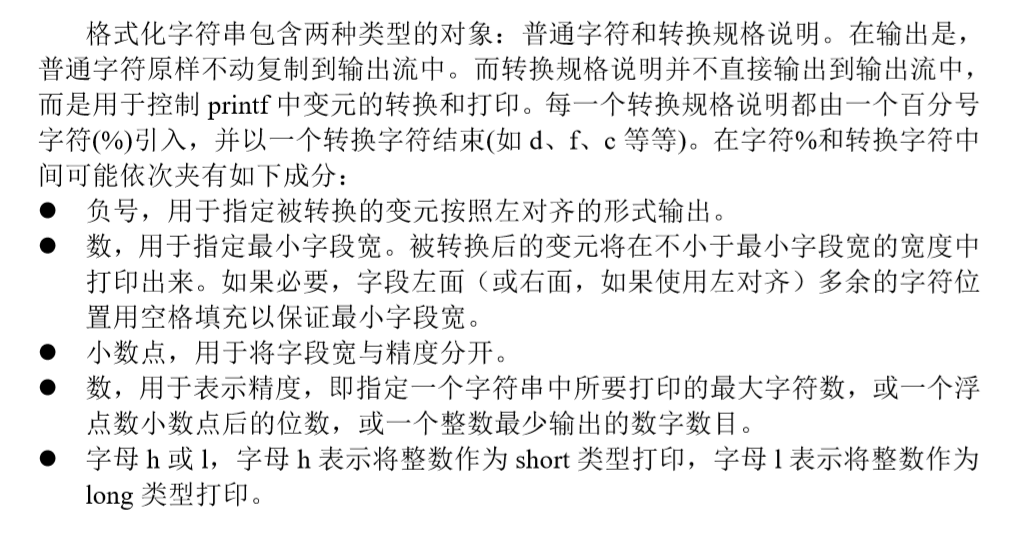
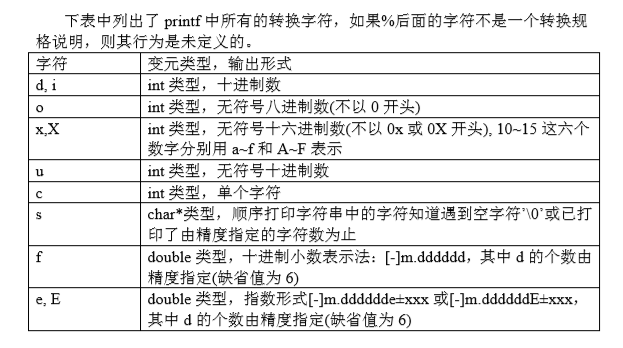

我实现的话就是按上面的实现的,说一下这个简化版存在的问题(简化的地方):
1)%d %i %o %x %X %u %c 这些都默认后面输入的是int,所以long long其实没有用。
2)支持最大精度<=30,如果有需要请更改PRECISION
myprintf默认四舍五入(rounding_off函数实现)
如果发现错误,请指出,谢谢大家啦!
 #include<stdio.h>

 #include<stdlib.h>

 #include<string.h>

 #include<math.h>

 #include<stdarg.h>

 #define N 110

 #define eps 1e-16

 #define INF 1e9

 #define PRECISION 30

 int maxx(int x,int y){return x>y ? x:y;}

 void swapp(char *x,char *y){char t;t=*x;*x=*y;*y=t;}

 int find_int_type(int int_type,char ch);

 void change_int_type_to_char(int x,int int_type,char *s,int *sl,int *minus);

 void print_int_regardless_type(char *s,int *sl,int minus,int Justify_type,int min_width,int precision);

 void print_int(int x,int Justify_type,int min_width,int precision,int int_type);

 void print_string(char *s,int Justify_type,int min_width,int precision);

 int is_g_or_G(char double_type){return (double_type == 'g' || double_type=='G');}

 void rounding_off(char *s,int *sl,int *ml,int precision);

 void print_double_e_or_E(char *s,int sl,int exponent,int minus,int Justify_type,int min_width,int precision,char double_type);

 void print_double_f(char *s,int sl,int ml,int minus,int Justify_type,int min_width,int precision);

 void print_double(double x,int Justify_type,int min_width,int precision,char double_type);

 int myprintf(const char *format,...);

 int main()

 {

     // freopen("a.out","w",stdout);

     int a=;

     double b=9.9734567;

     int count=;

     myprintf("%\n");

     myprintf("%15e%15e\n",-0.0000123,123.123);printf("%15e%15e\n",-0.0000123,123.123);

     myprintf("%f\n",0.0000123);printf("%f\n",0.0000123);

     myprintf("%.1E\n",b);printf("%.1E\n",b);

     myprintf("%e\n",0.0000123);printf("%e\n",0.0000123);

     myprintf("%15.8g\n",0.000012346789);printf("%15.8g\n",0.0000123456789);

     myprintf("%5d%10d\n",a,a);printf("%5d%10d\n",a,a);

     myprintf("%10.5d%10.5d\n",a,a);printf("%10.5d%10.5d\n",a,a);

     myprintf("%15.10hd%15.10ld\n",count,count);printf("%15.10hd%15.10ld\n",count,count);

     myprintf("%5o\n",a);printf("%5o\n",a);

     myprintf("%f\n",b);printf("%f\n",b);

     myprintf("%15f%20.10f\n",-b,-b);printf("%15f%20.10f\n",-b,-b);

     myprintf("%15g\n",0.0000123);printf("%15g\n",0.0000123);

     myprintf("%15e%15E%15g%15g\n",-b,b,b,0.0000123);printf("%15e%15E%15g%15g\n",-b,b,b,0.0000123);

     myprintf("%15g\n",0.0000123);printf("%15g\n",0.0000123);

     myprintf("%-15.10x%10.10X\n",count);printf("%-15.10x%10.10X\n",count);

     myprintf("%10.5s\n%c\n","asdfghjkl",'a');printf("%10.5s\n%c\n","asdfghjkl",'a');

     myprintf("\x41\101 \\ \r\n");printf("\x41\101 \\ \r\n");

     unsigned int d = ;

     myprintf("%.10u\n",d);printf("%.10u\n",d);

     int *p;

     myprintf("%p\n",p);printf("%p\n",p);

     return ;

 }

 int find_int_type(int int_type,char ch)

 {

     if(ch=='d' || ch=='i') return int_type;

     if(ch=='o') return ;

     if(ch=='x') return ;

     if(ch=='X') return ;

     if(ch=='u') return int_type+;

 }

 void change_int_type_to_char(int x,int int_type,char *s,int *sl,int *minus)

 {

     *sl=;

     switch(int_type)

     {

         case :{//int

             int y=(int)x;if(y<) *minus=,y=-y;

             while(y) s[(*sl)++]=(y%)+'',y/=;

             break;

         }

         case :{//unsigned int

             unsigned int y=(unsigned int)x;

             while(y) s[(*sl)++]=(y%)+'',y/=;

             break;

         }

         case :{//short

             short int y=(short int)x;if(y<) *minus=,y=-y;

             while(y) s[(*sl)++]=(y%)+'',y/=;

             break;

         }

         case :{//unsigned short

             unsigned short int y=(unsigned short int)x;

             while(y) s[(*sl)++]=(y%)+'',y/=;

             break;

         }

         case :{//long int

             long int y=(long int )x;if(y<) *minus=,y=-y;

             while(y) s[(*sl)++]=(y%)+'',y/=;

             break;

         }

         case :{//unsigned long int

             unsigned long int y=(unsigned long int)y;

             while(y) s[(*sl)++]=(y%)+'',y/=;

             break;

         }

         case :{//o

             int y=(int )x;

             while(y) s[(*sl)++]=(y%)+'',y/=;

             break;

         }

         case :{//x

             int y=(int)x;

             while(y) s[(*sl)++]=((y%)>=) ? (y%)-+'a' : (y%)+'',y/=;

             break;

         }

         case :{//X

             int y=(int)x;

             while(y) s[(*sl)++]=((y%)>=) ? (y%)-+'A' : (y%)+'',y/=;

             break;

         }

     }

 }

 void print_int_regardless_type(char *s,int *sl,int minus,int Justify_type,int min_width,int precision)

 {

     while(precision<INF && *sl<precision) s[(*sl)++]='';

     if(minus) s[(*sl)++]='-';

     int space=min_width-*sl;

     if(Justify_type==)//right

         for(int i=;i<=space;i++) putchar(' ');

     for(int i=(*sl)-;i>=;i--) putchar(s[i]);

     if(Justify_type==)//left

         for(int i=;i<=space;i++) putchar(' ');

 }

 void print_int(int x,int Justify_type,int min_width,int precision,int int_type)

 {

     int minus=(x<) ? :;

     char *s=(char *)malloc(N*sizeof(char));

     int *sl=(int *)malloc(sizeof(int));

     change_int_type_to_char(x,int_type,s,sl,&minus);

     print_int_regardless_type(s,sl,minus,Justify_type,min_width,precision);

     free(s);

     free(sl);

 }

 void print_string(char *s,int Justify_type,int min_width,int precision)

 {

     int sl=strlen(s);

     if(sl > precision) sl=precision;

     int space=min_width-sl;

     if(Justify_type==)//right

         for(int i=;i<=space;i++) putchar(' ');

     for(int i=;i<sl;i++) putchar(s[i]);

     if(Justify_type==)//left

         for(int i=;i<=space;i++) putchar(' ');

 }

 void rounding_off(char *s,int *sl,int *ml,int precision)//四舍五入

 {

     if(s[(*ml)+precision]<='') return;

     s[(*ml)+precision-]++;

     for(int i=(*ml)+precision-;i>=;i--) s[i-]+=(s[i]-'')/,s[i]=(s[i]-'')%+'';

     if(s[]>'')

     {

         (*sl)++;(*ml)++;

         for(int i=(*ml)+precision;i>=;i--) s[i]=s[i-];

         s[]=(s[]-'')/+'';

         s[]=(s[]-'')%+'';

     }

 }

 void print_double_e_or_E(char *s,int sl,int exponent,int minus,int Justify_type,int min_width,int precision,char double_type)

 {

     int space=min_width-(minus++precision+++);

     if(precision) space--;//'.'

     if(Justify_type==)//right

         for(int i=;i<=space;i++) putchar(' ');

     if(minus) putchar('-');

     putchar(s[]);

     if(precision) putchar('.');

     for(int i=;i<=precision;i++)

     {

         if(i>=sl && is_g_or_G(double_type)) break;

         putchar((i<sl) ? s[i] : '');

     }

     putchar(is_g_or_G(double_type) ? double_type+'e'-'g' : double_type);

     if(exponent>=) putchar('+');

     else putchar('-'),exponent*=-;

     putchar(exponent/+'');putchar((exponent/)%+'');putchar(exponent%+'');

     if(Justify_type==)//left

         for(int i=;i<=space;i++) putchar(' ');

 }

 void print_double_f(char *s,int sl,int ml,int minus,int Justify_type,int min_width,int precision)

 {

     int space=min_width-(minus+ml+precision);

     if(precision) space--;//'.'

     if(Justify_type==)//right

          for(int i=;i<=space;i++) putchar(' ');

     if(minus) putchar('-');

     for(int i=;i<ml;i++) putchar(s[i]);

     if(precision) putchar('.');

     for(int i=ml;i<=ml-+precision;i++) putchar((i<sl) ? s[i]:'');

     if(Justify_type==)//left

         for(int i=;i<=space;i++) putchar(' ');

 }

 //m.ddddd

 void print_double(double x,int Justify_type,int min_width,int precision,char double_type)

 {

     if(precision==INF) precision=;

     int zero=(fabs(x) < eps);

     int minus=(x<) ? :;x=fabs(x);

     char *s=(char *)malloc(N*sizeof(char));

     int sl=,ml=,y=(int)x;x-=y;

     if(y==) s[sl++]='';

     while(y) s[sl++]=y%+'',y/=;

     for(int i=;i<=(sl-)/;i++) swapp(&s[i],&s[sl--i]);

     ml=sl;

     while(sl<=ml+PRECISION) s[sl++]=(int)(x*)+'',x=x*-(int)(x*);

     //f

     if(double_type=='f')

     {

         rounding_off(s,&sl,&ml,precision);

         print_double_f(s,sl,ml,minus,Justify_type,min_width,precision);

     }

     else//e E g G

     {

         int st=,ssl=,exponent=ml-;

         char *ss=(char *)malloc(N*sizeof(char));

         while(!zero && s[st]=='') st++,exponent--,s[sl++]='';

         for(int i=st;i<sl;i++) ss[ssl++]=s[i];

         if(double_type=='e' || double_type=='E' ||

           (is_g_or_G(double_type) && (exponent < - || exponent >=precision)))

         {

             ml=;

             if(is_g_or_G(double_type))

             {

                 if(precision) precision--,ssl--;

                 while(precision && ss[ml+precision-]=='') precision--;

             }

             int mml=;

             rounding_off(ss,&ssl,&mml,precision);

             if(mml==) exponent++;

             print_double_e_or_E(ss,ssl,exponent,minus,Justify_type,min_width,precision,double_type);

         }

         else

         {

             precision-=ml;sl-=ml;

             rounding_off(s,&sl,&ml,precision);

             while(precision && s[ml+precision-]=='') precision--;

             print_double_f(s,sl,ml,minus,Justify_type,min_width,precision);

         }

         free(ss);

     }

     free(s);

 }

 int myprintf(const char *format,...)

 {

     char ch;

     int arg_int;

     double arg_double;

     char *arg_str;

     void *arg_p;

     va_list ap;

     va_start(ap,format);

     while((ch = *format++)!='\0')

     {

         if(ch!='%') {putchar(ch);continue;}

         //ch = '%'  *format = '\0'

         if(*format=='\0' || *format=='%') {putchar('%');continue;}

         int Justify_type=,min_width=,precision=INF,int_type=,ok=;

         if(*format=='-') Justify_type=,format++;

         while(*format>='' && *format<='') min_width=min_width*+*format-'',format++;

         if(*format=='.')

         {

             format++;precision=;

             while(*format>='' && *format<='') precision=precision*+*format-'',format++;

         }

         if(*format=='h') int_type=,format++;

         if(*format=='l') int_type=,format++;

         if(*format=='d' || *format=='i' || *format=='o' || *format=='x' || *format=='X' || *format=='u')

         {

             ok=;arg_int=va_arg(ap,int);

             print_int(arg_int,Justify_type,min_width,precision,find_int_type(int_type,*format));

         }

         if(*format=='c')

         {

             ok=;arg_int=va_arg(ap,int);

             putchar(arg_int);

         }

         if(*format=='s')

         {

             ok=;arg_str=va_arg(ap,char *);

             print_string(arg_str,Justify_type,min_width,precision);

         }

         if(*format=='f' || *format=='e' || *format=='E' || *format=='g' || *format=='G')

         {

             ok=;arg_double=va_arg(ap,double);

             print_double(arg_double,Justify_type,min_width,precision,*format);

         }

         if(*format=='p')

         {

             ok=;arg_p=va_arg(ap,void *);

             arg_int=(int)arg_p;

             precision=;//默认地址为8位,若机器地址不为8位可更改此处。

             print_int(arg_int,Justify_type,min_width,precision,);

         }

         if(!ok) {putchar('%');format--;}//ch=='%'

         format++;

     }

     va_end(ap);

 }
手写简化版printf函数的更多相关文章
- 依据ECMA规范,手写一个bind函数
Function.prototype.bind 函数,参见ECMA规范地址 如题,这次来实现一个boundFunction函数,不挂载在Function.prototype上,而是一个单独声明的函数. ...
- 【OpenCV学习笔记】之六 手写图像旋转函数---万丈高楼平地起
话说,平凡之处显真格,这一点也没错! 比如,对旋转图像进行双线性插值,很简单吧? 可,对我,折腾了大半天,也没有达到预期效果! 尤其是三个误区让我抓瞎好久: 1,坐标旋转公式. 这东西,要用 ...
- 手写事件代理函数 (Delegated function)
‘手写 ’ 这个词 ,面试是不是听过无数遍呢 ! 今天我们来手写一个这样的事件委托函数 => function( parent, selector, type , handle) {} 你需 ...
- 前端面试手写代码——JS函数柯里化
目录 1 什么是函数柯里化 2 柯里化的作用和特点 2.1 参数复用 2.2 提前返回 2.3 延迟执行 3 封装通用柯里化工具函数 4 总结和补充 1 什么是函数柯里化 在计算机科学中,柯里化(Cu ...
- cs224d 作业 problem set2 (一) 用tensorflow纯手写实现sofmax 函数,线性判别分析,命名实体识别
Hi Dear Today we will use tensorflow to implement the softmax regression and linear classifier algor ...
- 手写Function.bind函数
if(!Function.prototype.bind){ Function.prototype.bind = function(oThis){ if(typeof this !=="fun ...
- 手写简化版SpringBoot
Springboot项目全部依赖注解的,web工程是如何启动的 1 首先引入了Tomcat依赖,然后用java代码启动Tomcat容器,默认Tomcat版本是8.5版本 2 Tomcat是实现了ser ...
- 手写map, filter函数
function map(arr, fn) { let newArr = []; for (let i = 0; i < arr.length; i++) { newArr[i] = fn(ar ...
- 22 道高频 JavaScript 手写面试题及答案
实现防抖函数(debounce) 防抖函数原理:在事件被触发n秒后再执行回调,如果在这n秒内又被触发,则重新计时. 那么与节流函数的区别直接看这个动画实现即可. 手写简化版: // 防抖函数 cons ...
随机推荐
- vue 中使用better-scroll 遇到的问题
以下是遇到问题以及解决方法 1.使用v-for 循环循环出来的列表,不能滚动. 原因是没有给wrapper 父层 加高度,当子层的高度大于父层的高度,才能滚动 打印scroll 对象,显示如此 竟然相 ...
- maven在eclipse上的配置
1,安装maven,配置MAVEN_HOME 和 bin Path环境变量. 2,配置maven setting文件 <mirror> <id>alimirrorId ...
- Windows 作为 openssl server端时的处理
1. 跟上一个博客一样, 下载openssh 然后安装时 同时选择 server端. 2. 安装时设置密码 其他默认即可 3. xshell 创建连接. 注意 我使用的是 administrator ...
- robotium学习及整理
一. Robotium 简介 Robotium是一款国外的Android自动化测试框架,主要针对Android平台的应用进行黑盒自动化测试,它提供了模拟各种手 ...
- angular 神坑 ,回调函数无法被监视
原方法,使用一个confirm 点ok然后回调,结果 界面无法刷新,搜索了下 是因为$scope没有监视model,必须使用apply方法 $scope.SelectedRow=row; negAle ...
- 用SQL查询方式显示GROUP BY中的TOP解决方法[转]
用SQL查询方式显示GROUP BY中的TOP怎样用一个SQL语句来显示 分组后每个组的前几位 比如把一个学校所有学生的成绩按班级分组,再显示每个班级前五名的信息. 班级 学生 成绩 一班 ...
- bzoj2302-Problem c
题意 有 \(n\) 个人,从 1 到 \(i\) 编号.给每个人一个值 \(a_i\) ,他们会按编号从小到大进行如下操作:查看 \(a_i\) 有没有人,若没有就坐进去,否则查看 \(a_i+1\ ...
- c++11 模板的别名
c++11 模板的别名 #define _CRT_SECURE_NO_WARNINGS #include <iostream> #include <string> #inclu ...
- Spring点滴六:Spring中定义bean的继承
在基于XML配置元数据中,bean标签可以包含很多配置信息,可以包含构造函数的参数,属性值以及其他一些初始化方法.子bean的定义可以继承父bean定义元数据,子bean定义可以根据需要重写父bean ...
- CentOS 6.6下配置本地yum源与网络yum源
一.本地yum源 1.系统默认已经安装了可使用yum的软件包,所以可以直接配置: [root@localhost ~]# cd /etc/yum.repos.d/ ...