
Model Representation and Cost Function
Model Representation
To establish notation for future use, we’ll use x(i) to denote the “input” variables (living area in this example), also called input features, and y(i) to denote the “output” or target variable that we are trying to predict (price). A pair (x(i),y(i)) is called a training example, and the dataset that we’ll be using to learn—a list of m training examples (x(i),y(i));i=1,...,m—is called a training set. Note that the superscript “(i)” in the notation is simply an index into the training set, and has nothing to do with exponentiation. We will also use X to denote the space of input values, and Y to denote the space of output values. In this example, X = Y = ℝ.
To describe the supervised learning problem slightly more formally, our goal is, given a training set, to learn a function h : X → Y so that h(x) is a “good” predictor for the corresponding value of y. For historical reasons, this function h is called a hypothesis. Seen pictorially, the process is therefore like this:

When the target variable that we’re trying to predict is continuous, such as in our housing example, we call the learning problem a regression problem. When y can take on only a small number of discrete values (such as if, given the living area, we wanted to predict if a dwelling is a house or an apartment, say), we call it a classification problem.
Cost Function
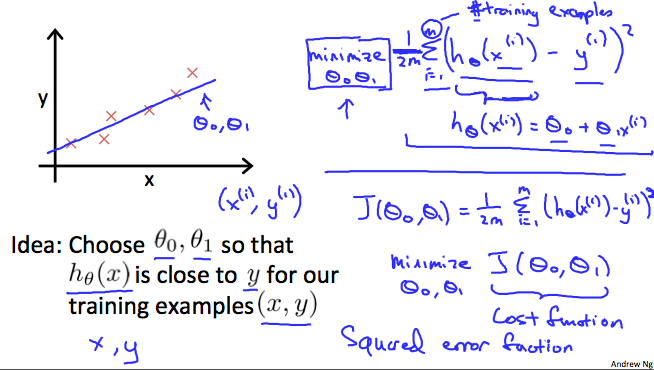
We can measure the accuracy of our hypothesis function by using a cost function. This takes an average difference (actually a fancier version of an average) of all the results of the hypothesis with inputs from x's and the actual output y's.
J(θ0,θ1)=12m∑i=1m(y^i−yi)2=12m∑i=1m(hθ(xi)−yi)2
To break it apart, it is 12 x¯ where x¯ is the mean of the squares of hθ(xi)−yi , or the difference between the predicted value and the actual value.
This function is otherwise called the "Squared error function", or "Mean squared error". The mean is halved (12)as a convenience for the computation of the gradient descent, as the derivative term of the square function will cancel out the 12 term. The following image summarizes what the cost function does:
Cost Function - Intuition I
If we try to think of it in visual terms, our training data set is scattered on the x-y plane. We are trying to make a straight line (defined by hθ(x)) which passes through these scattered data points.
Our objective is to get the best possible line. The best possible line will be such so that the average squared vertical distances of the scattered points from the line will be the least. Ideally, the line should pass through all the points of our training data set. In such a case, the value of J(θ0,θ1) will be 0. The following example shows the ideal situation where we have a cost function of 0.

When θ1=1, we get a slope of 1 which goes through every single data point in our model. Conversely, when θ1=0.5, we see the vertical distance from our fit to the data points increase.

This increases our cost function to 0.58. Plotting several other points yields to the following graph:

Thus as a goal, we should try to minimize the cost function. In this case, θ1=1 is our global minimum.
Cost Function - Intuition II
A contour plot is a graph that contains many contour lines. A contour line of a two variable function has a constant value at all points of the same line. An example of such a graph is the one to the right below.

Taking any color and going along the 'circle', one would expect to get the same value of the cost function. For example, the three green points found on the green line above have the same value for J(θ0,θ1) and as a result, they are found along the same line. The circled x displays the value of the cost function for the graph on the left when θ0 = 800 and θ1= -0.15. Taking another h(x) and plotting its contour plot, one gets the following graphs:

When θ0 = 360 and θ1 = 0, the value of J(θ0,θ1) in the contour plot gets closer to the center thus reducing the cost function error. Now giving our hypothesis function a slightly positive slope results in a better fit of the data.

The graph above minimizes the cost function as much as possible and consequently, the result of θ1 and θ0 tend to be around 0.12 and 250 respectively. Plotting those values on our graph to the right seems to put our point in the center of the inner most 'circle'.
Model Representation and Cost Function的更多相关文章
- Linear regression with one variable - Cost function
摘要: 本文是吴恩达 (Andrew Ng)老师<机器学习>课程,第二章<单变量线性回归>中第7课时<代价函数>的视频原文字幕.为本人在视频学习过程中逐字逐句记录下 ...
- loss function与cost function
实际上,代价函数(cost function)和损失函数(loss function 亦称为 error function)是同义的.它们都是事先定义一个假设函数(hypothesis),通过训练集由 ...
- 【caffe】loss function、cost function和error
@tags: caffe 机器学习 在机器学习(暂时限定有监督学习)中,常见的算法大都可以划分为两个部分来理解它 一个是它的Hypothesis function,也就是你用一个函数f,来拟合任意一个 ...
- 逻辑回归损失函数(cost function)
逻辑回归模型预估的是样本属于某个分类的概率,其损失函数(Cost Function)可以像线型回归那样,以均方差来表示:也可以用对数.概率等方法.损失函数本质上是衡量”模型预估值“到“实际值”的距离, ...
- [Machine Learning] 浅谈LR算法的Cost Function
了解LR的同学们都知道,LR采用了最小化交叉熵或者最大化似然估计函数来作为Cost Function,那有个很有意思的问题来了,为什么我们不用更加简单熟悉的最小化平方误差函数(MSE)呢? 我个人理解 ...
- logistic回归具体解释(二):损失函数(cost function)具体解释
有监督学习 机器学习分为有监督学习,无监督学习,半监督学习.强化学习.对于逻辑回归来说,就是一种典型的有监督学习. 既然是有监督学习,训练集自然能够用例如以下方式表述: {(x1,y1),(x2,y2 ...
- 机器学习 损失函数(Loss/Error Function)、代价函数(Cost Function)和目标函数(Objective function)
损失函数(Loss/Error Function): 计算单个训练集的误差,例如:欧氏距离,交叉熵,对比损失,合页损失 代价函数(Cost Function): 计算整个训练集所有损失之和的平均值 至 ...
- 损失函数(Loss function) 和 代价函数(Cost function)
1损失函数和代价函数的区别: 损失函数(Loss function):指单个训练样本进行预测的结果与实际结果的误差. 代价函数(Cost function):整个训练集,所有样本误差总和(所有损失函数 ...
- 手势跟踪论文学习:Realtime and Robust Hand Tracking from Depth(三)Cost Function
iker原创.转载请标明出处:http://blog.csdn.net/ikerpeng/article/details/39050619 Realtime and Robust Hand Track ...
随机推荐
- JPA关系映射之one-to-one
一对一关联有两种实现方式:一种是共享的主键关联,另一种是一对一的外键关联 1.共享的主键关联:让两个对象具有共同的主键值,以表明他们之间的一一对应关系. Person.java类 public cla ...
- MyBatis框架(二)
导包, 配置mybatis的总配置文件: mybatis-config.xml, <?xml version="1.0" encoding="UTF-8" ...
- MongoDB中的映射,限制记录和记录拼排序 文档的插入查询更新删除操作
映射 在 MongoDB 中,映射(Projection)指的是只选择文档中的必要数据,而非全部数据.如果文档有 5 个字段,而你只需要显示 3 个,则只需选择 3 个字段即可. find() 方法 ...
- JVM菜鸟进阶高手之路五
转载请注明原创出处,谢谢! 参考gc,发现大概一小时运行一次FGC,特别奇怪,笨神一看这样的问题就知道是system gc导致的,rmi默认一小时主动触发一次,由于没有gc日志,通过jstat命令观察 ...
- AngularJS [ 快速入门教程 ]
前 序 S N AngularJS是什么? 我想既然大家查找AngularJS就证明大家多多少少对AngularJS都会有了解. AngularJS就是,使用JavaScript编写的客户 ...
- JAVA实现上传文件到服务器、删除服务器文件
使用的jar包: <dependency> <groupId>com.jcraft</groupId> <artifactId>jsch</art ...
- 在JavaScript中使用json.js:Ajax项目之POST请求(异步)
经常在百度搜索框输入一部分关键词后,弹出候选关键热词.现在我们就用Ajax技术来实现这一功能. 一.下载json.js文件 百度搜一下,最好到json官网下载,安全起见. 并与新建的两个文件部署如图 ...
- H5上传图片并使用canvas制作海报
马上就要"十一"国庆节了,又恰逢公司已经三周岁了,所以市场部和产品共同策划了一个"正青春,共成长"的主题代言活动,准备在国庆节以及中秋节期间让公司员工和用户为公 ...
- Sublime Text3使用指南
前言(Prologue) Sublime Text是一款跨平台代码编辑器(Code Editor),从最初的Sublime Text 1.0,到现在的Sublime Text 3.0,Sublime ...
- js-注释代码习惯
功能块代码 /** * xxxx */ 定义的函数或方法 /* xxxx */ 调用了某个函数或方法 // <--xxx