
Linear regression with one variable - Cost function
摘要: 本文是吴恩达 (Andrew Ng)老师《机器学习》课程,第二章《单变量线性回归》中第7课时《代价函数》的视频原文字幕。为本人在视频学习过程中逐字逐句记录下来以便日后查阅使用。现分享给大家。如有错误,欢迎大家批评指正,在此表示诚挚地感谢!同时希望对大家的学习能有所帮助。
In this video (article), we'll define something called the cost function. This will let us figure out how to fit the best possible straight line to our data.
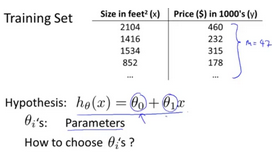
In linear regression we have a training set like that shown here. Remember our notation M was the number of training examples, so maybe M=47. And the form of hypothesis, which we use to make prediction, is this linear function. To introduce a little bit more terminology, this and
, these
are what I call the parameters of the model. What we are going to do in this video (article) is talk about how to go about choosing these two parameter values,
and
.
With different choices of parameters and
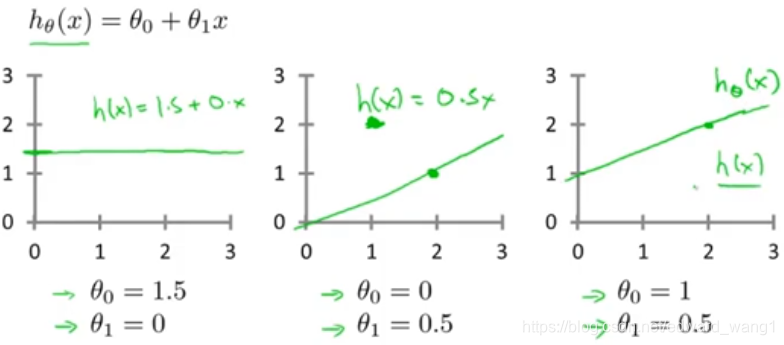
we get different hypotheses, different hypothesis functions. I know some of you will probably be already familiar with what I'm going to do on this slide, but just to review here are a few examples. If
and
, then the hypothesis function will look like this. Right, because your hypothesis function will be
, this is flat at 1.5. If
and
, then the hypothesis will look like this. And this should pass through this point (2,1), says you now have
which looks like that. And if
and
, then we end up with the hypothesis that looks like this. Let's see, it should pass through the
point like so. And this is my new
. All right, well you remember that this is
but as a shorthand, sometimes I just write this as
.
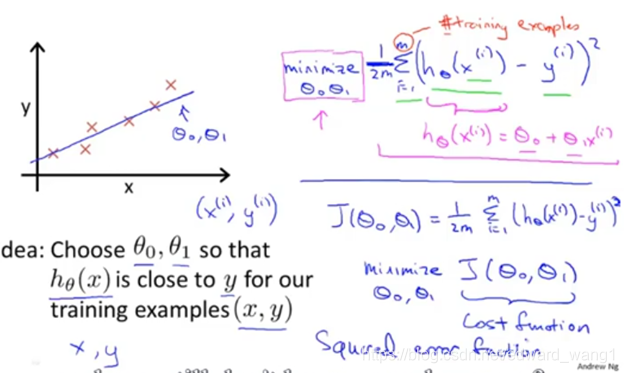
In linear regression we have a training set like maybe the one I've plotted here. What we want to do is come up with values for the parameters and
. So that the straight line we get out of this corresponds to a straight line that somehow fits the data well. Like maybe the line over there. So how do we come up with values
,
that corresponds to a good fit to the data? The idea is we're going to choose our parameters
and
so that
, meaning the value we predict on input x, that is at least close to the values y for the examples in our training set. So, in our training set we're given a number of examples where we know x decides the house and we know the actual price of what it's sold for. So, let's try to choose values for the parameters so that at least in the training set, given the x's in the training set, we make reasonably accurate predictions for the y values. Let's formalize this. So linear regression, what we're going to do is that I'm going to want to solve a minimization problem. So, I'm going to write minimize over
,
. And, I want this to be small, right, I want the difference between
and y to be small. And one thing I might do is try to minimize the square difference between the output of the hypothesis and the actual price of the house. Okay? So, let's fill in some details. Remember that I was using the notation
to represent the
training example. So, what I want really is to sum over my training set. Sum from i to M of the square difference between the prediction of my hypothesis when it is input the size of the house number i, minus the actual price that house number i was sold for and I want to minimize the sum of my training set sum from i equals 1 through M of the difference of this squared error, square difference between the predicted price of the house and the price that was actually sold for. And just remind you of your notation M here was the size of my training set, right, so the M there is my number of training examples, right? That hash sign is the abbreviation for "number" of training examples. Okay? And to make the math a little bit easier, I'm going to actually look at, you know,
times that. So, we're going to try to minimize my average error, which we're going to minimize
. Putting the 2, the constant one half, in front it just makes some of the math a little easier. So, minimizing one half of something, right, should give you the same values of the parameters
,
as minimizing that function. And just make sure this equation is clear, right? This expression in here,
, this is our usual, right? That's equal to
. And, this notation, minimize over
and
, this means find me the values of theta zero and theta one that causes this expression to be minimized. And this expression depends on
and
. Okay? So just to recap, we're posing this problem as find me the values of
and
so that the average already one over two M times the sum of square errors between my predictions on the training set minus the actual values of the houses on the training set is minimized. So, this is going to be my overall objective function for linear regression. And just to, you know rewrite this out a little bit more cleanly, what I'm going to do by convention is we usually define a cost function. Which is going to be exactly this. That formula that I have up here. And what I want to do is minimize over
and
my function
. Just write this out, this is my cost function. So, this cost function is also called the squared error function or sometimes called the square error cost function and it turns out that why do we take the square of the errors? It turns out the squared error cost function is reasonable choice and will work well for most problems, for most regression problems. There are other cost functions that will work pretty well, but the squared error cost function is probably the most common used one for regression problems. Later in this class we'll also talk about alternative cost functions as well, but this choice that we just had should be a pretty reasonable thing to try for most linear regression problems. Okay, so, that's the cost function. So far we've just seen a mathematical definition of, you know, the cost function and in case this function
seems a little bit abstract and you still don't have a good sense of what it's doing, in the next couple of videos (articles) we're actually going to go a little bit deeper into what the cost function J is doing and try to give you better intuition about what it's computing and why we want to use it.
<end>
Linear regression with one variable - Cost function的更多相关文章
- Linear regression with one variable - Cost function intuition I
摘要: 本文是吴恩达 (Andrew Ng)老师<机器学习>课程,第二章<单变量线性回归>中第8课时<代价函数的直观认识 - 1>的视频原文字幕.为本人在视频学习过 ...
- Stanford机器学习---第二讲. 多变量线性回归 Linear Regression with multiple variable
原文:http://blog.csdn.net/abcjennifer/article/details/7700772 本栏目(Machine learning)包括单参数的线性回归.多参数的线性回归 ...
- Stanford机器学习---第一讲. Linear Regression with one variable
原文:http://blog.csdn.net/abcjennifer/article/details/7691571 本栏目(Machine learning)包括单参数的线性回归.多参数的线性回归 ...
- 机器学习笔记1——Linear Regression with One Variable
Linear Regression with One Variable Model Representation Recall that in *regression problems*, we ar ...
- Machine Learning 学习笔记2 - linear regression with one variable(单变量线性回归)
一.Model representation(模型表示) 1.1 训练集 由训练样例(training example)组成的集合就是训练集(training set), 如下图所示, 其中(x,y) ...
- MachineLearning ---- lesson 2 Linear Regression with One Variable
Linear Regression with One Variable model Representation 以上篇博文中的房价预测为例,从图中依次来看,m表示训练集的大小,此处即房价样本数量:x ...
- 机器学习 (一) 单变量线性回归 Linear Regression with One Variable
文章内容均来自斯坦福大学的Andrew Ng教授讲解的Machine Learning课程,本文是针对该课程的个人学习笔记,如有疏漏,请以原课程所讲述内容为准.感谢博主Rachel Zhang的个人笔 ...
- Lecture0 -- Introduction&&Linear Regression with One Variable
Introduction What is machine learning? Tom Mitchell provides a more modern definition: "A compu ...
- machine learning (2)-linear regression with one variable
machine learning- linear regression with one variable(2) Linear regression with one variable = univa ...
随机推荐
- [GraphQL] Query GraphQL Interface Types in GraphQL Playground
Interfaces are similar to Unions in that they provide a mechanism for dealing with different types o ...
- P2679 子串 DP
P2679 子串 DP 从字符串A中取出\(k\)段子串,按原顺序拼接,问存在多少个方案使拼接的字符串与字符串B相同 淦,又是这种字符串dp 设状态\(ans[i][j][k]\)表示A串位置\(i\ ...
- P1850 换教室——期望DP
题目描述 对于刚上大学的牛牛来说,他面临的第一个问题是如何根据实际情况申请合适的课程. 在可以选择的课程中,有 2n2n2n 节课程安排在 nnn 个时间段上.在第 iii(1≤i≤n1 \leq i ...
- [bzoj 2768]&[bzoj 1877]
传送门1 传送门1 Solution 两道比较裸的题... 复习一下最大流和费用流的模板. Code[bzoj 2768][JLOI 2010] 冠军调查 #include<bits/stdc+ ...
- SqlServer 获取 当前地址下 所有数据库字段信息 / 快速 批量插入数据库(TVPs)
SQL执行 --拼装 当前地址下 所有数据库字段信息 BEGIN DECLARE @dataBaseName NVARCHAR(MAX)--数据库名称 DECLARE @tableName NVARC ...
- GC的判定的2种方式
对象是否死亡的2中判定方法:引用计数和可达性分析(又称引用链) 1.引用计数 对象再被创建时,对象头里会存储引用计数器,对象被引用,计数器+1:引用失效,计数器 -1:GC时会回收计数器为0的对象.但 ...
- 2018-2019-2 20165209 《网络对抗技术》Exp9: Web安全基础
2018-2019-2 20165209 <网络对抗技术>Exp9: Web安全基础 1 基础问题回答和实验内容 1.1基础问题回答 (1)SQL注入攻击原理,如何防御? 原理:SQL注入 ...
- [Android] i2c-toos 在 Android 上使用
CPU:RK3399 系统:Android 7.1 i2c-tools 是一款免费开源的工具,可以检测 i2c 总线上的设备,可以读写寄存器等等 可以从下面路径下载需要的版本: https://www ...
- scroll-view组件实现下拉刷新, 拉到底加载更多
官方文档已声明,即使在page.json和app.json中开启下拉刷新,scroll-view组件也是不支持的.但我们可以通过曲线救国的方法来实现 实现代码 // wxml <scroll-v ...
- 【转】nodejs获取post请求发送的formData数据
前端post请求发送formData的类型数据时,需要服务端引入中间件body-parser,主要原因是post请求发送的数据,是在http的body里面,所以需要进行解析,否则获取不到数据(数据为空 ...