
《机器学习Python实现_09_02_决策树_CART》
简介
CART树即分类回归树(classification and regression tree),顾名思义,它即能用作分类任务又能用作回归任务,它的应用比较广泛,通常会用作集成学习的基分类器,总得来说,它与ID3/C4.5有如下不同:
(1)它是一颗二叉树;
(2)特征选择的方法不一样,CART分类树利用基尼系数做特征选择,CART回归树利用平方误差做特征选择;
接下来,分别对CART分类树和回归树做介绍
CART分类树
首先介绍特征选择方法,基尼系数:
\]
所以,对于给定的样本集合\(D\),其基尼指数:
\]
这里,\(C_k\)是\(D\)中属于第\(k\)类的样本子集,\(K\)是类的个数,由于CART树是二叉树,所以对于某特征\(A\),判断其对分类标签的贡献时,只需要判断该特征是否等于某个取值\(a\)的情况,将当前数据集分割成\(D_1\)和\(D_2\)两部分:
\]
所以在特征\(A(x)=a\)的条件下,集合\(D\)的基尼指数可以定义为:
\]
代码实现
接下来进行CART分类树的代码实现,这里与ID3/C4.5最大的不同就是每次对当前结点仅进行二分处理
"""

定义计算gini系数相关的函数,代码封装到ml_models.utils

"""

import numpy as np

def gini(x, sample_weight=None):

    """

    计算基尼系数 Gini(D)

    :param x:

    :param sample_weight:

    :return:

    """

    x_num = len(x)

    # 如果sample_weight为None设均设置一样

    if sample_weight is None:

        sample_weight = np.asarray([1.0] * x_num)

    x_counter = {}

    weight_counter = {}

    # 统计各x取值出现的次数以及其对应的sample_weight列表

    for index in range(0, x_num):

        x_value = x[index]

        if x_counter.get(x_value) is None:

            x_counter[x_value] = 0

            weight_counter[x_value] = []

        x_counter[x_value] += 1

        weight_counter[x_value].append(sample_weight[index])

    # 计算gini系数

    gini_value = 1.0

    for key, value in x_counter.items():

        p_i = 1.0 * value * np.mean(weight_counter.get(key)) / x_num

        gini_value -= p_i * p_i

    return gini_value

def cond_gini(x, y, sample_weight=None):

    """

    计算条件gini系数:Gini(y,x)

    """

    x = np.asarray(x)

    y = np.asarray(y)

    # x中元素个数

    x_num = len(x)

    # 如果sample_weight为None设均设置一样

    if sample_weight is None:

        sample_weight = np.asarray([1.0] * x_num)

    # 计算

    gini_value = .0

    for x_value in set(x):

        x_index = np.where(x == x_value)

        new_x = x[x_index]

        new_y = y[x_index]

        new_sample_weight = sample_weight[x_index]

        p_i = 1.0 * len(new_x) / x_num

        gini_value += p_i * gini(new_y, new_sample_weight)

    return gini_value

def gini_gain(x, y, sample_weight=None):

    """

    gini值的增益

    """

    x_num = len(x)

    if sample_weight is None:

        sample_weight = np.asarray([1.0] * x_num)

    return gini(y, sample_weight) - cond_gini(x, y, sample_weight)
import os

os.chdir('../')

from ml_models import utils

from ml_models.wrapper_models import DataBinWrapper

"""

CART分类树的实现,代码封装到ml_models.tree模块

"""

class CARTClassifier(object):

    class Node(object):

        """

        树节点,用于存储节点信息以及关联子节点

        """

        def __init__(self, feature_index: int = None, feature_value=None, target_distribute: dict = None,

                     weight_distribute: dict = None,

                     left_child_node=None, right_child_node=None, num_sample: int = None):

            """

            :param feature_index: 特征id

            :param feature_value: 特征取值

            :param target_distribute: 目标分布

            :param weight_distribute:权重分布

            :param left_child_node: 左孩子结点

            :param right_child_node: 右孩子结点

            :param num_sample:样本量

            """

            self.feature_index = feature_index

            self.feature_value = feature_value

            self.target_distribute = target_distribute

            self.weight_distribute = weight_distribute

            self.left_child_node = left_child_node

            self.right_child_node = right_child_node

            self.num_sample = num_sample

    def __init__(self, criterion='gini', max_depth=None, min_samples_split=2, min_samples_leaf=1,

                 min_impurity_decrease=0, max_bins=10):

        """

        :param criterion:划分标准,默认为gini,另外entropy表示用信息增益比

        :param max_depth:树的最大深度

        :param min_samples_split:当对一个内部结点划分时,要求该结点上的最小样本数,默认为2

        :param min_samples_leaf:设置叶子结点上的最小样本数,默认为1

        :param min_impurity_decrease:打算划分一个内部结点时,只有当划分后不纯度(可以用criterion参数指定的度量来描述)减少值不小于该参数指定的值,才会对该结点进行划分,默认值为0

        """

        self.criterion = criterion

        if criterion == 'gini':

            self.criterion_func = utils.gini_gain

        else:

            self.criterion_func = utils.info_gain_rate

        self.max_depth = max_depth

        self.min_samples_split = min_samples_split

        self.min_samples_leaf = min_samples_leaf

        self.min_impurity_decrease = min_impurity_decrease

        self.root_node: self.Node = None

        self.dbw = DataBinWrapper(max_bins=max_bins)

    def _build_tree(self, current_depth, current_node: Node, x, y, sample_weight):

        """

        递归进行特征选择,构建树

        :param x:

        :param y:

        :param sample_weight:

        :return:

        """

        rows, cols = x.shape

        # 计算y分布以及其权重分布

        target_distribute = {}

        weight_distribute = {}

        for index, tmp_value in enumerate(y):

            if tmp_value not in target_distribute:

                target_distribute[tmp_value] = 0.0

                weight_distribute[tmp_value] = []

            target_distribute[tmp_value] += 1.0

            weight_distribute[tmp_value].append(sample_weight[index])

        for key, value in target_distribute.items():

            target_distribute[key] = value / rows

            weight_distribute[key] = np.mean(weight_distribute[key])

        current_node.target_distribute = target_distribute

        current_node.weight_distribute = weight_distribute

        current_node.num_sample = rows

        # 判断停止切分的条件

        if len(target_distribute) <= 1:

            return

        if rows < self.min_samples_split:

            return

        if self.max_depth is not None and current_depth > self.max_depth:

            return

        # 寻找最佳的特征以及取值

        best_index = None

        best_index_value = None

        best_criterion_value = 0

        for index in range(0, cols):

            for index_value in set(x[:, index]):

                criterion_value = self.criterion_func((x[:, index] == index_value).astype(int), y, sample_weight)

                if criterion_value > best_criterion_value:

                    best_criterion_value = criterion_value

                    best_index = index

                    best_index_value = index_value

        # 如果criterion_value减少不够则停止

        if best_index is None:

            return

        if best_criterion_value <= self.min_impurity_decrease:

            return

        # 切分

        current_node.feature_index = best_index

        current_node.feature_value = best_index_value

        selected_x = x[:, best_index]

        # 创建左孩子结点

        left_selected_index = np.where(selected_x == best_index_value)

        # 如果切分后的点太少,以至于都不能做叶子节点,则停止分割

        if len(left_selected_index[0]) >= self.min_samples_leaf:

            left_child_node = self.Node()

            current_node.left_child_node = left_child_node

            self._build_tree(current_depth + 1, left_child_node, x[left_selected_index], y[left_selected_index],

                             sample_weight[left_selected_index])

        # 创建右孩子结点

        right_selected_index = np.where(selected_x != best_index_value)

        # 如果切分后的点太少,以至于都不能做叶子节点,则停止分割

        if len(right_selected_index[0]) >= self.min_samples_leaf:

            right_child_node = self.Node()

            current_node.right_child_node = right_child_node

            self._build_tree(current_depth + 1, right_child_node, x[right_selected_index], y[right_selected_index],

                             sample_weight[right_selected_index])

    def fit(self, x, y, sample_weight=None):

        # check sample_weight

        n_sample = x.shape[0]

        if sample_weight is None:

            sample_weight = np.asarray([1.0] * n_sample)

        # check sample_weight

        if len(sample_weight) != n_sample:

            raise Exception('sample_weight size error:', len(sample_weight))

        # 构建空的根节点

        self.root_node = self.Node()

        # 对x分箱

        self.dbw.fit(x)

        # 递归构建树

        self._build_tree(1, self.root_node, self.dbw.transform(x), y, sample_weight)

    # 检索叶子节点的结果

    def _search_node(self, current_node: Node, x, class_num):

        if current_node.left_child_node is not None and x[current_node.feature_index] == current_node.feature_value:

            return self._search_node(current_node.left_child_node, x, class_num)

        elif current_node.right_child_node is not None and x[current_node.feature_index] != current_node.feature_value:

            return self._search_node(current_node.right_child_node, x, class_num)

        else:

            result = []

            total_value = 0.0

            for index in range(0, class_num):

                value = current_node.target_distribute.get(index, 0) * current_node.weight_distribute.get(index, 1.0)

                result.append(value)

                total_value += value

            # 归一化

            for index in range(0, class_num):

                result[index] = result[index] / total_value

            return result

    def predict_proba(self, x):

        # 计算结果概率分布

        x = self.dbw.transform(x)

        rows = x.shape[0]

        results = []

        class_num = len(self.root_node.target_distribute)

        for row in range(0, rows):

            results.append(self._search_node(self.root_node, x[row], class_num))

        return np.asarray(results)

    def predict(self, x):

        return np.argmax(self.predict_proba(x), axis=1)

    def _prune_node(self, current_node: Node, alpha):

        # 如果有子结点,先对子结点部分剪枝

        if current_node.left_child_node is not None:

            self._prune_node(current_node.left_child_node, alpha)

        if current_node.right_child_node is not None:

            self._prune_node(current_node.right_child_node, alpha)

        # 再尝试对当前结点剪枝

        if current_node.left_child_node is not None or current_node.right_child_node is not None:

            # 避免跳层剪枝

            for child_node in [current_node.left_child_node, current_node.right_child_node]:

                # 当前剪枝的层必须是叶子结点的层

                if child_node.left_child_node is not None or child_node.right_child_node is not None:

                    return

            # 计算剪枝的前的损失值

            pre_prune_value = alpha * 2

            for child_node in [current_node.left_child_node, current_node.right_child_node]:

                for key, value in child_node.target_distribute.items():

                    pre_prune_value += -1 * child_node.num_sample * value * np.log(

                        value) * child_node.weight_distribute.get(key, 1.0)

            # 计算剪枝后的损失值

            after_prune_value = alpha

            for key, value in current_node.target_distribute.items():

                after_prune_value += -1 * current_node.num_sample * value * np.log(

                    value) * current_node.weight_distribute.get(key, 1.0)

            if after_prune_value <= pre_prune_value:

                # 剪枝操作

                current_node.left_child_node = None

                current_node.right_child_node = None

                current_node.feature_index = None

                current_node.feature_value = None

    def prune(self, alpha=0.01):

        """

        决策树剪枝 C(T)+alpha*|T|

        :param alpha:

        :return:

        """

        # 递归剪枝

        self._prune_node(self.root_node, alpha)
#造伪数据

from sklearn.datasets import make_classification

data, target = make_classification(n_samples=100, n_features=2, n_classes=2, n_informative=1, n_redundant=0,

                                   n_repeated=0, n_clusters_per_class=1, class_sep=.5,random_state=21)
#训练并查看效果

tree = CARTClassifier()

tree.fit(data, target)

utils.plot_decision_function(data, target, tree)
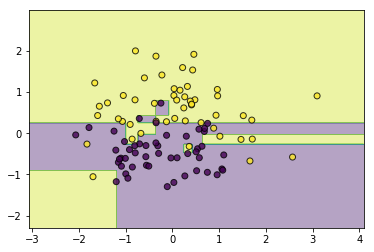
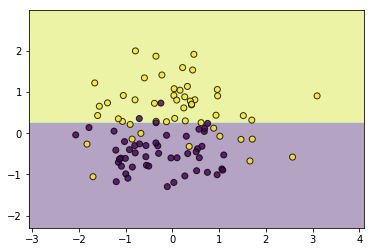
一样的,如果不加以限制,同样会存在过拟合现象,所以可以剪枝...
#剪枝

tree.prune(5)

utils.plot_decision_function(data, target, tree)
CART回归树
回归树的特征选择是使用的平方误差,即选择一个特征\(j\)和一个取值\(s\),将训练集按\(X^j\leq s\)和\(X^j>s\)分为两部分,寻找使这两部分的误差平方之和下降最多的\(j,s\),这个过程可以描述如下:
\]
这里\(R_1(j,s)=\{x\mid x^j\leq s\},R_2(j,s)=\{x\mid x^j> s\},c_1=ave(y_i\mid x_i\in R_1(j,s)),c_2=ave(y_i\mid x_i\in R_2(j,s))\)
代码实现:
"""

平方误差相关函数,封装到ml_models.utils

"""

def square_error(x, sample_weight=None):

    """

    平方误差

    :param x:

    :param sample_weight:

    :return:

    """

    x = np.asarray(x)

    x_mean = np.mean(x)

    x_num = len(x)

    if sample_weight is None:

        sample_weight = np.asarray([1.0] * x_num)

    error = 0.0

    for index in range(0, x_num):

        error += (x[index] - x_mean) * (x[index] - x_mean) * sample_weight[index]

    return error

def cond_square_error(x, y, sample_weight=None):

    """

    计算按x分组的y的误差值

    :param x:

    :param y:

    :param sample_weight:

    :return:

    """

    x = np.asarray(x)

    y = np.asarray(y)

    # x中元素个数

    x_num = len(x)

    # 如果sample_weight为None设均设置一样

    if sample_weight is None:

        sample_weight = np.asarray([1.0] * x_num)

    # 计算

    error = .0

    for x_value in set(x):

        x_index = np.where(x == x_value)

        new_y = y[x_index]

        new_sample_weight = sample_weight[x_index]

        error += square_error(new_y, new_sample_weight)

    return error

def square_error_gain(x, y, sample_weight=None):

    """

    平方误差带来的增益值

    :param x:

    :param y:

    :param sample_weight:

    :return:

    """

    x_num = len(x)

    if sample_weight is None:

        sample_weight = np.asarray([1.0] * x_num)

    return square_error(y, sample_weight) - cond_square_error(x, y, sample_weight)
"""

CART回归树实现,封装到ml_models.tree

"""

class CARTRegressor(object):

    class Node(object):

        """

        树节点,用于存储节点信息以及关联子节点

        """

        def __init__(self, feature_index: int = None, feature_value=None, y_hat=None, square_error=None,

                     left_child_node=None, right_child_node=None, num_sample: int = None):

            """

            :param feature_index: 特征id

            :param feature_value: 特征取值

            :param y_hat: 预测值

            :param square_error: 当前结点的平方误差

            :param left_child_node: 左孩子结点

            :param right_child_node: 右孩子结点

            :param num_sample:样本量

            """

            self.feature_index = feature_index

            self.feature_value = feature_value

            self.y_hat = y_hat

            self.square_error = square_error

            self.left_child_node = left_child_node

            self.right_child_node = right_child_node

            self.num_sample = num_sample

    def __init__(self, criterion='mse', max_depth=None, min_samples_split=2, min_samples_leaf=1, min_std=1e-3,

                 min_impurity_decrease=0, max_bins=10):

        """

        :param criterion:划分标准,目前仅有平方误差

        :param max_depth:树的最大深度

        :param min_samples_split:当对一个内部结点划分时,要求该结点上的最小样本数,默认为2

        :param min_std:最小的标准差

        :param min_samples_leaf:设置叶子结点上的最小样本数,默认为1

        :param min_impurity_decrease:打算划分一个内部结点时,只有当划分后不纯度(可以用criterion参数指定的度量来描述)减少值不小于该参数指定的值,才会对该结点进行划分,默认值为0

        """

        self.criterion = criterion

        if criterion == 'mse':

            self.criterion_func = utils.square_error_gain

        self.max_depth = max_depth

        self.min_samples_split = min_samples_split

        self.min_samples_leaf = min_samples_leaf

        self.min_std = min_std

        self.min_impurity_decrease = min_impurity_decrease

        self.root_node: self.Node = None

        self.dbw = DataBinWrapper(max_bins=max_bins)

    def _build_tree(self, current_depth, current_node: Node, x, y, sample_weight):

        """

        递归进行特征选择,构建树

        :param x:

        :param y:

        :param sample_weight:

        :return:

        """

        rows, cols = x.shape

        # 计算当前y的加权平均值

        current_node.y_hat = np.dot(sample_weight / np.sum(sample_weight), y)

        current_node.num_sample = rows

        # 判断停止切分的条件

        current_node.square_error = np.dot(y - np.mean(y), y - np.mean(y))

        if np.sqrt(current_node.square_error / rows) <= self.min_std:

            return

        if rows < self.min_samples_split:

            return

        if self.max_depth is not None and current_depth > self.max_depth:

            return

        # 寻找最佳的特征以及取值

        best_index = None

        best_index_value = None

        best_criterion_value = 0

        for index in range(0, cols):

            for index_value in sorted(set(x[:, index])):

                criterion_value = self.criterion_func((x[:, index] <= index_value).astype(int), y, sample_weight)

                if criterion_value > best_criterion_value:

                    best_criterion_value = criterion_value

                    best_index = index

                    best_index_value = index_value

        # 如果criterion_value减少不够则停止

        if best_index is None:

            return

        if best_criterion_value <= self.min_impurity_decrease:

            return

        # 切分

        current_node.feature_index = best_index

        current_node.feature_value = best_index_value

        selected_x = x[:, best_index]

        # 创建左孩子结点

        left_selected_index = np.where(selected_x <= best_index_value)

        # 如果切分后的点太少,以至于都不能做叶子节点,则停止分割

        if len(left_selected_index[0]) >= self.min_samples_leaf:

            left_child_node = self.Node()

            current_node.left_child_node = left_child_node

            self._build_tree(current_depth + 1, left_child_node, x[left_selected_index], y[left_selected_index],

                             sample_weight[left_selected_index])

        # 创建右孩子结点

        right_selected_index = np.where(selected_x > best_index_value)

        # 如果切分后的点太少,以至于都不能做叶子节点,则停止分割

        if len(right_selected_index[0]) >= self.min_samples_leaf:

            right_child_node = self.Node()

            current_node.right_child_node = right_child_node

            self._build_tree(current_depth + 1, right_child_node, x[right_selected_index], y[right_selected_index],

                             sample_weight[right_selected_index])

    def fit(self, x, y, sample_weight=None):

        # check sample_weight

        n_sample = x.shape[0]

        if sample_weight is None:

            sample_weight = np.asarray([1.0] * n_sample)

        # check sample_weight

        if len(sample_weight) != n_sample:

            raise Exception('sample_weight size error:', len(sample_weight))

        # 构建空的根节点

        self.root_node = self.Node()

        # 对x分箱

        self.dbw.fit(x)

        # 递归构建树

        self._build_tree(1, self.root_node, self.dbw.transform(x), y, sample_weight)

    # 检索叶子节点的结果

    def _search_node(self, current_node: Node, x):

        if current_node.left_child_node is not None and x[current_node.feature_index] <= current_node.feature_value:

            return self._search_node(current_node.left_child_node, x)

        elif current_node.right_child_node is not None and x[current_node.feature_index] > current_node.feature_value:

            return self._search_node(current_node.right_child_node, x)

        else:

            return current_node.y_hat

    def predict(self, x):

        # 计算结果概率分布

        x = self.dbw.transform(x)

        rows = x.shape[0]

        results = []

        for row in range(0, rows):

            results.append(self._search_node(self.root_node, x[row]))

        return np.asarray(results)

    def _prune_node(self, current_node: Node, alpha):

        # 如果有子结点,先对子结点部分剪枝

        if current_node.left_child_node is not None:

            self._prune_node(current_node.left_child_node, alpha)

        if current_node.right_child_node is not None:

            self._prune_node(current_node.right_child_node, alpha)

        # 再尝试对当前结点剪枝

        if current_node.left_child_node is not None or current_node.right_child_node is not None:

            # 避免跳层剪枝

            for child_node in [current_node.left_child_node, current_node.right_child_node]:

                # 当前剪枝的层必须是叶子结点的层

                if child_node.left_child_node is not None or child_node.right_child_node is not None:

                    return

            # 计算剪枝的前的损失值

            pre_prune_value = alpha * 2 + \

                              (0.0 if current_node.left_child_node.square_error is None else current_node.left_child_node.square_error) + \

                              (0.0 if current_node.right_child_node.square_error is None else current_node.right_child_node.square_error)

            # 计算剪枝后的损失值

            after_prune_value = alpha + current_node.square_error

            if after_prune_value <= pre_prune_value:

                # 剪枝操作

                current_node.left_child_node = None

                current_node.right_child_node = None

                current_node.feature_index = None

                current_node.feature_value = None

                current_node.square_error = None

    def prune(self, alpha=0.01):

        """

        决策树剪枝 C(T)+alpha*|T|

        :param alpha:

        :return:

        """

        # 递归剪枝

        self._prune_node(self.root_node, alpha)
#构造数据

data = np.linspace(1, 10, num=100)

target = np.sin(data) + np.random.random(size=100)#添加噪声

data = data.reshape((-1, 1))
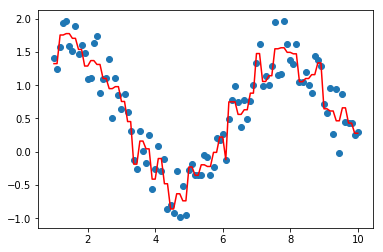
tree = CARTRegressor(max_bins=50)

tree.fit(data, target)
import matplotlib.pyplot as plt

plt.scatter(data, target)

plt.plot(data, tree.predict(data), color='r')
[<matplotlib.lines.Line2D at 0x221783ed9b0>]
#剪枝

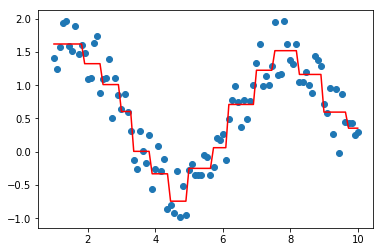
tree.prune(1)

plt.scatter(data, target)

plt.plot(data, tree.predict(data), color='r')
[<matplotlib.lines.Line2D at 0x221783fcb70>]
《机器学习Python实现_09_02_决策树_CART》的更多相关文章
- 简单物联网:外网访问内网路由器下树莓派Flask服务器
最近做一个小东西,大概过程就是想在教室,宿舍控制实验室的一些设备. 已经在树莓上搭了一个轻量的flask服务器,在实验室的路由器下,任何设备都是可以访问的:但是有一些限制条件,比如我想在宿舍控制我种花 ...
- 利用ssh反向代理以及autossh实现从外网连接内网服务器
前言 最近遇到这样一个问题,我在实验室架设了一台服务器,给师弟或者小伙伴练习Linux用,然后平时在实验室这边直接连接是没有问题的,都是内网嘛.但是回到宿舍问题出来了,使用校园网的童鞋还是能连接上,使 ...
- 外网访问内网Docker容器
外网访问内网Docker容器 本地安装了Docker容器,只能在局域网内访问,怎样从外网也能访问本地Docker容器? 本文将介绍具体的实现步骤. 1. 准备工作 1.1 安装并启动Docker容器 ...
- 外网访问内网SpringBoot
外网访问内网SpringBoot 本地安装了SpringBoot,只能在局域网内访问,怎样从外网也能访问本地SpringBoot? 本文将介绍具体的实现步骤. 1. 准备工作 1.1 安装Java 1 ...
- 外网访问内网Elasticsearch WEB
外网访问内网Elasticsearch WEB 本地安装了Elasticsearch,只能在局域网内访问其WEB,怎样从外网也能访问本地Elasticsearch? 本文将介绍具体的实现步骤. 1. ...
- 怎样从外网访问内网Rails
外网访问内网Rails 本地安装了Rails,只能在局域网内访问,怎样从外网也能访问本地Rails? 本文将介绍具体的实现步骤. 1. 准备工作 1.1 安装并启动Rails 默认安装的Rails端口 ...
- 怎样从外网访问内网Memcached数据库
外网访问内网Memcached数据库 本地安装了Memcached数据库,只能在局域网内访问,怎样从外网也能访问本地Memcached数据库? 本文将介绍具体的实现步骤. 1. 准备工作 1.1 安装 ...
- 怎样从外网访问内网CouchDB数据库
外网访问内网CouchDB数据库 本地安装了CouchDB数据库,只能在局域网内访问,怎样从外网也能访问本地CouchDB数据库? 本文将介绍具体的实现步骤. 1. 准备工作 1.1 安装并启动Cou ...
- 怎样从外网访问内网DB2数据库
外网访问内网DB2数据库 本地安装了DB2数据库,只能在局域网内访问,怎样从外网也能访问本地DB2数据库? 本文将介绍具体的实现步骤. 1. 准备工作 1.1 安装并启动DB2数据库 默认安装的DB2 ...
- 怎样从外网访问内网OpenLDAP数据库
外网访问内网OpenLDAP数据库 本地安装了OpenLDAP数据库,只能在局域网内访问,怎样从外网也能访问本地OpenLDAP数据库? 本文将介绍具体的实现步骤. 1. 准备工作 1.1 安装并启动 ...
随机推荐
- 2019-2020 ICPC, Asia Jakarta Regional Contest C. Even Path(思维)
Pathfinding is a task of finding a route between two points. It often appears in many problems. For ...
- nginx常见应用实例
1.nginx 中 location 应用实例location 是 nginx 的精华,nginx 就是通过拦截到的请求去对配置好的 location 块(location block)进行请求代理的 ...
- socket编程之时间回射服务器
使用到的函数: // 返回值:读到的字节数,若已到文件尾,返回0:若出错,返回-1 ssize_t read(int fd, void *buf, size_t nbytes); // 返回值:若成功 ...
- turtle库应用实例2-六芒星的绘制
六芒星的绘制 ...
- 初识CoAP协议
前言 本文介绍什么是CoAP,以及如何在物联网设备上使用它.CoAP是一种物联网协议,具有一些专门为受约束的设备而设计的有趣功能.还有其他一些可用于构建物联网解决方案的IoT协议,例如MQTT等. 物 ...
- Python3 迭代器与生成器 - 学习笔记
可迭代对象(Iterable) 迭代器(Iterator) 定义 迭代器和可迭代对象的区别 创建一个迭代器 创建一个迭代器类 使用内置iter()函数 StopIteration异常 生成器(gene ...
- Spring Cloud学习 之 Spring Cloud Ribbon(负载均衡器源码分析)
文章目录 AbstractLoadBalancer: BaseLoadBalancer: DynamicServerListLoadBalancer: ServerList: ServerListUp ...
- python --内建结构 汉诺塔结构
规则: 1.每次移动一个盘子 2.任何时候大盘子在下面,小盘子在上面 方法: 1.n=1:直接将A上的盘子移动到c 上面,A->C 2.n=2: 1>A->B 2>A-> ...
- PAT 1009 Product of Polynomials (25分) 指数做数组下标,系数做值
题目 This time, you are supposed to find A×B where A and B are two polynomials. Input Specification: E ...
- vue在钩子中引用方法不成功
在组建创建成功后调用methods里的方法fn1,失败,提示not a function: created(){ getData(){} } solution: created(){ this.get ...