
tensorflow1.0 lstm学习曲线
import tensorflow as tf

import numpy as np

import matplotlib.pyplot as plt

BATCH_START = 0

TIME_STEPS = 20

BATCH_SIZE = 20

INPUT_SIZE = 1

OUTPUT_SIZE = 1

CELL_SIZE = 10

LR = 0.0025

def get_batch():

    global BATCH_START, TIME_STEPS

    # xs shape (50batch, 20steps)

    xs = np.arange(BATCH_START, BATCH_START+TIME_STEPS*BATCH_SIZE).reshape((BATCH_SIZE, TIME_STEPS)) / (10*np.pi)

    seq = np.sin(xs)

    res = np.cos(xs)

    BATCH_START += TIME_STEPS

    # plt.plot(xs[0, :], res[0, :], 'r', xs[0, :], seq[0, :], 'b--')

    # plt.show()

    # returned seq, res and xs: shape (batch, step, input)

    return [seq[:, :, np.newaxis], res[:, :, np.newaxis], xs]

class LSTMRNN(object):

    def __init__(self, n_steps, input_size, output_size, cell_size, batch_size):

        self.n_steps = n_steps

        self.input_size = input_size

        self.output_size = output_size

        self.cell_size = cell_size

        self.batch_size = batch_size

        with tf.name_scope('inputs'):

            self.xs = tf.placeholder(tf.float32, [None, n_steps, input_size], name='xs')

            self.ys = tf.placeholder(tf.float32, [None, n_steps, output_size], name='ys')

        with tf.variable_scope('in_hidden'):

            self.add_input_layer()

        with tf.variable_scope('LSTM_cell'):

            self.add_cell()

        with tf.variable_scope('out_hidden'):

            self.add_output_layer()

        with tf.name_scope('cost'):

            self.compute_loss()

        with tf.name_scope('train'):

            self.train_op = tf.train.AdamOptimizer(LR).minimize(self.loss)

    def add_input_layer(self,):

        l_in_x = tf.reshape(self.xs, [-1, self.input_size], name='2_2D')  # (batch*n_step, in_size)

        # Ws (in_size, cell_size)

        Ws_in = self._weight_variable([self.input_size, self.cell_size])

        # bs (cell_size, )

        bs_in = self._bias_variable([self.cell_size,])

        # l_in_y = (batch * n_steps, cell_size)

        with tf.name_scope('Wx_plus_b'):

            l_in_y = tf.matmul(l_in_x, Ws_in) + bs_in

        # reshape l_in_y ==> (batch, n_steps, cell_size)

        self.l_in_y = tf.reshape(l_in_y, [-1, self.n_steps, self.cell_size], name='2_3D')

    def add_cell(self):

        lstm_cell = tf.contrib.rnn.BasicLSTMCell(self.cell_size, forget_bias=1.0, state_is_tuple=True)

        with tf.name_scope('initial_state'):

            self.cell_init_state = lstm_cell.zero_state(self.batch_size, dtype=tf.float32)

        self.cell_outputs, self.cell_final_state = tf.nn.dynamic_rnn(

            lstm_cell, self.l_in_y, initial_state=self.cell_init_state, time_major=False)

    def add_output_layer(self):

        # shape = (batch * steps, cell_size)

        l_out_x = tf.reshape(self.cell_outputs, [-1, self.cell_size], name='2_2D')

        Ws_out = self._weight_variable([self.cell_size, self.output_size])

        bs_out = self._bias_variable([self.output_size, ])

        # shape = (batch * steps, output_size)

        with tf.name_scope('Wx_plus_b'):

            self.pred = tf.matmul(l_out_x, Ws_out) + bs_out

    # def compute_cost(self):

    #     losses = tf.contrib.legacy_seq2seq.sequence_loss_by_example(

    #         [tf.reshape(self.pred, [-1], name='reshape_pred')],

    #         [tf.reshape(self.ys, [-1], name='reshape_target')],

    #         [tf.ones([self.batch_size * self.n_steps], dtype=tf.float32)],

    #         average_across_timesteps=True,

    #         softmax_loss_function=self.ms_error,

    #         name='losses'

    #     )

    #     with tf.name_scope('average_cost'):

    #         self.cost = tf.div(

    #             tf.reduce_sum(losses, name='losses_sum'),

    #             self.batch_size,

    #             name='average_cost')

    def compute_loss(self):

        prediction = tf.reshape(self.pred, [-1], name='reshape_pred')

        ys = tf.reshape(self.ys, [-1], name='reshape_target')

        self.loss = tf.reduce_mean(tf.reduce_sum(tf.square(ys - prediction),

                                                reduction_indices=[0]))

    @staticmethod

    def ms_error(labels, logits):

        return tf.square(tf.subtract(labels, logits))

    def _weight_variable(self, shape, name='weights'):

        initializer = tf.random_normal_initializer(mean=0., stddev=1.,)

        return tf.get_variable(shape=shape, initializer=initializer, name=name)

    def _bias_variable(self, shape, name='biases'):

        initializer = tf.constant_initializer(0.1)

        return tf.get_variable(name=name, shape=shape, initializer=initializer)

if __name__ == '__main__':

    model = LSTMRNN(TIME_STEPS, INPUT_SIZE, OUTPUT_SIZE, CELL_SIZE, BATCH_SIZE)

    sess = tf.Session()

    # tf.initialize_all_variables() no long valid from

    # 2017-03-02 if using tensorflow >= 0.12

    if int((tf.__version__).split('.')[1]) < 12 and int((tf.__version__).split('.')[0]) < 1:

        init = tf.initialize_all_variables()

    else:

        init = tf.global_variables_initializer()

    sess.run(init)

    # relocate to the local dir and run this line to view it on Chrome (http://0.0.0.0:6006/):

    # $ tensorboard --logdir='logs'

    plt.figure(figsize=(12, 4))

    plt.ion()

    plt.show()

    for i in range(300):

        seq, res, xs = get_batch()

        if i == 0:

            feed_dict = {

                    model.xs: seq,

                    model.ys: res,

                    # create initial state

            }

        else:

            feed_dict = {

                model.xs: seq,

                model.ys: res,

                model.cell_init_state: state    # use last state as the initial state for this run

            }

        _, cost, state, pred = sess.run(

            [model.train_op, model.loss, model.cell_final_state, model.pred],

            feed_dict=feed_dict)

        # plotting

        plt.plot(xs[0, :], seq[0].flatten(), 'r', xs[0, :], pred.flatten()[:TIME_STEPS], 'b--')

        plt.ylim((-1.5, 1.5))

        plt.draw()

        plt.pause(0.1)

        if i % 20 == 0:

            print('loss: ', round(cost, 4))
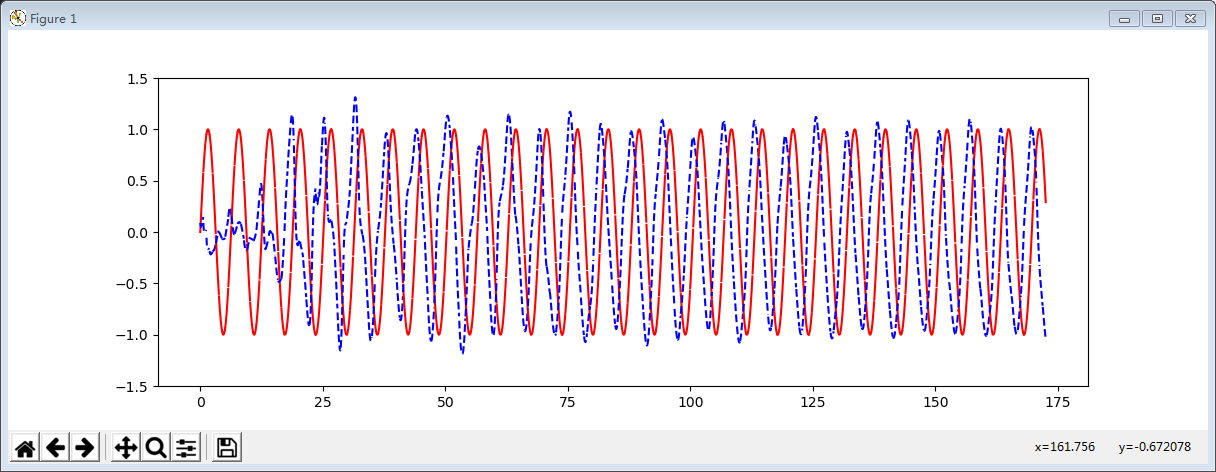
tensorflow1.0 lstm学习曲线的更多相关文章
- Ubuntu14.10安装TensorFlow1.0.1
本文记录了在Ubuntu上安装TensorFlow的步骤.系统环境:Ubuntu14.10 64bitPython版本:Python 2.7.8TensorFlow版:TensorFlow 1.0.1 ...
- tensorflow1.0 构建lstm做图片分类
import tensorflow as tf from tensorflow.examples.tutorials.mnist import input_data #this is data mni ...
- 初用Linux, 安装Ubuntu16.04+NVIDIA387+CUDA8.0+cudnn5.1+TensorFlow1.0.1
因为最近Deep Learning十分热门, 装一下TensorFlow学习一下. 本文主要介绍安装流程, 将自己遇到的问题说明出来, 并记录自己如何处理, 原理方面并没有能力解释. 由于本人之前从来 ...
- tensorflow1.0.0 弃用了几个operator写法
除法和取模运算符(/, //, %)现已匹配 Python(flooring)语义.这也适用于 tf.div 和 tf.mod.为了获取强制的基于整数截断的行为,你可以使用 tf.truncatedi ...
- tensorflow1.0中的改善
TensorFlow 1.0 重大功能及改善 XLA(实验版):初始版本的XLA,针对TensorFlow图(graph)的专用编译器,面向CPU和GPU. TensorFlow Debugger(t ...
- tensorflow1.0 队列FIFOQueue管理实现异步读取训练
import tensorflow as tf #模拟异步子线程 存入样本, 主线程 读取样本 # 1. 定义一个队列,1000 Q = tf.FIFOQueue(1000,tf.float32) # ...
- tensorflow1.0 数据队列FIFOQueue的使用
import tensorflow as tf #模拟一下同步先处理数据,然后才能取数据训练 #tensorflow当中,运行操作有依赖性 #1.首先定义队列 Q = tf.FIFOQueue(3,t ...
- tensorflow1.0 dropout层
""" Please note, this code is only for python 3+. If you are using python 2+, please ...
- tensorflow1.0 构建卷积神经网络
import tensorflow as tf from tensorflow.examples.tutorials.mnist import input_data import os os.envi ...
随机推荐
- ADO.NET 的使用(二)
一.本篇主要讲ADO.NET的核心DataSet DataSet里面有个DataTable,DataTable还有个对应的DataView 首先呢,假设数据库的数据 id name mob 100 张 ...
- redis吊锤面试官,这篇足够了!
原理篇 redis 时单线程的为什么还能那么快? 数据都在内存中,运算都是内存级别的运算. redis既然是单线程的为什么能处理那么多的并发数? 多路复用,操作系统时间轮训epoll 函数作为选择器, ...
- 不可思议的hexo,五分钟教你免费搭一个高逼格技术博客
引言 作为程序员拥有一个属于自己的个人技术博客,绝对是百利无一害的事,不仅方便出门装b,面试时亮出博客地址也会让面试官对你的好感度倍增.经常能在很多大佬的技术文章的文末,看到这样一句话: " ...
- coding++:maven根据不同的运行环境,打包不同的配置文件
1.使用maven管理项目中的依赖,非常的方便.同时利用maven内置的各种插件,在命令行模式下完成打包.部署等操作,可方便后期的持续集成使用. 2.但是每一个maven工程(比如web项目),开发人 ...
- Thread wait notify sleep
wait: 必须暂定当前正在执行的线程,并释放资源锁,让其他线程可以有机会运行 notify/notifyall: 唤醒因锁池中的线程,使之运行 wait与sleep区别 对于sleep()方法,我们 ...
- python——os平台编程
一.os平台编程需求 1.目录文件的操作 对系统目录,文件的操作方法 2.程序的定时执行 3.可执行程序的转换 python程序向可执行程序的转换 二.目录文件操作 root:当前目录: dirs:当 ...
- codeforces 1038a(找最长的前k个字母出现相同次数的字符串)
codeforces 1038a You are given a string s of length n, which consists only of the first k letters of ...
- js实现 多级联动
<head> <meta http-equiv="Content-Type" content="text/html; charset=utf-8&quo ...
- 定位 iframe
定位iframe # 1.有id,并且唯一,直接写id driver.switch_to_frame("x-URS-iframe") driver.switch_to.frame( ...
- go 内置函数
一.什么是内置函数? 二.内置函数有哪些? 名称 说明 close 用于管道通信 len.cap len 用于返回某个类型的长度或数量(字符串.数组.切片.map 和管道):cap 是容量的意思,用于 ...