
Data Replication in a Multi-Cloud Environment using Hadoop & Peer-to-Peer technologies
要FQ。。。
——————————————————————————————————————————————————————
Few years ago, i started working on a project named Jxtadoop providing Hadoop Distributed Filesystem capabilities on top of of a peer-to-peer network. This initial goal was simply to load a file once to a Data Cloud which will take care of replication wherever the peers (data nodes) are deployed... I also wanted to avoid putting my data outside of my private network to ensure complete data privacy.
After some times, it appeared that this solution is also a very good fit to support data replication in a Multi-Cloud Environment. Any file (small or big) can be loaded in one cloud and then gets automatically replicated to the other clouds. This makes multi-cloud Data Brokering very easy and straightforward.
Hadoop is a very good candidate to provide those functionalities at a datacenter level. However when moving to a multi-cloud environment, it is no longer viable unless a Virtual Private Data Network is built. This VPDN is created on top of a peer-to-peer network which provides redundancy, multi-path routing, privacy, encryption across all the clouds...
Concept
Let's assume we are in a true Multi-Cloud Broker environment. For this blog, i assume i actually have 3 clouds hosting multiple workloads (aka virtual servers) in each. The picture below depicts a classical configuration which will appear in the coming years where business will source IT from different Cloud providers and really consume IT in a true Service Broker model.
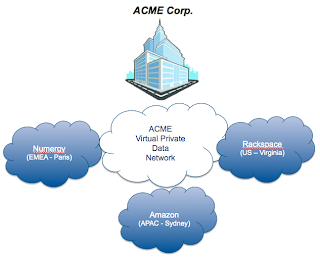
ACME Corp. has its headquarters based out of France and subsidiaries all over the world.
The new strategy is to source IT infrastructure from local service providers to deliver IT services directly to the local branches. There is no will to set up local IT anymore.
Data replication, propagation, protection (...) is really an issue in such a configuration and reversibility has to also be configured.
Setting up this Virtual Private Data Network will support this Service Broker Strategy.
Conceptually, the solution is very simple. A master node (calledRendez-vous Namenode) is located in the HQ and is the brain of the VPDN. That's where all the logic is handled such as data availability, multi-path data transfer, data placement... In each Cloud, there is a Relay Datanode which acts as the entry point for the Cloud. It will play a routing role communicating directly with other Cloud relays and also play a buffering role for data transmission. To avoid any SPOF, all those peers can be deployed in a multi-instance mode.
Finally each workload instance (physical servers, virtual machines, containers...) hosts a Peer Datanode which is the actual endpoint for data storage and consumption.
Virtual Private Data Network Architecture
As explained in the previous section, the overall architecture relies on three main components.
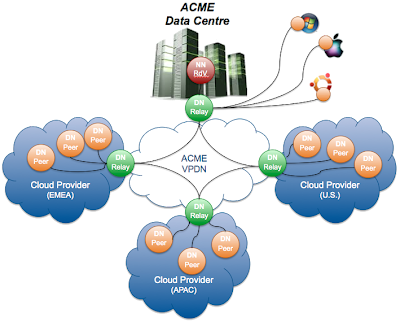
- Namenode Rendez-Vous providing Data Transport Logic as well as Data placement and replication. It has the peer-to-peer network topology overall understanding as well as the data cloud meta-data. There is no data traffic going through this peer.
- Datanode Relay providing Data Storage as well as Data Transport. The local peers which can communicate between each others through multicast, will rely on the relays to communicate with remote peers located in other data clouds. It can also store data as a temporary buffer.
- Datanode Peer providing Data Storage to store data chunks on each server peer and even on remote desktop peers.
All the peers can be made redundant (multiple Rendez-Vous, multiple Relays ...) to increase the multi-path routing capability and avoid any SPOF. The data is then split into chunks of pre-defined size and dispatched across the Data Cloud. Data locality can be set to ensure there is one replica per Cloud or that replicas are limited to a Cloud (for example for data which must stay in a specific country).
All the communications are multi-path, authenticated, encrypted... There is no need to set-up VPNs between the Clouds which could lead to some contentions points. Here the communication is either direct through multicast or going through the best (shortest) routing path at the peer-to-peer layer level.
The traffic flows are of 2 kinds.
. The RPC flow and the DATA flow. The first one handles all the signaling required to operate the VPDN such as routing, heartbeat, placement requests, updates ... There is actually no business data on this flow, hence it is possible to have a set-up where data traffic is limited to a cloud or even a country while the commands are centrally managed.
. The DATA flow is the actual business data transferred over the wire. This flow can be local to a datacentre using multicast wherever possible. It can also still be local but transiting through the Cloud relay for multiple domains. Finally this flow can go through multiple relays. In the example below, a data block located on the Windows PC will get replicated to the APAC Cloud by going through 2 relays (the DC one + the APAC Cloud one).
Benefits
This new approach brings many benefits for a mutli-Cloud environment and for companies willing to operate their IT with an IT Service Broker model.
- Redundancy : the data is automatically replicated in the Clouds wherever needed ;
- Availability : the data is always available with the use of multiple replicas (3, 5, 7...) ;
- Efficiency : quick deployment, quick capacity expansion ;
- Simplicity : load once on a peer and automated replication ;
- Future-proof : leverage big data technologies ;
- Portable : can run on any server and desktop platforms supporting Java 7 ;
- Confidentiality : all the data transfer are encrypted, authenticated ... ;
- Locality : data can be located in a specific Cloud and not leak outside ;
Setting up your own environment
The technology used to create this Virtual Private Data Network can be found here. The testing described above has been done using a physical environment from OVH in France to simulate the HQ. 3 clouds have been consumed :Numergy (EMEA - France), Rackspace (U.S. - Virginia) and Amazon (APAC - Australia).
The testing leveraged Docker to create multiple Datanode peers on a single VM with a complex network topology (see1 & 2). The associated containers can be found on the Docker main repository :
- Namenode Rendez-Vous (jxtadoop/namenode)
- Datanode Relay (jxtadoop/relay)
- Datanode Peer (jxtadoop/datanode)
Desktop clients have been installed on Mac OS, Windows and Linux. Just ensure you use Windows 7.
Conclusion
This concludes my Jxtadoop project which will get released as version 1.0.0 later this month. I'll provide a SaaS set-up with a Rendez-vous Namenode and a Relay Peer for quick testing.
Next ideas :
- Roll-out StandaloneHDFSUI for Jxtadoop ;
- Release FileSharing capability based on Jxtadoop ;
- PaaS/SaaS set-up for Jxtadoop with Docker and CloudFoundry ;
- Think about magic combination of App Virtualization (Docker), Network Virtualization (Open vSwitch) and Data Virtualization (Jxtadoop) ;
Links
Data Replication in a Multi-Cloud Environment using Hadoop & Peer-to-Peer technologies的更多相关文章
- elasticsearch6.7 05. Document APIs(1)data replication model
data replication model 本节首先简要介绍Elasticsearch的data replication model,然后详细描述以下CRUD api: 1.读写文档(Reading ...
- ACID、Data Replication、CAP与BASE
ACID 在传数据库系统中,事务具有ACID 4个属性. (1) 原子性(Atomicity):事务是一个原子操作单元,其对数据的修改,要么全都执行,要么全都不执行. (2) 一致性(Consiste ...
- 【Cloud Computing】Hadoop环境安装、基本命令及MapReduce字数统计程序
[Cloud Computing]Hadoop环境安装.基本命令及MapReduce字数统计程序 1.虚拟机准备 1.1 模板机器配置 1.1.1 主机配置 IP地址:在学校校园网Wifi下连接下 V ...
- 6 Multi-Cloud Architecture Designs for an Effective Cloud
https://www.simform.com/multi-cloud-architecture/ Enterprises increasingly want to take advantage of ...
- Hive-0.x.x - Enviornment Setup
All Hadoop sub-projects such as Hive, Pig, and HBase support Linux operating system. Therefore, you ...
- Enabling granular discretionary access control for data stored in a cloud computing environment
Enabling discretionary data access control in a cloud computing environment can begin with the obtai ...
- Tagging Physical Resources in a Cloud Computing Environment
A cloud system may create physical resource tags to store relationships between cloud computing offe ...
- Awesome Big Data List
https://github.com/onurakpolat/awesome-bigdata A curated list of awesome big data frameworks, resour ...
- Scalable MySQL Cluster with Master-Slave Replication, ProxySQL Load Balancing and Orchestrator
MySQL is one of the most popular open-source relational databases, used by lots of projects around t ...
随机推荐
- glib wpa_supplicant Unix上库编译错误解决与总结
编译Linux下的库是一件痛苦的事情,这里主要阐述glib和wpa_supplicant库的编译,因各自的依赖关系,另外一些库要事先编译.glib依赖libffi和zlib,而wpa_supplica ...
- 全局流水ID号生成的几种方法
这个问题源自于,我想找一个分布式下的ID生成器. 这个最简单的方案是,数据库自增ID.为啥不用咧?有这么几点原因,一是,会依赖于数据库的具体实现,比如,mysql有自增,oracle没有,得用序列, ...
- Shell--nl命令
nl命令在linux系统中用来计算文件中行号.nl 可以将输出的文件内容自动的加上行号!其默认的结果与 cat -n 有点不太一样, nl 可以将行号做比较多的显示设计,包括位数与是否自动补齐 0 等 ...
- 【java】为数组全部元素赋同样的值 以及 数组之间的复制
为数组全部元素赋同样的值 : boolean[] resArray=new boolean[100]; Arrays.fill(resArray, true); 数组之间的复制: System.arr ...
- [Spring boot] Application properties and configurations
We can use different application properties application.properties: server.port=9090 application-pro ...
- MyBatis批量添加、修改和删除
1.批量添加元素session.insert(String string,Object o) 1 2 3 4 5 6 7 8 9 10 11 12 13 14 15 16 17 18 19 20 21 ...
- 爪哇国新游记之二十八----从url指定的地址下载文件到本地
package download; import java.io.File; import java.io.FileOutputStream; import java.io.InputStream; ...
- Eclipse user library位置
原因: 转自:http://happycoolyp.iteye.com/blog/1853135 user libraries的记录文件%eclipse_workspace%\.metadata\.p ...
- RabbitMQ搭建
1. RabbitMQ简介 RabbitMQ是一个在AMQP基础上完整的,可复用的企业消息系统.他遵循Mozilla Public License开源协议 2.安装与部署 RabbitMQ的安装依赖E ...
- LoadRunner测试Google Suggest
Google的搜索框是典型的AJAX应用,用户在输入关键字的同时,前端页面通过xmlhttp与后台服务器动态交互,根据用户输入的关键字查找匹配的内容,向用户提示建议的搜索项,也就是所谓的“google ...