
HDU 1693 Eat the Trees(插头DP,入门题)
So Pudge’s teammates give him a new assignment—Eat the Trees!
The trees are in a rectangle N * M cells in size and each of the cells either has exactly one tree or has nothing at all. And what Pudge needs to do is to eat all trees that are in the cells.
There are several rules Pudge must follow:
I. Pudge must eat the trees by choosing a circuit and he then will eat all trees that are in the chosen circuit.
II. The cell that does not contain a tree is unreachable, e.g. each of the cells that is through the circuit which Pudge chooses must contain a tree and when the circuit is chosen, the trees which are in the cells on the circuit will disappear.
III. Pudge may choose one or more circuits to eat the trees.
Now Pudge has a question, how many ways are there to eat the trees?
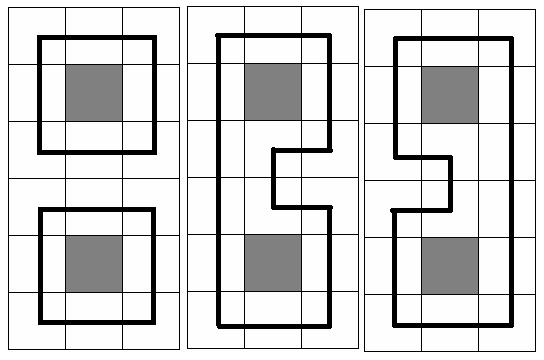
At the picture below three samples are given for N = 6 and M = 3(gray square means no trees in the cell, and the bold black line means the chosen circuit(s))
For each case, the first line contains the integer numbers N and M, 1<=N, M<=11. Each of the next N lines contains M numbers (either 0 or 1) separated by a space. Number 0 means a cell which has no trees and number 1 means a cell that has exactly one tree.
 #include <cstdio>

 #include <algorithm>

 #include <cstring>

 #include <iostream>

 using namespace std;

 typedef long long LL;

 const int MAXN = ;

 int mat[MAXN][MAXN];

 LL dp[MAXN][MAXN][ << MAXN];

 int n, m, T;

 LL solve() {

     memset(dp, , sizeof(dp));

     dp[][m][] = ;

     for(int i = ; i <= n; ++i) {

         for(int j = ; j < ( << m); ++j) dp[i][][j << ] = dp[i - ][m][j];

         for(int k = ; k <= m; ++k) {

             for(int state = ; state < ( << (m + )); ++state) {

                 int y =  << k, x = y >> ;

                 if(mat[i][k]) {

                     if((state & x) && (state & y)) {

                         dp[i][k][state] = dp[i][k - ][state - x - y];

                     } else if((state & x) ==  && (state & y) == ) {

                         dp[i][k][state] = dp[i][k - ][state + x + y];

                     } else dp[i][k][state] = dp[i][k - ][state ^ x ^ y] + dp[i][k - ][state];

                 } else {

                     if((state & x) ==  && (state & y) == ) {

                         dp[i][k][state] = dp[i][k - ][state];

                     } else dp[i][k][state] = ;

                 }

             }

         }

     }

     return dp[n][m][];

 }

 int main() {

     scanf("%d", &T);

     for(int t = ; t <= T; ++t) {

         scanf("%d%d", &n, &m);

         for(int i = ; i <= n; ++i)

             for(int j = ; j <= m; ++j) scanf("%d", &mat[i][j]);

         printf("Case %d: There are %I64d ways to eat the trees.\n", t, solve());

     }

 }
代码(0MS)(hash)(下面代码是lld的……):
 #include <iostream>

 #include <algorithm>

 #include <cstring>

 #include <cstdio>

 using namespace std;

 typedef long long LL;

 const int MAXH = ;

 const int SIZEH = ;

 struct hash_map {

     int head[SIZEH];

     int next[MAXH], state[MAXH];

     LL val[MAXH];

     int size;

     void init() {

         memset(head, -, sizeof(head));

         size = ;

     }

     void insert(int st, LL sv) {

         int h = st % SIZEH;

         for(int p = head[h]; ~p; p = next[p]) {

             if(state[p] == st) {

                 val[p] += sv;

                 return ;

             }

         }

         state[size] = st; val[size] = sv; next[size] = head[h]; head[h] = size++;

     }

 } hashmap[];

 int getB(int state, int i) {

     return (state >> i) & ;

 }

 void setB(int &state, int i, int val) {

     state = (state & ~( << i)) | (val << i);

 }

 int mat[][];

 int n, m, T;

 hash_map *cur, *last;

 void update(int state, LL val, int x, int y) {

     int left = getB(state, y);

     int up = getB(state, y + );

     if(mat[x][y] == ) {

         if(left ==  && up == ) cur->insert(state, val);

         return ;

     }

     if(left ==  && up == ) {

         if(x < n -  && y < m - ) {

             int newState = state;

             setB(newState, y, );

             setB(newState, y + , );

             cur->insert(newState, val);

         }

     } else if(left ==  || up == ) {

         if(x < n - ) {

             int newState = state;

             setB(newState, y, );

             setB(newState, y + , );

             cur->insert(newState, val);

         }

         if(y < m - ) {

             int newState = state;

             setB(newState, y, );

             setB(newState, y + , );

             cur->insert(newState, val);

         }

     } else {

         int newState = state;

         setB(newState, y, );

         setB(newState, y + , );

         cur->insert(newState, val);

     }

 }

 LL solve() {

     cur = hashmap, last = hashmap + ;

     last->init();

     last->insert(, );

     for(int i = ; i < n; ++i) {

         int sz = last->size;

         for(int k = ; k < sz; ++k) last->state[k] <<= ;

         for(int j = ; j < m; ++j) {

             cur->init();

             sz = last->size;

             for(int k = ; k < sz; ++k)

                 update(last->state[k], last->val[k], i, j);

             swap(cur, last);

         }

     }

     for(int k = ; k < last->size; ++k)

         if(last->state[k] == ) return last->val[k];

     return ;

 }

 int main() {

     scanf("%d", &T);

     for(int t = ; t <= T; ++t) {

         scanf("%d%d", &n, &m);

         for(int i = ; i < n; ++i)

             for(int j = ; j < m; ++j) scanf("%d", &mat[i][j]);

         printf("Case %d: There are %lld ways to eat the trees.\n", t, solve());

     }

 }
HDU 1693 Eat the Trees(插头DP,入门题)的更多相关文章
- hdu 1693 Eat the Trees——插头DP
题目:http://acm.hdu.edu.cn/showproblem.php?pid=1693 第一道插头 DP ! 直接用二进制数表示状态即可. #include<cstdio> # ...
- HDU 1693 Eat the Trees ——插头DP
[题目分析] 吃树. 直接插头DP,算是一道真正的入门题目. 0/1表示有没有插头 [代码] #include <cstdio> #include <cstring> #inc ...
- HDU 1693 Eat the Trees(插头DP)
题目链接 USACO 第6章,第一题是一个插头DP,无奈啊.从头看起,看了好久的陈丹琦的论文,表示木看懂... 大体知道思路之后,还是无法实现代码.. 此题是插头DP最最简单的一个,在一个n*m的棋盘 ...
- hdu1693 Eat the Trees [插头DP经典例题]
想当初,我听见大佬们谈起插头DP时,觉得插头DP是个神仙的东西. 某大佬:"考场见到插头DP,直接弃疗." 现在,我终于懂了他们为什么这么说了. 因为-- 插头DP很毒瘤! 为什么 ...
- HDU 1693 Eat the Trees(插头DP、棋盘哈密顿回路数)+ URAL 1519 Formula 1(插头DP、棋盘哈密顿单回路数)
插头DP基础题的样子...输入N,M<=11,以及N*M的01矩阵,0(1)表示有(无)障碍物.输出哈密顿回路(可以多回路)方案数... 看了个ppt,画了下图...感觉还是挺有效的... 参考 ...
- HDU1693 Eat the Trees 插头dp
原文链接http://www.cnblogs.com/zhouzhendong/p/8433484.html 题目传送门 - HDU1693 题意概括 多回路经过所有格子的方案数. 做法 最基础的插头 ...
- hdu 1693 : Eat the Trees 【插头dp 入门】
题目链接 题意: 给出一个n*m大小的01矩阵,在其中画线连成封闭图形,其中对每一个值为1的方格,线要恰好穿入穿出共两次,对每一个值为0的方格,所画线不能经过. 参考资料: <基于连通性状态压缩 ...
- HDU - 1693 Eat the Trees(多回路插头DP)
题目大意:要求你将全部非障碍格子都走一遍,形成回路(能够多回路),问有多少种方法 解题思路: 參考基于连通性状态压缩的动态规划问题 - 陈丹琦 下面为代码 #include<cstdio> ...
- HDU 1693 Eat the Trees (插头DP)
题意:给一个n*m的矩阵,为1时代表空格子,为0时代表障碍格子,问如果不经过障碍格子,可以画一至多个圆的话,有多少种方案?(n<12,m<12) 思路: 这题不需要用到最小表示法以及括号表 ...
随机推荐
- LeetCode11.盛最多水的容器 JavaScript
给定 n 个非负整数 a1,a2,...,an,每个数代表坐标中的一个点 (i, ai) .在坐标内画 n 条垂直线,垂直线 i 的两个端点分别为 (i, ai) 和 (i, 0).找出其中的两条线, ...
- Android 初步-Android文件目录介绍
src:存放的是应用程序使用到的java文件. gen:系统自动生成的目录,不需要程序员进行修改,包含了R.java文件.该文件包含了 程序使用到的资源文件对应的唯一资源ID,注意:如果R文件生成错误 ...
- DBCacheServer升级
前段时间完成了该服务的设计的功能,花了很多时间和经历,最终完成了一个版本,已经测试了:现在后期再次在以前的基础上,完成了一些扩展. 1.扩展了内存存储 最初版本只是采用了gauva cache进行存储 ...
- C/C++使用Socket通信UDP
接收端 #include <stdio.h> #include <WinSock2.h> #pragma comment(lib,"WS2_32.lib") ...
- 关于对连接数据库时出现1130-host “**” is not allowed to connect to this MySql/mariadb server 的错误解决方法
在完成mariadb的搭建后,在端口与防火墙均为正常的情况下,出现了1130- Host xxx is not allowed to connect to this MariaDb server 的情 ...
- unbuntu16初始化设置,并解决虚拟机操作系统窗口不能自适应问题
版本说明: 虚拟机:VMware Workstation 12.5.2 操作系统:ubuntu 16.04 unbuntu不同版本的下载链接:http://old-releases.ubuntu.co ...
- angularjs 自定义服务(serive,factory,provder) 以及三者的区别
1.Serive 服务:通过service方式创建自定义服务,相当于new的一个对象:var s = new myService();,只要把属性和方法添加到this上才可以在controller里调 ...
- 一个好用的C# HttpCookieHelper.cs类
using System; using System.Collections.Generic; using System.Text; using System.Text.RegularExpressi ...
- 百度app红包? 百度全家桶?果断卸载
听说今年的春晚红包与百度合作.这不 刚又下载了一个百度app,之前下载过,太卡了,用户体验极.本身对百度也没啥好感,再加上这周看了:百度已死的文章,搜索全百家号.具体啥情况,你们百度搜一搜吧
- django的HttpResponse对象
服务器接收到http协议的请求后,会根据报文创建HttpRequest对象,这个对象不需要我们创建,直接使用服务器构造好的对象就可以.视图的第一个参数必须是HttpRequest对象,在django. ...