
COCO 数据集的使用
1 简介
微软发布的 COCO 数据库是一个大型图像数据集, 专为对象检测、分割、人体关键点检测、语义分割和字幕生成而设计。
COCO 数据库的网址是:
- MS COCO 数据集主页:http://mscoco.org/
- Github 网址:https://github.com/Xinering/cocoapi
- 关于 API 更多的细节在网站: http://mscoco.org/dataset/#download
COCO API 提供了 Matlab, Python 和 Lua 的 API 接口. 该 API 接口可以提供完整的图像标签数据的加载, parsing 和可视化。此外,网站还提供了数据相关的文章, 教程等。
在使用 COCO 数据库提供的 API 和 demo 之前, 需要首先下载 COCO 的图像和标签数据(类别标志、类别数量区分、像素级的分割等 ):
- 图像数据下载到
coco/images/文件夹中 - 标签数据下载到
coco/annotations/文件夹中
下面我们来探讨一下如何利用 Python 来使用 COCO 数据集?
COCO API 对 WIndows 系统不是太友好,首先我先是 fork 了 COCO API,然后下载到本地,并切换到:D:\API\cocoapi\PythonAPI。
cd D:\API\cocoapi\PythonAPI
打开 Makefile 可以看到 API 的安装和使用说明。
在 Windows 下直接运行 python setup.py build_ext --inplace 会报错:
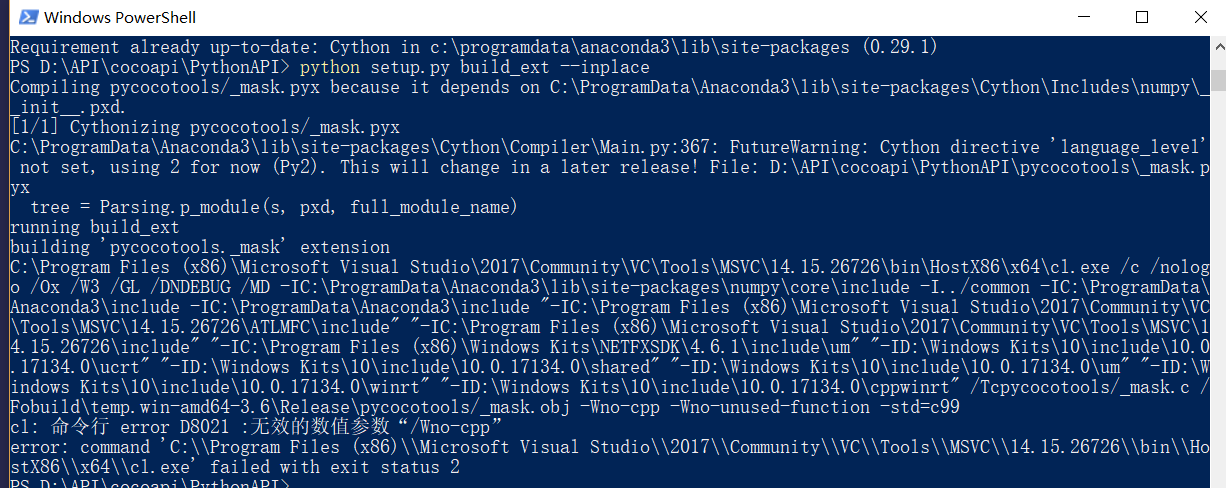
Windows 中 (一般需要安装 visual studio)有许多的坑,参考 Windows 10 编译 Pycocotools 踩坑记 暴力删掉参数 Wno-cpp 和 Wno-unused-function,如下图所示:
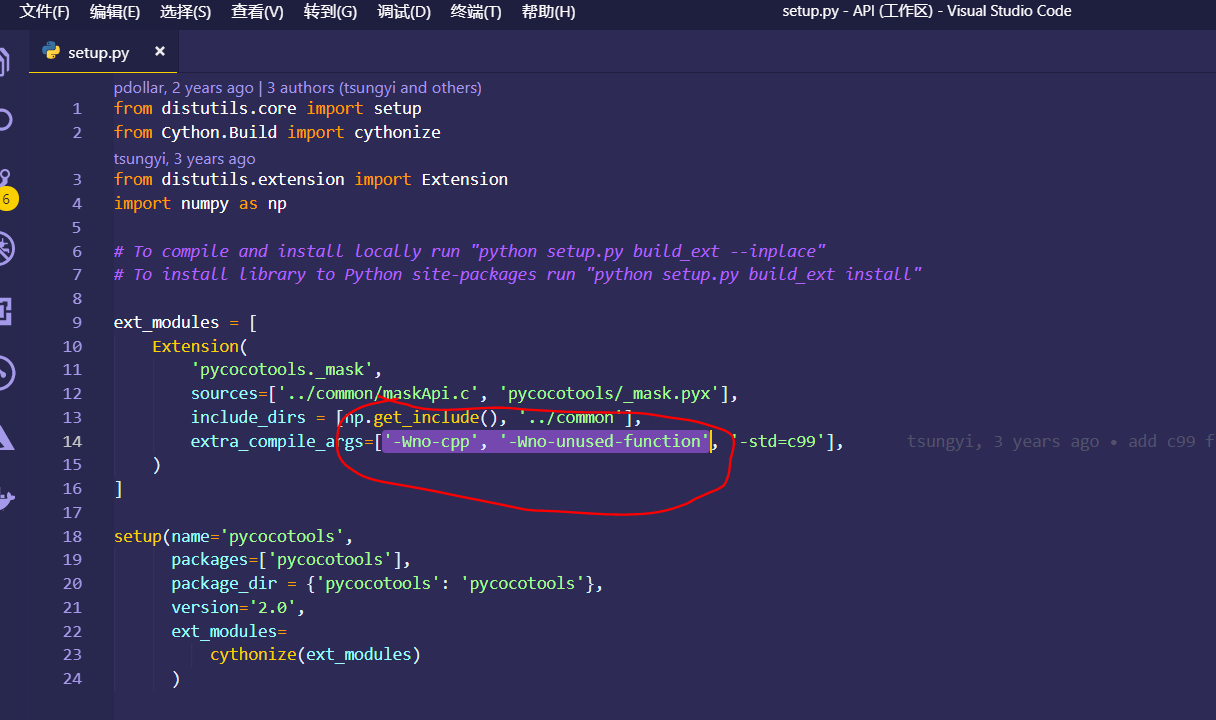
这样,我们便可以使用 pycocotools,不过每次你想要调用 pycocotools 都需要先载入局部环境:
import sys

sys.path.append('D:\API\cocoapi\PythonAPI')   # 将你的 `pycocotools` 所在路径添加到系统环境
如果你不想这么麻烦,你可以直接将 pycocotools 安装在你的主环境下:
先切换到包所在路径
cd D:\API\cocoapi\PythonAPI
然后,运行
python setup.py build_ext install

rd build   # 删除
在 Linux 下,不需要上面这么多编译步骤,我们直接在终端输入下列命令即可正常使用 COCO API:
pip3 install -U Cython

pip3 install -U pycocotools
下面你便可载入 pycocotools 了。
2 COCO API
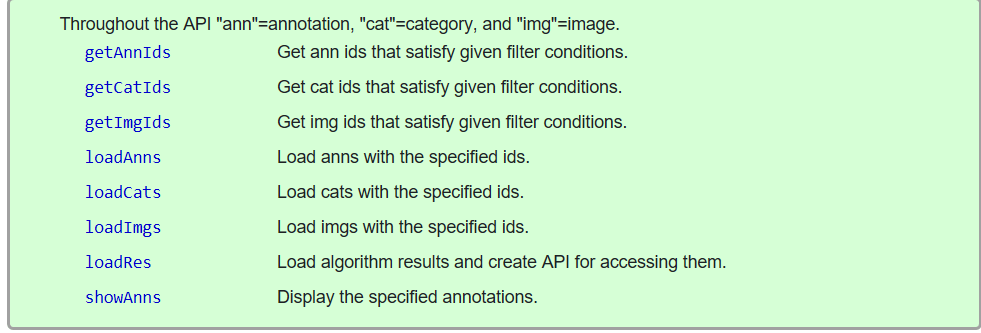
COCO API 可以帮助你载入、解析和可视化 annotations。 该 API 支持 multiple annotation 格式 (详情见 data format). 更多关于 API 的细节可参考 coco.py,同时你也可以查看 Python API demo。
COCO API 的记号说明:
3 MASK API
COCO 为每个实例对象提供分割掩码(segmentation masks)。这就产生了两个挑战: 紧凑地存储掩码和高效地执行掩码计算。 MASK API 使用自定义运行长度编码 (Run Length Encoding, RLE) 方案解决这两个难题。RLE 表示的大小与掩码的边界像素数成正比, 并且可以在 RLE 上直接有效地计算操作 (如面积、联合或交集)。具体来说, 假设 shapes 相当简单, RLE 表示形式为 \(O(\sqrt{n}\), 其中 \(n\) 是对象中的像素数, 而通常计算量同样是 \(O(\sqrt{n})\)。在解码掩码 (存储为阵列) 上进行相同操作的自然的计算量将是 \(O(n)\)。
Mask API 提供了一个用于操作以 RLE 格式存储的掩码的接口。这个 API 被定义在 mask.py。最后, 大多数 ground truth masks 存储为多边形 (相当紧凑), 这些多边形在需要时转换为 RLE。
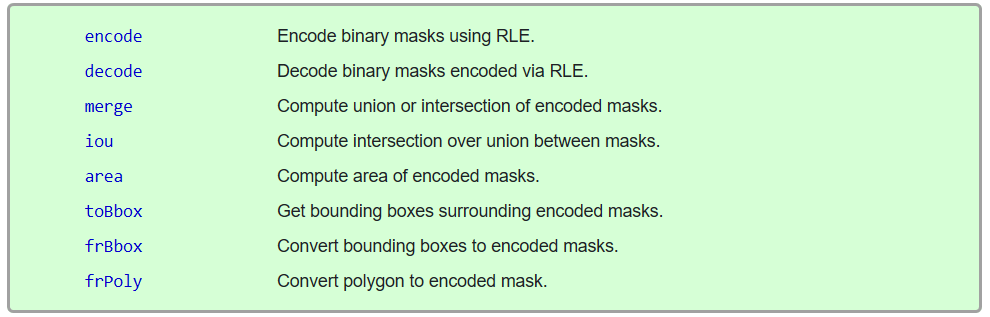
下面我们来解读一下 pycocoDemo.ipynb。由于 COCO API 对 Windows 不是那么友好,为了避免去调试各种 Bug,下面我们先在 Linux 系统下来使用 COCO API。下面我是在 Jupyter Notebook 下运行代码的。
4 pycocoDemo.ipynb 解读
%matplotlib inline

import zipfile

import os

import numpy as np

import skimage.io as io

import matplotlib.pyplot as plt

import pylab

pylab.rcParams['figure.figsize'] = (8.0, 10.0)

# -------------------

try:       # pycocotools 已经加入了全局环境变量中

    from pycocotools.coco import COCO

except ModuleNotFoundError:

    import sys

    # 加载 COCO API 环境

    sys.path.append('D:\API\cocoapi\PythonAPI')

    from pycocotools.coco import COCO

root = 'E:/Data/coco'  # 你下载的 COCO 数据集所在目录

# 查看 images 下的图片

os.listdir(f'{root}/images')
['test2014.zip',

 'test2015.zip',

 'test2017.zip',

 'train2014.zip',

 'train2017.zip',

 'unlabeled2017.zip',

 'val2014.zip',

 'val2017.zip']
下面我以 val2017.zip 图片数据集为例,来说明下面的一些问题。
Z = zipfile.ZipFile(f'{root}/images/val2017.zip')

Z.namelist()[7]   # 查看一张图片的文件名
'val2017/000000463918.jpg'
由于 Z.read 函数返回的是 bytes,所以,我们需要借助一些其他模块来将图片数据转换为 np.uint8 形式。
img_b = Z.read(Z.namelist()[7])

print(type(img_b))
<class 'bytes'>
方式1:np.frombuffer(img_b, 'B')
import numpy as np

import cv2

img_flatten = np.frombuffer(img_b, 'B')

img_cv = cv2.imdecode(img_flatten, cv2.IMREAD_ANYCOLOR)

print(img_cv.shape)
(359, 500, 3)
方式2:imageio.imread
import imageio

img_io = imageio.imread(img_b)

print(img_io.shape)
(359, 500, 3)
方式3:mxnet.image.imdecode
import mxnet as mx

img_mx = mx.image.imdecode(img_b)
下面我们来看看这张图片张什么样?
from matplotlib import pyplot as  plt

plt.subplot(231)

plt.imshow(cv2.cvtColor(img_cv, cv2.COLOR_BGR2RGB))

plt.title('OpenCV')

plt.axis('off')

plt.subplot(232)

plt.imshow(img_io)

plt.title('imageio')

plt.axis('off')

plt.subplot(233)

plt.imshow(img_io)

plt.title('MXNet')

plt.axis('off')

plt.show()
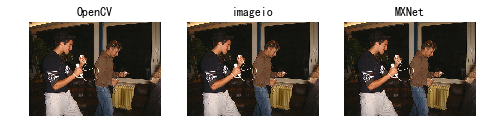
考虑到 OpenCV 的高效性,我们采用方式1 来处理 images 下的图片数据。
def buffer2array(Z, image_name):

    '''

    无需解压,直接获取图片数据

    参数

    ===========

    Z:: 图片数据是 ZipFile 对象

    '''

    buffer = Z.read(image_name)

    image = np.frombuffer(buffer, dtype="B")  # 将 buffer 转换为 np.uint8 数组

    img = cv2.imdecode(image, cv2.IMREAD_COLOR)

    return img

img = buffer2array(Z, Z.namelist()[8])

print('图片的尺寸:', img.shape)
图片的尺寸: (480, 640, 3)
4.1 获取标签信息(利用官方给定教程)
这里有一个坑 (由 PIL 引发) import skimage.io as io 在 Windows 下可能会报错,我的解决办法是:
先卸载 Pillow,然后重新安装即可。
插曲:PIL(Python Imaging Library)是Python一个强大方便的图像处理库,名气也比较大。Pillow 是 PIL 的一个派生分支,但如今已经发展成为比 PIL 本身更具活力的图像处理库。
dataDir = cocox.root

dataType = 'val2017'

annFile = '{}/annotations/instances_{}.json'.format(dataDir, dataType)
# initialize COCO api for instance annotations

coco=COCO(annFile)
loading annotations into memory...

Done (t=0.93s)

creating index...

index created!
COCO??
COCO 是一个类:
Constructor of Microsoft COCO helper class for reading and visualizing annotations.

:param annotation_file (str): location of annotation file

:param image_folder (str): location to the folder that hosts images.
4.2 COCO categories and supercategories
cats = coco.loadCats(coco.getCatIds())

nms = [cat['name'] for cat in cats]

print('COCO categories: \n{}\n'.format(' '.join(nms)))

nms = set([cat['supercategory'] for cat in cats])

print('COCO supercategories: \n{}'.format(' '.join(nms)))
COCO categories:

person bicycle car motorcycle airplane bus train truck boat traffic light fire hydrant stop sign parking meter bench bird cat dog horse sheep cow elephant bear zebra giraffe backpack umbrella handbag tie suitcase frisbee skis snowboard sports ball kite baseball bat baseball glove skateboard surfboard tennis racket bottle wine glass cup fork knife spoon bowl banana apple sandwich orange broccoli carrot hot dog pizza donut cake chair couch potted plant bed dining table toilet tv laptop mouse remote keyboard cell phone microwave oven toaster sink refrigerator book clock vase scissors teddy bear hair drier toothbrush

COCO supercategories:

appliance sports person indoor vehicle food electronic furniture animal outdoor accessory kitchen
# get all images containing given categories, select one at random

catIds = coco.getCatIds(catNms=['person', 'dog', 'skateboard'])

imgIds = coco.getImgIds(catIds=catIds)

imgIds = coco.getImgIds(imgIds=[335328])

img = coco.loadImgs(imgIds[np.random.randint(0, len(imgIds))])[0]
img
{'license': 4,

 'file_name': '000000335328.jpg',

 'coco_url': 'http://images.cocodataset.org/val2017/000000335328.jpg',

 'height': 640,

 'width': 512,

 'date_captured': '2013-11-20 19:29:37',

 'flickr_url': 'http://farm3.staticflickr.com/2079/2128089396_ddd988a59a_z.jpg',

 'id': 335328}
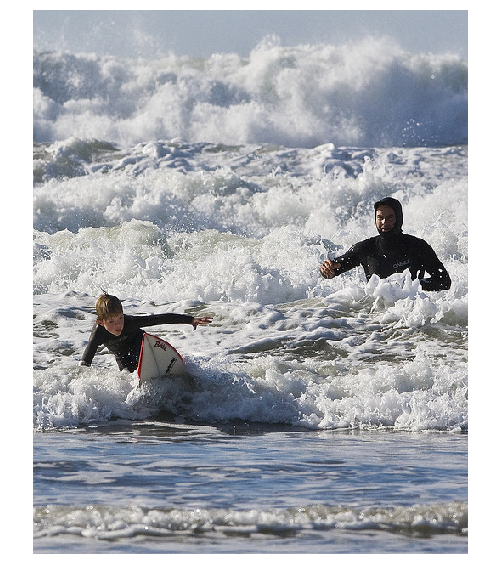
官方给的这个代码需要将图片数据集解压:
# load and display image

# use url to load image

# I = io.imread(img['coco_url'])

I = io.imread('%s/images/%s/%s' % (dataDir, dataType, img['file_name']))

plt.axis('off')

plt.imshow(I)

plt.show()
我们可以使用 zipfile 模块直接读取图片,而无须解压:
image_names[-1]
'E:/Data/coco/images/val2017.zip'
val_z = zipfile.ZipFile(image_names[-1])

I = image.imdecode(val_z.read('%s/%s' % (dataType, img['file_name']))).asnumpy()

# 或者直接使用 I = buffer2array(val_z, val_z.namelist()[8])

plt.axis('off')

plt.imshow(I)

plt.show()
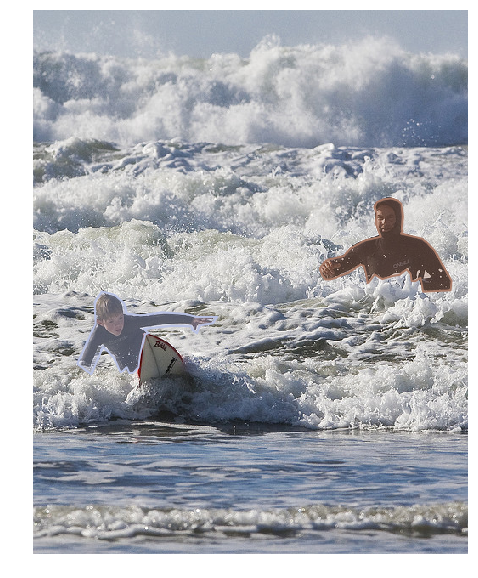
4.3 载入和展示 instance annotations
plt.imshow(I)

plt.axis('off')

annIds = coco.getAnnIds(imgIds=img['id'], catIds=catIds, iscrowd=None)

anns = coco.loadAnns(annIds)

coco.showAnns(anns)
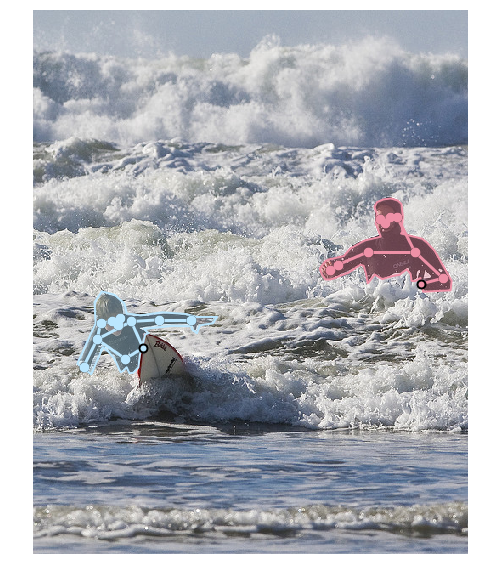
4.4 载入人体关键点标注
初始化人体关键点标注(person keypoints annotations)的 COCO api
annFile = '{}/annotations/person_keypoints_{}.json'.format(dataDir, dataType)

coco_kps = COCO(annFile)
loading annotations into memory...

Done (t=0.43s)

creating index...

index created!
show:
plt.imshow(I)

plt.axis('off')

ax = plt.gca()

annIds = coco_kps.getAnnIds(imgIds=img['id'], catIds=catIds, iscrowd=None)

anns = coco_kps.loadAnns(annIds)

coco_kps.showAnns(anns)
4.5 载入和展示 caption annotations
annFile = '{}/annotations/captions_{}.json'.format(dataDir, dataType)

coco_caps = COCO(annFile)
loading annotations into memory...

Done (t=0.06s)

creating index...

index created!
show:
annIds = coco_caps.getAnnIds(imgIds=img['id'])

anns = coco_caps.loadAnns(annIds)

coco_caps.showAnns(anns)

plt.imshow(I)

plt.axis('off')

plt.show()
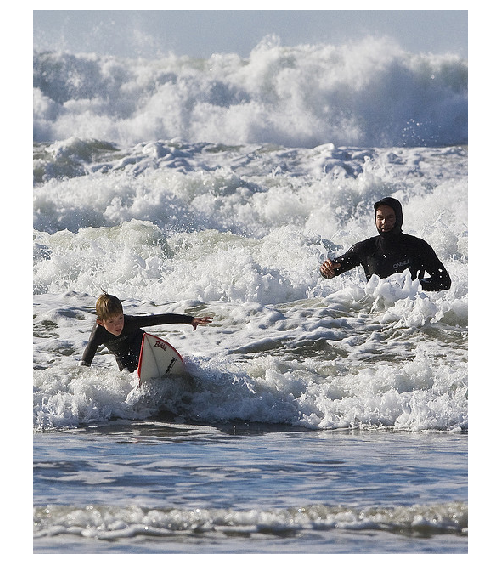
A couple of people riding waves on top of boards.

a couple of people that are surfing in water

A man and a young child in wet suits surfing in the ocean.

a man and small child standing on a surf board  and riding some waves

A young boy on a surfboard being taught to surf.
5 更新
2018/11/29
我在 Github 上放置了一个仓库:datasetsome,该仓库存储一些数据集处理相关的 API,如果感觉对您有帮助,请给个 star。
你也可以在线编辑:https://mybinder.org/v2/gh/DataLoaderX/datasetsome/master
除此之外,我还写了一个 深度学习常用数据集 API。
为了令 Windows 系统也可以更好的使用 COCO 数据集,我打算开发一个可以适用于 Windows 和 Linux 系统是 API,同时利用 Python 的 ZipFile 模块直接读取 images 下的图片数据以及 annotations 下的标注数据。(直接跳过解压这一费时的步骤)该 API 的更新我放置在了 cocox。欢迎大家阅览!
2018/11/30
2018/12/3
COCO 数据集使用说明书 着重介绍了 cocoz.py。
2018/12/13
自制 COCO api 直接读取类 COCO 的标注数据的压缩文件 改进 ImageZ,使其支持索引和切片以及迭代功能。为了令其他数据也可以使用 ImageZ 类,我将 ImageZ 的输入参数改为 images 所在路径,其他不变。同时,举了一个 Kaggle 比赛的例子:Humpback Whale Identification 来说明 ImageZ 的通用性。
2018/12/23
2019/1/29
利用 ImageZ 与 MXNet 实战 Kaggle 猫狗分类
2019/3/30
更多的项目更新
2019/4/1
- 利用 ImageZ 与 AnnZ:Faster RCNN 学习与实现
- GitHub:meet 求点赞。
2019/10/12
创建计算机视觉社区:动手实践计算机视觉。本社区欢迎大家贡献与计算机视觉相关的代码或者文档,同时也欢迎大家分享一些有意思的 idea 或者 issue。还可以在 gitter@cv-actions 或者 GitPress@cv_actions 交流计算机视觉学习心得。
2020/01/01
programming项目记录本人自学的些许笔记。在 book 放置了我的第一本书,该书记录了如何使用 Git 去管理项目以及如何使用 Python 处理数据集,训练神经网络,做符号运算。同时也介绍了 MXNet 与 TensorFlow2 的基本使用。介绍了如何设计属于自己的深度学习环境和 GitHub 社区。您亦可以下载 tutorials 观看。
本篇博文已经被收录到了 book。
COCO 数据集的使用的更多相关文章
- COCO数据集深入理解
TensorExpand/TensorExpand/Object detection/Data_interface/MSCOCO/ 深度学习数据集介绍及相互转换 Object segmentation ...
- COCO 数据集使用说明书
下面的代码改写自 COCO 官方 API,改写后的代码 cocoz.py 被我放置在 Xinering/cocoapi.我的主要改进有: 增加对 Windows 系统的支持: 替换 defaultdi ...
- Pascal VOC & COCO数据集介绍 & 转换
目录 Pascal VOC & COCO数据集介绍 Pascal VOC数据集介绍 1. JPEGImages 2. Annotations 3. ImageSets 4. Segmentat ...
- [PocketFlow]解决TensorFLow在COCO数据集上训练挂起无输出的bug
1. 引言 因项目要求,需要在PocketFlow中添加一套PeleeNet-SSD和COCO的API,具体为在datasets文件夹下添加coco_dataset.py, 在nets下添加pelee ...
- 在ubuntu1604上使用aria2下载coco数据集效率非常高
简单的下载方法: 所以这里介绍一种能照顾大多数不能上外网的同学的一种简单便捷,又不会中断的下载方法:系统环境: Ubuntu 14.04 方法: a. 使用aria2 搭配命令行下载.需要先安装: s ...
- MS coco数据集下载
2017年12月02日 23:12:11 阅读数:10411 登录ms-co-co数据集官网,一直不能进入,FQ之后开看到下载链接.有了下载链接下载还是很快的,在我这儿晚上下载,速度能达到7M/s,所 ...
- coco数据集标注图转为二值图python(附代码)
coco数据集大概有8w张以上的图片,而且每幅图都有精确的边缘mask标注. 后面后分享一个labelme标注的json或xml格式转二值图的源码(以备以后使用) 而我现在在研究显著性目标检测,需要的 ...
- COCO数据集使用
一.简介 官方网站:http://cocodataset.org/全称:Microsoft Common Objects in Context (MS COCO)支持任务:Detection.Keyp ...
- Microsoft COCO 数据集
本篇博客主要以介绍MS COCO数据集为目标,分为3个部分:COCO介绍,数据集分类和COCO展示. 本人主要下载了其2014年版本的数据,一共有20G左右的图片和500M左右的标签文件.标签文件标记 ...
随机推荐
- setInterval()使用时易疏忽的点
举个例子: 一道题目 这两个程序的区别就在于我向setInterval的参数一function写入了参数.这就是导致运行结果不尽如人意的原因. setInterval()方法可以接收三个参数,此参数会 ...
- PyMySQL模块的使用
PyMySQL介绍 PyMySQL是在Python3.x版本中用于连接MySQL服务器的一个库,Python2系列中则使用mysqldb.Django中也可以使用PyMySQL连接MySQL数据库. ...
- java集合小知识的复习
*Map接口 Map<k,v>接口中接收两个泛型,key和value的两个数据类型 Map中的集合中的元素都是成对存在的每个元素由键与值两部分组成,通过键可以找对所对应的值.值可以重复,键 ...
- Python系列之 - 面向对象(1)
python是一门面向对象的编程语言,python中的一切均是对象. 有对象就提到类,对象和类就像是儿子和老子的关系,是不可分的一对. 什么是类 类就是具有一些共同特性的事物的统称.好比人类, ...
- hdu2674 N!Again---思维
题目链接: http://acm.hdu.edu.cn/showproblem.php?pid=2674 题目大意: 求n!%2009的值 思路: 由于模2009,所以大于等于2009的直接为0,前2 ...
- MongoDB系列五(地理空间索引与查询).
一.经纬度表示方式 MongoDB 中对经纬度的存储有着自己的一套规范(主要是为了可以在该字段上建立地理空间索引).包括两种方式,分别是 Legacy Coordinate Pairs (这个词实在不 ...
- Jenkins的安装
安装环境: 512M内存 10G硬盘空间 Java 8环境 先来创建jenkins的运行目录: mkdir /data/jenkins && cd /data/jenkins 下载je ...
- 物联网 MQTT 服务质量级别
欢迎大家前往腾讯云+社区,获取更多腾讯海量技术实践干货哦~ 翻译人:Tnecesoc,该成员来自云+社区翻译社 消息队列遥测传输(MQTT)是一种客户端服务器发布 / 订阅消息传输协议.它轻量,开放, ...
- ORACLE 行转列 案例解析
-- 创建 国家城市信息 临时表 WITH T_NATION_CITY_INFO AS( SELECT '北京' AS CITY,'中国' AS N ...
- 实验吧_密码忘记了(vim编辑器+代码审计)&天网管理系统(php弱比较+反序列化)
密码忘记了 一开始尝试了各种注入发现都无效,在网页源码中找到了admin 的地址,输入地址栏发现并没有什么有用的信息,随便输个邮箱,网页返回了一个地址 ./step2.php?email=youmai ...