
Turtelizer 2 provide JTAG Flash programming and debugging of ARM based boards via USB
http://www.ethernut.de/en/hardware/turtelizer/
Introducing Turtelizer 2
Overview
Turtelizer 2 had been developed to provide JTAG Flash programming and debugging of ARM based boards via USB. Typical target boards are Ethernut 3 , the Elektor Internet Radio or Ethernut 5. However, as the hardware is based on the FT2232 chip from www.ftdichip.com, it offers a general JTAG, SPI, I2C and RS 232 capabilities.
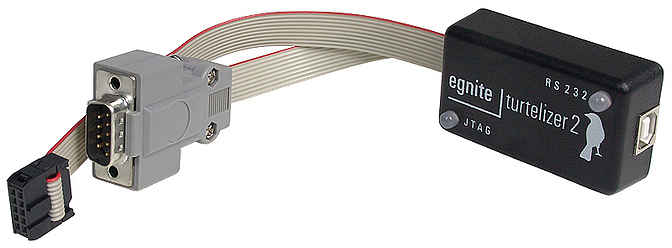
This document will present the open source hardware design and some basic information how to get it up and running. Several links to external resources are given, where specific topics are discussed in detail. It is intended for hardware developers, who want to build their own FTDI based JTAG dongle.
If you bought a ready-to-run Turtelizer dongle or any of its clones and just want to know, how to use it for programming and debugging your target board, then theTurtelizer 2 User's Guide is the right document for you.
Features
Fully buffered JTAG interface for target voltages from 1.65V to 5.5V.
Additional RS 232 Interface with virtual COM port driver.
Space saving 10-pin JTAG connector. Standard 14-pin and 20-pin connectors require an adapter.
Open Source hardware and software. Supported by OpenOCD and YAGARTO and tested on Linux, Mac OS X and Windows.
Requirements
Most tools used here to get the Turtelizer hardware up and running are available for Windows only, specifically the MProg Tool.
Once configured, the Turtelizer can be used on Mac OS X, Linux and Windows PCs.
Open Source Hardware Copyright
Copyright (C) by egnite GmbH
Redistribution and use of the layout itself or products based on this design, with or without modification, are permitted provided that the following conditions are met:
- Redistributions of the layout must retain the above copyright notice, this list of conditions and the following disclaimer.
- Redistributions of hardware products based on this design must reproduce the above copyright notice, this list of conditions and the following disclaimer in the documentation and/or other materials provided with the distribution.
THIS HARDWARE DESIGN IS PROVIDED BY EGNITE SOFTWARE GMBH AND CONTRIBUTORS ``AS IS'' AND ANY EXPRESS OR IMPLIED WARRANTIES, INCLUDING, BUT NOT LIMITED TO, THE IMPLIED WARRANTIES OF MERCHANTABILITY AND FITNESS FOR A PARTICULAR PURPOSE ARE DISCLAIMED. IN NO EVENT SHALL EGNITE SOFTWARE GMBH OR CONTRIBUTORS BE LIABLE FOR ANY DIRECT, INDIRECT, INCIDENTAL, SPECIAL, EXEMPLARY, OR CONSEQUENTIAL DAMAGES (INCLUDING, BUT NOT LIMITED TO, PROCUREMENT OF SUBSTITUTE GOODS OR SERVICES; LOSS OF USE, DATA, OR PROFITS; OR BUSINESS INTERRUPTION) HOWEVER CAUSED AND ON ANY THEORY OF LIABILITY, WHETHER IN CONTRACT, STRICT LIABILITY, OR TORT (INCLUDING NEGLIGENCE OR OTHERWISE) ARISING IN ANY WAY OUT OF THE USE OF THIS DESIGN, EVEN IF ADVISED OF THE POSSIBILITY OF SUCH DAMAGE.
In simple words, you can use this layout for your personal use or for a commercial product free of charge.
If you want to pay for it, I'd suggest to donate a small amount to the OpenOCD.
Important Legal Notes
Some time ago a discussion came up in the OpenOCD development mailing list about whether it is legal to distribute a binary version of OpenOCD, which is linked to the proprietary library FTD2XX provided by FTDI. The result in one short sentence: It violates the GPL, under which OpenOCD is released.
This does not mean that OpenOCD stops workingwith Turtelizer 2. One alternative is to use the free library libftdi as a replacement for the FTD2XX library. However, there are some disadvantages:
- libftdi had been reported to be up to 2.5x slower than its closed source counterpart.
- The serial port on the Turtelizer will no longer work.
- libftdi will not work on 64-bit Windows.
Hopefully upcoming versions of libftdi will overcome these limitations. What can be done in the meantime?
The GPL regulates distribution of software, not its usage. For your own personal use it is allowed to create a version of OpenOCD that is linked with proprietary code. For Linux and OS X users this is typically no problem. Unfortunately, building OpenOCD from source code on Windows PCs is not trivial and requires a number of additional tools. Most unexperienced users will probably fail.
We decided to provide a pragmatic solution by seperating OpenOCD and the FTDI driver. You can find both packets on egnite's product page.
It is not allowed to distribute OpenOCD and the Turtelizer USB driver in a single package. Always keep them seperated.
Turtelizer 2 Hardware
PCB Version 2.0 Revision C
This is the current board revision. Compared to Rev-B, the following changes apply:
While it had been claimed, that Rev-B boards support target voltages down to 1.65V, it turned out, that this was out of specs. In fact, target voltages below 2.5V tend to work unreliable. This has been fixed in Rev-C by replacing two push-pull drivers NC7SZ125P5X (IC6 and IC8) with a single NC7WZ07P6X open collector driver.
An additional signal nTRST had been added to pin 8 of the JTAG connector. In the previous revision this pin was left unconnected.
IC2 FT2232L went out of production and had been replaced by its pin-compatible successor FT2232D. Pins SI/WUA and SI/WUB had been left floating in the previous revision, but are now tied to VCC as recommended in later data sheets.
The input pin FORCEOFF at the RS-232 driver is now connected to the SLEEP output of IC2. This forces the RS-232 driver to power-down after USB suspend. Furthermore, FORCEON of the RS-232 driver is now tied to VCC (permanently enabled) to allow to connect to low power devices.
All series resistors had been changed from 22Ω to 27Ω.
An RC-circuit had been added between digital ground and shield.
- Turtelizer 2.0 Rev-C Schematic
- Turtelizer 2.0 Rev-C CAD files: Can be viewed with the Freeware Version from Cadsoft.
PCB Version 2.0 Revision B
This was the first published revision.
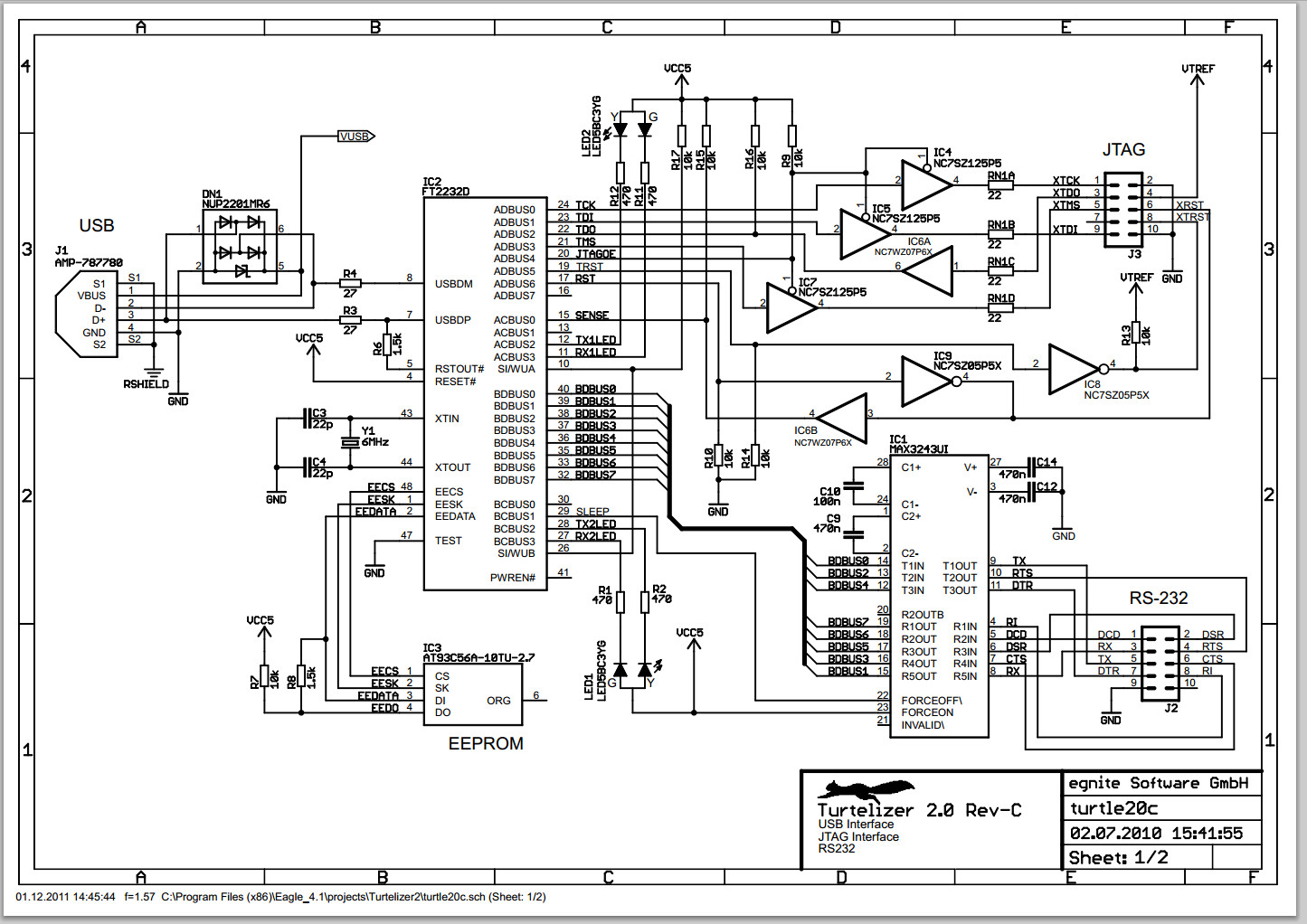
Schematic Page 1: USB, JTAG and RS232 interface.
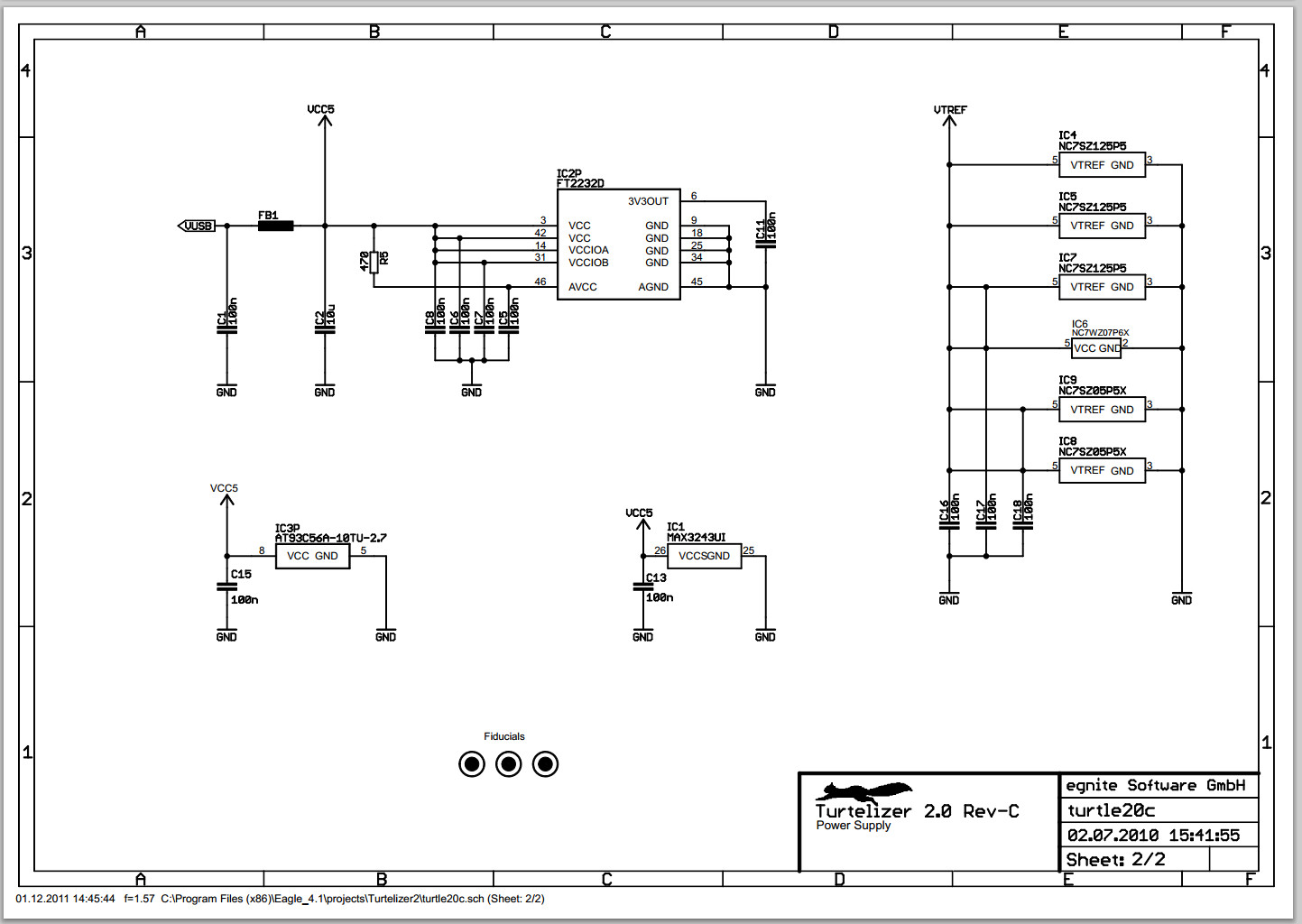
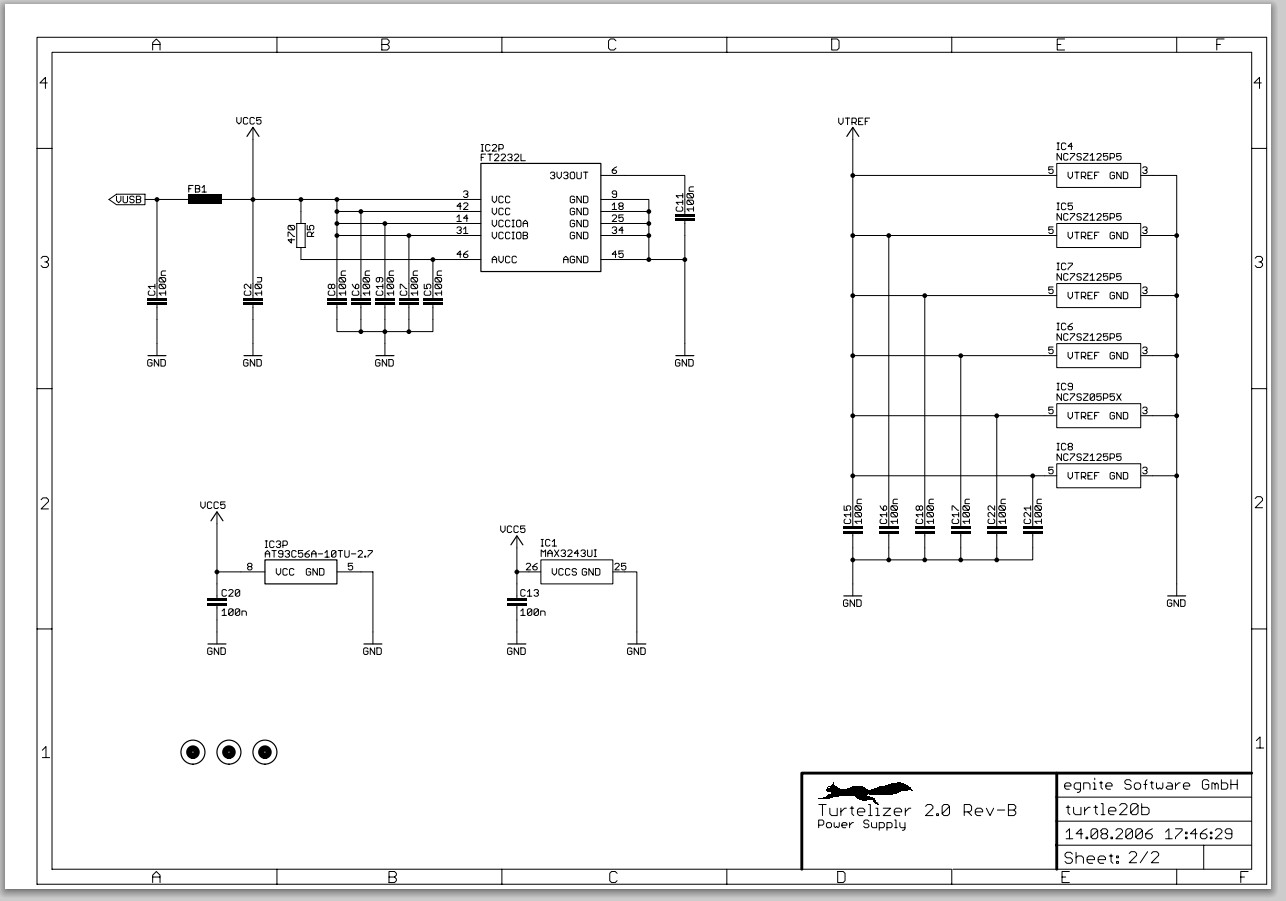
Schematic Page 2: Power Supply.
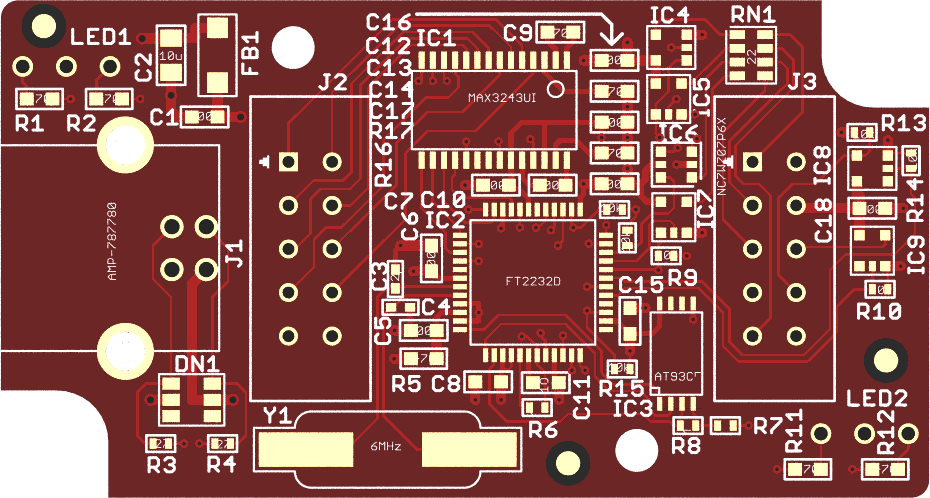
Board Layout: Fits in Hammond 1551H. enclosure.
turtle20b.zip : Eagle CAD Files. Can be viewed with the Freeware Version from Cadsoft.
All parts are available in RoHS compliant versions.
USB Interface
For detailed information about the FT2232 USB controller, please visit www.ftdichip.com. An Atmel AT93C56 EEPROM is used to store the configuration data.
A USB type B connector is mounted on the PCB (Tyco 292304 or similar). Power supply for the USB controller and the RS 232 driver is drawn from USB. A transient voltage suppressor array is used to protect the circuit from ESD and a ferrite bead suppresses noise in the power supply line.
JTAG Interface
A 10-pin female header connector is attached to the PCB via a ribbon cable, which is kept short to avoid problems at high transfer rates. The following table shows the connector layout.
| Turtelizer 2 JTAG Connector | |
|---|---|
| TCK - 1 | 2 - GND |
| TDO - 3 | 4 - VTref |
| TMS - 5 | 6 - nSRST |
| Vsupply - 7 | 8 - NC |
| TDI - 9 | 10 - GND |
All JTAG signals are buffered by LCX type single logic gates, which are powered by the JTAG VTref line. This way, the JTAG interface is automatically adjusted to different target voltage levels from 5.5V down to 1.65V. Additional series resistors in the JTAG lines help to maintain signal integrity and even provide some limited overvoltage protection.
RS 232 Interface
A second ribbon cable is used to attach a 9-pin male DSub connector for the RS 232 interface.
| Turtelizer 2 RS 232 Connector | |
|---|---|
| DCD - 1 | |
| 6 - DSR | |
| RD - 2 | |
| 7 - RTS | |
| TD - 3 | |
| 8 - CTS | |
| DTR - 4 | |
| 9 - RI | |
| GND - 5 | |
LED Indicators
Two 3-pin dual color LEDs with common anode are mounted on the back side of the PCB. LED1 indicates JTAG activity. LED2 is lit green when RS 232 data is received and lit red on RS 232 transmits.
JTAG Adapter
Using Turtelizer 2 with standard 14-pin or 20-pin JTAG connectors requires a
Special Adapter.
PCB Version 2.0 Revision B

Turtelizer 2 provide JTAG Flash programming and debugging of ARM based boards via USB的更多相关文章
- Implementation of Serial Wire JTAG flash programming in ARM Cortex M3 Processors
Implementation of Serial Wire JTAG flash programming in ARM Cortex M3 Processors The goal of the pro ...
- [原创] Keil uVision5 下载程序 add flash programming algorithm选项缺少需要的算法解决办法
MDK开发环境从V4升级到V5后,支持包不再是集成到开发环境当中,而是封装在PACK中,需要自行安装,比较麻烦. 搭建MDK开发环境以及破解的方法,在前面的文章中有详细说明,这里不再赘述,有兴趣的可以 ...
- 《FLASH PROGRAMMING 那些事》总结
注明来自 http://www.ssdfans.com/?p=5589 以MLC为例: 对FGF(Floating Gate Flash)技术的,MLC programming一般分两步走:先prog ...
- [React + Functional Programming ADT] Connect State ADT Based Redux Actions to a React Application
With our Redux implementation lousy with State ADT based reducers, it is time to hook it all up to a ...
- [Functional Programming ADT] Create State ADT Based Reducers (applyTo, Maybe)
The typical Redux Reducer is function that takes in the previous state and an action and uses a swit ...
- Serial Wire Viewer (SWV)
Being able to display values for counters, sensors and other debugging information is an important p ...
- LPCScrypt, DFUSec : USB FLASH download, programming, and security tool, LPC-Link 2 Configuration tool, Firmware Programming
What does this tool do? The LPC18xx/43xx DFUSec utility is a Windows PC tool that provides support f ...
- Programming Internal Flash Over the Serial Wire Debug <SWD> Interface -- EFM32
1 Debug Interface Overview 1.1 Serial Wire Debug Serial Wire Debug (SWD) is a two-wire protocol for ...
- JTAG 引脚自动识别 JTAG Finder, JTAG Pinout Tool, JTAG Pin Finder, JTAG pinout detector, JTAGULATOR, Easy-JTAG, JTAG Enumeration
JTAG Finder Figuring out the JTAG Pinouts on a Device is usually the most time-consuming and frustra ...
随机推荐
- table中的td等长(不随内容大小变化)
使用的table时候发现td的长度是随着内容的大小而变化的,但是有的时候我们不希望这样.想要td等长可以在 tbale中加上 style=“table-layout:fixed” ...
- AngularJs(SPA)单页面SEO以及百度统计应用(上)
只有两种人最具有吸引力,一种是无所不知的人,一种是一无所知的人 问:学生问追一个女孩总是追不上怎么办?回答:女孩不是追来的,是吸引来的,你追的过程是吸引女孩的过程,如果女孩没有看上你,再追都是没有用的 ...
- django使用RestFramework的Token认证
今天实现的想法有点不正规: Django Rest framework的框架的认证,API都运行良好. 现在是要自己写一个function来实现用户的功能. 而不是用Rest 框架里的APIVIEW这 ...
- HBase(七)Hbase过滤器
一.过滤器(Filter) 基础API中的查询操作在面对大量数据的时候是非常苍白的,这里Hbase提供了高级的查询方法:Filter.Filter可以根据簇.列.版本等更多的条件来对数据进行过滤,基于 ...
- jQuery类名添加click方法
通过$("").jQuery为元素添加点击事件,在使用类的情况下,可以使用$(e.target).attr('title');获得被点击元素的属性值. 示例代码如下 $(" ...
- 非ROOT用户不能识别声卡问题
将非ROOT用户加入到audio组中即可 sudo usermod -a -G audio usrname
- bzoj 3926 转换+广义后缀自动机
思路:重点在于叶子节点只有20个,我们把叶子节点提到根,把20个trie图插入后缀自动机,然后就是算有多少个本质不同的字串. #include<bits/stdc++.h> #define ...
- TradingView 初识
如引用 TradingView 库,需引入库中 3 个文件(所需库为 github 私有库,需申请) <script type="text/javascript" src=& ...
- react篇章-React Props
state 和 props 主要的区别在于 props 是不可变的,而 state 可以根据与用户交互来改变.这就是为什么有些容器组件需要定义 state 来更新和修改数据. 而子组件只能通过 pro ...
- JAVAEE——SSH项目实战04:联系人添加、列表显示和修改
作者: kent鹏 转载请注明出处: http://www.cnblogs.com/xieyupeng/p/7159337.html 一.联系人添加 1.添加页面设计 linkman/list. ...