
Sparse Autoencoder(一)
Neural Networks
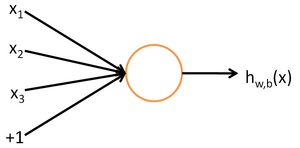
We will use the following diagram to denote a single neuron:
This "neuron" is a computational unit that takes as input x1,x2,x3 (and a +1 intercept term), and outputs
, where
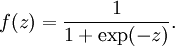
is called the activation function. In these notes, we will choose
to be the sigmoid function:
Thus, our single neuron corresponds exactly to the input-output mapping defined by logistic regression.
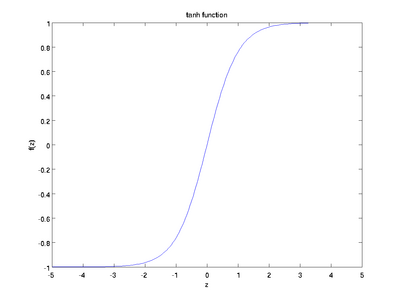
Although these notes will use the sigmoid function, it is worth noting that another common choice for f is the hyperbolic tangent, or tanh, function:
Here are plots of the sigmoid and tanh functions:
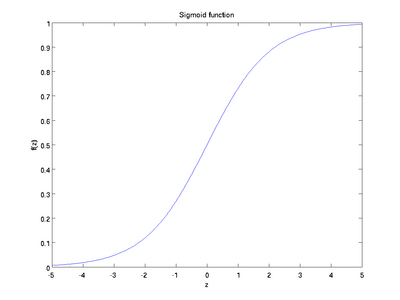
Finally, one identity that'll be useful later: If f(z) = 1 / (1 + exp( − z)) is the sigmoid function, then its derivative is given by f'(z) = f(z)(1 − f(z))
sigmoid 函数 或 tanh 函数都可用来完成非线性映射

Neural Network model
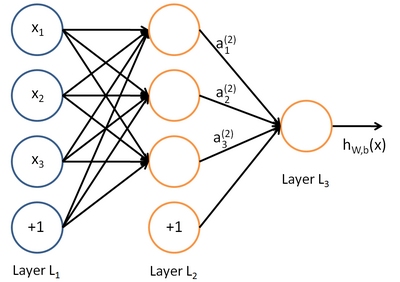
A neural network is put together by hooking together many of our simple "neurons," so that the output of a neuron can be the input of another. For example, here is a small neural network:
In this figure, we have used circles to also denote the inputs to the network. The circles labeled "+1" are called bias units, and correspond to the intercept term. The leftmost layer of the network is called the input layer, and the rightmost layer the output layer (which, in this example, has only one node). The middle layer of nodes is called the hidden layer, because its values are not observed in the training set. We also say that our example neural network has 3 input units (not counting the bias unit), 3 hidden units, and 1 output unit.
Our neural network has parameters (W,b) = (W(1),b(1),W(2),b(2)), where we write
to denote the parameter (or weight) associated with the connection between unit j in layer l, and unit i in layerl + 1. (Note the order of the indices.) Also,
is the bias associated with unit i in layer l + 1.
We will write
to denote the activation (meaning output value) of unit i in layer l. For l = 1, we also use
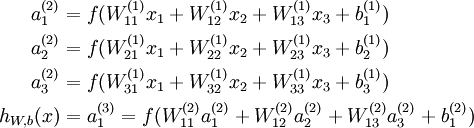
to denote the i-th input. Given a fixed setting of the parameters W,b, our neural network defines a hypothesis hW,b(x) that outputs a real number. Specifically, the computation that this neural network represents is given by:
每层都是线性组合 + 非线性映射
In the sequel, we also let
denote the total weighted sum of inputs to unit i in layer l, including the bias term (e.g.,
), so that
.
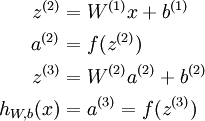
Note that this easily lends itself to a more compact notation. Specifically, if we extend the activation function
We call this step forward propagation.
Backpropagation Algorithm
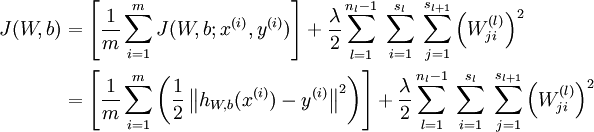
for a single training example (x,y), we define the cost function with respect to that single example to be:
This is a (one-half) squared-error cost function. Given a training set of m examples, we then define the overall cost function to be:
J(W,b;x,y) is the squared error cost with respect to a single example; J(W,b) is the overall cost function, which includes the weight decay term.
Our goal is to minimize J(W,b) as a function of W and b. To train our neural network, we will initialize each parameter
will be the same for all values of i, so that
for any input x). The random initialization serves the purpose of symmetry breaking.
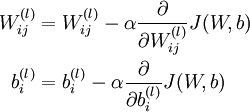
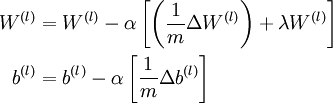
One iteration of gradient descent updates the parameters W,b as follows:
The two lines above differ slightly because weight decay is applied to W but not b.
The intuition behind the backpropagation algorithm is as follows. Given a training example (x,y), we will first run a "forward pass" to compute all the activations throughout the network, including the output value of the hypothesis hW,b(x). Then, for each node i in layer l, we would like to compute an "error term"
that measures how much that node was "responsible" for any errors in our output.
For an output node, we can directly measure the difference between the network's activation and the true target value, and use that to define
(where layer nl is the output layer). For hidden units, we will compute
- 1,Perform a feedforward pass, computing the activations for layers L2, L3, and so on up to the output layer
.

2,For each output unit i in layer nl (the output layer), set

For
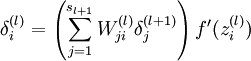
For each node i in layer l, set

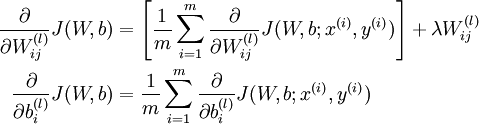
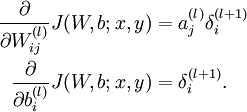
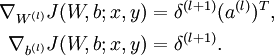
4,Compute the desired partial derivatives, which are given as:
We will use "
" to denote the element-wise product operator (denoted ".*" in Matlab or Octave, and also called the Hadamard product), so that if
, then
. Similar to how we extended the definition of
to apply element-wise to vectors, we also do the same for
(so that
).
The algorithm can then be written:
- 1,Perform a feedforward pass, computing the activations for layers
,
, up to the output layer
, using the equations defining the forward propagation steps
2,For the output layer (layer
), set
3,For
- Set
4,Compute the desired partial derivatives:
Implementation note: In steps 2 and 3 above, we need to compute
for each value of
. Assuming
is the sigmoid activation function, we would already have
stored away from the forward pass through the network. Thus, using the expression that we worked out earlier for
, we can compute this as
.
Finally, we are ready to describe the full gradient descent algorithm. In the pseudo-code below,
is a matrix (of the same dimension as
), and
is a vector (of the same dimension as
). Note that in this notation, "
times
- 1,Set
,
(matrix/vector of zeros) for all
.
- 2,For
to
,
- Use backpropagation to compute
and
.
- Set
.
- Set
.
- 3,Update the parameters:



Sparse Autoencoder(一)的更多相关文章
- Deep Learning 1_深度学习UFLDL教程:Sparse Autoencoder练习(斯坦福大学深度学习教程)
1前言 本人写技术博客的目的,其实是感觉好多东西,很长一段时间不动就会忘记了,为了加深学习记忆以及方便以后可能忘记后能很快回忆起自己曾经学过的东西. 首先,在网上找了一些资料,看见介绍说UFLDL很不 ...
- (六)6.5 Neurons Networks Implements of Sparse Autoencoder
一大波matlab代码正在靠近.- -! sparse autoencoder的一个实例练习,这个例子所要实现的内容大概如下:从给定的很多张自然图片中截取出大小为8*8的小patches图片共1000 ...
- UFLDL实验报告2:Sparse Autoencoder
Sparse Autoencoder稀疏自编码器实验报告 1.Sparse Autoencoder稀疏自编码器实验描述 自编码神经网络是一种无监督学习算法,它使用了反向传播算法,并让目标值等于输入值, ...
- 七、Sparse Autoencoder介绍
目前为止,我们已经讨论了神经网络在有监督学习中的应用.在有监督学习中,训练样本是有类别标签的.现在假设我们只有一个没有带类别标签的训练样本集合 ,其中 .自编码神经网络是一种无监督学习算法,它使用 ...
- CS229 6.5 Neurons Networks Implements of Sparse Autoencoder
sparse autoencoder的一个实例练习,这个例子所要实现的内容大概如下:从给定的很多张自然图片中截取出大小为8*8的小patches图片共10000张,现在需要用sparse autoen ...
- 【DeepLearning】Exercise:Sparse Autoencoder
Exercise:Sparse Autoencoder 习题的链接:Exercise:Sparse Autoencoder 注意点: 1.训练样本像素值需要归一化. 因为输出层的激活函数是logist ...
- Sparse AutoEncoder简介
1. AutoEncoder AutoEncoder是一种特殊的三层神经网络, 其输出等于输入:\(y^{(i)}=x^{(i)}\), 如下图所示: 亦即AutoEncoder想学到的函数为\(f_ ...
- Exercise:Sparse Autoencoder
斯坦福deep learning教程中的自稀疏编码器的练习,主要是参考了 http://www.cnblogs.com/tornadomeet/archive/2013/03/20/2970724 ...
- DL二(稀疏自编码器 Sparse Autoencoder)
稀疏自编码器 Sparse Autoencoder 一神经网络(Neural Networks) 1.1 基本术语 神经网络(neural networks) 激活函数(activation func ...
- sparse autoencoder
1.autoencoder autoencoder的目标是通过学习函数,获得其隐藏层作为学习到的新特征. 从L1到L2的过程成为解构,从L2到L3的过程称为重构. 每一层的输出使用sigmoid方法, ...
随机推荐
- birthday
2.29 7.25 7.... 5... 10.01 02 03
- <Sicily> 生成字符串
一.题目描述 假设一个字符串只由字符'0','1','?'组成,其中字符'?'表示该字符可由字符'0'或'1'替代. 现有一些字符串,根据这些字符串生成所有可生成的字符串. 如:{10,?1,0? } ...
- html5开发页游(前话)
导师要求模仿某个页游网站开发益智小游戏.老板的要求是要跨平台,IOS,Android.PC.Mac等系统主要通过浏览器打开都能用.那个网站的页游是通过flash实现的,使用这种方法肯定不能满足老板的要 ...
- tensorflow 1 - 起步
使用图 (graph) 来表示计算任务. 在被称之为 会话 (Session) 的上下文 (context) 中执行图. 使用 tensor 表示数据. 通过 变量 (Variable) 维护状态. ...
- mysql优化篇之表分区
当表的数据量达到一定数量时(如单个.myd文件都达到10G,myd 是mysql的数据文件),这时候读取起来必然效率很低. 1.从业务角度可以解决(分表) ...
- caioj 1078 动态规划入门(非常规DP2:不重叠线段)(状态定义问题)
我一开始想的是前i个区间的最大值 显然对于当前的区间,有不选和选两种情况 如果不选的话,就继承f[i-1] 如果选的话,找离当前区间最近的区间取最优 f[i] = max(f[i-1, f[j] + ...
- Unity 编辑器学习(四)之 静态游戏物体
一.Static GameObjects 关于静态对象的信息往往可以预先在编辑器里计算,不需要实时计算,进而优化性能,明显降低DrawCall. 各种Static说明: Lightmapping: 用 ...
- LocalDateTime在spring boot中的格式化配置
在项目中日期格式化是最常见的问题,之前涉及的 java.util.Date 和 java.util.Calendar 类易用性差,不支持时区,非线程安全,对日期的计算方式繁琐,而且容易出错,因为月份是 ...
- No WebApplicationContext found: no ContextLoaderListener registered?报错解决
今天跑了下新搭的一个SSI框架. 报例如以下错误: 严重: Exception sending context initialized event to listener instance of cl ...
- [Recompose] Merge RxJS Button Event Streams to Build a React Counter Component
Combining input streams then using scan to track the results is a common scenario when coding with s ...