
2019南京区域赛ABCHJK题解 & KM-bfs(O(n^3))板子
A.Hard Problem
题目大意:给你一个数n,然后让你计算一个子集大小,这个大小的子集要保证一定存在一个数是另一个数的约数,求出这个最小的数。
做法:显然后面的\(\frac{n}{2}\)个数是互相不为约数的。然后细节再随便搞一搞就行,可以发现\(ans=\lceil\frac{n}{2}\rceil+1\)。
#include<bits/stdc++.h>

using namespace std;

int n,t;

int main(){

	scanf("%d",&t);

	for(int i=1;i<=t;i++){

		scanf("%d",&n);

		printf("%d\n",(n+1)/2+1);

	}

	return 0;

}
B. Chessboard
题目大意:给你棋盘的大小n,m。你需要求出有多少种遍历方式可以遍历整个棋盘,但是在遍历过程中有限制:你不能让你涂完色的格子与其他涂完色的格子在涂色的格子上的最短距离变得更短。
做法:(以下直接抄的别人blog)
首先,我们可以观察到如下几个不难证明的性质:
- 两个被染上颜色的格子之间的距离始终为:曼哈顿距离。
- 一个染色方案是合法的,当且仅当:任何时刻,每行/列被染色的格子要么不存在,要么是连续的一段。
- 如果当前被染色的区域是个矩形,那么最后一个被染色的点,一定在角上。
如果当前被染色的区域是个\(r(r>=2)\)行\(c(c>=2)\)列的矩形,那么接下来要么扩充成 r+1 行 c 列的矩阵(扩充行),要么扩充成 r 行 c+1 列的矩形(扩充列)。并且根据当前状态中最后一个被染色的格子在哪个角上,扩充行/列的方案都是唯一的。
从 1∗1 的矩阵,到 n∗m 的矩阵,一共要扩充 n+m−2 次,其中有 n−1 次是扩充行,这样的决策有 \(C_{n+m-2}^{n-1}\) 种,又由于 1*1 时候的矩阵可以视为左上/右上/左下/右下角,答案需要乘以4.
所以最终答案为\(4C_{n+m-2}^{n-1}\)
具体做法只需要预处理阶乘,然后直接套组合数原始公式+用快速幂求逆即可。
小心\(n=1\)和\(m=1\)的情况。
#include<cstdio>

#include<cstring>

#include<algorithm>

using namespace std;

#define IL inline

typedef long long LL;

const int N = 2e6 + 3;

const LL mod = 1e9 + 7;

LL jc[N];

IL void init() {

	jc[0] = 1;

	for(int i=1;i<=2e6;i++) {

		jc[i] = jc[i-1]*i%mod;

	}

}

IL LL ksm(LL a,LL b,LL p)  {

	LL res = 1LL;

	while(b) {

		if(b&1LL) res = res * a % p;

		a = a * a % p;

		b >>= 1LL;

	}

	return res;

}

IL LL C(LL n,LL m,LL p)  {

	if(n < m) return 0;

	return jc[n]*ksm(jc[m],p-2,p)%p*ksm(jc[n-m],p-2,p) % p;

}

int main() {

	init();

	int T; scanf("%d",&T);

	while(T--) {

		LL n,m; scanf("%lld%lld",&n,&m);

		if(n == 1) {

			if(m == 1) printf("1\n");

			else printf("2\n");

			continue;

		}

		if(m == 1) {

			if(n == 1) printf("1\n");

			else printf("2\n");

			continue;

		}

		printf("%lld\n",4LL*C(n+m-2,n-1,mod)%mod);

	}

	return 0;

}
C. Digital Path
题目大意:你需要找出单调递增1且长度不小于4的路径有多少条。
做法:队友做的。我觉得就是个大模拟Orz。
#include <bits/stdc++.h>

using namespace std;

const int N = 1005;

const int MOD = 1e9 + 7;

const int addx[] = {-1, 0, 1, 0};

const int addy[] = {0, 1, 0, -1};

int a[N][N];

int f[N][N][4];

struct Point {

	int x, y, a;

}P[1000005];

bool cmp(Point A, Point B) {

	return A.a < B.a;

}

int main() {

	//freopen("1.txt", "r", stdin);

	int n, m;

	scanf("%d%d", &n, &m);

	int t = 0;

	for (int i = 1; i <= n; i++)

		for (int j = 1; j <= m; j++) {

			scanf("%d", &a[i][j]);

			P[++t] = (Point) {i, j, a[i][j]};

		}

	sort(P + 1, P + t + 1, cmp);

	for (int i = 1; i <= t; i++) {

		int x = P[i].x, y = P[i].y;

		for (int j = 0; j < 4; j++) {//四个方向

			int fx = x + addx[j], fy = y + addy[j];

			if (fx >= 1 && fx <= n && fy >= 1 && fy <= m && a[fx][fy] + 1 == a[x][y]) {

				for (int k = 1; k < 4; k++) {

					f[x][y][k] = (f[x][y][k] + f[fx][fy][k - 1]) % MOD;

				}

				f[x][y][3] = (f[x][y][3] + f[fx][fy][3]) % MOD;

			}

		}

		if (f[x][y][1] == 0 && f[x][y][2] == 0 && f[x][y][3] == 0)

			f[x][y][0] = 1;

	}

	int ans = 0;

	for (int i = 1; i <= n; i++)

		for (int j = 1; j <= m; j++) {

			int pd = 1;

			for (int k = 0; k < 4; k++) {

				int x = i + addx[k], y = j + addy[k];

				if (x >= 1 && x <= n && y >= 1 && y <= m && a[x][y] == a[i][j] + 1) pd = 0;

			}

			if (pd)

				ans = (ans + f[i][j][3]) % MOD;

		}

	printf("%d", ans);

	return 0;

}
H.Prince and Princess
大意:王子要找到公主在哪个房间。有三类人,说真话的(包括公主),不说真话的,随便人。给你这三种人各自的人数a,b,c,你需要判断你最少需要问多少人才能问出来公主在哪个房间。
做法:显然当\(a>b+c\)时你就能问出来公主在哪,问的次数也显然是\(2(b+c)+1\),不过要小心\(1,0,0\)的情况应该输出0.
#include <bits/stdc++.h>

using namespace std;

int main() {

	int a, b, c;

	cin >> a >> b >> c;

	if (a > b + c) {

		if (a == 1 && b == 0 && c == 0)

			printf("YES\n0");

		else

			printf("YES\n%d", (b + c) * 2 + 1);

	}

	else

		printf("NO\n");

	return 0;

}
J. Spy
大意:你需要给你的人配对,两人配成一对击败对面的队伍获得一定的名声值,你要求出最大的期望名声*n。
做法:假如此时你已经把所有人都配对好了,设此时你每个队队伍的力量值为\(d_i\),那么最后答案为$$ans=\sum_{i=1}n\sum_{j=1}n[d_i<a_j]p_j$$
我们可以发现配对的过程是一个二分图最大权匹配。边权就是\(b_i\)与\(c_j\)相连对答案的贡献$$\sum_{k=1}^n[b_i+c_j>a_k]p_k$$
然后这个题把(在我已知范围内的)除了bfs的\(O(n^3)\)以外的所有算法都给卡了。包括我写dfs的\(O(n^3)\)算法也过不去,甚至dfs的\(O(n^4)\)算法比\(O(n^3)\)还快。
这个板子需要记录一下,因为我不会写。
bfs ac。
#include<cstdio>

#include<cstring>

#include<algorithm>

using namespace std;

#define IL inline

typedef long long LL;

const int N = 400 + 3;

const int INF = 0x3f3f3f3f;

struct Kuhn_Munkers {

	int n;

	int W[N][N];

	int Lx[N],Ly[N];

	int left[N];

	int slack[N];

	int pre[N];

	bool T[N];

	IL void init(int n) {

		this->n = n;

		for(int i=1;i<=n;i++) fill(W[i],W[i]+1+n,INF);

	}

	IL void bfs(int u) {

		fill(slack,slack+1+n,INF);

		fill(pre,pre+1+n,0);

		int x,y=0,yy=0,a;

		left[y] = u;

		for(;;) {

			x = left[y]; a = INF, T[y] = true;

			for(int i=1;i<=n;i++) if(!T[i]){

				if(slack[i] > Lx[x]+Ly[i]-W[x][i]) {

					slack[i] = Lx[x] + Ly[i] - W[x][i];

					pre[i] = y;

				}

				if(slack[i] < a) a = slack[i],yy = i;

			}

			for(int i=0;i<=n;i++) {

				if(T[i]) { Lx[left[i]] -= a; Ly[i] += a;}

				else slack[i] -= a;

			}

			y = yy;

			if(!left[y]) break;

		}

		while(y) left[y] = left[pre[y]], y = pre[y];

	}

	IL int KM() {

		fill(Lx,Lx+1+n,0);

		fill(Ly,Ly+1+n,0);

		fill(left,left+1+n,0);

		for(int i=1;i<=n;i++) {

			fill(T,T+1+n,false);

			bfs(i);

		}

		int ans = 0LL;

		for(int j=1;j<=n;j++) ans += W[left[j]][j];

		return ans;

	}

}solver;

int n;

int p[N];

LL a[N],b[N],c[N];

int main() {

	scanf("%d",&n); solver.init(n);

	for(int i=1;i<=n;i++) scanf("%lld",&a[i]);

	for(int i=1;i<=n;i++) scanf("%d",&p[i]);

	for(int i=1;i<=n;i++) scanf("%lld",&b[i]);

	for(int i=1;i<=n;i++) scanf("%lld",&c[i]);

	for(int i=1;i<=n;i++) {

		for(int j=1;j<=n;j++) {

			int v = 0;

			for(int k=1;k<=n;k++) if(b[i]+c[j] > a[k]) v += p[k];

			solver.W[i][j] = v;

		}

	}

	printf("%d\n",solver.KM());

	return 0;

}
dfs tle
#include<cstdio>

#include<cstring>

#include<algorithm>

using namespace std;

#define IL inline

typedef long long LL;

const int N = 400 + 3;

const int INF = 0x3f3f3f3f;

struct Kuhn_Munkers {

	int n;

	int W[N][N];

	int Lx[N],Ly[N];

	int left[N];

	int slack[N];

	bool S[N],T[N];

	IL void init(int n) {

		this->n = n;

		for(int i=1;i<=n;i++) fill(W[i],W[i]+1+n,INF);

		fill(Lx,Lx+1+n,0);

		fill(Ly,Ly+1+n,0);

		fill(left,left+1+n,0);

	}

	bool match(int i) {

		S[i] = true;

		for(int j=1;j<=n;j++) if(!T[j]) {

			if(Lx[i]+Ly[j] == W[i][j]) {

				T[j] = true;

				if(!left[j] || match(left[j])) {

					left[j] = i;

					return true;

				}

			}

			else slack[j] = min(slack[j],Lx[i]+Ly[j]-W[i][j]);

		}

		return false;

	}

	IL void update() {

		int a = INF;

		for(int j=1;j<=n;j++) if(!T[j]) a = min(a,slack[j]);

		for(int i=1;i<=n;i++) {

			if(S[i]) Lx[i] -= a;

			if(T[i]) Ly[i] += a;

			else slack[i] -= a;

		}

	}

	IL int KM() {

		for(int i=1;i<=n;i++) {

			left[i] = Lx[i] = Ly[i] = 0;

			for(int j=1;j<=n;j++)

				Lx[i] = max(Lx[i],W[i][j]);

		}

		for(int i=1;i<=n;i++) {

			fill(slack,slack+1+n,INF);

			for(;;) {

				for(int j=1;j<=n;j++) S[j]=T[j]=0;

				if(match(i)) break; else update();

			}

		}

		int ans = 0LL;

		for(int j=1;j<=n;j++) {

			ans += W[left[j]][j];

		}

		return ans;

	}

}solver;

int n;

int p[N];

LL a[N],b[N],c[N];

int main() {

	scanf("%d",&n); solver.init(n);

	for(int i=1;i<=n;i++) scanf("%lld",&a[i]);

	for(int i=1;i<=n;i++) scanf("%d",&p[i]);

	for(int i=1;i<=n;i++) scanf("%lld",&b[i]);

	for(int i=1;i<=n;i++) scanf("%lld",&c[i]);

	for(int i=1;i<=n;i++) {

		for(int j=1;j<=n;j++) {

			int v = 0;

			for(int k=1;k<=n;k++) if(b[i]+c[j] > a[k]) v += p[k];

			solver.W[i][j] = v;

		}

	}

	printf("%d\n",solver.KM());

	return 0;

}
K.Triangle
大意:给你一个三角形,你需要找到一条线段平分这个三角形的面积,这个线段的一个端点已经给出了。
做法:简单的计算几何题,但是我写了3.5kb,非常难受。
给的端点如果不在三角形边上或者角上直接输出-1.
那么在三角形边上可以分成两种情况:
- 给的端点在角上。
- 给的端点在边上。
如果给的端点在角上,那么显然你只需要输出对边的中点即可。
如果给的端点在边上,那么你可以枚举这个端点相邻的两个角,然后利用正弦的面积公式,得出另一个端点在哪里,如果另一个端点不在三角形上就不要它。
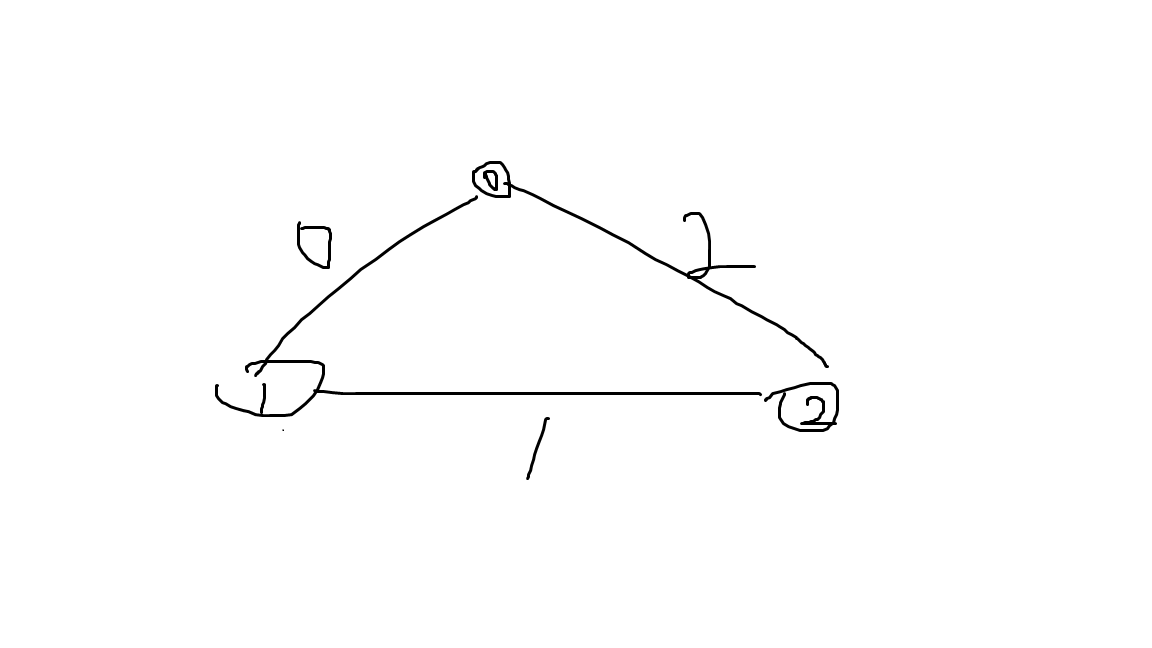
配一张图,看一下我的代码里边和角的命名。
#include<cstdio>

#include<cmath>

#include<cstring>

#include<cstdlib>

#include<vector>

#include<algorithm>

using namespace std;

#define IL inline

typedef long long LL;

const double PI = acos(-1.0);

const double eps = 1e-10;

struct Point {

	double x,y;

	IL Point() {}

	IL Point(double x,double y):x(x),y(y){}

};

typedef Point Vector;

IL Vector operator + (const Vector& A,const Vector& B) { return Vector(A.x+B.x,A.y+B.y);}

IL Vector operator - (const Vector& A,const Vector& B) { return Vector(A.x-B.x,A.y-B.y);}

IL Vector operator * (const Vector& A,double p) { return Vector(A.x*p,A.y*p);}

IL Vector operator / (const Vector& A,double p) { return Vector(A.x/p,A.y/p);}

IL bool operator < (const Point& a, const Point& b) { return a.x < b.x || (a.x == b.x && a.y < b.y);}

IL int dcmp(double x) { if(fabs(x) < eps) return 0; else return x < 0 ? -1 : 1;}

IL bool operator == (const Point& A,const Point& B) { return dcmp(A.x-B.x) == 0 && dcmp(A.y-B.y) == 0;}

IL double Dot(const Vector& A,const Vector& B) { return A.x*B.x + A.y*B.y;}

IL double Length(const Vector& A) { return sqrt(Dot(A,A));}

IL double Angle(const Vector& A,const Vector& B) { return acos(Dot(A,B) / Length(A) / Length(B));}

IL double Cross(const Vector& A,const Vector& B) { return A.x*B.y - A.y*B.x;}

IL double Area2(const Point& A, const Point& B,const Point& C) { return Cross(B-A,C-A);}

IL Vector Rotate(const Vector& A,double rad) { return Vector(A.x*cos(rad)-A.y*sin(rad),A.x*sin(rad)+A.y*cos(rad));}

IL Vector Normal(const Vector& A) { double L = Length(A); return Vector(-A.y/L,-A.x/L);}

IL double DistanceToSegment(const Point& P,const Point& A,const Point& B) {

	if(A == B) return Length(P-A);

	Vector v1 = B-A, v2 = P-A, v3 = P-B;

	if(dcmp(Dot(v1,v2)) < 0) return Length(v2);

	else if(dcmp(Dot(v1,v3)) > 0) return Length(v3);

	else return fabs(Cross(v1,v2)) / Length(v1);

}

int vtos[5][5];

int stov[5][5];

IL void init() {

	vtos[0][1] = vtos[1][0] = 0;

	vtos[0][2] = vtos[2][0] = 2;

	vtos[1][2] = vtos[2][1] = 1;

	stov[0][0] = 0; stov[0][1] = 1;

	stov[1][0] = 1; stov[1][1] = 2;

	stov[2][0] = 0; stov[2][1] = 2;

}

bool may[5];

IL int valid(Point* p) {

	may[0]=may[1]=may[2] = false;

	for(int i=0;i<3;i++) if(p[i] == p[3]) {

		may[(i+1)%3] = true; return 1;

	}

	for(int i=0;i<3;i++) {

		for(int j=0;j<i;j++) {

			if(DistanceToSegment(p[3],p[i],p[j]) == 0) {

				may[0]=may[1]=may[2] = true;

				may[vtos[i][j]] = false;

				return 2;

			}

		}

	}

	return 0;

}

IL void EndPoint_On_Vertices(Point* p) {

	int now;

	for(int i=0;i<3;i++) if(may[i]) now = i;

	Point a = p[stov[now][0]] , b = p[stov[now][1]];

	Point ans = a + (b-a) / 2.0;

	printf("%lf %lf\n",ans.x,ans.y);

}

IL void EndPoint_On_Sides(Point *p) {

	int pos;

	for(int i=0;i<3;i++) if(!may[i]){ pos = i;}

	for(int i=0;i<2;i++) {

		int v1 = stov[pos][i], v2 = stov[pos][i^1], v3 = 3-v1-v2;

		double S = Length(p[v2]-p[v1]) / 2.0 *Length(p[v3]-p[v1]);

		double d = S / Length(p[3]-p[v1]);

		Point ans = p[v1] + (p[v3]-p[v1]) / Length(p[v3]-p[v1]) * d;

		if(DistanceToSegment(ans,p[v1],p[v3]) > eps) continue;

		printf("%lf %lf\n",ans.x,ans.y); return;

	}

	printf("-1\n");

}

Point p[10];

int main() {

	int T; scanf("%d",&T); init();

	while(T--) {

		for(int i=0;i<4;i++) {

			int x,y; scanf("%d%d",&x,&y);

			p[i] = Point(x,y);

		}

		int d = valid(p);

		if(!d) { printf("-1\n"); continue;}

		else if(d == 1) EndPoint_On_Vertices(p);

		else EndPoint_On_Sides(p);

	}

	return 0;

}
后面随便复制粘贴一些别人博客我没写的题解。
2019南京区域赛ABCHJK题解 & KM-bfs(O(n^3))板子的更多相关文章
- 【2013南京区域赛】部分题解 hdu4802—4812
上周末打了一场训练赛,题目是13年南京区域赛的 这场题目有好几个本来应该是我擅长的,但是可能是太久没做比赛了各种小错误代码写的也丑各种warusn trush搞得人很不爽 全场题之一的1002也没有想 ...
- 2019 南京网络赛A
南京网络赛自闭现场 https://nanti.jisuanke.com/t/41298 二维偏序经典题型 二维前缀和!!! #include<bits/stdc++.h> using n ...
- 2018 ACM-ICPC南京区域赛题解
解题过程 开场开A,A题shl看错题意,被制止.然后开始手推A,此时byf看错E题题意,开始上机.推出A的规律后,shl看了E题,发现题意读错.写完A题,忘记判断N=0的情况,WA+1.过了A后,sh ...
- The Preliminary Contest for ICPC Asia Nanjing 2019/2019南京网络赛——题解
(施工中……已更新DF) 比赛传送门:https://www.jisuanke.com/contest/3004 D. Robots(期望dp) 题意 给一个DAG,保证入度为$0$的点只有$1$,出 ...
- 2017沈阳区域赛Infinite Fraction Path(BFS + 剪枝)
Infinite Fraction Path Time Limit: 6000/3000 MS (Java/Others) Memory Limit: 262144/262144 K (Java ...
- 2018ACM-ICPC南京区域赛M---Mediocre String Problem【exKMP】【Manacher】
这题就单独写个题解吧.想了两天了,刚刚问了一个大佬思路基本上有了. 题意: 一个串$S$,一个串$T$,在$S$中选一段子串$S[i,j]$,在$T$中选一段前缀$T[1,k]$使得$S[i,j]T[ ...
- 2018ACM-ICPC南京区域赛---AJGIDKM
含[最小球覆盖][最大流isap]模板. 题面pdf https://codeforc.es/gym/101981/attachments/download/7891/20182019-acmicpc ...
- 2018-2019 ACM-ICPC 徐州区域赛 部分题解
题目链接:2018-2019 ACM-ICPC, Asia Xuzhou Regional Contest A. Rikka with Minimum Spanning Trees 题意: 给出一个随 ...
- 2018南京区域赛K题 Kangaroo Puzzle——随机&&乱搞
题意 在 n * m 的平面上有若干个袋鼠和墙(1为袋鼠,0为墙),每次可以把所有袋鼠整体往一个方向移动一步(不能走出边界和不能走到墙),为在不超过50000步的情况下能否把全部袋鼠聚集在同一个位置. ...
- Robots 2019南京网络赛 (概率dp)
Robots \[ Time Limit: 1000 ms \quad Memory Limit: 262144 kB \] 题意 有一个机器人要从 \(1\) 点走到 \(n\) 点,每走一步都需要 ...
随机推荐
- 3种方式自动化控制APP
自动化控制APP不管是在工作还是生活方面,都可以帮助我们高效地完成任务,节省时间和精力.本文主要介绍自动化控制APP的3种常用方式. 1.Python + adb 这种方式需要对Android有一些基 ...
- 6.Ingress 七层负载
官方文档:https://kubernetes.io/zh-cn/docs/concepts/services-networking/ingress/题目: 设置配置环境: [candidate@no ...
- ubuntu_24.04 Noble LTS安装docker desktop启动无窗口及引擎启动失败的解决方法
ubuntu_24.04 LTS安装docker desktop启动无窗口及引擎启动失败的解决方法 1. 安装docker desktop后启动无窗口 现象: 执行sudo apt install . ...
- SQL Server实战四:查询数据库的数据
本文介绍基于Microsoft SQL Server软件,实现数据库表中多种数据查询方法的具体操作. 目录 1 指定列或全部列查询--查询S表学生记录 2 指定列或全部列查询--查询学生姓名与出生 ...
- pageoffice6 版本在线打开文件弹出网页对话框
用户在使用PageOffice在线编辑文档的操作过程中,如果遇到一些复杂的编辑需求,可能会需要弹出一个新的对话框,做相应的处理,可能是设置一些格式,就如同Office设置字体.段落等各种对话框,也可能 ...
- PyQt5 GUI编程(组件使用)
一.简介 PyQt5 是一个用于创建图形用户界面(GUI)应用程序的 Python 绑定,它基于 Qt 库.PyQt5 提供了大量的组件(也称为控件或部件),用于构建复杂的用户界面.以下是一些常用的 ...
- mysql 命令行安装方式
一:下载 先到 mysql 官方网站下载:https://dev.mysql.com/downloads/mysql/ 点击直接下载: 解压到目录:D:\mysql-8.0.19-winx64 如图 ...
- Java——成语接龙——递归算法——SpringJDBC+c3p0
这个例子,是我练习SpringJdbc+c3p0时所写.实现了输入一个成语,得到一颗不完整的接龙树.因为我数据库里有3W多个成语,在排除了接龙树成语重复的情况下,依然不能得到全部的结果,我感觉应该 ...
- Vue cli使用Element UI
当前的测试环境如下: ---- 新版的@vue/cli ---- Vue2.x版本 第一步:安装Element UI npm i element-ui -S 第二步:引入Element UI 在mai ...
- FFmpeg中的常见结构体
代码基于FFmpeg5.0.1 目录 FFFormatContext AVFormatContext AVIOContext FFIOContext URLContext URLProtocol AV ...