
Python integer objects implementation
http://www.laurentluce.com/posts/python-integer-objects-implementation/
Python integer objects implementation
This article describes how integer objects are managed by Python internally.
An integer object in Python is represented internally by the structure PyIntObject. Its value is an attribute of type long.
1 |
typedef struct { |
2 |
PyObject_HEAD |
3 |
long ob_ival; |
4 |
} PyIntObject; |
To avoid allocating a new integer object each time a new integer object is needed, Python allocates a block of free unused integer objects in advance.
The following structure is used by Python to allocate integer objects, also called PyIntObjects. Once this structure is initialized, the integer objects are ready to be used when new integer values are assigned to objects in a Python script. This structure is called “PyIntBlock” and is defined as:
1 |
struct _intblock { |
2 |
struct _intblock *next; |
3 |
PyIntObject objects[N_INTOBJECTS]; |
4 |
}; |
5 |
typedef struct _intblock PyIntBlock; |
When a block of integer objects is allocated by Python, the objects have no value assigned to them yet. We call them free integer objects ready to be used. A value will be assigned to the next free object when a new integer value is used in your program. No memory allocation will be required when a free integer object’s value is set so it will be fast.
The integer objects inside the block are linked together back to front using their internal pointer called ob_type. As noted in the source code, this is an abuse of this internal pointer so do not pay too much attention to the name.
Each block of integers contains the number of integer objects which can fit in a block of 1K bytes, about 40 PyIntObject objects on my 64-bit machine. When all the integer objects inside a block are used, a new block is allocated with a new list of integer objects available.
A singly-linked list is used to keep track of the integers blocks allocated. It is called “block_list” internally.

A specific structure is used to refer small integers and share them so access is fast. It is an array of 262 pointers to integer objects. Those integer objects are allocated during initialization in a block of integer objects we saw above. The small integers range is from -5 to 256. Many Python programs spend a lot of time using integers in that range so this is a smart decision.
1 |
#define NSMALLPOSINTS 257 |
2 |
#define NSMALLNEGINTS 5 |
3 |
static PyIntObject *small_ints[NSMALLNEGINTS + NSMALLPOSINTS]; |
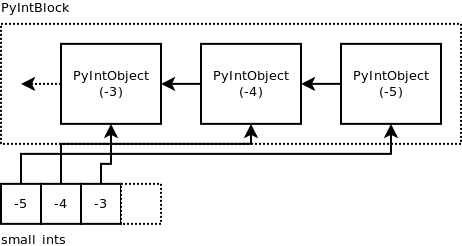
The integer object representing the integer -5 is at the offset 0 inside the small integers array. The integers object representing -4 is at offset 1 …
What happens when an integer is defined in a Python script like this one?
1 |
>>> a=1 |
2 |
>>> a |
3 |
1 |
When you execute the first line, the function PyInt_FromLong is called and its logic is the following:
1 |
if integer value in range -5,256: |
2 |
return the integer object pointed by the small integers array at the |
3 |
offset (value + 5). |
4 |
else: |
5 |
if no free integer object available: |
6 |
allocate new block of integer objects |
7 |
set value of the next free integer object in the current block |
8 |
of integers. |
9 |
return integer object |
With our example: integer 1 object is pointed by the small integers array at offset: 1+5 = 6. A pointer to this integer object will be returned and the variable “a” will be pointing to that integer object.
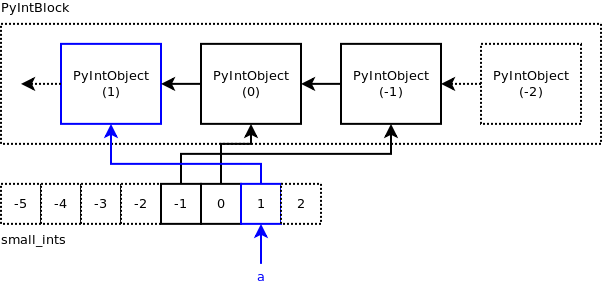
Let’s a look at a different example:
1 |
>>> a=300 |
2 |
>>> a |
3 |
300 |
300 is not in the range of the small integers array so the next free integer object’s value is set to 300.

If you take a look at the file intobject.c in the Python 2.6 source code, you will see a long list of functions taking care of operations like addition, multiplication, conversion… The comparison function looks like this:
1 |
static int |
2 |
int_compare(PyIntObject *v, PyIntObject *w) |
3 |
{ |
4 |
register long i = v->ob_ival; |
5 |
register long j = w->ob_ival; |
6 |
return (i < j) ? -1 : (i > j) ? 1 : 0; |
7 |
} |
The value of an integer object is stored in its ob_ival attribute which is of type long. Each value is placed in a register to optimize access and the comparison is done between those 2 registers. -1 is returned if the integer object pointed by v is less than the one pointed by w. 1 is returned for the opposite and 0 is returned if they are equal.
That’s it for now. I hope you enjoyed the article. Please write a comment if you have any feedback.
Python integer objects implementation的更多相关文章
- Python string objects implementation
http://www.laurentluce.com/posts/python-string-objects-implementation/ Python string objects impleme ...
- Exploring Python Code Objects
Exploring Python Code Objects https://late.am/post/2012/03/26/exploring-python-code-objects.html Ins ...
- [LeetCode][Python]Integer to Roman
# -*- coding: utf8 -*-'''__author__ = 'dabay.wang@gmail.com'https://oj.leetcode.com/problems/integer ...
- python中objects的all和get方法的区别
all返回的是QuerySet: get返回的是模型对象. 想要获取查询结果的字段值: 从QuerySet中获取对象可以通过for in的形式遍历,之后通过对象获取对象的具体值: get 返回的是对象 ...
- The internals of Python string interning
JUNE 28TH, 2014Tweet This article describes how Python string interning works in CPython 2.7.7. A fe ...
- Python string interning原理
原文链接:The internals of Python string interning 由于本人能力有限,如有翻译出错的,望指明. 这篇文章是讲Python string interning是如何 ...
- [python 源码]字符串对象的实现
还是带着问题上路吧,和整数对象的实现同样的问题: >>> a='abc' >>> b='abc' >>> a is b True >> ...
- 字符串池化 python
前言 在 Python 中经常通过内存池化技术来提高其性能,那么问题来了,在什么情况下会池化呢? 让我们通过几个例子进行一下理解一下. 预备知识 在查看例子之前,首先要提 python 中的一个函数 ...
- Python中的内置函数
2.1 Built-in Functions The Python interpreter has a number of functions built into it that are alway ...
随机推荐
- UINavigationController 操作记录
//设置字体大小 颜色 { UIColor *color = [UIColor brownColor]; UIFont * font = [UIFont systemFontOfSize:20]; N ...
- Casperjs/PhantomJs 中文网站截图乱码
使用CasperJs进行自动化测试中文网站的时候发现中文网站截图会出现乱码的现象,中文汉字被一个个小方框代替 查找了一些资料发现是因为Linux服务器上没有安装中文字体导致的,Linux如何安装中文字 ...
- Tableau学习笔记之二
2张图片解析下Tableau 9.0界面的功能 1.数据加载界面: 2.数据分析界面:
- c++与java的优缺点
大多数程序员都认为C/C++会比Java语言快,甚至于觉得从Java语言诞生以来,"执行速度缓慢"的帽子就应当被扣在头顶,这种观点的出现是由于Java刚出现的时候JIT编译技术 ...
- 实际例子描述和分析“猎豹抢票跨站推荐功能有票刷不到”的疑似bug
前言 快过年了,又到了一年抢票时.今年douba和douma计划要带着doudou回姥姥家.昨天在家用抢票软件居然发现了一个bug,那就是在猎豹抢票中跨站推荐的车票几天里一直是没有,但是在12306手 ...
- BestCoder Round #70 Jam's math problem(hdu 5615)
Problem Description Jam has a math problem. He just learned factorization. He is trying to factorize ...
- HDU 3668 Volume (数学,积分)
题意:求图中交叉圆柱体的体积! 析:大体思路很明确,把两个圆柱的体积加起来 减去中间公共部分的即可!第一步首先得想到公共部分是一个怎样的图形.这个在高数下册例题中有讲到! 中间实线部分就是第一卦限内的 ...
- HDU 4431 Mahjong (DFS,暴力枚举,剪枝)
题意:给定 13 张麻将牌,问你是不是“听”牌,如果是输出“听”哪张. 析:这个题,很明显的暴力,就是在原来的基础上再放上一张牌,看看是不是能胡,想法很简单,也比较好实现,结果就是TLE,一直TLE, ...
- Java中重写与重载的辨析
摘要:在我们学习Java过程中,重写与重载使我们在面向对象里要学习的重要知识点之一,那我们看看它们有那些区别: 一.重写 1.概念:简单的说就是子类将从父类继承而来的方法重新实现一次. 2.特点: ① ...
- 连接查询中on and和on where的区别
一.区别 1. and条件是在生成临时表时使用的条件,它不管and中的条件是否为真,都会返回左(或者右)边表中的记录. 2.where条件是在临时表生成好后,再对临时表进行过滤的条件.这时已经没有le ...