
The internals of Python string interning
JUNE 28TH, 2014Tweet
This article describes how Python string interning works in CPython 2.7.7.
A few days ago, I had to explain to a colleague what the built-in function intern does. I gave him the following example:
>>> s1 = 'foo!'

>>> s2 = 'foo!'

>>> s1 is s2

False

>>> s1 = intern('foo!')

>>> s1

'foo!'

>>> s2 = intern('foo!')

>>> s1 is s2

True
You got the idea but… how does it work internally?
The PyStringObject structure
Let’s delve into CPython source code and take a look at PyStringObject, the C structure representing Python strings located in the file stringobject.h:
typedef struct {

    PyObject_VAR_HEAD

    long ob_shash;

    int ob_sstate;

    char ob_sval[1];

    /* Invariants:

     *     ob_sval contains space for 'ob_size+1' elements.

     *     ob_sval[ob_size] == 0.

     *     ob_shash is the hash of the string or -1 if not computed yet.

     *     ob_sstate != 0 iff the string object is in stringobject.c's

     *       'interned' dictionary; in this case the two references

     *       from 'interned' to this object are *not counted* in ob_refcnt.

     */

} PyStringObject;
According to this comment, the variable ob_sstate is different from 0 if and only if the string is interned. This variable is never accessed directly but always through the macro PyString_CHECK_INTERNED defined a few lines below:
#define PyString_CHECK_INTERNED(op) (((PyStringObject *)(op))->ob_sstate)The interned dictionary
Then, let’s open stringobject.c. Line 24 declares a reference to an object where interned strings will be stored:
static PyObject *interned;In fact, this object is a regular Python dictionary and is initialized line 4745:
interned = PyDict_New();Finally, all the magic happens line 4732 in the PyString_InternInPlace function. The implementation is straightforward:
PyString_InternInPlace(PyObject **p)

{

    register PyStringObject *s = (PyStringObject *)(*p);

    PyObject *t;

    if (s == NULL || !PyString_Check(s))

        Py_FatalError("PyString_InternInPlace: strings only please!");

    /* If it's a string subclass, we don't really know what putting

       it in the interned dict might do. */

    if (!PyString_CheckExact(s))

        return;

    if (PyString_CHECK_INTERNED(s))

        return;

    if (interned == NULL) {

        interned = PyDict_New();

        if (interned == NULL) {

            PyErr_Clear(); /* Don't leave an exception */

            return;

        }

    }

    t = PyDict_GetItem(interned, (PyObject *)s);

    if (t) {

        Py_INCREF(t);

        Py_DECREF(*p);

        *p = t;

        return;

    }

    if (PyDict_SetItem(interned, (PyObject *)s, (PyObject *)s) < 0) {

        PyErr_Clear();

        return;

    }

    /* The two references in interned are not counted by refcnt.

       The string deallocator will take care of this */

    Py_REFCNT(s) -= 2;

    PyString_CHECK_INTERNED(s) = SSTATE_INTERNED_MORTAL;

}
As you can see, keys in the interned dictionary are pointers to string objects and values are the same pointers. Furthermore, string subclasses cannot be interned. Let me set aside error checking and reference counting and rewrite this function in pseudo Python code:
interned = None

def intern(string):

    if string is None or not type(string) is str:

        raise TypeError

    if string.is_interned:

        return string

    if interned is None:

        global interned

        interned = {}

    t = interned.get(string)

    if t is not None:

        return t

    interned[string] = string

    string.is_interned = True

    return string
Simple, isn’t it?
What are the benefits of interning strings?
Object sharing
Why would you intern strings? Firstly, “sharing” string objects reduces the amount of memory used. Let’s go back to our first example, initially, the variables s1 and s2 reference two different objects:
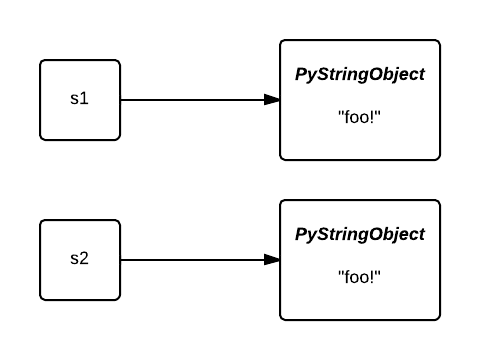
After being interned, they both point to the same object. The memory occupied by the second object is saved:
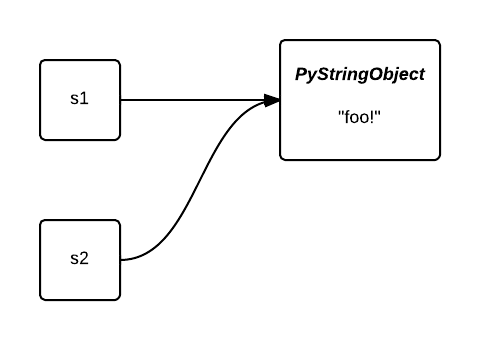
When dealing with large lists with low entropy, interning makes sense. For instance, when tokenizing a corpus, we could benefit from the very heavy-tailed distribution of word frequencies in human languages to intern strings to our advantage. In the following example, we will load the play Hamlet by Shakespeare with NLTK and we will use Heapy to inspect the object heap before and after interning:
import guppy

import nltk

hp = guppy.hpy()

hp.setrelheap()

hamlet = nltk.corpus.shakespeare.words('hamlet.xml')

print hp.heap()

hamlet = [intern(wrd) for wrd in nltk.corpus.shakespeare.words('hamlet.xml')]

print hp.heap()
$ python intern.py
Partition of a set of 31187 objects. Total size = 1725752 bytes.
Index Count % Size % Cumulative % Kind (class / dict of class)
0 31166 100 1394864 81 1394864 81 str
...
Partition of a set of 4555 objects. Total size = 547840 bytes.
Index Count % Size % Cumulative % Kind (class / dict of class)
0 4 0 328224 60 328224 60 list
1 4529 99 215776 39 544000 99 str
...As you can see, we drastically reduced the number of allocated string objects from 31 166 to 4 529 and divided by 6.5 the memory occupied by the strings!
Pointer comparison
Secondly, strings can be compared by a O(1) pointer comparison instead of a O(n) byte-per-byte comparison.
To prove so, I have measured the time required to verify the equality of two strings as a function of their length when they are interned and when they are not. The following should convince you:
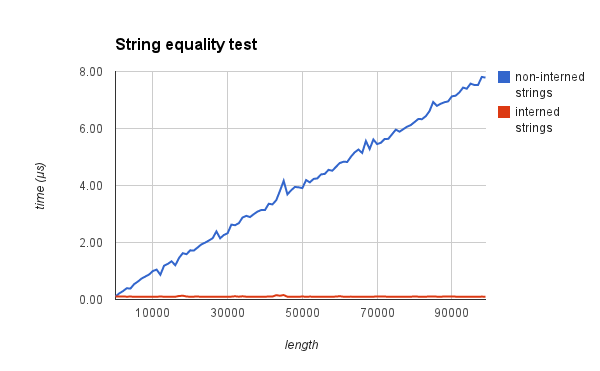
Native interning
Under certain conditions, strings are natively interned. Recall the first example, if I had written foo instead of foo!, the stringss1 and s2 would have been interned “automatically”:
>>> s1 = 'foo'

>>> s2 = 'foo'

>>> s1 is s2

True
Interned or not interned?
Before writing this blog post, I always thought that, under the hood, strings were natively interned according to a rule taking into account their length and the characters composing them. I was not far away from the truth but, unfortunately, when playing with pairs of strings built in very different ways, I could never infer what this rule exactly was. Can you?
>>> 'foo' is 'foo'

True

>>> 'foo!' is 'foo!'

False

>>> 'foo' + 'bar' is 'foobar'

True

>>> ''.join(['f']) is ''.join(['f'])

True

>>> ''.join(['f', 'o', 'o']) is ''.join(['f', 'o', 'o'])

False

>>> 'a' * 20 is 'aaaaaaaaaaaaaaaaaaaa'

True

>>> 'a' * 21 is 'aaaaaaaaaaaaaaaaaaaaa'

False

>>> 'foooooooooooooooooooooooooooooo' is 'foooooooooooooooooooooooooooooo'

True
After looking at these examples, you have to admit that it is hard to tell on which basis a string is natively interned or not. So let’s read some more CPython code and figure it out!
Fact 1: all length 0 and length 1 strings are interned
Still in stringobject.c, this time we will take a look at these interesting lines placed in both of the following functionsPyString_FromStringAndSize and PyString_FromString:
/* share short strings */

if (size == 0) {

    PyObject *t = (PyObject *)op;

    PyString_InternInPlace(&t);

    op = (PyStringObject *)t;

    nullstring = op;

    Py_INCREF(op);

} else if (size == 1 && str != NULL) {

    PyObject *t = (PyObject *)op;

    PyString_InternInPlace(&t);
This leaves no ambiguity: all strings of length 0 and 1 are interned.
Fact 2: strings are interned at compile time
The Python code you write is not directly interpreted and goes through a classic compilation chain which generates an intermediate language called bytecode. Python bytecode is a set of instructions executed by a virtual machine: the Python interpreter. The list of these instructions can be found here and you can find out what instructions are run by a particular function or module, by using the dis module:
>>> import dis

>>> def foo():

...     print 'foo!'

...

>>> dis.dis(foo)

  2           0 LOAD_CONST               1 ('foo!')

              3 PRINT_ITEM

              4 PRINT_NEWLINE

              5 LOAD_CONST               0 (None)

              8 RETURN_VALUE
As you know, in Python everything is an object and Code objects are Python objects which represent pieces of bytecode. A Code object carries along with all the information needed to execute: constants, variable names, and so on. It turns out that when building a Code object in CPython, some more strings are interned:
PyCodeObject *

PyCode_New(int argcount, int nlocals, int stacksize, int flags,

           PyObject *code, PyObject *consts, PyObject *names,

           PyObject *varnames, PyObject *freevars, PyObject *cellvars,

           PyObject *filename, PyObject *name, int firstlineno,

           PyObject *lnotab)

           ...

           /* Intern selected string constants */

           for (i = PyTuple_Size(consts); --i >= 0; ) {

               PyObject *v = PyTuple_GetItem(consts, i);

               if (!PyString_Check(v))

                   continue;

               if (!all_name_chars((unsigned char *)PyString_AS_STRING(v)))

                   continue;

               PyString_InternInPlace(&PyTuple_GET_ITEM(consts, i));

           }
In codeobject.c, the tuple consts contains the literals defined at compile time: booleans, floating-point numbers, integers, and strings declared in your program. The strings stored in this tuple and not filtered out by the all_name_chars function are interned.
In the example below, s1 is declared at compile time. Oppositely, s2 is produced at runtime:
s1 = 'foo'

s2 = ''.join(['f', 'o', 'o'])
As a consequence, s1 will be interned whereas s2 will not.
The function all_name_chars rules out strings that are not composed of ascii letters, digits or underscores, i.e. strings looking like identifiers:
#define NAME_CHARS \

    "0123456789ABCDEFGHIJKLMNOPQRSTUVWXYZ_abcdefghijklmnopqrstuvwxyz"

/* all_name_chars(s): true iff all chars in s are valid NAME_CHARS */

static int

all_name_chars(unsigned char *s)

{

    static char ok_name_char[256];

    static unsigned char *name_chars = (unsigned char *)NAME_CHARS;

    if (ok_name_char[*name_chars] == 0) {

        unsigned char *p;

        for (p = name_chars; *p; p++)

            ok_name_char[*p] = 1;

    }

    while (*s) {

        if (ok_name_char[*s++] == 0)

            return 0;

    }

    return 1;

}
With all these explanations in mind, we now understand why 'foo!' is 'foo!' evaluates to False whereas'foo' is 'foo' evaluates to True. Victory? Not quite yet.
Bytecode optimization produces more string constants
It might sound very counterintuitive, but in the example below, the outcome of the string concatenation is not performed at runtime but at compile time:
>>> 'foo' + 'bar' is 'foobar'

True
This is why the result of 'foo' + 'bar' is also interned and the expression evaluates to True.
How? The penultimate source code compilation step produces a first version of bytecode. This “raw” bytecode finally goes into a last compilation step called “peephole optimization”.
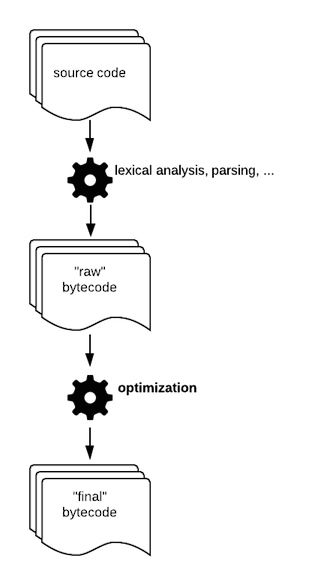
The goal of this step is to produce more efficient bytecode by replacing some instructions by faster ones.
Constant folding
One of the techniques applied during peephole optimization is called constant folding and consists in simplifying constant expressions in advance. Imagine you are a compiler and you come across this line:
SECONDS = 24 * 60 * 60What can you do to simplify this expression and save some clock cycles at runtime? You are going to substitute this expression by the computed value 86400. This is exactly what happens to the 'foo' + 'bar' expression. Let’s define the foobar function and disassemble the corresponding bytecode:
>>> import dis

>>> def foobar():

...         return 'foo' + 'bar'

>>> dis.dis(foobar)

  2           0 LOAD_CONST               3 ('foobar')

              3 RETURN_VALUE
See? No sign of the addition and the two initial constants 'foo' and 'bar'. If CPython bytecode was not optimized, the output would have been the following:
>>> dis.dis(foobar)

  2           0 LOAD_CONST               1 ('foo')

              3 LOAD_CONST               2 ('bar')

              6 BINARY_ADD

              7 RETURN_VALUE
We discovered why the following expression evaluates to True:
>>> 'a' * 20 is 'aaaaaaaaaaaaaaaaaaaa'Avoiding large .pyc files
So why does 'a' * 21 is 'aaaaaaaaaaaaaaaaaaaaa' not evaluate to True? Do you remember the .pyc files you encounter in all your packages? Well, Python bytecode is stored in these files. What would happen if someone wrote something like this['foo!'] * 10**9? The resulting .pyc file would be huge! In order to avoid this phenomena, sequences generated through peephole optimization are discarded if their length is superior to 20.
I know interning
Now, you know all about Python string interning!
I’m amazed at how deep I dug in CPython in order to understand something as anecdotic as string interning. I’m also surprised by the simplicity of the CPython API. Even though, I’m a poor C developer, the code is very readable, very well documented, and I feel like even I could contribute to it.
Immutability required
Oh… one last thing, I forgot to mention one VERY important thing. Interning works because Python strings are immutable. Interning mutable objects would not make sense at all and would cause disastrous side effects.
But wait… We know some other immutable objects. Integers for instance. Well… guess what?
>>> x, y = 256, 256

>>> x is y

True

>>> x, y = int('256'), int('256')

>>> x is y

True

>>> 257 is 257

True

>>> x, y = int('257'), int('257')

>>> x is y

False
;)
Going deeper
- Exploring Python Code Objects, Dan Crosta;
- Python string objects implementation, Laurent Luce.
The internals of Python string interning的更多相关文章
- Python string interning原理
原文链接:The internals of Python string interning 由于本人能力有限,如有翻译出错的,望指明. 这篇文章是讲Python string interning是如何 ...
- 什么是string interning(字符串驻留)以及python中字符串的intern机制
Incomputer science, string interning is a method of storing only onecopy of each distinct string val ...
- python string module
String模块中的常量 >>> import string >>> string.digits ' >>> string.letters 'ab ...
- python string
string比较连接 >>> s1="python string" >>> len(s) 13 >>> s2=" p ...
- Python string objects implementation
http://www.laurentluce.com/posts/python-string-objects-implementation/ Python string objects impleme ...
- Python string replace 方法
Python string replace 方法 方法1: >>> a='...fuck...the....world............' >>> b=a ...
- python string与list互转
因为python的read和write方法的操作对象都是string.而操作二进制的时候会把string转换成list进行解析,解析后重新写入文件的时候,还得转换成string. >>&g ...
- python string 文本常量和模版
最近在看python标准库这本书,第一感觉非常厚,第二感觉,里面有很多原来不知道的东西,现在记下来跟大家分享一下. string类是python中最常用的文本处理工具,在python的 ...
- Python String 方法详解
官网文档地址:https://docs.python.org/3/library/stdtypes.html#string-methods 官网 公号:软测小生ruancexiaosheng 文档里的 ...
随机推荐
- JAVA和C/C++之间的相互调用。
在一些Android应用的开发中,需要通过JNI和 Android NDK工具实现JAVA和C/C++之间的相互调用. Java Native Interface (JNI)标准是java平台的一部分 ...
- 用javascript 面向对象制作坦克大战(二)
2. 完善地图 我们的地图中有空地,墙,钢,草丛,水,总部等障碍物. 我们可以把这些全部设计为对象. 2.1 创建障碍物对象群 对象群保存各种地图上的对象,我们通过对象的属性来判断对 ...
- Apriori学习笔记
Apriori算法是一种挖掘关联规则的频繁项集算法,是由Rakesh Agrawal和Ramakrishnan Srikant两位在1994年提出的布尔关联规则的频繁项集挖掘算法.算法的名字" ...
- NGUI-快捷键
ALT+SHIFT+S :添加一个新的sprite ALT+SHIFT+L :添加一个新的Label ALT+SHIFT+T:添加一个简单的Texture ALT+SHIFT+W 添加一个可见的wid ...
- 通过gdb跟踪Linux内核装载和启动可执行程序过程
作者:吴乐 山东师范大学 <Linux内核分析>MOOC课程http://mooc.study.163.com/course/USTC-1000029000 实验目的:通过对一个简单的可执 ...
- 通过gdb调试分析Linux内核的启动过程
作者:吴乐 山东师范大学 <Linux内核分析>MOOC课程http://mooc.study.163.com/course/USTC-1000029000 一.实验流程 1.打开环境 执 ...
- bzoj 2186 [Sdoi2008]沙拉公主的困惑(欧拉函数,逆元)
[题目链接] http://www.lydsy.com/JudgeOnline/problem.php?id=2186 [题意] 若干个询问,求1..n!中与m!互质的个数. [思路] 首先有gcd( ...
- wireshark筛选器汇总
抓取指定IP地址的数据流: 如果你的抓包环境下有很多主机正在通讯,可以考虑使用所观察主机的IP地址来进行过滤.以下为IP地址抓包过滤示例: host 10.3.1.1:抓取发到/来自10.3.1.1的 ...
- Chapter 2 创建一个应用
App Engine开发模式如下一般简单<1.The App Engine development model is as simple as it gets:>: 1.创建这个应用 2. ...
- Yii CModel中rules验证规则
array( array(‘username’, ‘required’), array(‘username’, ‘length’, ‘min’=>3, ‘max’=>12), array( ...