
Accelerating Deep Learning by Focusing on the Biggest Losers
Accelerating Deep Learning by Focusing on the Biggest Losers
概
思想很简单, 在训练网络的时候, 每个样本都会产生一个损失\(\mathcal{L}(f(x_i),y_i)\), 训练的模式往往是批训练, 将一个批次\(\sum_i \mathcal{L}(f(x_i),y_i)\)所产生的损失的梯度都传回去, 然后更新参数. 本文认为, 有些样本\((x_i,y_i)\)由于重复度高, 网络很高能够识别, 使得对应的\(\mathcal{L}(f(x_i),y_i)\)相对较小, 所以设计了一种机制, 使得损失较大的样本有大概率被选中, 而不重要的样本不被选中, 以此来降低计算时间. 实验证明, 这种方法能够在保持准确率不变的前提下降低训练时间.
相关工作
作者说这个算法首先是由Are Loss Functions All the Same?提出的, 但是这篇文章只是讲了hinge loss的优势和对其它损失函数的分析.
作者说最相关的文章是Not All Samples Are Created Equal: Deep Learning with Importance Sampling, 这篇文章是从预处理(虽然也是要算loss的)的角度出发的, 理论部分较本文多一些.
主要内容
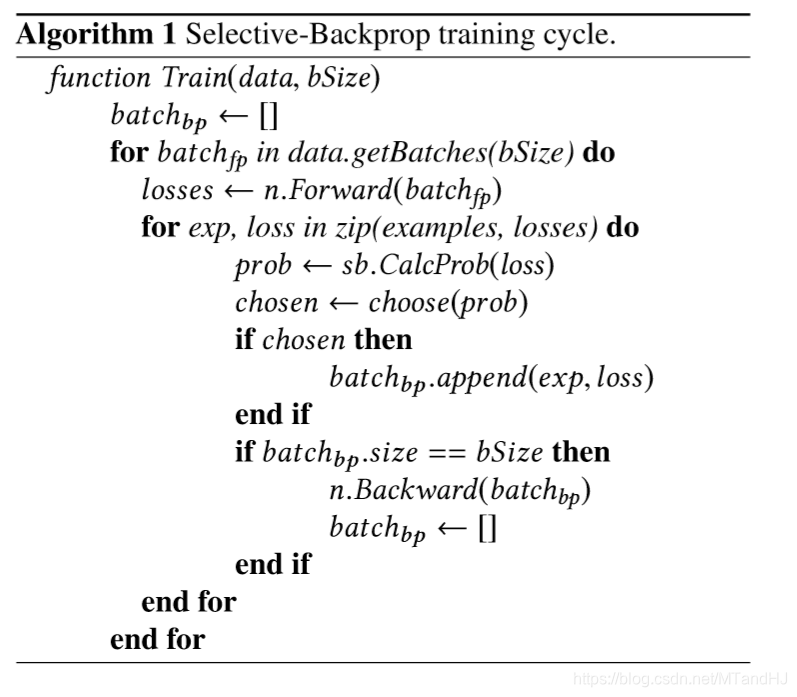
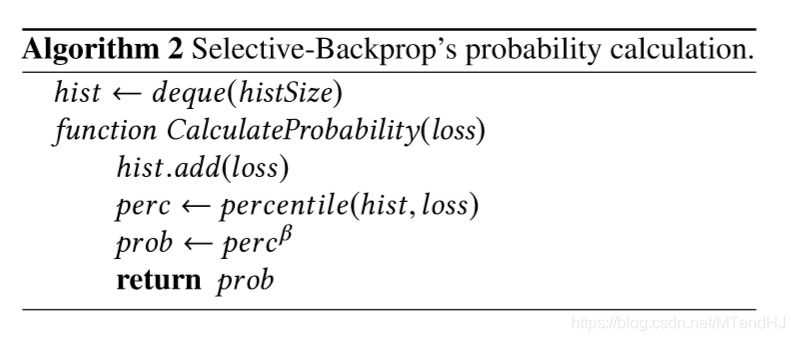
算法1的思路是很清晰的, 主要困扰在算法2概率的计算上. 假设我们以及计算了\(n\)个样本的损失, 我们将其存储起来, 假设下一个样本的损失是\(\mathcal{L}_c\), 如果这\(n\)个样本中有\(k\)个样本的损失均小于\(\mathcal{L}_c\), 则改样本被选中的概率是:
\]
其中\(s\in[0,1]\)是人为设置的, 保证每个样本都有被选中的可能.
我们还可以设置一个最大的长度\(r\), 将以往的损失存储在一个双栈中, 当\(n=r\)的时候,存储下一个损失的同时会抛弃第一个损失, 这么做能在一定程度上减少计算量.
A[样本x] --> C(网络f)
C --> D[损失l]
D--更新-->E[损失库]
D-->F[计算概率]
F-->G(形成batch)
G--反向传递-->C
E-->F
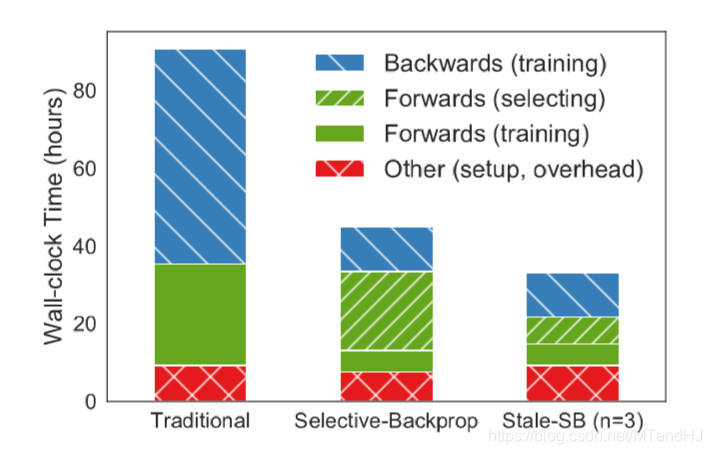
从最开始的图中, 第二列就是表示这个算法, 第三列是在此基础上对前向传递进行一些处理. 直接的是, 每隔\(n\)次epoches更新一次损失, 然后中间的n-1次不更新损失, 直接用旧的损失对样本选择(应该是直接在传入网络就将样本选择好否则就不能降低时间了).
在随机算法中, 有单通道选择样本的一个算法, 但是这个算法只用于选择一个. 所以如果选择很多这个算法就没用了, 感觉一次性选择很多个不好弄.
代码
因为条件限制, 代码并没有测试过, 论文也给出了很棒的代码.
"""

OptInput.py

纯粹是为了便于交互一些, 直接用argparse也可以

"""

class Unit:

    def __init__(self, command, type=str,

                    default=None):

        if default is None:

            default = type()

        self.command = command

        self.type = type

        self.default = default

class Opi:

    """

    >>> parser = Opi()

    >>> parser.add_opt(command="lr", type=float)

    >>> parser.add_opt(command="epochs", type=int)

    """

    def __init__(self):

        self.store = []

        self.infos = {}

    def add_opt(self, **kwargs):

        self.store.append(

            Unit(**kwargs)

        )

    def acquire(self):

        s = "Acquire args {0.command} [" \

            "type:{0.type.__name__} " \

            "default:{0.default}] : "

        for unit in self.store:

            while True:

                inp = input(s.format(

                    unit

                ))

                try:

                    if inp: #若有输入

                        inp = unit.type(inp)

                    else:

                        inp = unit.default

                    self.infos.update(

                        {unit.command:inp}

                    )

                    self.__setattr__(unit.command, inp)

                    break

                except:

                    print("Type {0} should be given".format(

                        unit.type.__name__

                    ))

if __name__ == "__main__":

    parser = Opi()

    parser.add_opt(command = "x", type=int)

    parser.add_opt(command="y", type=str)

    parser.acquire()

    print(parser.infos)

    print(parser.x)
'''

calcprob.py

计算概率

'''

import collections

class Calcprob:

    def __init__(self, beta, sample_min, max_len=3000):

        assert 0. <= sample_min <= 1., "Invalid sample_min"

        assert beta > 0, "Invalid beta"

        self.beta = beta

        self.sample_min = sample_min

        self.max_len = max_len

        self.history = collections.deque(maxlen=max_len)

        self.num_slot = 1000

        self.hist = [0] * self.num_slot

        self.count = 0

    def update_history(self, losses):

        """

        BoundedHistogram

        :param losses:

        :return:

        """

        for loss in losses:

            assert loss > 0

            if self.count is self.max_len:

                loss_old = self.history.popleft()

                slot_old = int(loss_old * self.num_slot) % self.num_slot

                self.hist[slot_old] -= 1

            else:

                self.count += 1

                self.history.append(loss)

            slot = int(loss * self.num_slot) % self.num_slot

            self.hist[slot] += 1

    def get_probability(self, loss):

        assert loss > 0

        slot = int(loss * self.num_slot) % self.num_slot

        prob = sum(self.hist[:slot]) / self.count

        assert isinstance(prob, float), "int division error..."

        return prob ** self.beta

    def calc_probability(self, losses):

        if isinstance(losses, float):

            losses =  (losses, )

        self.update_history(losses)

        probs = (

            max(

                self.get_probability(loss),

                self.sample_min

            )

            for loss in losses

        )

        return probs

    def __call__(self, losses):

        return self.calc_probability(losses)

if __name__ == "__main__":

    pass
'''

selector.py

'''

import calcprob

import numpy as np

class Selector:

    def __init__(self, batch_size,

                 beta, sample_min, max_len=3000):

        self.batch_size = batch_size

        self.calcprob = calcprob.Calcprob(beta,

                                          sample_min,

                                          max_len)

        self.reset()

    def backward(self):

        loss = sum(self.batch)

        loss.backward()

        self.reset()

    def reset(self):

        self.batch = []

        self.length = 0.

    def select(self, losses):

        probs = self.calcprob(losses)

        for i, prob in enumerate(probs):

            if np.random.rand() < prob:

                self.batch.append(losses[i])

                self.length += 1

                if self.length >= self.batch_size:

                    self.backward()

    def __call__(self, losses):

        self.select(losses)
'''

main.py

'''

import torch

import torch.nn as nn

import torchvision

import torchvision.transforms as transforms

import numpy as np

import os

import selector

class Train:

    def __init__(self, model, lossfunc,

                 bpsize, beta, sample_min, max_len=3000,

                 lr=0.01, momentum=0.9, weight_decay=0.0001):

        self.net = self.choose_net(model)

        self.criterion = self.choose_lossfunc(lossfunc)

        self.opti = torch.optim.SGD(self.net.parameters(),

                                    lr=lr, momentum=momentum,

                                    weight_decay=weight_decay)

        self.selector = selector.Selector(bpsize, beta,

                                          sample_min, max_len)

        self.gpu()

        self.generate_path()

        self.acc_rates = []

        self.errors = []

    def choose_net(self, model):

        net = getattr(

            torchvision.models,

            model,

            None

        )

        if net is None:

            raise ValueError("no such model")

        return net()

    def choose_lossfunc(self, lossfunc):

        lossfunc = getattr(

            nn,

            lossfunc,

            None

        )

        if lossfunc is None:

            raise ValueError("no such lossfunc")

        return lossfunc

    def gpu(self):

        self.device = torch.device("cuda:0" if torch.cuda.is_available() else "cpu")

        if torch.cuda.device_count() > 1:

            print("Let'us use %d GPUs" % torch.cuda.device_count())

            self.net = nn.DataParallel(self.net)

        self.net = self.net.to(self.device)

    def generate_path(self):

        """

        生成保存数据的路径

        :return:

        """

        try:

            os.makedirs('./paras')

            os.makedirs('./logs')

            os.makedirs('./infos')

        except FileExistsError as e:

            pass

        name = self.net.__class__.__name__

        paras = os.listdir('./paras')

        logs = os.listdir('./logs')

        infos = os.listdir('./infos')

        number = max((len(paras), len(logs), len(infos)))

        self.para_path = "./paras/{0}{1}.pt".format(

            name,

            number

        )

        self.log_path = "./logs/{0}{1}.txt".format(

            name,

            number

        )

        self.info_path = "./infos/{0}{1}.npy".format(

            name,

            number

        )

    def log(self, strings):

        """

        运行日志

        :param strings:

        :return:

        """

        # a 往后添加内容

        with open(self.log_path, 'a', encoding='utf8') as f:

            f.write(strings)

    def save(self):

        """

        保存网络参数

        :return:

        """

        torch.save(self.net.state_dict(), self.para_path)

    def derease_lr(self, multi=0.96):

        """

        降低学习率

        :param multi:

        :return:

        """

        self.opti.param_groups[0]['lr'] *= multi

    def train(self, trainloder, epochs=50):

        data_size = len(trainloder) * trainloder.batch_size

        part = int(trainloder.batch_size / 2)

        for epoch in range(epochs):

            running_loss = 0.

            total_loss = 0.

            acc_count = 0.

            if (epoch + 1) % 8 is 0:

                self.derease_lr()

                self.log(#日志记录

                    "learning rate change!!!\n"

                )

            for i, data in enumerate(trainloder):

                imgs, labels = data

                imgs = imgs.to(self.device)

                labels = labels.to(self.device)

                out = self.net(imgs)

                _, pre = torch.max(out, 1)  #判断是否判断正确

                acc_count += (pre == labels).sum().item() #加总对的个数

                losses = (

                    self.criterion(out[i], labels[i])

                    for i in range(len(labels))

                )

                self.opti.zero_grad()

                self.selector(losses) #选择

                self.opti.step()

                running_loss += sum(losses).item()

                if (i+1) % part is 0:

                    strings = "epoch {0:<3} part {1:<5} loss: {2:<.7f}\n".format(

                        epoch, i, running_loss / part

                    )

                    self.log(strings)#日志记录

                    total_loss += running_loss

                    running_loss = 0.

            self.acc_rates.append(acc_count / data_size)

            self.errors.append(total_loss / data_size)

            self.log( #日志记录

                "Accuracy of the network on %d train images: %d %%\n" %(

                    data_size, acc_count / data_size * 100

                )

            )

            self.save() #保存网络参数

        #保存一些信息画图用

        np.save(self.info_path, {

            'acc_rates': np.array(self.acc_rates),

            'errors': np.array(self.errors)

        })

if __name__ == "__main__":

    import OptInput

    args = OptInput.Opi()

    args.add_opt(command="model", default="resnet34")

    args.add_opt(command="lossfunc", default="CrossEntropyLoss")

    args.add_opt(command="bpsize", default=32)

    args.add_opt(command="beta", default=0.9)

    args.add_opt(command="sample_min", default=0.3)

    args.add_opt(command="max_len", default=3000)

    args.add_opt(command="lr", default=0.001)

    args.add_opt(command="momentum", default=0.9)

    args.add_opt(command="weight_decay", default=0.0001)

    args.acquire()

    root = "C:/Users/pkavs/1jupiterdata/data"

    trainset = torchvision.datasets.CIFAR10(root=root, train=True,

                                          download=False,

                                          transform=transforms.Compose(

                                              [transforms.Resize(224),

                                               transforms.ToTensor(),

                                               transforms.Normalize((0.5, 0.5, 0.5), (0.5, 0.5, 0.5))]

                                          ))

    train_loader = torch.utils.data.DataLoader(trainset, batch_size=128,

                                              shuffle=True, num_workers=8,

                                               pin_memory=True)

    dog = Train(**args.infos)

    dog.train(train_loader, epochs=1000)
Accelerating Deep Learning by Focusing on the Biggest Losers的更多相关文章
- Deep Learning 27:Batch normalization理解——读论文“Batch normalization: Accelerating deep network training by reducing internal covariate shift ”——ICML 2015
这篇经典论文,甚至可以说是2015年最牛的一篇论文,早就有很多人解读,不需要自己着摸,但是看了论文原文Batch normalization: Accelerating deep network tr ...
- Applied Deep Learning Resources
Applied Deep Learning Resources A collection of research articles, blog posts, slides and code snipp ...
- [C3] Andrew Ng - Neural Networks and Deep Learning
About this Course If you want to break into cutting-edge AI, this course will help you do so. Deep l ...
- 【深度学习Deep Learning】资料大全
最近在学深度学习相关的东西,在网上搜集到了一些不错的资料,现在汇总一下: Free Online Books by Yoshua Bengio, Ian Goodfellow and Aaron C ...
- (转) Awesome - Most Cited Deep Learning Papers
转自:https://github.com/terryum/awesome-deep-learning-papers Awesome - Most Cited Deep Learning Papers ...
- deep learning 的综述
从13年11月初开始接触DL,奈何boss忙or 各种问题,对DL理解没有CSDN大神 比如 zouxy09等 深刻,主要是自己觉得没啥进展,感觉荒废时日(丢脸啊,这么久....)开始开文,即为记录自 ...
- (转)分布式深度学习系统构建 简介 Distributed Deep Learning
HOME ABOUT CONTACT SUBSCRIBE VIA RSS DEEP LEARNING FOR ENTERPRISE Distributed Deep Learning, Part ...
- Machine and Deep Learning with Python
Machine and Deep Learning with Python Education Tutorials and courses Supervised learning superstiti ...
- The Brain vs Deep Learning Part I: Computational Complexity — Or Why the Singularity Is Nowhere Near
The Brain vs Deep Learning Part I: Computational Complexity — Or Why the Singularity Is Nowhere Near ...
随机推荐
- 零基础学习java------23---------动态代理,ip,url案例
1. 动态代理 2. ip,url案例 给定的access.log是电信运营商的用户上网数据,第一个字段是时间, 第二个字段是ip地址,第三个字段是访问的网站,其他字段可以忽略不计. 第一个字段是网段 ...
- 【c++】解析多文件编程的原理
其实一直搞不懂为什么头文件和其他cpp文件之间的关系,今晚索性一下整明白 [c++]解析多文件编程的原理 a.cpp #include<stdio.h> int main(){ a(); ...
- 容器的分类与各种测试(二)——vector部分用法
向量 vector 是一种对象实体, 能够容纳许多其他类型相同的元素, 因此又被称为容器. 与string相同, vector 同属于STL(Standard Template Library, 标准 ...
- Output of C++ Program | Set 9
Predict the output of following C++ programs. Question 1 1 template <class S, class T> class P ...
- linux shell学习之shell流程控制
在linux shell编程中,流程控制结构与语句,也算是shell脚本中的重点了,不了解的朋友,跟随脚本小编一起来学习下吧. linux控制流结构学习. 一,shell控制流结构 1.控制结构 ...
- Java 使用slf4j记录日志
引入依赖 <dependency> <groupId>org.slf4j</groupId> <artifactId>slf4j-log4j12< ...
- MySQL索引及性能优化分析
一.SQL性能下降的原因 查询语句问题,各种连接.子查询 索引失效(单值索引.复合索引) 服务器调优及各个参数设置(缓冲.线程池等) 二.索引 排好序的快速查找数据结构 1. 索引分类 单值索引 一个 ...
- eclipse.ini配置 vmargs 说明
-vmargs -Xms128M -Xmx512M -XX:PermSize=64M -XX:MaxPermSize=128M 1. 各个参数的含义什么? 参数中-vmargs的意思是设置JVM参数, ...
- 使用beanUtils封装对象的servlet
package com.hopetesting.web.servlet;import com.hopetesting.dao.UserDao;import com.hopetesting.domain ...
- 【保姆级教程】Ubuntu18.04+Geforce 980Ti+安装CUDA10.2+Cudnn
首先感谢师兄的博客!前半部分按照这个照做没有问题! https://www.bilibili.com/read/cv9162965/ 第一步:下载CUDA 在官网下载,查询自己的GPU型号对应的CUD ...