
jvm源码解读--09 创建oop对象,将static静态变量放置在oop的96 offset处 第二篇
先打断点systemDictionary.cpp 1915行
Universe::fixup_mirrors(CHECK);
进入
void Universe::fixup_mirrors(TRAPS) {

  // Bootstrap problem: all classes gets a mirror (java.lang.Class instance) assigned eagerly,

  // but we cannot do that for classes created before java.lang.Class is loaded. Here we simply

  // walk over permanent objects created so far (mostly classes) and fixup their mirrors. Note

  // that the number of objects allocated at this point is very small.

  assert(SystemDictionary::Class_klass_loaded(), "java.lang.Class should be loaded");

  HandleMark hm(THREAD);

  // Cache the start of the static fields

  InstanceMirrorKlass::init_offset_of_static_fields();

  GrowableArray <Klass*>* list = java_lang_Class::fixup_mirror_list();

  int list_length = list->length();

  for (int i = 0; i < list_length; i++) {

    Klass* k = list->at(i);

    assert(k->is_klass(), "List should only hold classes");

    EXCEPTION_MARK;

    KlassHandle kh(THREAD, k);

    java_lang_Class::fixup_mirror(kh, CATCH);

}

  delete java_lang_Class::fixup_mirror_list();

  java_lang_Class::set_fixup_mirror_list(NULL);

}
给红色打断点,当i=12的时候进入java.lang.String类的解析
void java_lang_Class::fixup_mirror(KlassHandle k, TRAPS) {

  assert(InstanceMirrorKlass::offset_of_static_fields() != 0, "must have been computed already");

  // If the offset was read from the shared archive, it was fixed up already

  if (!k->is_shared()) {

    if (k->oop_is_instance()) {

      // During bootstrap, java.lang.Class wasn't loaded so static field

      // offsets were computed without the size added it.  Go back and

      // update all the static field offsets to included the size.

        for (JavaFieldStream fs(InstanceKlass::cast(k())); !fs.done(); fs.next()) {

        if (fs.access_flags().is_static()) {

          int real_offset = fs.offset() + InstanceMirrorKlass::offset_of_static_fields();

          fs.set_offset(real_offset);

        }

      }

    }

  }

  create_mirror(k, Handle(NULL), CHECK);

}
给紫色的构造器
JavaFieldStream(instanceKlassHandle k): FieldStreamBase(k->fields(), k->constants(), 0, k->java_fields_count()) {}

  FieldStreamBase(Array<u2>* fields, constantPoolHandle constants, int start, int limit) {

    _fields = fields;

    _constants = constants;

    _index = start;

    int num_fields = init_generic_signature_start_slot();

    if (limit < start) {

      _limit = num_fields;

    } else {

      _limit = limit;

    }

  }
打印对象
(gdb) p fields
$25 = (Array<unsigned short> *) 0x7f28e0a03280
(gdb) x/36h fields
0x7f28e0a03280:    0x001f 0x0000 0x0012 0x0098 0x0099 0x0000 0x0031 0x0000
0x7f28e0a03290:    0x0002 0x009a 0x009b 0x0000 0x0041 0x0000 0x001a 0x009c
0x7f28e0a032a0:    0x009d 0x009f 0x0021 0x0000 0x001a 0x00a1 0x00a2 0x0000
0x7f28e0a032b0:    0x0001 0x0000 0x0819 0x00a3 0x00a4 0x0000 0x0011 0x0000
0x7f28e0a032c0:    0x00a6 0x0000 0x0000 0x0000
(gdb) p * this

$35 = {

  <MetaspaceObj> = {<No data fields>},

  members of Array<unsigned short>:

  _length = 31,

  _data = {18}

}

(gdb) p this

$36 = (Array<unsigned short> * const) 0x7f28e0a03280
这个array类,前俩位是length,所以数数的时候从0x7f28e0a03284 开始数
看黄色的判断,判断访问表示符号是否是static static 是0x10
想进入的看的话可以简单的解释一下
  AccessFlags access_flags() const {

    AccessFlags flags;

    flags.set_flags(field()->access_flags());

    return flags;

  }

//那么需要进入field(),这个就是获取字段信息

 FieldInfo* field() const { return FieldInfo::from_field_array(_fields, _index); }

//在FieldInfo类中

  static FieldInfo* from_field_array(Array<u2>* fields, int index) {

    return ((FieldInfo*)fields->adr_at(index * field_slots));

  }

//在Array类中

  T    at(int i) const                 { assert(i >= 0 && i< _length, err_msg("oob: 0 <= %d < %d", i, _length)); return _data[i]; }
这个array对象已经打印过,在上边贴的代码中
那么进入绿色的代码
int real_offset = fs.offset() + InstanceMirrorKlass::offset_of_static_fields();
  int offset() const {

    return field()->offset();

  }
这个field()已经展示过了,获取field信息,不说了
  u4 offset() const {

    u2 lo = _shorts[low_packed_offset];

    switch(lo & FIELDINFO_TAG_MASK) {

      case FIELDINFO_TAG_OFFSET:

        return build_int_from_shorts(_shorts[low_packed_offset], _shorts[high_packed_offset]) >> FIELDINFO_TAG_SIZE;

  }
inline int build_int_from_shorts( jushort low, jushort high ) {
return ((int)((unsigned int)high << 16) | (unsigned int)low);
}
这打印下
(gdb) p _shorts
$44 = {26, 156, 157, 159, 33, 0}
这就很明确的,高位加低位的和 右移2位
// Packed field has the tag, and can be either of:

//    hi bits <--------------------------- lo bits

//   |---------high---------|---------low---------|

//    ..........................................00  - blank

//    [------------------offset----------------]01  - real field offset

//    ......................[-------type-------]10  - plain field with type

//    [--contention_group--][-------type-------]11  - contended field with type and contention group

enum FieldOffset {

    access_flags_offset      = 0,

    name_index_offset        = 1,

    signature_index_offset   = 2,

    initval_index_offset     = 3,

    low_packed_offset        = 4,

    high_packed_offset       = 5,

    field_slots              = 6

};
其中分支判断的宏
#define FIELDINFO_TAG_SIZE             2

#define FIELDINFO_TAG_BLANK            0

#define FIELDINFO_TAG_OFFSET           1

#define FIELDINFO_TAG_TYPE_PLAIN       2

#define FIELDINFO_TAG_TYPE_CONTENDED   3

#define FIELDINFO_TAG_MASK             3
这个向右移动2 就是这个宏定义的
那么这个结果就是高位 0x00 和低位 33 右移动2为,计算结果是8
还有就是后面的 InstanceMirrorKlass::offset_of_static_fields()
  static int offset_of_static_fields() {

    return _offset_of_static_fields;

  }

//这是一个固定的值为96
那么real_offset就是96+8为104,
我们可以结合这个$44 = {26, 156, 157, 159, 33, 0}来查这个变量信息
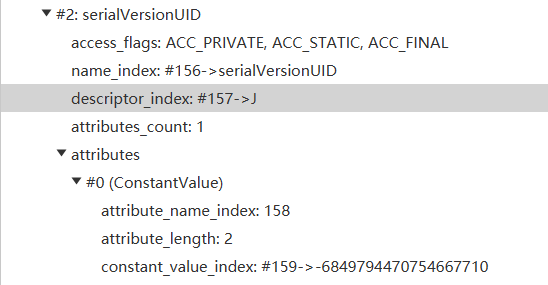
这个就对应上了
最后执行的是将真是偏移量放到field变量中
          fs.set_offset(real_offset);

-->//field变量

  void set_offset(int offset) {

    field()->set_offset(offset);

  }

-->

  void set_offset(u4 val)                        {

    val = val << FIELDINFO_TAG_SIZE; // make room for tag

    _shorts[low_packed_offset] = extract_low_short_from_int(val) | FIELDINFO_TAG_OFFSET;

    _shorts[high_packed_offset] = extract_high_short_from_int(val);

  }
执行前打印信息
(gdb) p _shorts

$46 = {26, 156, 157, 159, 33, 0}

(gdb) p &_shorts

$47 = (unsigned short (*)[6]) 0x7f28e0a0329c
执行后打印信息
(gdb) p &_shorts

$48 = (unsigned short (*)[6]) 0x7f28e0a0329c

(gdb) p _shorts

$49 = {26, 156, 157, 159, 417, 0}
比如在看下一个变量的解析,执行前
(gdb) p &_shorts
$50 = (unsigned short (*)[6]) 0x7f28e0a032a8
(gdb) p _shorts
$51 = {26, 161, 162, 0, 1, 0}
我们同样分析一下这个变量
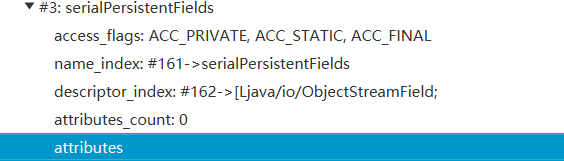
那么执行过程就是将96偏移量放了进去,执行后
(gdb) p _shorts
$52 = {26, 161, 162, 0, 385, 0}
那么还是进入create_mirror这个函数,之前解析过这个函数,不过那个时候解析的不带static变量,专门说下,static和其他不同的地方
 Handle mirror = InstanceMirrorKlass::cast(SystemDictionary::Class_klass())->allocate_instance(k, CHECK_0);

-->

    instanceOop InstanceMirrorKlass::allocate_instance(KlassHandle k, TRAPS) {

  // Query before forming handle.

  int size = instance_size(k);

  KlassHandle h_k(THREAD, this);

  instanceOop i = (instanceOop) CollectedHeap::Class_obj_allocate(h_k, size, k, CHECK_NULL);

  return i;

}

-->

int InstanceMirrorKlass::instance_size(KlassHandle k) {

  if (k() != NULL && k->oop_is_instance()) {

    return align_object_size(size_helper() + InstanceKlass::cast(k())->static_field_size());

  }

  return size_helper();

}
看到了_static_field_size=2 那么就清楚了, 最终size=14
最后打印一下生成的对象
(gdb) p * mirror

$54 = {

  _mark = 0x1,

  _metadata = {

    _klass = 0x200003e0,

    _compressed_klass = 536871904

  },

  static _bs = 0x7f28dc01ea48

}
接着就是设置属性oop的便宜量定义了不同的信息OOP
| _protection_domain_offset | 52 |
| _init_lock_offset | 56 |
| _signers_offset | 60 |
| _klass_offset | 64 |
| _array_klass_offset | 72 |
| classRedefinedCount_offset | 80 |
| _oop_size_offset | 84 |
| _static_oop_field_count_offset | 88 |
| 静态变量1 | 96 |
| 静态变量2 | 104 |
| 静态变量2 | |
| 静态变量3 | |
| 静态变量n |
比如这个函数
void java_lang_Class::set_static_oop_field_count(oop java_class, int size) {

  assert(_static_oop_field_count_offset != 0, "must be set");

  java_class->int_field_put(_static_oop_field_count_offset, size);

}
就是在oop的88 偏移量设置了2
接着看
      typeArrayOop r = oopFactory::new_typeArray(T_INT, 0, CHECK_NULL);

      set_init_lock(mirror(), r);

      // Set protection domain also

      set_protection_domain(mirror(), protection_domain());
这两个还是设置oop偏移量的 52 和 56的两个属性
      // Initialize static fields

      InstanceKlass::cast(k())->do_local_static_fields(&initialize_static_field, CHECK_NULL);
这个就是本篇的主旨,给静态变量赋值
      typeArrayOop r = oopFactory::new_typeArray(T_INT, 0, CHECK_NULL);

      set_init_lock(mirror(), r);

      // Set protection domain also

      set_protection_domain(mirror(), protection_domain());

      // Initialize static fields

      InstanceKlass::cast(k())->do_local_static_fields(&initialize_static_field, CHECK_NULL);
然后
void InstanceKlass::do_local_static_fields(void f(fieldDescriptor*, TRAPS), TRAPS) {

  instanceKlassHandle h_this(THREAD, this);

  do_local_static_fields_impl(h_this, f, CHECK);

}

void InstanceKlass::do_local_static_fields_impl(instanceKlassHandle this_oop, void f(fieldDescriptor* fd, TRAPS), TRAPS) {

  for (JavaFieldStream fs(this_oop()); !fs.done(); fs.next()) {

    if (fs.access_flags().is_static()) {

      fieldDescriptor& fd = fs.field_descriptor();

      f(&fd, CHECK);

    }

  }

}
进入
static void initialize_static_field(fieldDescriptor* fd, TRAPS) {

  Handle mirror (THREAD, fd->field_holder()->java_mirror());

  assert(mirror.not_null() && fd->is_static(), "just checking");

  if (fd->has_initial_value()) {

    BasicType t = fd->field_type();

    switch (t) {

      case T_BYTE:

        mirror()->byte_field_put(fd->offset(), fd->int_initial_value());

              break;

      case T_BOOLEAN:

        mirror()->bool_field_put(fd->offset(), fd->int_initial_value());

              break;

      case T_CHAR:

        mirror()->char_field_put(fd->offset(), fd->int_initial_value());

              break;

      case T_SHORT:

        mirror()->short_field_put(fd->offset(), fd->int_initial_value());

              break;

      case T_INT:

        mirror()->int_field_put(fd->offset(), fd->int_initial_value());

        break;

      case T_FLOAT:

        mirror()->float_field_put(fd->offset(), fd->float_initial_value());

        break;

      case T_DOUBLE:

        mirror()->double_field_put(fd->offset(), fd->double_initial_value());

        break;

      case T_LONG:

        mirror()->long_field_put(fd->offset(), fd->long_initial_value());

        break;

      case T_OBJECT:

        {

          #ifdef ASSERT

          TempNewSymbol sym = SymbolTable::new_symbol("Ljava/lang/String;", CHECK);

          assert(fd->signature() == sym, "just checking");

          #endif

          oop string = fd->string_initial_value(CHECK);

          mirror()->obj_field_put(fd->offset(), string);

        }

        break;

      default:

        THROW_MSG(vmSymbols::java_lang_ClassFormatError(),

                  "Illegal ConstantValue attribute in class file");

    }

  }

}
开始
(gdb) p * fd

$56 = {

  _access_flags = {

    _flags = 26

  },

  _index = 2,

  _cp = {

    <StackObj> = {

      <AllocatedObj> = {

        _vptr.AllocatedObj = 0x7f28e4a90390 <vtable for constantPoolHandle+16>

      }, <No data fields>},

    members of constantPoolHandle:

    _value = 0x7f28e0a01100,

    _thread = 0x7f28dc00b800

  }

}
条件判断
bool has_initial_value() const { return field()->initval_index() != 0; }
initval_index_offset = 3,
这获取了初始值,就是变量的 值,比如说 private static final long serialVersionUID = -6849794470754667710L; 值就是-6849794470754667710L,
意思就是如果你有值就给oop的96偏移量后面的static变量赋值
看这个
BasicType t = fd->field_type();
BasicType field_type()  const { return FieldType::basic_type(signature()); }

Symbol* signature() const {

    return field()->signature(_cp);

}

Symbol* signature(constantPoolHandle cp) const {

    int index = signature_index();  -->  u2 signature_index() const { return _shorts[signature_index_offset];   } //off=2  //index =157

    if (is_internal()) {

        return lookup_symbol(index);

    }

    return cp->symbol_at(index);

}

BasicType FieldType::basic_type(Symbol* signature) {

    return char2type(signature->byte_at(0));

}

BasicType t = fd->field_type(); t:T_LONG
就是解析出来了 t 是T_LONG
      case T_LONG:

        mirror()->long_field_put(fd->offset(), fd->long_initial_value());
这个fd->offset是oop偏移量
jlong fieldDescriptor::long_initial_value() const {

  return constants()->long_at(initial_value_index());

}
这个就是
int initial_value_index() const { return field()->initval_index(); }
(gdb) p initial_value_index()

$59 = 159
然后从常量池中找到这个159的符号
  jlong long_at(int which) {

    assert(tag_at(which).is_long(), "Corrupted constant pool");

    // return *long_at_addr(which);

    u8 tmp = Bytes::get_native_u8((address)&base()[which]);

    return *((jlong*)&tmp);

  }
具体在说一边这个fd->offset()
==> int offset() const { return field()->offset(); }
==>
FieldInfo* field() const {
InstanceKlass* ik = field_holder();
return ik->field(_index);
}
==>
InstanceKlass* field_holder() const { return _cp->pool_holder(); }
这就得到了Field这个6个成员的数组变量_short
让后就是调用Field->offset()函数
u4 offset() const {

    u2 lo = _shorts[low_packed_offset];

    switch(lo & FIELDINFO_TAG_MASK) {

      case FIELDINFO_TAG_OFFSET:

        return build_int_from_shorts(_shorts[low_packed_offset], _shorts[high_packed_offset]) >> FIELDINFO_TAG_SIZE;

  }
查到这个便宜量
(gdb) p fd->offset()
$60 = 104
接着就是赋值
inline void oopDesc::long_field_put(int offset, jlong contents) { *long_field_addr(offset) = contents; }
offset=104 值为求出来的常数 -6849794470754667710L
inline jlong* oopDesc::long_field_addr(int offset) const { return (jlong*) field_base(offset); }
inline void* oopDesc::field_base(int offset) const { return (void*)&((char*)this)[offset]; }
this 就是oop对象
那么这样子就给oop赋值了一个static 的常量
打印内存
(gdb) x/14xg 0xd7580830
0xd7580830: 0x0000000000000001 0x00000000200003e0
0xd7580840: 0x0000000000000000 0x0000000000000000
0xd7580850: 0x0000000000000000 0x0000000000000000
0xd7580860: 0x0000000000000000 0x00000000d75808a0
0xd7580870: 0x00000001000016d8 0x0000000000000000
0xd7580880: 0x0000000e00000000 0x0000000000000002
0xd7580890: 0x0000000000000000 0xa0f0a4387a3bb342
能看到了这个常数0xa0f0a4387a3bb342
到此就结束了static 变量的赋值
重要的也是证明了,static 静态变量放到了oop对象offset=96的便宜量位置
这个是instanceklass的的field的数据,其中,其中分析过
  enum FieldOffset {

    access_flags_offset      = 0,

    name_index_offset        = 1,

    signature_index_offset   = 2,

    initval_index_offset     = 3,

    low_packed_offset        = 4,

    high_packed_offset       = 5,

    field_slots              = 6

  };
(gdb) x/36h _data
0x7f28e0a03284:
0x0012 0x0098 0x0099 0x0000 0x0031 0x0000
0x0002 0x009a 0x009b 0x0000 0x0041 0x0000
0x001a 0x009c 0x009d 0x009f  0x0021 0x0000
0x001a 0x00a1 0x00a2 0x0000 0x0001 0x0000
0x0819 0x00a3 0x00a4 0x0000 0x0011 0x0000
0x00a6 0x0000  0x0000 0x0000 0x005e 0x0000
重点看序号为3的第4个,用来判断是否有 has_initial_value,那么所有变量了就只有一个0x9f,其他变量没有
,那么其他变量如何赋值呢?这又是另一个知识点了
jvm源码解读--09 创建oop对象,将static静态变量放置在oop的96 offset处 第二篇的更多相关文章
- jvm源码解读--08 创建oop对象,将static静态变量放置在oop的96 offset处
之前分析的已经加载的.Class文件中都没有Static 静态变量,所以也就没这部分的解析,自己也是不懂hotspot 将静态变量放哪里去了,追踪源码之后,看清楚了整个套路,总体上来说,可以举例来说对 ...
- jvm源码解读--07 创建 fixup_mirrors
通过前面的分析,创建的insttanceKlass 都没放入了java_lang_Class::fixup_mirror_list()这里类的数组里面了,所有的instance列举如下 ------- ...
- JVM 源码解读之 CMS 何时会进行 Full GC
t点击上方"涤生的博客",关注我 转载请注明原创出处,谢谢!如果读完觉得有收获的话,欢迎点赞加关注. 前言 本文内容是基于 JDK 8 在文章 JVM 源码解读之 CMS GC 触 ...
- jvm源码解读--17 Java的wait()、notify()学习
write and debug by 张艳涛 wait()和notify()的通常用法 A线程取得锁,执行wait(),释放锁; B线程取得锁,完成业务后执行notify(),再释放锁; B线程释放锁 ...
- jvm源码解读--15 oop对象详解
(gdb) p obj $15 = (oopDesc *) 0xf3885d08 (gdb) p * obj $16 = { _mark = 0x70dea4e01, _metadata = { _k ...
- jvm源码解读--13 gc_root中的栈中oop的mark 和copy 过程分析
粘贴源码 package com.test; import java.util.Random; public class Test { static int number=12; private in ...
- jvm源码解读--12 invokspecial指令的解读
先看代码 package com.zyt.jvmbook; public class Girl extends Person{ public Girl() { int a; } @Override p ...
- jvm源码解读--11 ldc指令的解读
写一个java文件 public static void main(String[] args) { String str1="abc"; String str2 ="a ...
- jvm源码解读--06 Method 方法解析
进入 // Methods bool has_final_method = false; AccessFlags promoted_flags; promoted_flags.set_flags(0) ...
随机推荐
- 搭建 MySQL 高可用高性能集群
什么是MySQL集群,什么是MySQL集群,如果你想知道什么是MySQL集群,我现在就带你研究. MySQL 是一款流行的轻量级数据库,很多应用都是使用它作为数据存储.作为小型应用的数据库,它完全可以 ...
- Java 到底是值传递还是引用传递?
关于这个问题,引发过很多广泛的讨论,看来很多程序员对于这个问题的理解都不尽相同,甚至很多人理解的是错误的.还有的人可能知道Java中的参数传递是值传递,但是说不出来为什么. 在开始深入讲解之前,有必要 ...
- golang 写文件--详细解释
1,不覆盖指定的文件 先看代码怎么写,下面再具体解释. func writeToFile(msg string) { f, err := os.OpenFile("/home/mingbai ...
- js笔记4
1.js数据类型分析 (1)基础类型:string.number.boolean.null.undefined (2)引用类型:object-->json.array... 2.点运算 xxx ...
- kafka简单介绍
Kafka是分布式发布-订阅消息系统.它最初由LinkedIn公司开发,之后成为Apache项目的一部分.Kafka是一个分布式的,可划分的,冗余备份的持久性的日志服务.它主要用于处理活跃的流式数据. ...
- 深入学习Netty(1)——传统BIO编程
前言 之前看过Dubbo源码,Nacos等源码都涉及到了Netty,虽然遇到的时候查查资料,后面自己也有私下学习Netty并实践,但始终没有形成良好的知识体系,Netty对想要在Java开发上不断深入 ...
- Gym - 101128E Wooden Signs DP
题目大意: 一共n块木板,前两个数给出最底下木块的两个端点,后面n-1个数给出第i层的一个固定端点,问你木块的所有放置情况. 分析: 状态: d[i][j]表示第i个木块,第i-1块木板的未固定端点为 ...
- java 的 IO简单理解
首先要先理解什么是 stream ? stream代表的是任何有能力产出数据的数据源,或是任何有能力接收数据的接收源. 一.不同导向的 stream 1)以字节为单位从 stream 中读取或往 st ...
- mac 中一些日常小问题与快捷键
1.备忘录中的中英文符号问题 比如:在备忘录中使用英文符号时,总是会被自动的修改为中文符号 解决方法:系统偏好设置-键盘-文本,去选"使用智能引号和存折号" p.p1 { marg ...
- 转:nginx服务器配置
1. user www-data说明的是使用的用户,至于www-data这个用户是系统自带的,我们不用说系统里没有这个账户的,虽然这个账户具体是做什么的,我也不太清楚2.worker_processe ...