
Tutorial: Triplet Loss Layer Design for CNN
Tutorial: Triplet Loss Layer Design for CNN
Xiao Wang 2016.05.02
Triplet Loss Layer could be a trick for further improving the accuracy of CNN. Today, I will introduce the whole process, and display the code for you. This tutorial mainly from the blog:
http://blog.csdn.net/tangwei2014/article/details/46812153
http://blog.csdn.net/tangwei2014/article/details/46788025
and the paper: <FaceNet: A Unified Embedding for Face Recognition and Clustering>.
First, Let's talk about how to add the layer into caffe and make test this layer to check whether it works or not. And then, we will discuss the paper and introduce the process of how the triplet loss come from. In the new version of caffe framework, it mainly consists of these steps for add a new layer i.e.
step 1. add the paprameter message in the corresponding layer, which located in ./src/caffe/proto/caffe.proto ;
step 2. add the declaration information of the layer in ./include/caffe/***layers.hpp ;
step 3. add the corresponding .cpp and .cu files in ./src/caffe/layers/, realize the function of the new added layer;
step 4. add test code of new added layers in ./src/caffe/gtest/, test its foreward and back propagation and its computation speed.
Let's do it step by step.
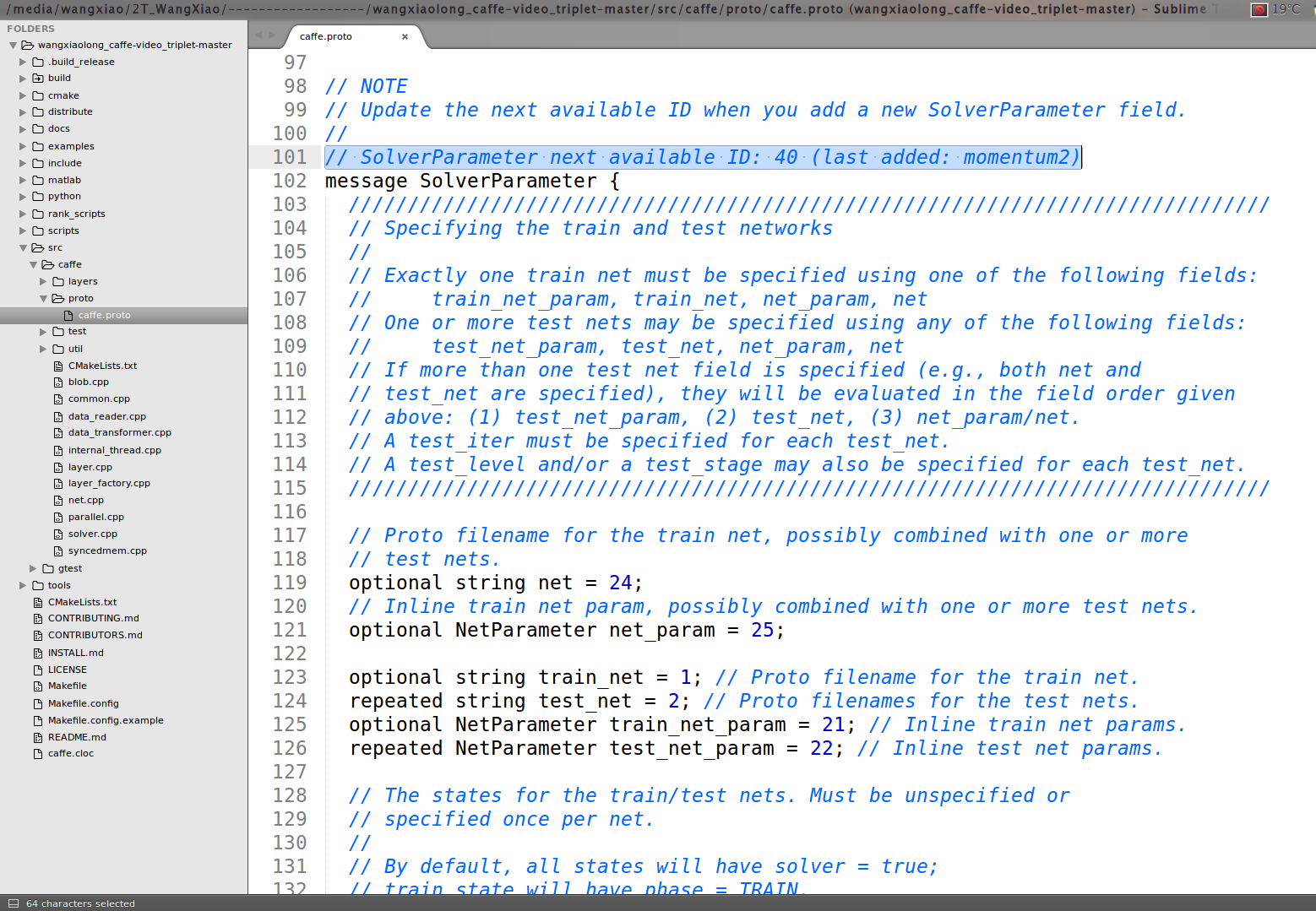
First, we add triplet loss layer in caffe.proto file:
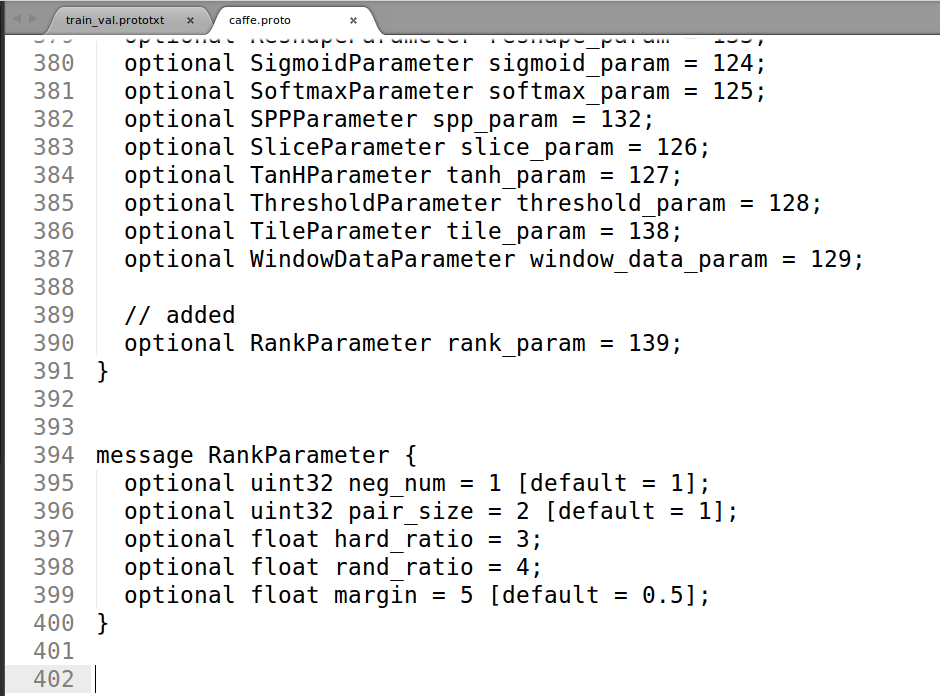
we could found that in line 101, it said: SolverParameter next available ID: 40 (last added: momentum2), thus we add the ID: 40 as the new added information :
message RankParameter {
optional uint32 neg_num = 1 [default = 1];
optional uint32 pair_size = 2 [default = 1];
optional float hard_ratio = 3;
optional float rand_ratio = 4;
optional float margin = 5 [default = 0.5];
}
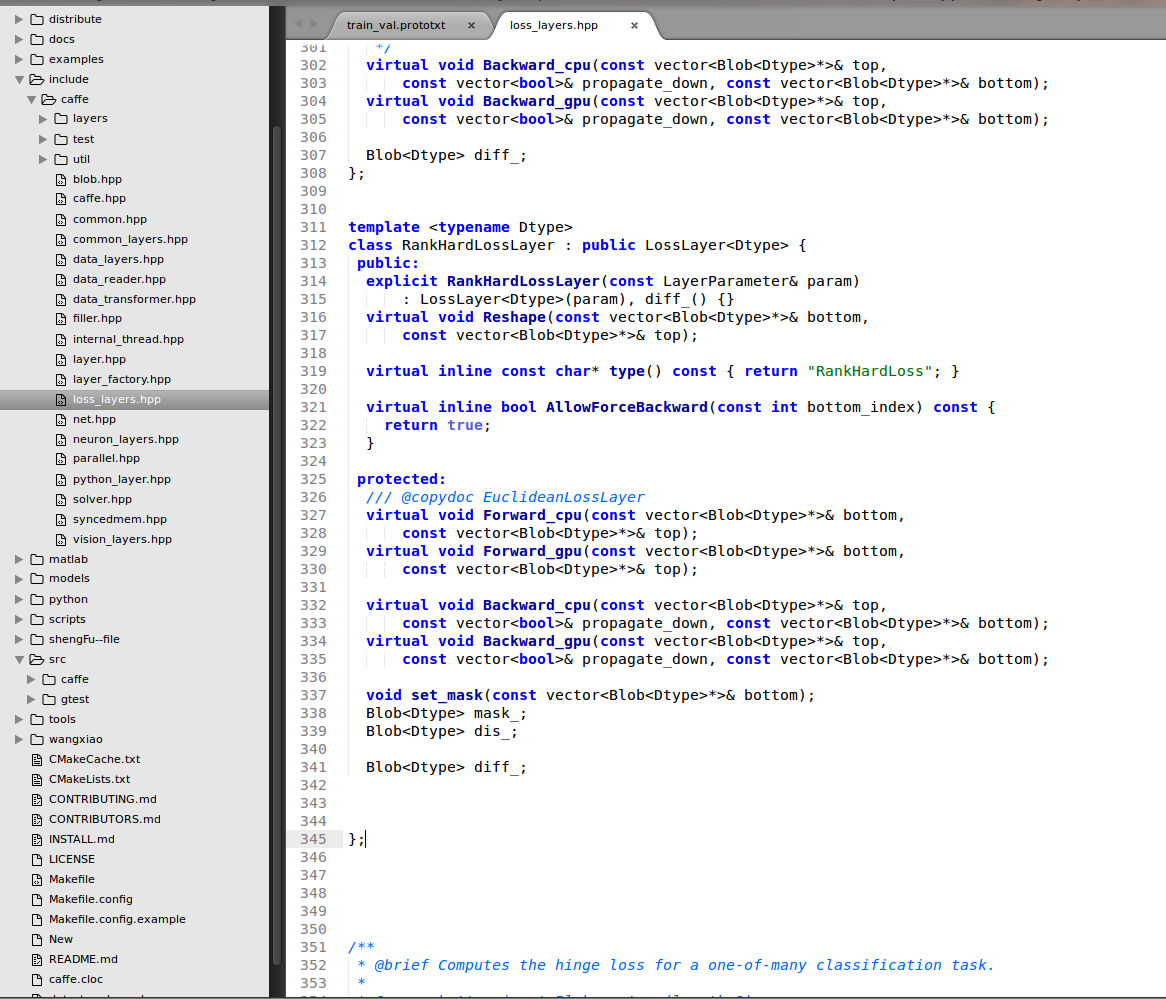
Second, we add the declearation information about triplet loss layer in ./include/caffe/TripletLoss_layers.hpp
Third, We compile the triplet loss layer of .cpp and .cu file
First of all is the .cpp file
 #include <vector>

 #include <algorithm>

 #include <cmath>

 #include <cfloat>

 #include "caffe/layer.hpp"

 #include "caffe/util/io.hpp"

 #include "caffe/util/math_functions.hpp"

 #include "caffe/vision_layers.hpp"

 using std::max;

 using namespace std;

 using namespace cv;

 namespace caffe {

 int myrandom (int i) { return caffe_rng_rand()%i;}

 template <typename Dtype>

 void RankHardLossLayer<Dtype>::Reshape(

   const vector<Blob<Dtype>*>& bottom, const vector<Blob<Dtype>*>& top) {

   LossLayer<Dtype>::Reshape(bottom, top);

   diff_.ReshapeLike(*bottom[]);

   dis_.Reshape(bottom[]->num(), bottom[]->num(), , );

   mask_.Reshape(bottom[]->num(), bottom[]->num(), , );

 }

 template <typename Dtype>

 void RankHardLossLayer<Dtype>::set_mask(const vector<Blob<Dtype>*>& bottom)

 {

     RankParameter rank_param = this->layer_param_.rank_param();

     int neg_num = rank_param.neg_num();

     int pair_size = rank_param.pair_size();

     float hard_ratio = rank_param.hard_ratio();

     float rand_ratio = rank_param.rand_ratio();

     float margin = rank_param.margin();

     int hard_num = neg_num * hard_ratio;

     int rand_num = neg_num * rand_ratio;

     const Dtype* bottom_data = bottom[]->cpu_data();

     const Dtype* label = bottom[]->cpu_data();

     int count = bottom[]->count();

     int num = bottom[]->num();

     int dim = bottom[]->count() / bottom[]->num();

     Dtype* dis_data = dis_.mutable_cpu_data();

     Dtype* mask_data = mask_.mutable_cpu_data();

     for(int i = ; i < num * num; i ++)

     {

         dis_data[i] = ;

         mask_data[i] = ;

     }

     // calculate distance

     for(int i = ; i < num; i ++)

     {

         for(int j = i + ; j < num; j ++)

         {

             const Dtype* fea1 = bottom_data + i * dim;

             const Dtype* fea2 = bottom_data + j * dim;

             Dtype ts = ;

             for(int k = ; k < dim; k ++)

             {

               ts += (fea1[k] * fea2[k]) ;

             }

             dis_data[i * num + j] = -ts;

             dis_data[j * num + i] = -ts;

         }

     }

     //select samples

     vector<pair<float, int> >negpairs;

     vector<int> sid1;

     vector<int> sid2;

     for(int i = ; i < num; i += pair_size)

     {

         negpairs.clear();

         sid1.clear();

         sid2.clear();

         for(int j = ; j < num; j ++)

         {

             if(label[j] == label[i])

                 continue;

             Dtype tloss = max(Dtype(), dis_data[i * num + i + ] - dis_data[i * num + j] + Dtype(margin));

             if(tloss == ) continue;

             negpairs.push_back(make_pair(dis_data[i * num + j], j));

         }

         if(negpairs.size() <= neg_num)

         {

             for(int j = ; j < negpairs.size(); j ++)

             {

                 int id = negpairs[j].second;

                 mask_data[i * num + id] = ;

             }

             continue;

         }

         sort(negpairs.begin(), negpairs.end());

         for(int j = ; j < neg_num; j ++)

         {

             sid1.push_back(negpairs[j].second);

         }

         for(int j = neg_num; j < negpairs.size(); j ++)

         {

             sid2.push_back(negpairs[j].second);

         }

         std::random_shuffle(sid1.begin(), sid1.end(), myrandom);

         for(int j = ; j < min(hard_num, (int)(sid1.size()) ); j ++)

         {

             mask_data[i * num + sid1[j]] = ;

         }

         for(int j = hard_num; j < sid1.size(); j++)

         {

             sid2.push_back(sid1[j]);

         }

         std::random_shuffle(sid2.begin(), sid2.end(), myrandom);

         for(int j = ; j < min( rand_num, (int)(sid2.size()) ); j ++)

         {

             mask_data[i * num + sid2[j]] = ;

         }

     }

 }

 template <typename Dtype>

 void RankHardLossLayer<Dtype>::Forward_cpu(const vector<Blob<Dtype>*>& bottom,

     const vector<Blob<Dtype>*>& top) {

     const Dtype* bottom_data = bottom[]->cpu_data();

     const Dtype* label = bottom[]->cpu_data();

     int count = bottom[]->count();

     int num = bottom[]->num();

     int dim = bottom[]->count() / bottom[]->num();

     RankParameter rank_param = this->layer_param_.rank_param();

     int neg_num = rank_param.neg_num();      //

     int pair_size = rank_param.pair_size();  //

     float hard_ratio = rank_param.hard_ratio();

     float rand_ratio = rank_param.rand_ratio();

     float margin = rank_param.margin();

     Dtype* dis_data = dis_.mutable_cpu_data();

     Dtype* mask_data = mask_.mutable_cpu_data();

     set_mask(bottom);

     Dtype loss = ;

     int cnt = neg_num * num / pair_size * ;

     for(int i = ; i < num; i += pair_size)

     {

         for(int j = ; j < num; j++)

         {

             if(mask_data[i * num + j] == )

                 continue;

             Dtype tloss1 = max(Dtype(), dis_data[i * num + i + ] - dis_data[i * num + j] + Dtype(margin));

             Dtype tloss2 = max(Dtype(), dis_data[i * num + i + ] - dis_data[(i + ) * num + j] + Dtype(margin));

             loss += tloss1 + tloss2;

         }

     }

     loss = loss / cnt;

     top[]->mutable_cpu_data()[] = loss;

 }

 template <typename Dtype>

 void RankHardLossLayer<Dtype>::Backward_cpu(const vector<Blob<Dtype>*>& top,

     const vector<bool>& propagate_down, const vector<Blob<Dtype>*>& bottom) {

     const Dtype* bottom_data = bottom[]->cpu_data();

     const Dtype* label = bottom[]->cpu_data();

     Dtype* bottom_diff = bottom[]->mutable_cpu_diff();

     int count = bottom[]->count();

     int num = bottom[]->num();

     int dim = bottom[]->count() / bottom[]->num();

     RankParameter rank_param = this->layer_param_.rank_param();

     int neg_num = rank_param.neg_num();

     int pair_size = rank_param.pair_size();

     float hard_ratio = rank_param.hard_ratio();

     float rand_ratio = rank_param.rand_ratio();

     float margin = rank_param.margin();

     Dtype* dis_data = dis_.mutable_cpu_data();

     Dtype* mask_data = mask_.mutable_cpu_data();

     for(int i = ; i < count; i ++ )

         bottom_diff[i] = ;

     int cnt = neg_num * num / pair_size * ;

     for(int i = ; i < num; i += pair_size)

     {

         const Dtype* fori = bottom_data + i * dim;

         const Dtype* fpos = bottom_data + (i + ) * dim;

         Dtype* fori_diff = bottom_diff + i * dim;

         Dtype* fpos_diff = bottom_diff + (i + ) * dim;

         for(int j = ; j < num; j ++)

         {

             if(mask_data[i * num + j] == ) continue;

             Dtype tloss1 = max(Dtype(), dis_data[i * num + i + ] - dis_data[i * num + j] + Dtype(margin));

             Dtype tloss2 = max(Dtype(), dis_data[i * num + i + ] - dis_data[(i + ) * num + j] + Dtype(margin));

             const Dtype* fneg = bottom_data + j * dim;

             Dtype* fneg_diff  = bottom_diff + j * dim;

             if(tloss1 > )

             {

                 for(int k = ; k < dim; k ++)

                 {

                     fori_diff[k] += (fneg[k] - fpos[k]); // / (pairNum * 1.0 - 2.0);

                     fpos_diff[k] += -fori[k]; // / (pairNum * 1.0 - 2.0);

                     fneg_diff[k] +=  fori[k];

                 }

             }

             if(tloss2 > )

             {

                 for(int k = ; k < dim; k ++)

                 {

                     fori_diff[k] += -fpos[k]; // / (pairNum * 1.0 - 2.0);

                     fpos_diff[k] += fneg[k]-fori[k]; // / (pairNum * 1.0 - 2.0);

                     fneg_diff[k] += fpos[k];

                 }

             }

         }

     }

     for (int i = ; i < count; i ++)

     {

         bottom_diff[i] = bottom_diff[i] / cnt;

     }

 }

 #ifdef CPU_ONLY

 STUB_GPU(RankHardLossLayer);

 #endif

 INSTANTIATE_CLASS(RankHardLossLayer);

 REGISTER_LAYER_CLASS(RankHardLoss);

 }  // namespace caffe
and the .cu file
 #include <vector>

 #include "caffe/layer.hpp"

 #include "caffe/util/io.hpp"

 #include "caffe/util/math_functions.hpp"

 #include "caffe/vision_layers.hpp"

 namespace caffe {

 template <typename Dtype>

 void RankHardLossLayer<Dtype>::Forward_gpu(const vector<Blob<Dtype>*>& bottom,

     const vector<Blob<Dtype>*>& top) {

   Forward_cpu(bottom, top);

 }

 template <typename Dtype>

 void RankHardLossLayer<Dtype>::Backward_gpu(const vector<Blob<Dtype>*>& top,

     const vector<bool>& propagate_down, const vector<Blob<Dtype>*>& bottom) {

    Backward_cpu(top, propagate_down, bottom);

 }

 INSTANTIATE_LAYER_GPU_FUNCS(RankHardLossLayer);

 }  // namespace caffe
Finally, we make the caffe file and check whether have some mistakes about it.
--------------------------------------------------------------------------------------------------------------------------------------------------------------------------------------------------------------------------------------------------------------------------------------------------------------------------------------------
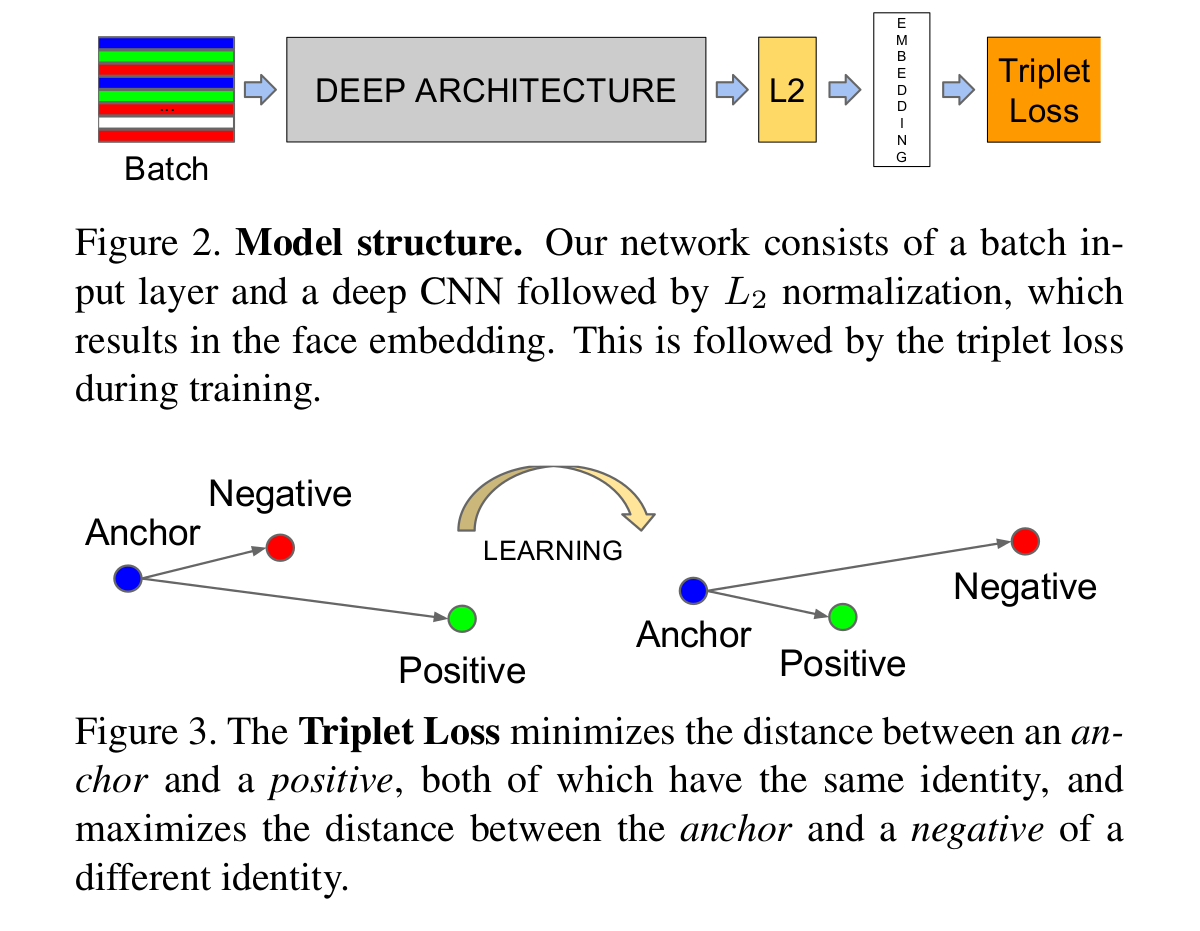
Let's continue to talk about the triplet loss:
Just like the above figure showns, the triplet loss usually have three components, i.e. the anchors, the positive, and the negative. What we are going to do is try to reduce the distance between the archor and the same, and push the different from the anchors.

Thus, the whole loss could be described as following:

Only select triplets randomly may lead to slow converage of the network, and we need to find those hard triplets, that are active and can therefore contribute to improving the model. The following section will give you an explanination about the approach.
Triplet Selection:
There are two appproaches for generate triplets, i.e.
1. Generate triplets offline every n steps, using the most recent newwork checkpoint and computing the argmin and argmax on a subset of the data.
2. Generate the triplets online. This can be done by selecting the hard positive/negative exemplars form within a mini-batch.
This paper use all anchor-positive pairs in a mini-batch while still selecting the hard negatives. the all anchor-positive method was more stable and converaged slightly faster at the begining of training.
The code could refer the github page: https://github.com/wangxiao5791509/caffe-video_triplet
layer {

    name: "loss"

    type: "RankHardLoss"

    rank_param{

        neg_num: 4

        pair_size: 2

        hard_ratio: 0.5

        rand_ratio: 0.5

        margin: 1

    }

    bottom: "norml2"

    bottom: "label"

}
Triplet Loss Implementation using Pytorch:
the following document comes from: https://pytorch.org/docs/stable/nn.html#tripletmarginloss
Creates a criterion that measures the triplet loss given an input tensors x1, x2, x3 and a margin with a value greater than 0. This is used for measuring a relative similarity between samples. A triplet is composed by a, p and n: anchor, positive examples and negative example respectively. The shapes of all input tensors should be (N,D)(N,D).
The distance swap is described in detail in the paper Learning shallow convolutional feature descriptors with triplet losses by V. Balntas, E. Riba et al.
The loss function for each sample in the mini-batch is:
where d(xi,yi)=∥xi−yi∥pd(xi,yi)=‖xi−yi‖p.
| Parameters: |
|
|---|
- Shape:
-
- Input: (N,D)(N,D) where D is the vector dimension.
- Output: scalar. If reduce is False, then (N).
>>> triplet_loss = nn.TripletMarginLoss(margin=1.0, p=2)

>>> input1 = torch.randn(100, 128, requires_grad=True)

>>> input2 = torch.randn(100, 128, requires_grad=True)

>>> input3 = torch.randn(100, 128, requires_grad=True)

>>> output = triplet_loss(input1, input2, input3)

>>> output.backward()
Example:
import torch.nn as nn

triplet_loss = nn.TripletMarginLoss(margin=1.2, p=2)

# 计算特征向量

anchor = model.forward(data[0])

positive = model.forward(data[1])

negative = model.forward(data[2])

# 计算三元组loss

loss = triplet_loss.forward(anchor, positive, negative)

loss.backward()

optimizer.step()
Tutorial: Triplet Loss Layer Design for CNN的更多相关文章
- 怎样在caffe中添加layer以及caffe中triplet loss layer的实现
关于triplet loss的原理.目标函数和梯度推导在上一篇博客中已经讲过了.详细见:triplet loss原理以及梯度推导.这篇博文主要是讲caffe下实现triplet loss.编程菜鸟.假 ...
- 论文笔记之: Person Re-Identification by Multi-Channel Parts-Based CNN with Improved Triplet Loss Function
Person Re-Identification by Multi-Channel Parts-Based CNN with Improved Triplet Loss Function CVPR 2 ...
- Paper Reading: In Defense of the Triplet Loss for Person Re-Identification
In Defense of the Triplet Loss for Person Re-Identification 2017-07-02 14:04:20 This blog comes ...
- Re-ID with Triplet Loss
一篇讲Person Re-ID的论文,与人脸识别(认证)有非常多相通的地方. 文章链接: <In Defense of the Triplet Loss for Person Re-Identi ...
- triplet loss 在深度学习中主要应用在什么地方?有什么明显的优势?
作者:罗浩.ZJU链接:https://www.zhihu.com/question/62486208/answer/199117070来源:知乎著作权归作者所有.商业转载请联系作者获得授权,非商业转 ...
- Facenet Triplet Loss
Triplet Loss 在人脸识别中,Triplet loss被用来进行人脸嵌入的训练.如果你对triplet loss很陌生,可以看一下吴恩达关于这一块的课程.Triplet loss实现起来并不 ...
- triplet loss
因为待遇低,因为工作不开心,已经严重影响了自己的工作积极性和工作效率,这几天发觉这样对自己实在是一种损失,决定提高工作效率,减少工作时间. 说说最近做的tracking, multi-object t ...
- Triplet Loss(转)
参考:https://blog.csdn.net/u013082989/article/details/83537370 作用:用于对差异较小的类别进行区分
- Caffe的loss layer(转)
英文可查:地址 1.SoftmaxWithLoss 对一对多的分类任务计算多项逻辑斯蒂损失,并通过softmax传递预测值,来获得各类的概率分布.该层可以分解为SoftmaxLayer+Multino ...
随机推荐
- 将salt取到的数据处理
#!/usr/bin/env python #coding:utf-8 import json with open('minfo') as f,open('minfoMiddle','w') as f ...
- 使用iskindofclass来发现对象是否是某类或其子类的实例
发现对象是否是特定类或其子类的实例 要发现对象是否是某类或其子类的实例,请在对象上调用 isKindOfClass: 方法.当应用程序需要发现其响应的消息(实现的或继承的),它有时进行以上的检查. s ...
- Add a stylesheet link programmatically in ASP.NET
Here’s a code snippet used to programmatically insert a stylesheet link to an external CSS file: // ...
- 删除目录下所有gif的图片
find -name "*.gif" -exec rm -fv {} \;
- HDU5090--Game with Pearls 二分图匹配 (匈牙利算法)
题意:给N个容器,每个容器里有一定数目的珍珠,现在Jerry开始在管子上面再放一些珍珠,放上的珍珠数必须是K的倍数,可以不放.最后将容器排序,如果可以做到第i个容器上面有i个珍珠,则Jerry胜出,反 ...
- 程序员是怎么炼成的---OC题集--练习答案与题目(1)
一. 1. 定义3个类,全部代码.效果:能默写,关键词全部正确. 2. ⾯面向对象和⾯面向过程有什么区别? 答:面向对象以事物(对象)为核⼼,完成事件只是一个任务.面向过程以事件为核心,为了完成任务, ...
- Day01_JAVA语言基础第一天
1.计算机基础知识(理解) 1.计算机硬件 软件的基础设施,就是载体,计算机的硬件由五大组成部件:运算器,控制器,存储器,输入设备和输出设备 2.计算机软件 系统软件:windows,MAC,LINU ...
- Evaluate Reverse Polish Notation
Evaluate the value of an arithmetic expression in Reverse Polish Notation. Valid operators are +, -, ...
- ubuntu 下建立桌面快捷方式
1)新建文件eclipse.desktop,命令如下: sudo vim /usr/share/applications/eclipse.desktop 2)在新建文件中添加如下内容并保存: [Des ...
- jquery easyui datebox 时间控件默认显示当前日期的实现方法
jquery easyui datebox 时间控件默认显示当前日期的实现方法 直接class easyui-datebox后添加一个value="true"就可以