
POJ 2528 Mayor's posters 【区间离散化+线段树区间更新&&查询变形】
任意门:http://poj.org/problem?id=2528
Mayor's posters
| Time Limit: 1000MS | Memory Limit: 65536K | |
| Total Submissions: 77814 | Accepted: 22404 |
Description
- Every candidate can place exactly one poster on the wall.
- All posters are of the same height equal to the height of the wall; the width of a poster can be any integer number of bytes (byte is the unit of length in Bytetown).
- The wall is divided into segments and the width of each segment is one byte.
- Each poster must completely cover a contiguous number of wall segments.
They have built a wall 10000000 bytes long (such that there is enough place for all candidates). When the electoral campaign was restarted, the candidates were placing their posters on the wall and their posters differed widely in width. Moreover, the candidates started placing their posters on wall segments already occupied by other posters. Everyone in Bytetown was curious whose posters will be visible (entirely or in part) on the last day before elections.
Your task is to find the number of visible posters when all the posters are placed given the information about posters' size, their place and order of placement on the electoral wall.
Input
Output
The picture below illustrates the case of the sample input. 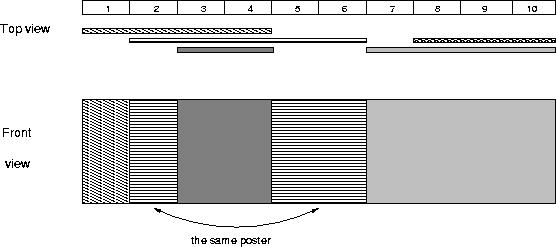
Sample Input
1

5

1 4

2 6

8 10

3 4

7 10
Sample Output
4
Source
题目大意:
贴海报,给出每张海报的起点和终点,问最后能看见多少张海报(后来的海报会把前面的覆盖);
解题思路:
海报的数据范围太大了,如果按照海报的数据范围开线段树会放不下而且浪费内存。所以考虑离散化,但是这不同于单点离散化,这是区间离散化,意思就是说离散化原来数据的同时还要保留他们的区间的性质。(大神的栗子:原数据“1-10, 1-4,6-10”,常规单点离散化之后“1-4,1-2,3-4”,原本不相邻的点变成邻居了,如果继续按照这种错误的数据建树,那么后果是直接失去了区间的性质) 如果我们想缩小这两点的数据范围,但又想保留不相邻两点表示一个区间的性质,区间离散化要这样搞:缩小数据范围就是按原本数据大小进行排序,他们的先后性保持不变,新下标暂时替代他们,而保留不相邻两点的性质嘛,小脑洞:在他们之间加一个值把他们隔离,这样他们排序之后就不会相邻啦。
离散化之后就还是常规的线段树区间更新,但最后求解的区间查询操作如果暴力单点查询找出有几种不同的海报这样太委屈线段树了,这里的查询只要这张海报类型出现了,那么我们的答案肯定就要加加,然后这张海报我们就可以book一下,下次如果见到有book的海报类型也不需要再更新答案了,这些判重的操作可以直接在Query()里面做,这样才能更好的发挥线段树的本领。
AC code:
 #include <cstdio>

 #include <iostream>

 #include <algorithm>

 #include <cstring>

 #define INF 0x3f3f3f3f

 #define LL long long int

 #define lson l, mid, root<<1

 #define rson mid+1, r, root<<1|1

 using namespace std;

 const int MAXN = 1e4+;

 struct date

 {

     int L, R;

 }node[MAXN];

 int num[MAXN<<];

 int lazy_tag[MAXN<<];

 bool book[MAXN<<];

 int res, cnt;

 int read()

 {

     int f=, res=;char s=getchar();

     while(s<''||s>''){if(s=='-')f=-;s=getchar();}

     while(s>=''&&s<=''){res=res*+s-'';s=getchar();}

     res*=f;

     return res;

 }

 void PushD(int root)

 {

     if(lazy_tag[root]){

         lazy_tag[root<<] = lazy_tag[root];

         lazy_tag[root<<|] = lazy_tag[root];

         lazy_tag[root] = ;

     }

 }

 void Update(int st, int ed, int l, int r, int root, int val)

 {

     if(st <= l && ed >= r){lazy_tag[root] = val; return;}

     PushD(root);

     int mid = (l+r)>>;

     if(st <= mid) Update(st, ed, lson, val);

     if(ed > mid)  Update(st, ed, rson, val);

 }

 void Query(int l, int r, int root)

 {

     if(lazy_tag[root]){

         if(!book[lazy_tag[root]]) res++;

         book[lazy_tag[root]] = true;

         return;

     }

     if(l == r) return;

     int mid = (l+r)>>;

     Query(lson); Query(rson);

 }

 void init()

 {

     cnt = ; res = ;

     memset(lazy_tag, , sizeof(lazy_tag));

     memset(book, false, sizeof(book));

 }

 int main()

 {

     int T_case, N;

     T_case = read();

     while(T_case--)

     {

         init();

         N = read();

         for(int i = ; i < N; i++){

             node[i].L = read();node[i].R = read();

             num[cnt++] = node[i].L;

             num[cnt++] = node[i].R;

         }

         sort(num, num+cnt);

         cnt = unique(num, num+cnt)-num;

         int top = cnt;

         for(int i = ; i < top-; i++){

             if(num[i+]!=num[i]+) num[cnt++] = num[i]+;

         }

         sort(num, num+cnt);

         /*

         for(int i = 0; i < cnt; i++)

             printf("%d ", num[i]);

         puts("");

         */

         for(int i = ; i < N; i++){

             int st = lower_bound(num, num+cnt, node[i].L)-num;

             int ed = lower_bound(num, num+cnt, node[i].R)-num;

             Update(st+, ed+, , cnt, , i+);

         }

         Query(, cnt, );

         printf("%d\n", res);

     }

     return ;

 }
POJ 2528 Mayor's posters 【区间离散化+线段树区间更新&&查询变形】的更多相关文章
- POJ - 2528 Mayor's posters (离散化+线段树区间修改)
https://cn.vjudge.net/problem/POJ-2528 题意 给定一些海报,可能相互重叠,告诉你每个海报的宽度(高度都一样的)和先后叠放顺序,问没有被完全盖住的有多少张? 分析 ...
- POJ 2528 Mayor's posters 贴海报 线段树 区间更新
注意离散化!!!线段树的叶子结点代表的是一段!!! 给出下面两个简单的例子应该能体现普通离散化的缺陷: 1-10 1-4 5-10 1-10 1-4 6-10 普通离散化算出来的结果都会是2,但是第二 ...
- Mayor's posters (离散化线段树+对lazy的理解)
题目 题意: n(n<=10000) 个人依次贴海报,给出每张海报所贴的范围 li,ri(1<=li<=ri<=10000000) .求出最后还能看见多少张海报. 思路: 由于 ...
- POJ - 2528Mayor's posters (离散化+线段树区间覆盖)
The citizens of Bytetown, AB, could not stand that the candidates in the mayoral election campaign h ...
- [POJ2528]Mayor's posters(离散化+线段树)
Mayor's posters Time Limit: 1000MS Memory Limit: 65536K Total Submissions: 70365 Accepted: 20306 ...
- poj 2528 Mayor’s posters 【离散化】+【线段树】
<题目链接> 题目大意: 往一堵墙上贴海报,依次输出这些海报张贴的范围,这些海报能够相互覆盖,问最后能够看见几张海报? 解题分析: 由于是给出每张海报的区间,所以在这些区间内的很多点可能用 ...
- POJ.2528 Mayor's posters (线段树 区间更新 区间查询 离散化)
POJ.2528 Mayor's posters (线段树 区间更新 区间查询 离散化) 题意分析 贴海报,新的海报能覆盖在旧的海报上面,最后贴完了,求问能看见几张海报. 最多有10000张海报,海报 ...
- poj 2528 Mayor's posters(线段树+离散化)
/* poj 2528 Mayor's posters 线段树 + 离散化 离散化的理解: 给你一系列的正整数, 例如 1, 4 , 100, 1000000000, 如果利用线段树求解的话,很明显 ...
- poj 2528 Mayor's posters 线段树+离散化技巧
poj 2528 Mayor's posters 题目链接: http://poj.org/problem?id=2528 思路: 线段树+离散化技巧(这里的离散化需要注意一下啊,题目数据弱看不出来) ...
随机推荐
- spring-data-elasticsearch使用笔记
使用spring-data遇到了一些问题,记录一下. spring-data-elasticsearch版本选择 这里有一份官方github上的spring-data-elasticsearch与el ...
- 使用params
using System; using System.Collections.Generic; using System.Linq; using System.Text; using System.T ...
- C# 定制特性
一.初识特性 特性(attribute)是被指定给某一声明的一则附加的声明性信息. 设计类型的时候可以使用各种成员来描述该类型的信息,但有时候我们可能不太愿意将一些附加信息放到类的内部,因为这样,可能 ...
- HTTP和HTTPS的区别?
HTTP1.1(Hypertext Transfer Protocol Vertion 1.1)超文本传输协议-版本1.1它是用来在Internet上传送超文本的传送协议.它是运行在Tcp/Ip协议族 ...
- 对while;do while;for三种循环语句的理解与区分。
while:先判断表达式的值,在表达式值为真的情况下执行循环语句,直到表达式值为假结束循环: while(循环条件) { 循环体. } do-while:先执行循环体语句一次,再判别表达式的值,在表达 ...
- 日期控件html
日期控件多的是,这里收录的是最简单的一种 <html> <head> <script type="text/javascript"> funct ...
- RestTemplate请求出现401错误
最近遇到一个请求API接口总是报401 Unauthorized错误,起初是认为这个是平台返回的,后来用Postman请求,发现平台其实返回的是一串json,里面带有一些权限验证失败的消息,但到我们代 ...
- Spring课程 Spring入门篇 5-1 aop基本概念及特点
概念: 1 什么是aop及实现方式 2 aop的基本概念 3 spring中的aop 1 什么是aop及实现方式 1.1 aop,面向切面编程,比如:唐僧取经需要经过81难,多一难少一难都不行.孙悟空 ...
- 关于c3p0连接池连接mysql数据库需要注意的几点
什么是数据库连接池: 用池来管理Connection,这可以重复使用Connection.有了池,所以我们就不用自己来创建Connection,而是通过池来获取Connection对象. 当使用完Co ...
- 【数据库】4.0 MySQL入门学习(四)——linux系统环境下MySQL安装
1.0 我的操作系统是CentOS Linux release 7.6.1810 (Core) 系统详细信息如下: Linux version 3.10.0-957.1.3.el7.x86_64 ( ...