
Rolling in the Deep (Learning)
Rolling in the Deep (Learning)
Deep Learning has been getting a lot of press lately, and is one of the hottest the buzz terms in Tech these days. Just check out one of the few recent headlines from Forbes, MIT Tech Review and you will surely see these words pop up at least once.
But what is this strange concept everybody is talking about ?
Is it just a fleeting craze, that everybody will forget in a few years (or maybe months) ?
What is all the hype about ?
We will try to answer these questions, and a few more, in the following post.
Beyond the buzz — What is Deep Learning ?
Let us first give a quick definition of Deep Learning:
- It’s (just) a Machine Learning technique
- It’s about learning features and representations
- It’s based on Artificial Neural Networks
Some of these terms may be unfamiliar to you. The aim is to give an overview of every one of these concepts, so that by the end you will have a pretty clear picture of what it is all about.
Machine Learning — Quick Refresher
Machine Learning (yet another buzz term) boils down to learning a mapping from an input space to an output space in an automated manner, using available data.
In the case of what we call supervised learning, the output space is a response that we are trying to predict by using examples of this mapping as training.
Example: Learning whether a person is likely or not to default on their loan
- Input space: Attributes of a person (age, income, …)
- Output space: Whether they are likely to default or not (1 or 0)
- Data: Historical data of people who took a loan, and whether they defaulted or not
In the case of what we call unsupervised learning, the output space is often a simpler representation of the input space, that is more structured, we are not given explicit examples of this mapping, so we need to learn it by exploiting the internal structure in the input data.
Example: Clustering customers by their purchase habits
- Input space: How much each customer spent in each product category
- Output space: The segment that each customer belongs to
- Data: Customer purchase data
These examples seem simple to understand and reason about, and the representation of the input space is rather natural.
But a lot of other tasks fall in the Machine Learning framework, and some are quite complicated.
- Automatic recognition of objects, by classifying images into one or more predefined categories.
- Converting spoken words and sentences into text.
- Assigning a sentiment to a sentence, or classifying text data
In these examples, finding a suitable representation of the input data is more complicated.
The process of Machine Learning
We can divide the Machine Learning process into, essentially, two steps:
- Engineering/Building/Learning the features and representations of our inputs
- Using these representations to get a useful output (predicting a quantity, finding most similar neighbors …)
The first step is usually the most time consuming, and the most task specific, that’s where Deep Learning comes in.
Before we elaborate on this, let us first introduce the family of models on which most Deep Learning techniques are based: Artificial Neural Network.
Artificial Neural Network
(The images in this section were taken from Christopher Olah’s excellent blog post http://colah.github.io/posts/2014-03-NN-Manifolds-Topology/)
In its most basic form, an artificial neuron is a simple computational unit that outputs a weighted sum of its inputs.
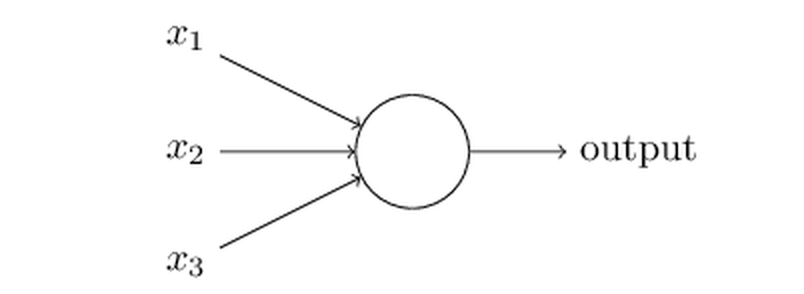
An artificial neuron
It is somewhat inspired by its biological cousin (the “real” neuron), but it doesn’t replicate at all its inner workings.
Data in the form of (input, output) couples is used to adjust the weights of this neuron, to make the output as close as possible to the expected output. Let’s illustrate this on a toy example:
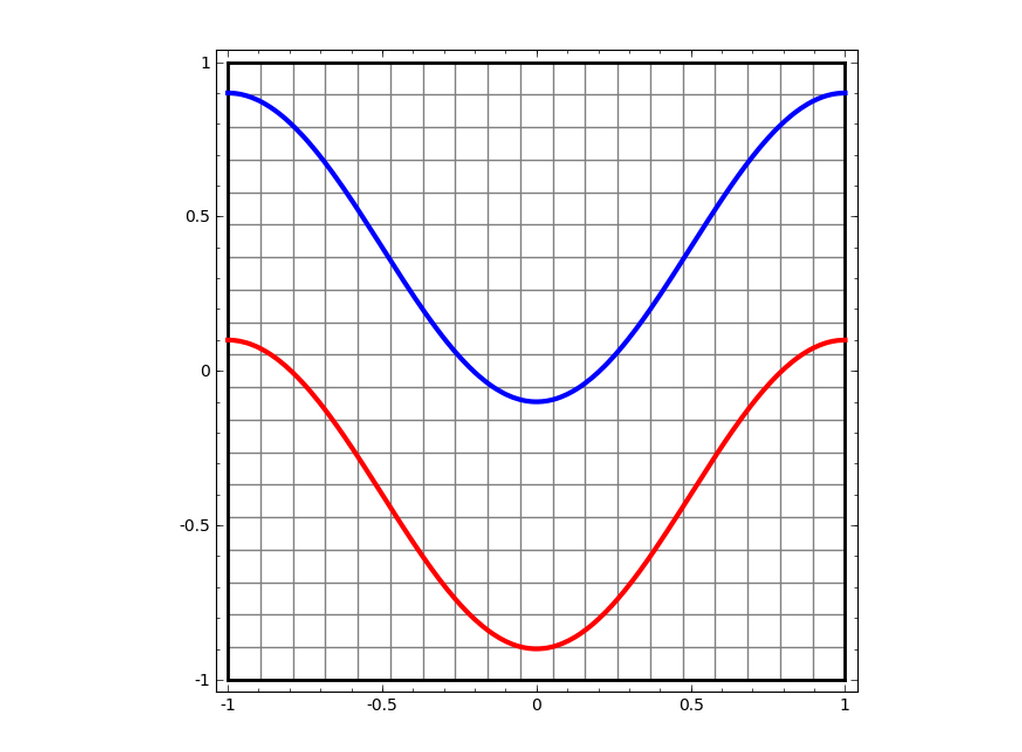
We are trying to separate the blue and red curves
Let’s say we wanted to classify a point in this 2D space, as being part of the red curve, or blue curve. If we use our simple neuron to solve this problem, the task comes down to finding the best separating line between the two curves.
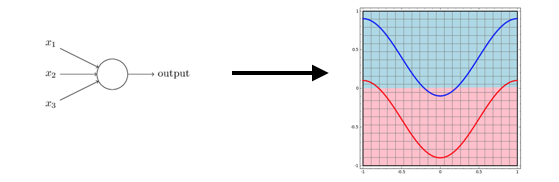
A simple neuron gives us a linear separation
Not bad. The separating line does a pretty good job, but we can clearly see that a line will never separate the two curves perfectly, the problem is just a bit too complex. What if we add an extra layer to our simple network ? i.e.
- We first compute several weighted sums of our inputs
- Then we use these weighted sums as an input to a simple neuron
Let’s try this and see what happens:
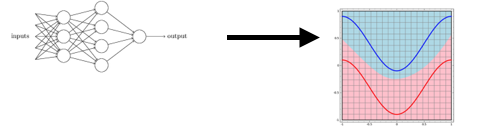
A neural network with a hidden layer can separate the curves perfectly
Better ! We can now separate our two curves perfectly. What is happening in the extra layer, that made this possible ?

How neural networks work
No .. Not really … We are just bending and twisting our space, so that we can better separate our two curves. If we sneak a peak into what’s happening, to see how the input space is transformed, we can see that our extra layer computes a new representation, that makes the two curves linearly separable:
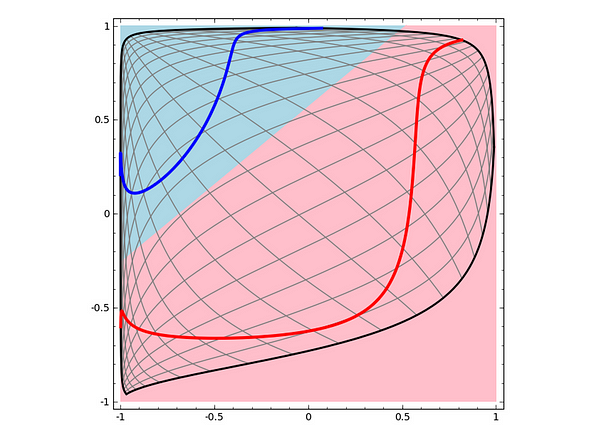
Computed representation of input space
This is one of the things Deep Learning is all about.
To better show how learning multiple levels of new, more useful representations looks like, we will make the (huge) jump to the world of human face detection. If we train a Deep Learning model on a dataset of face images, we can see that we naturally have a hierarchy of representations that is learned (object edges -> parts of faces -> whole faces )
(Image Source: http://www.nature.com/news/computer-science-the-learning-machines-1.14481)
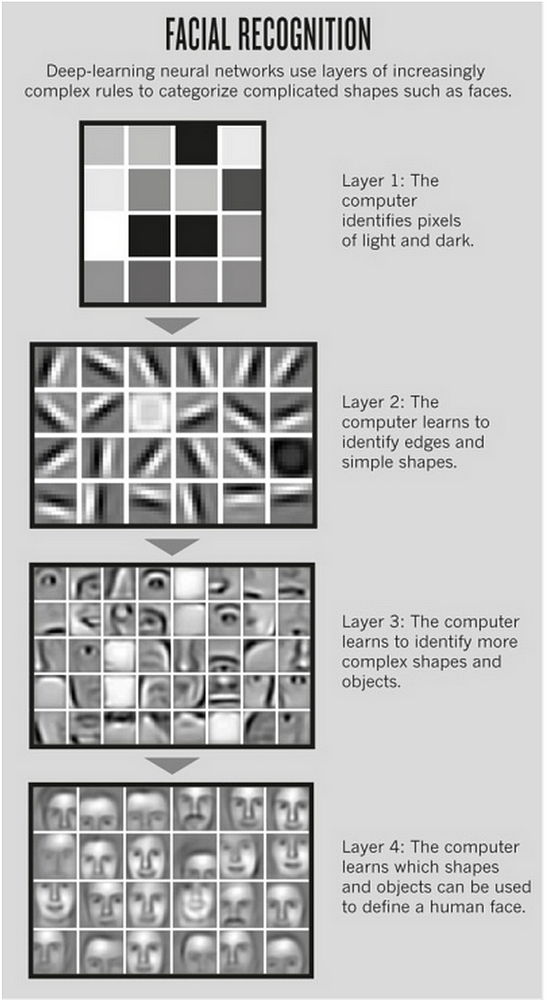
Multiple layers of features for face detection
How Deep is your learning ?
Ok, so that’s how a neural network works (basically).
We can argue that if we make our neural networks deeper, by adding more layers (that’s where the Deep is Deep Learning comes from), we can learn more and more complex representations of our input, and we can potentially capture more complicated structures (as in images or text data).
Wait … That’s what took everybody several decades to figure out ?
Well not exactly. These ideas were here a while ago, but (until 2006) people just couldn’t properly train these Deep Networks.
(If you want to know more about the history of Deep Learninghttp://www.wired.com/2014/01/geoffrey-hinton-deep-learning)
This Deep Learning renaissance is due to a mix of three things:
- New techniques for training these complex models (new optimization methods, better initializations …)
- More computational power (GPUs are now used to dramatically speed up the training)
- More data ! (The internet)
The reason everyone (or almost everyone) is so excited about Deep Learning, is that it achieved really promising results on a variety of tasks and in a relatively short period of time.
Deep Learning — Cool stuff
Computer Vision — Recognizing Objects:
Deep Learning models are now the state-of-the-art methods on this task.
If we take for instance the ImageNet Large Scale Visual Recognition Challenge (ILSVRC), which is a annual competition where the task is classifying several tens of thousands of images into one of 1000 different object categories, this competition was dominated by Deep Learning Models in the last few years.
Check out http://www.image-net.org/challenges/LSVRC/ for more info.
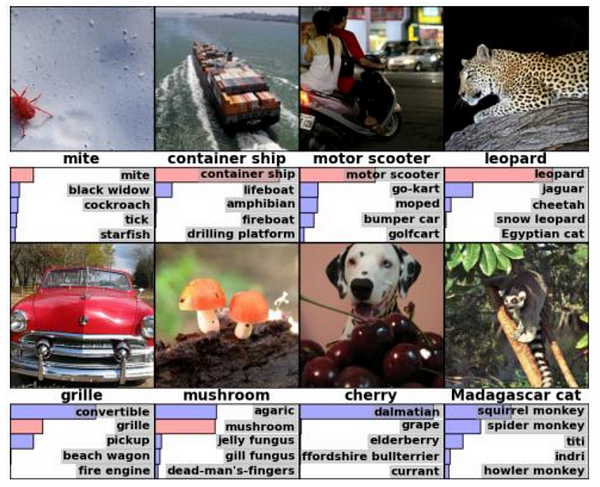
Some examples of predicted image labels
Computer Vision — Facebook’s DeepFace
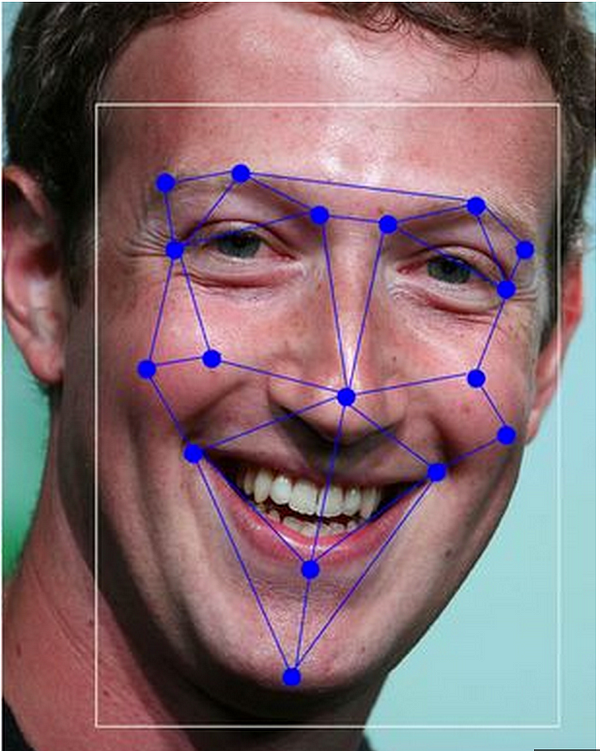
Facebook’s DeepFace model is closely approaching human level performance on the task of recognizing faces (the dataset used ishttp://vis-www.cs.umass.edu/lfw/ ), achieving an accuracy 97.25%.
News article http://www.mirror.co.uk/news/technology-science/technology/facebooks-deepface-ai-system-scarily-5137505)
Computer Vision + Natural Language Processing — Generating image captions
Another really cool application. This model generates image captions automatically by learning correspondences between language and visual data.
Check out the results here:http://cs.stanford.edu/people/karpathy/deepimagesent/
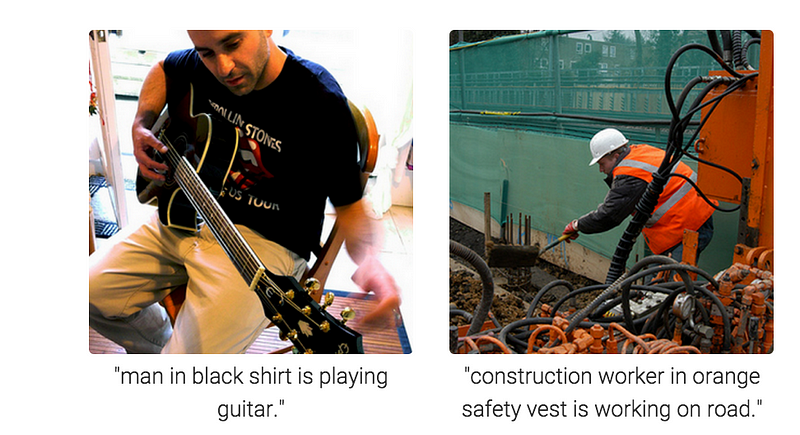
Some examples of generated caption
Speech Recognition — Google Voice
Today, each time you speak to your android phone, so you can send a text message, call someone, or do a google a search, there is a large Deep Learning model that is processing your voice and translating it into text.
The use of Deep Learning models helped reduce the error rate of this system dramatically.
Natural Language Processing — Neural Machine Translation
Something that’s been showing some promise in recent years, is the use of Deep Learning to better understand the human language.
Neural Machine Translation is an interesting application of such models, where using just an aligned corpus on the sentence level (like the Euro Parliament corpus (http://www.statmt.org/europarl/ ), we can learn to translate new sentences, and even align words and groups of words across languages.
Here’s a link to the demo: http://104.131.78.120/
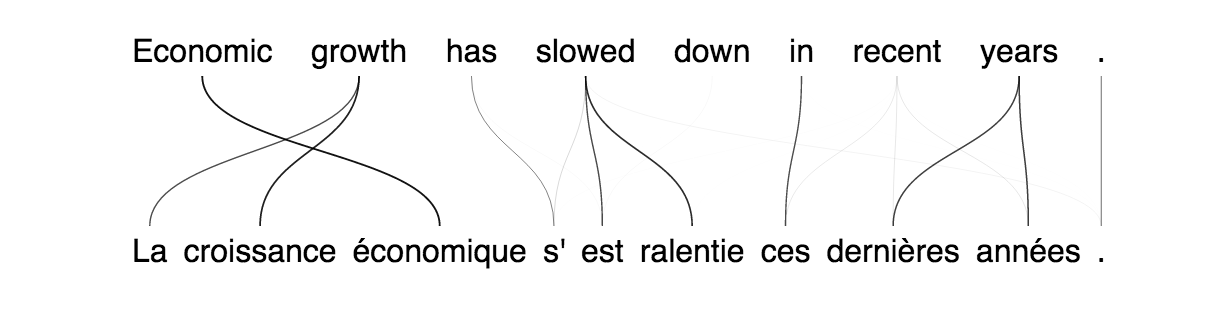
An example of generated translation with alignement
And more:
There’s a lot more applications, and it’s hard to give an exhaustive view of every one of them.
- Reinforcement Learning or how a machine can learn to play a gamehttp://www.wired.co.uk/news/archive/2015-02/25/google-deepmind-atari
- Deep Learning of artistic stylehttp://www.boredpanda.com/computer-deep-learning-algorithm-painting-masters/
- Medicine http://blog.kaggle.com/2012/10/31/merck-competition-results-deep-nn-and-gpus-come-out-to-play/
- …
Deep Leaning is impressive
Ok, so all of this seems great, the results are promising, the models are powerful. But there must be some flaw in these models ? They are certainly not perfect in every way ? Are they ?
Well, the answer is no, they are not perfect, and they do have some flaws, which brings us to our next section.
Deep Learning — The Good, the bad and the ugly

The good:
We argued earlier, that Deep Learning models have a lot of advantages:
- They work quite well for a variety of tasks
- Less time is spent on engineering features and representations
- Some variants make good use of the mass of unlabelled data
Which make them the tool of choice for a lot of modern problems.
The bad:
But there are some downsides to using these models
- They are far from being a silver bullet: they are not well suited for every task, and they will not replace other Machine Learning models anytime soon.
- Relatively hard to tune (a lot of fiddling around): There’s a lot of engineering involved in tuning every parameter of the network (depth, architecture, …), and it is more of an art than a science.
- They require a lot of data to work properly, which in certain tasks is not a problem, but for other tasks where data is scarce, it is kind of hard to get them to work.
Resolving all of these problems is still an active area of research, and people are trying to make implementing and tuning these models easier. Some people will even argue that these flaws are inherent to a lot of Machine Learning methods and not only Deep Learning.
There are also some flaws which are even more severe, and have more profound consequences.
The ugly:
Your model is as good as your data
Deep Learning models learn representations that capture the structure of the data. So if we want to learn useful features, we need to make sure our data is large and diverse enough to represent the real world.
One particular example comes to mind. (http://googleresearch.blogspot.fr/2015/06/inceptionism-going-deeper-into-neural.html)
If we ask a Deep Learning model trained on a computer vision task to generate what it thinks most resembles a dumbbell, here’s what we obtain:
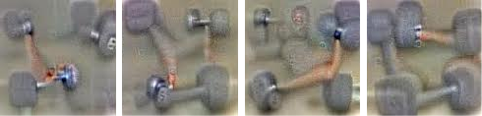
This is what a Dumbbell is for a Deep NN
The network thinks a dumbbell always has an arm attached to it, because it was the case in most of the training examples it saw. The model is still far from being “intelligent”, it failed to completely distill the essence of a dumbbell.
Deep networks can be (easily ?) fooled
Some researchers found that Deep Learning models are quite easily fooled by noise in the input data.
They took an image of an object that was recognizable by the network and added just a little bit of noise, so little that it was basically identical to the human eye. The network completely mislabelled these examples.
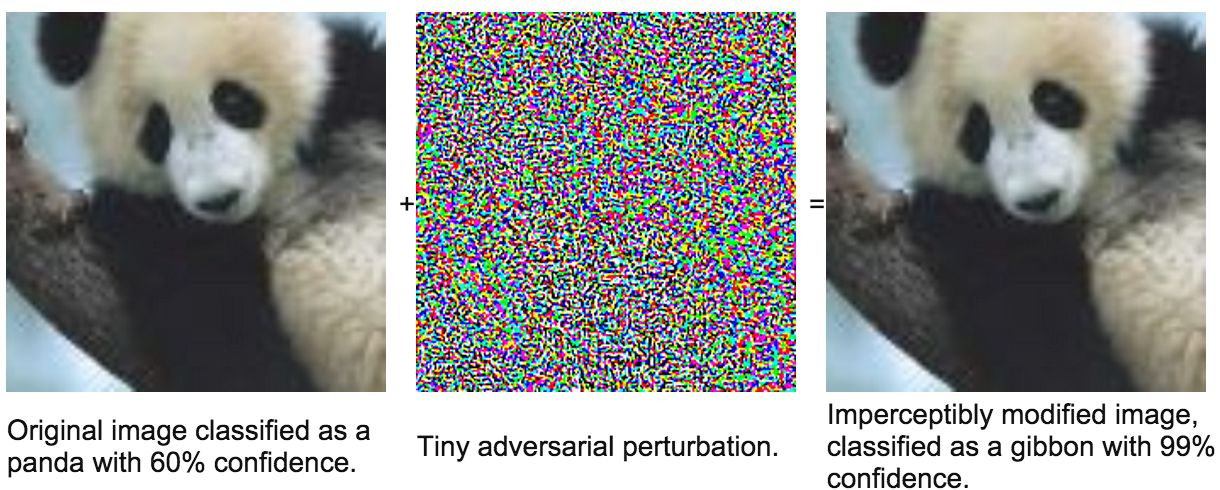
Perturbed panda is a gibbon
The reverse was also done, taking images that were, to the human eye, just random pixels on a canvas, yet the network labelled them as objects with near certainty.
Some examples of this:
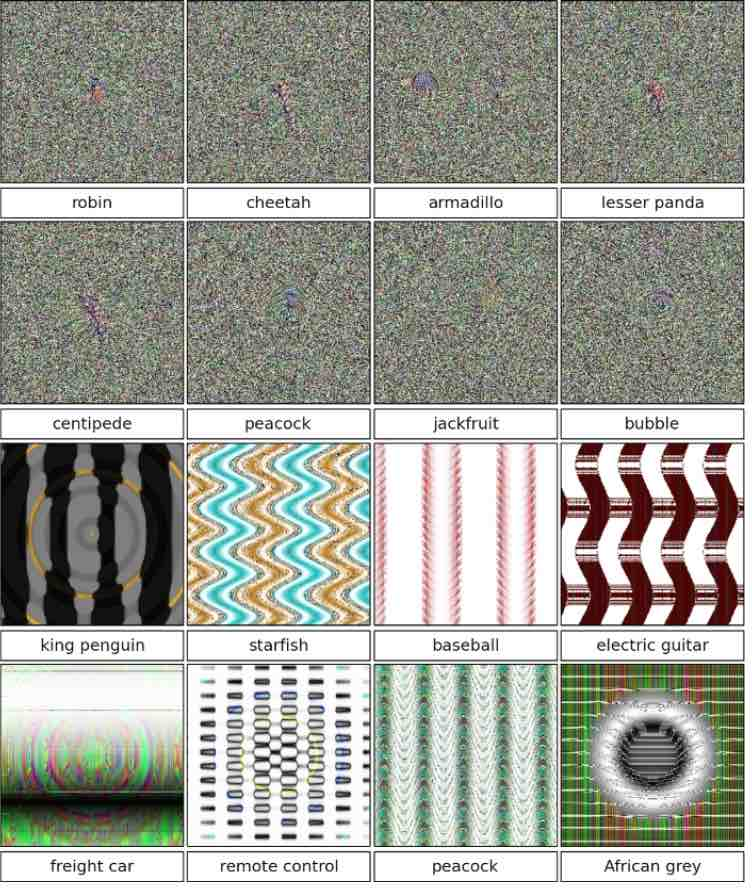
I can’t see the resemblance
It makes us question whether these networks are really robust, and understand the essence of what an object is.
More details and examples of this can be found here
http://www.kdnuggets.com/2014/06/deep-learning-deep-flaws.htmland here http://www.kdnuggets.com/2015/01/deep-learning-can-be-easily-fooled.html
What’s in the box ?

Brad Pitt on the inner workings of Deep Learning models
You probably noticed that most of these examples are related to Computer Vision, not because it’s the only application domain or the most important (which is not), but because we can “see” what is happening under the hood, and that’s not the case with every task.
This is a problem with these kinds of model, they are more like black boxes, and it’s kind of hard to see what’s exactly happening inside. Sure, it’s ok if all we care about is accuracy and performance, but that’s rarely the case, sometimes we do need to open the box.
The point is …
We tried to give a brief overview of Deep Learning, so you can see and understand what is happening beyond the hype.
Three key points to remember are:
- Deep Learning is about learning features and representations
- It is overhyped, but it works well for a lot of stuff
- Vision, Speech, and a bit of NLP are the main applications right now (but there is some promise in other areas)
Amine — @amine_benh
You should follow us on Twitter: @mfg_labs
Rolling in the Deep (Learning)的更多相关文章
- Deep Learning with Torch
原文地址:https://github.com/soumith/cvpr2015/blob/master/Deep%20Learning%20with%20Torch.ipynb Deep Learn ...
- Deep learning:五十一(CNN的反向求导及练习)
前言: CNN作为DL中最成功的模型之一,有必要对其更进一步研究它.虽然在前面的博文Stacked CNN简单介绍中有大概介绍过CNN的使用,不过那是有个前提的:CNN中的参数必须已提前学习好.而本文 ...
- 【深度学习Deep Learning】资料大全
最近在学深度学习相关的东西,在网上搜集到了一些不错的资料,现在汇总一下: Free Online Books by Yoshua Bengio, Ian Goodfellow and Aaron C ...
- 《Neural Network and Deep Learning》_chapter4
<Neural Network and Deep Learning>_chapter4: A visual proof that neural nets can compute any f ...
- Deep Learning模型之:CNN卷积神经网络(一)深度解析CNN
http://m.blog.csdn.net/blog/wu010555688/24487301 本文整理了网上几位大牛的博客,详细地讲解了CNN的基础结构与核心思想,欢迎交流. [1]Deep le ...
- paper 124:【转载】无监督特征学习——Unsupervised feature learning and deep learning
来源:http://blog.csdn.net/abcjennifer/article/details/7804962 无监督学习近年来很热,先后应用于computer vision, audio c ...
- Deep Learning 26:读论文“Maxout Networks”——ICML 2013
论文Maxout Networks实际上非常简单,只是发现一种新的激活函数(叫maxout)而已,跟relu有点类似,relu使用的max(x,0)是对每个通道的特征图的每一个单元执行的与0比较最大化 ...
- Deep Learning 23:dropout理解_之读论文“Improving neural networks by preventing co-adaptation of feature detectors”
理论知识:Deep learning:四十一(Dropout简单理解).深度学习(二十二)Dropout浅层理解与实现.“Improving neural networks by preventing ...
- Deep Learning 19_深度学习UFLDL教程:Convolutional Neural Network_Exercise(斯坦福大学深度学习教程)
理论知识:Optimization: Stochastic Gradient Descent和Convolutional Neural Network CNN卷积神经网络推导和实现.Deep lear ...
随机推荐
- 300道随机四则运算小程序(java编写)
这是由Java编写的300道随机四则运算小程序, 运算数范围为0~100(不包括100),运算结果保留两位小数. 程序代码: import java.util.*; class Yunsuan{ pu ...
- Java中的常见异常
非检查异常:Error 和 RuntimeException 以及他们的子类.0错误ArithmeticException,错误的强制类型转换错误ClassCastException,数组索引越界Ar ...
- Java面试& HashMap实现原理分析
1. HashMap的数据结构 数据结构中有数组和链表来实现对数据的存储,但这两者基本上是两个极端. 数组 数组存储区间是连续的,占用内存严重,故空间复杂的很大.但数组的二分查找时间复杂度小,为O( ...
- 未能加载文件或程序集“Microsoft.ReportViewer.WebForms, Version=10.0.0.0, Culture=neutral, PublicKeyToken=b03f5f7f11d50a3a”或它的某一个依赖项。系统找不到指定的文件
发布的打包项目在本机测试好使,部署到客户服务器上报错 分析器错误消息: 未能加载文件或程序集“Microsoft.ReportViewer.WebForms, Version=10.0.0.0, Cu ...
- 关于react 官方脚手架使用出现的问题
首先按照官网说明,一路的安装下来,很顺利,然后开始运行吧,提示个错误,缺少index.js 文件 原来是默认给出的文件是App.js 如何更改呢 找到react-script模块文件夹config下 ...
- ORA-06530: 引用未初始化的组合 ;
select * FROM TABLE(fun_test_1) : ORA-06530: 引用未初始化的组合ORA-06512: 在 "PCISS.FUN_TEST_1", lin ...
- php框架的制作原理
php框架的制作原理 (2012-08-16 14:25:55) 转载▼ 标签: php框架制作 杂谈 分类: php index.php 主入口文件 <?php define('ISEXIS ...
- 面试问题总结二(技术能力-PHP)----Ⅲ
42.什么是单点登录? 答:单点登录 SSO(Single Sign On)说得简单点就是在一个多系统共存的环境下,用户在一处登录后,就不用在其他系统中登录,也就是用户的一次登录能得到其他所有系统的信 ...
- CF992C Nastya and a Wardrobe
我是题面 题意很清晰,这种题,我们当然还是有两种方法来做啦 方法一:找规律 读完题我们来看样例,通过样例一已我们大概可以看出,答案或许是\(n*2^{k+1}\) 肯定不能这么简单对吧,那就来看样例二 ...
- c# base64算法解密
/// <summary> /// 将字符串使用base64算法加密 /// </summary> /// <param name="code_type&quo ...