
Luogu P4709 信息传递 (群论、生成函数、多项式指数函数)
题意:
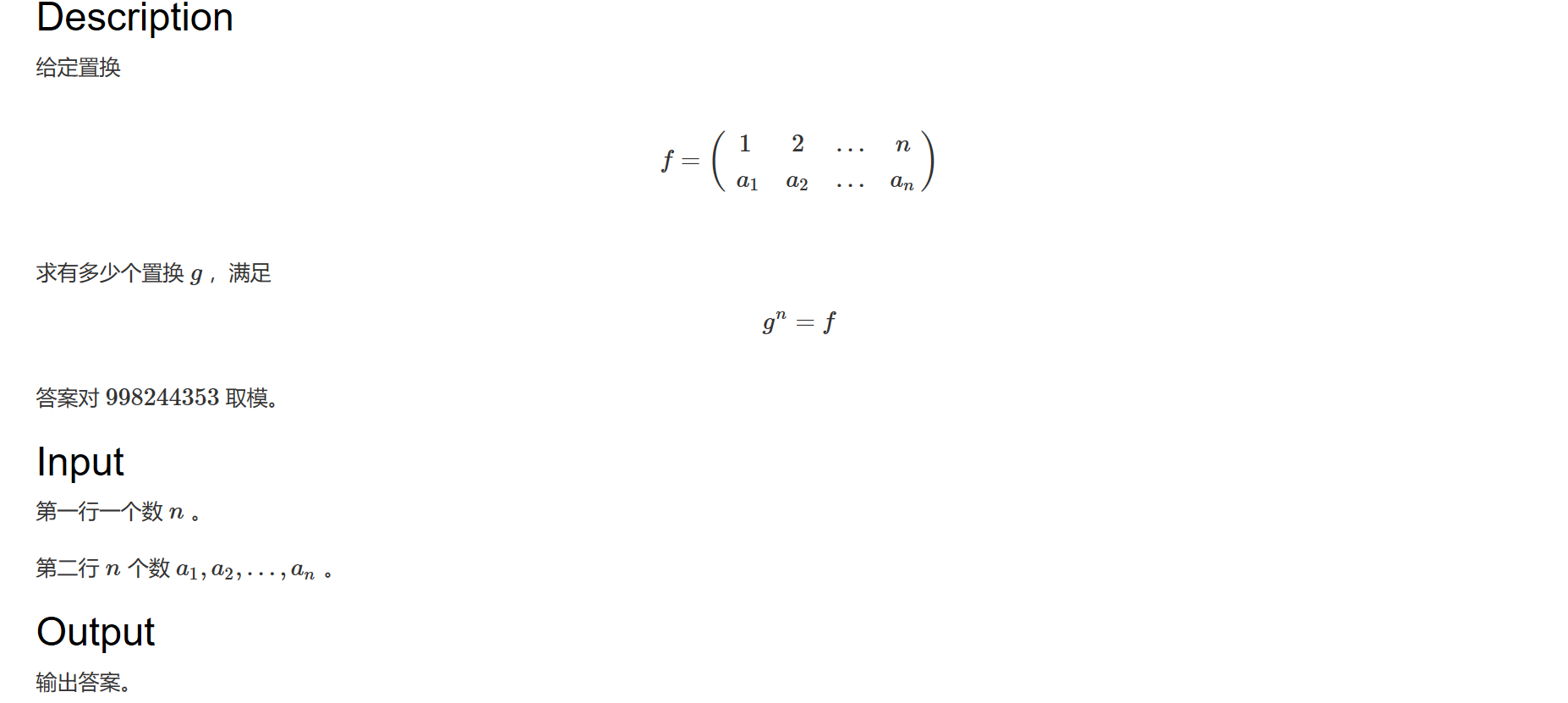
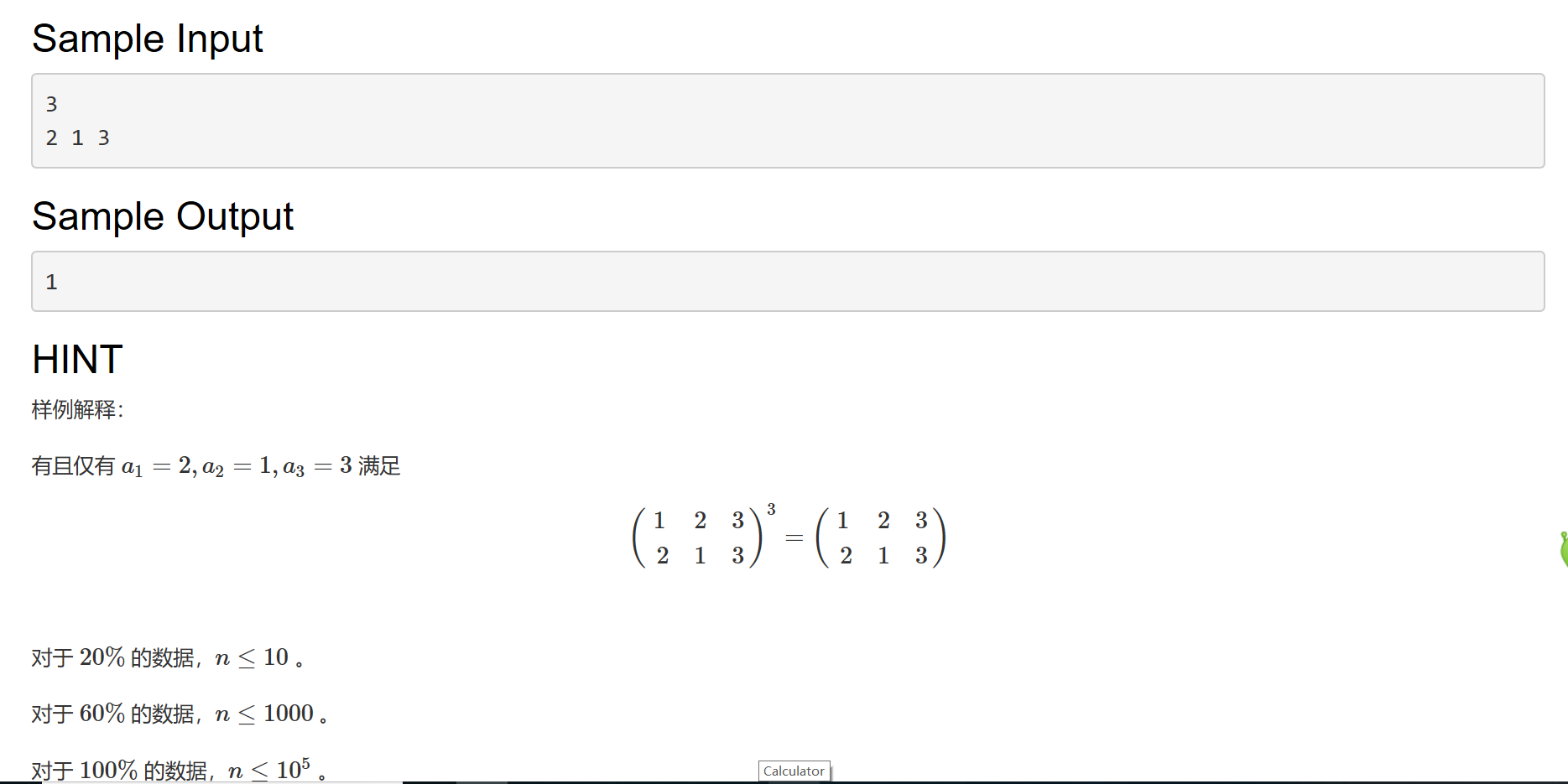
题解: 这道题我思路大方向是正确的,但是生成函数推错导致一直WA,看了标程才改对……
首先一个长为\(m\)的轮换的\(n\)次幂会分裂成\(\gcd(n,m)\)个长为\(\frac{m}{\gcd(n,m)}\)的轮换
所以合并的时候相当于对于一个长度\(l\)若存在一个\(m\)使得\(\frac{m}{\gcd(n,m)}=l\)则\(\gcd(n,m)\)个长度为\(l\)的轮换可以合并
显然不同长度的轮换是互不影响的,那么我们可以分开每种长度计算
就相当于对于一个长度为\(l\)的有标号的轮换,要把它们划分成若干无标号集合,每个集合大小都在给定的集合\(S\)内,并且每个集合有权值(合并的方案数),一种划分方案的权值为所有集合权值之积,求所有划分方案权值总和
那么显然这个东西的EGF就等于\(\exp(\sum_{i\in S} \frac{w_i}{i!})\), \(w_i\)为权值
如何求\(w_i\)? 在这里我出了问题
正确的答案是,假设\(k\)个长度为\(l\)的轮换合并,方案数为\(l^{k-1}(k-1)!\), 也就是\(\frac{l^kk!}{lk}\).
这大概是因为,假设我们定住第一个轮换的第一个元素的位置,那么其余每个轮换自身内部的顺序都可以改变,这样是\(l^{k-1}\)种;这些轮换之间的顺序也可以改变,这样是\((k-1)!\)种。
代码
#include<cstdio>

#include<cstdlib>

#include<cstring>

#include<cassert>

#include<iostream>

#include<vector>

#define llong long long

using namespace std;

inline int read()

{

	int x=0; bool f=1; char c=getchar();

	for(;!isdigit(c);c=getchar()) if(c=='-') f=0;

	for(; isdigit(c);c=getchar()) x=(x<<3)+(x<<1)+(c^'0');

	if(f) return x;

	return -x;

}

const int N = 1<<19;

const int LGN = 19;

const int P = 998244353;

const int G = 3;

llong quickpow(llong x,llong y)

{

	llong cur = x,ret = 1ll;

	for(int i=0; y; i++)

	{

		if(y&(1ll<<i)) {y-=(1ll<<i); ret = ret*cur%P;}

		cur = cur*cur%P;

	}

	return ret;

}

llong mulinv(llong x) {return quickpow(x,P-2);}

namespace FFT

{

	llong tmp1[N+3],tmp2[N+3],tmp3[N+3],tmp4[N+3],tmp5[N+3],tmp6[N+3],tmp7[N+3],tmp8[N+3],tmp9[N+3],tmp10[N+3];

	llong tst1[N+3],tst2[N+3],tst3[N+3];

	llong sexp[N+3];

	int fftid[N+3];

	int getdgr(int n) {int ret = 1; while(ret<=n) ret<<=1; return ret;}

	void init_fftid(int dgr)

	{

		int len = 0; for(int i=1; i<=LGN; i++) {if((1<<i)==dgr) {len = i; break;}}

		fftid[0] = 0; for(int i=1; i<dgr; i++) fftid[i] = (fftid[i>>1]>>1)|((i&1)<<(len-1));

	}

	void ntt(int dgr,int coe,llong poly[],llong ret[])

	{

		init_fftid(dgr);

		if(poly==ret) {for(int i=0; i<dgr; i++) {if(i<fftid[i]) swap(ret[i],ret[fftid[i]]);}}

		else {for(int i=0; i<dgr; i++) ret[i] = poly[fftid[i]];}

		for(int i=1; i<=(dgr>>1); i<<=1)

		{

			llong tmp = quickpow(G,(P-1)/(i<<1));

			if(coe==-1) {tmp = mulinv(tmp);}

			sexp[0] = 1ll; for(int j=1; j<i; j++) sexp[j] = sexp[j-1]*tmp%P;

			for(int j=0; j<dgr; j+=(i<<1))

			{

				for(llong *k=ret+j,*kk=sexp; k<ret+i+j; k++,kk++)

				{

					llong y = k[i]*(*kk)%P;

					k[i] = (*k)-y<0 ? (*k)-y+P : (*k)-y;

					(*k) = (*k)+y>=P ? (*k)+y-P : (*k)+y;

				}

			}

		}

		if(coe==-1)

		{

			llong tmp = mulinv(dgr);

			for(int i=0; i<dgr; i++) ret[i] = ret[i]*tmp%P;

		}

	}

	void polymul(int dgr,llong poly1[],llong poly2[],llong ret[])

	{

		ntt((dgr<<1),1,poly1,tmp1); ntt((dgr<<1),1,poly2,tmp2);

		for(int i=0; i<(dgr<<1); i++) ret[i] = tmp1[i]*tmp2[i]%P;

		ntt((dgr<<1),-1,ret,ret);

	}

	void polyinv(int dgr,llong poly[],llong ret[])

	{

		for(int i=0; i<(dgr<<1); i++) ret[i] = tmp3[i] = tmp4[i] = tmp5[i] = 0ll;

		ret[0] = mulinv(poly[0]);

		for(int i=1; i<=(dgr>>1); i<<=1)

		{

			for(int j=0; j<(i<<1); j++) tmp3[j] = poly[j];

			ntt((i<<2),1,tmp3,tmp4); ntt((i<<2),1,ret,tmp5);

			for(int j=0; j<(i<<2); j++) tmp3[j] = tmp4[j]*tmp5[j]%P*tmp5[j]%P;

			ntt((i<<2),-1,tmp3,tmp4);

			for(int j=0; j<(i<<1); j++) ret[j] = (ret[j]+ret[j]-tmp4[j]+P)%P;

		}

	}

	void polyder(int dgr,llong poly[],llong ret[])

	{

		for(int i=0; i<dgr-1; i++) ret[i] = poly[i+1]*(i+1)%P;

		ret[dgr-1] = 0ll;

	}

	void polyint(int dgr,llong poly[],llong ret[])

	{

		for(int i=1; i<dgr; i++) ret[i] = poly[i-1]*mulinv(i)%P;

		ret[0] = 0ll;

	}

	void polyln(int dgr,llong poly[],llong ret[])

	{

		for(int i=0; i<(dgr<<1); i++) ret[i] = tmp6[i] = tmp7[i] = tmp8[i] = 0ll;

		polyder(dgr,poly,tmp6);

		polyinv(dgr,poly,tmp7);

		polymul(dgr,tmp6,tmp7,tmp8);

		polyint(dgr,tmp8,ret);

	}

	void polyexp(int dgr,llong poly[],llong ret[])

	{

		for(int i=0; i<(dgr<<1); i++) ret[i] = tmp9[i] = tmp10[i] = 0ll;

		ret[0] = 1ll;

		for(int i=1; i<=(dgr>>1); i<<=1)

		{

			polyln((i<<1),ret,tmp9);

			for(int j=0; j<(i<<1); j++) tmp9[j] = (-tmp9[j]+poly[j]+P)%P; tmp9[0]++;

			polymul((i<<2),ret,tmp9,tmp10);

			for(int j=0; j<(i<<1); j++) ret[j] = tmp10[j];

		}

	}

}

int permu[N+3];

int a[N+3];

int dgr[N+3];

bool vis[N+3];

vector<int> s[N+3];

llong f[N+3],expf[N+3];

llong fact[N+3];

int n;

int gcd(int x,int y) {return y==0?x:gcd(y,x%y);}

int main()

{

	fact[0] = 1ll; for(int i=1; i<=N; i++) fact[i] = fact[i-1]*i%P;

	scanf("%d",&n);

	for(int i=1; i<=n; i++) scanf("%d",&permu[i]);

	for(int i=1; i<=n; i++)

	{

		if(vis[i]) continue;

		int len = 1; vis[i] = true;

		for(int j=permu[i]; j!=i; j=permu[j])

		{

			len++;

			vis[j] = true;

		}

		a[len]++;

	}

	for(int i=1; i<=n; i++)

	{

		int g = gcd(i,n),l = i/gcd(i,n);

		s[l].push_back(g);

	}

	llong ans = 1ll;

	for(int i=1; i<=n; i++)

	{

		if(a[i]==0) continue;

		int dgr = FFT::getdgr(a[i]);

		for(int j=0; j<s[i].size(); j++)

		{

			if(s[i][j]<dgr)

			{

				f[s[i][j]] = (f[s[i][j]]+mulinv(s[i][j])*quickpow(i,s[i][j]-1))%P;

			}

		}

		FFT::polyexp(dgr,f,expf);

		ans = ans*expf[a[i]]%P*fact[a[i]]%P;

		for(int j=0; j<(dgr<<1); j++) f[j] = expf[j] = 0ll;

	}

	printf("%lld\n",ans);

	return 0;

}
Luogu P4709 信息传递 (群论、生成函数、多项式指数函数)的更多相关文章
- 【luogu P2661 信息传递】 题解
题目链接:https://www.luogu.org/problemnew/show/P2661#sub 一种利用并查集求最小环的做法: 对于每个同学看作一个点,每次信息传递是一条有向边,当出现最小环 ...
- luogu P2661 信息传递 x
P2661 信息传递 题目描述 有n个同学(编号为1到n)正在玩一个信息传递的游戏.在游戏里每人都有一个固定的信息传递对象,其中,编号为i的同学的信息传递对象是编号为Ti同学. 游戏开始时,每人都只知 ...
- Luogu P2661 信息传递
传送门 一眼就能看出来是个并查集 但是并不会写... 看了一下题解说是并查集求最小环qwq 所以,每次加入第i个小同学,判断如果他要告诉的小同学k最后会告诉他(也就是转回来了), 就说明出现了一个环, ...
- 洛谷 P4709 - 信息传递(置换+dp)
题面传送门 一道挺有意思的题罢-- 首先看到这种与置换乘法相关的题,首先把这些置换拆成一个个置换环,假设输入的置换有 \(m\) 个置换环,大小分别为 \(s_1,s_2,\cdots,s_m\),显 ...
- 2015 NOIP day2 t2 信息传递 tarjan
信息传递 Time Limit: 20 Sec Memory Limit: 256 MB 题目连接 http://www.luogu.org/problem/show?pid=2661 Descrip ...
- Luogu2661 信息传递(图论)
Luogu2661 信息传递(图论) Description 有n个同学(编号为1到n)正在玩一个信息传递的游戏.在游戏里每人都有一个固定的信息传递对象,其中,编号为i的同学的信息传递对象是编号为Ti ...
- 洛谷 P2661 信息传递(并查集 & 最小环)
嗯... 题目链接:https://www.luogu.org/problemnew/show/P2661 这道题和一些比较水的并查集不太一样,这道题的思路就是用并查集来求最小环... 首先,如果我们 ...
- 洛谷——P2661 信息传递
https://www.luogu.org/problem/show?pid=2661#sub 题目描述 有n个同学(编号为1到n)正在玩一个信息传递的游戏.在游戏里每人都有一个固定的信息传递对象,其 ...
- tg2015 信息传递 (洛谷p2661)
题目描述 有n个同学(编号为1到n)正在玩一个信息传递的游戏.在游戏里每人都有一个固定的信息传递对象,其中,编号为i的同学的信息传递对象是编号为Ti同学. 游戏开始时,每人都只知道自己的生日.之后每一 ...
随机推荐
- @Select 数据表的字段与实体类的属性值
添加@Results @Select("select * from goods") @Results({ @Result(property = "id", co ...
- C++练习 | 铁轨问题
#include <iostream> #include <cmath> #include <cstring> #include <string> #i ...
- JavaScript刷新事件
1, Location reload() 方法 2,
- CSP前模板复习
Tarjan 求强连通分量 展开查看 #include #include #include using namespace std; const int N = 1e4 + 1e3; int n, m ...
- [Nest] 03.nest之提供者 provider
提供者 provider 提供程序是 Nest 的一个基本概念.许多基本的 Nest 类可能被视为提供者 - service,repository, factory, helper 等等. 他们都可以 ...
- [Next] next中文文档
Next.js 是一个轻量级的 React 服务端渲染应用框架. 怎么使用 安装 在项目文件夹中运行: npm install --save next react react-dom 将下面脚本添加到 ...
- Git复习(二)之远程仓库、注册GitHub账号、SSH警告、使用GitHub
远程仓库 Git是分布式版本控制系统,同一个Git仓库,可以分布到不同的机器上.怎么分布呢?最早,肯定只有一台机器有一个原始版本库,此后,别的机器可以“克隆”这个原始版本库,而且每台机器的版本库其实都 ...
- CSS media queries 媒体查询
最近在做一些页面打印时的特殊处理接触到了media queries,想系统学习一下,在MOZILLA DEVELOPER NETWORK看到一篇文章讲的很不错,结合自己的使用总结一下. CSS2/me ...
- 安装Mybatis插件
http://blog.csdn.net/nextyu/article/details/69225004
- List的Select 和Select().tolist()
List<Person> delp = new List<Person> { ,Name=,Sign= }, ,Name= ,Sign=}, }; delp.Select(u ...