
5 commands to check memory usage on Linux
Memory Usage
On linux, there are commands for almost everything, because the gui might not be always available. When working on servers only shell access is available and everything has to be done from these commands. So today we shall be checking the commands that can be used to check memory usage on a linux system. Memory include RAM and swap.
It is often important to check memory usage and memory used per process on servers so that resources do not fall short and users are able to access the server. For example a website. If you are running a webserver, then the server must have enough memory to serve the visitors to the site. If not, the site would become very slow or even go down when there is a traffic spike, simply because memory would fall short. Its just like what happens on your desktop PC.
1. free command
The free command is the most simple and easy to use command to check memory usage on linux. Here is a quick example
$ free -m

             total       used       free     shared    buffers     cached

Mem:          7976       6459       1517          0        865       2248

-/+ buffers/cache:       3344       4631

Swap:         1951          0       1951
The m option displays all data in MBs. The total os 7976 MB is the total amount of RAM installed on the system, that is 8GB. The used column shows the amount of RAM that has been used by linux, in this case around 6.4 GB. The output is pretty self explanatory. The catch over here is the cached and buffers column. The second line tells that 4.6 GB is free. This is the free memory in first line added with the buffers and cached amount of memory.
Linux has the habit of caching lots of things for faster performance, so that memory can be freed and used if needed.
The last line is the swap memory, which in this case is lying entirely free.
2. /proc/meminfo
The next way to check memory usage is to read the /proc/meminfo file.
Know that the /proc file system does not contain real files. They are
rather virtual files that contain dynamic information about the kernel
and the system.
$ cat /proc/meminfo

MemTotal:        8167848 kB

MemFree:         1409696 kB

Buffers:          961452 kB

Cached:          2347236 kB

SwapCached:            0 kB

Active:          3124752 kB

Inactive:        2781308 kB

Active(anon):    2603376 kB

Inactive(anon):   309056 kB

Active(file):     521376 kB

Inactive(file):  2472252 kB

Unevictable:        5864 kB

Mlocked:            5880 kB

SwapTotal:       1998844 kB

SwapFree:        1998844 kB

Dirty:              7180 kB

Writeback:             0 kB

AnonPages:       2603272 kB

Mapped:           788380 kB

Shmem:            311596 kB

Slab:             200468 kB

SReclaimable:     151760 kB

SUnreclaim:        48708 kB

KernelStack:        6488 kB

PageTables:        78592 kB

NFS_Unstable:          0 kB

Bounce:                0 kB

WritebackTmp:          0 kB

CommitLimit:     6082768 kB

Committed_AS:    9397536 kB

VmallocTotal:   34359738367 kB

VmallocUsed:      420204 kB

VmallocChunk:   34359311104 kB

HardwareCorrupted:     0 kB

AnonHugePages:         0 kB

HugePages_Total:       0

HugePages_Free:        0

HugePages_Rsvd:        0

HugePages_Surp:        0

Hugepagesize:       2048 kB

DirectMap4k:       62464 kB

DirectMap2M:     8316928 kB
Check the values of MemTotal, MemFree, Buffers, Cached, SwapTotal, SwapFree.
They indicate same values of memory usage as the free command.
3. vmstat
The vmstat command with the s option, lays out the memory usage statistics much like the proc command. Here is an example
$ vmstat -s

      8167848 K total memory

      7449376 K used memory

      3423872 K active memory

      3140312 K inactive memory

       718472 K free memory

      1154464 K buffer memory

      2422876 K swap cache

      1998844 K total swap

            0 K used swap

      1998844 K free swap

       392650 non-nice user cpu ticks

         8073 nice user cpu ticks

        83959 system cpu ticks

     10448341 idle cpu ticks

        91904 IO-wait cpu ticks

            0 IRQ cpu ticks

         2189 softirq cpu ticks

            0 stolen cpu ticks

      2042603 pages paged in

      2614057 pages paged out

            0 pages swapped in

            0 pages swapped out

     42301605 interrupts

     94581566 CPU context switches

   1382755972 boot time

         8567 forks

$
The top few lines indicate total memory, free memory etc and so on.
4. top command
The top command is generally used to check memory and cpu usage per process. However it also reports total memory usage and can be used to monitor the total RAM usage. The header on output has the required information. Here is a sample output
top - 15:20:30 up  6:57,  5 users,  load average: 0.64, 0.44, 0.33

Tasks: 265 total,   1 running, 263 sleeping,   0 stopped,   1 zombie

%Cpu(s):  7.8 us,  2.4 sy,  0.0 ni, 88.9 id,  0.9 wa,  0.0 hi,  0.0 si,  0.0 st

KiB Mem:   8167848 total,  6642360 used,  1525488 free,  1026876 buffers

KiB Swap:  1998844 total,        0 used,  1998844 free,  2138148 cached

  PID USER      PR  NI  VIRT  RES  SHR S  %CPU %MEM    TIME+  COMMAND

 2986 enlighte  20   0  584m  42m  26m S  14.3  0.5   0:44.27 yakuake

 1305 root      20   0  448m  68m  39m S   5.0  0.9   3:33.98 Xorg

 7701 enlighte  20   0  424m  17m  10m S   4.0  0.2   0:00.12 kio_thumbnail
Check the KiB Mem and KiB Swap lines on the header. They indicate total, used and free amounts of the memory. The buffer and cache information is present here too, like the free command.
5. htop
Similar to the top command, the htop command also shows memory usage along with various other details.
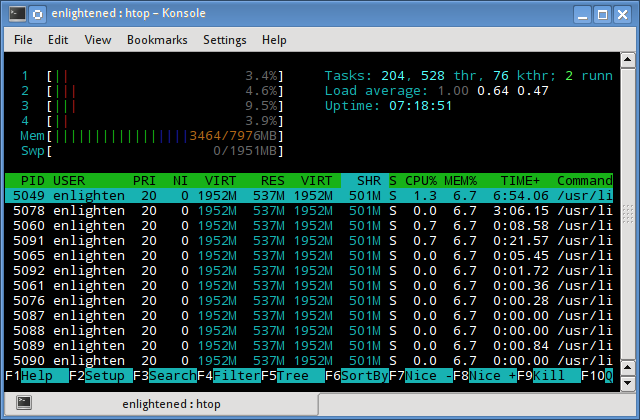
The header on top shows cpu usage along with RAM and swap usage with the corresponding figures.
RAM Information
To find out hardware information about the installed RAM, use the demidecode command. It reports lots of information about the installed RAM memory.
$ sudo dmidecode -t 17

# dmidecode 2.11

SMBIOS 2.4 present.

Handle 0x0015, DMI type 17, 27 bytes

Memory Device

        Array Handle: 0x0014

        Error Information Handle: Not Provided

        Total Width: 64 bits

        Data Width: 64 bits

        Size: 2048 MB

        Form Factor: DIMM

        Set: None

        Locator: J1MY

        Bank Locator: CHAN A DIMM 0

        Type: DDR2

        Type Detail: Synchronous

        Speed: 667 MHz

        Manufacturer: 0xFF00000000000000

        Serial Number: 0xFFFFFFFF

        Asset Tag: Unknown

        Part Number: 0x524D32474235383443412D36344643FFFFFF
Provided information includes the size (2048MB), type (DDR2) , speed(667 Mhz) etc.
Summary
All the above mentioned commands work from the terminal and do not have a gui. When working on a desktop with a gui, it is much easier to use a GUI tool with graphical output. The most common tools are gnome-system-monitor on gnome and
ksysguard on KDE. Both provide resource usage information about cpu,
ram, swap and network bandwidth in a graphical and easy to understand
visual output.
5 commands to check memory usage on Linux的更多相关文章
- SHELL:Find Memory Usage In Linux (统计每个程序内存使用情况)
转载一个shell统计linux系统中每个程序的内存使用情况,因为内存结构非常复杂,不一定100%精确,此shell可以在Ghub上下载. [root@db231 ~]# ./memstat.sh P ...
- 12 Useful “df” Commands to Check Disk Space in Linux
On the internet you will find plenty of tools for checking disk space utilization in Linux. However, ...
- 8 commands to check cpu information on Linux
https://www.binarytides.com/linux-cpu-information/
- Shell script for logging cpu and memory usage of a Linux process
Shell script for logging cpu and memory usage of a Linux process http://www.unix.com/shell-programmi ...
- 10 Useful du (Disk Usage) Commands to Find Disk Usage of Files and Directories
The Linux “du” (Disk Usage) is a standard Unix/Linux command, used to check the information of disk ...
- Reducing and Profiling GPU Memory Usage in Keras with TensorFlow Backend
keras 自适应分配显存 & 清理不用的变量释放 GPU 显存 Intro Are you running out of GPU memory when using keras or ten ...
- detect data races The cost of race detection varies by program, but for a typical program, memory usage may increase by 5-10x and execution time by 2-20x.
小结: 1. conflicting access 2.性能危害 优化 The cost of race detection varies by program, but for a typical ...
- Why does the memory usage increase when I redeploy a web application?
That is because your web application has a memory leak. A common issue are "PermGen" memor ...
- GPU Memory Usage占满而GPU-Util却为0的调试
最近使用github上的一个开源项目训练基于CNN的翻译模型,使用THEANO_FLAGS='floatX=float32,device=gpu2,lib.cnmem=1' python run_nn ...
随机推荐
- php字符串函数和数组函数
/验证码$str="abcdefghijklmnopqrstuvwxyz0123456789";$a=substr($str,rand(0,35),1);$b=substr($st ...
- hifi/ headphone test
https://www.youtube.com/watch?v=-r0gRjqN0N8 https://www.youtube.com/watch?v=sMh_zvCw6us
- 使用GitHub建立自己的个人主页
1.建仓库 在自己的库里建一个hujun123qwe.github.io的库 即可以使用这个名字当网址访问. 2.写内容 在库里建一个首页文件 index.html 这个个人主页只支持静态的内容,像p ...
- [vijos 1770]大内密探
描述 在古老的皇宫中,有N个房间以及N-1条双向通道,每条通道连接着两个不同的房间,所有的房间都能互相到达.皇宫中有许多的宝物,所以需要若干个大内密探来守护.一个房间被守护当切仅当该房间内有一名大内密 ...
- 电脑问题交流QQ群
各种电脑问题交流QQ群号 164853622 系统重装 系统恢复 系统出问题 电脑主页 修改 主页 搜狗 软件卸载 顽固 病毒 讨论
- 关于JS及应用程序开发的一些体会
代码通常从 一,生命周期 二,业务流程 这几方面来看. JS Client可以和Server端分离. JS端的生命周期. Server端就是 JS能处理的只是HTTP协议.
- unity3d 射线扫描 忽略图层
原地址:http://blog.csdn.net/w88193363/article/details/38331205 函数说明 static RaycastHit2D[] RaycastAll(Ve ...
- 总结:Unity3D游戏上线后的流程回顾
原地址:http://unity3d.9tech.cn/news/2014/0127/39748.html 首先.unity 灯光烘焙 :Unity 3d FBX模型导入.选项Model 不导入资源球 ...
- jstl if条件判断字符串代码
<c:if test="${netWorkInfo.networkType eq '快修店'}"> <input type="radio" n ...
- lintcode 中等题:N Queens II N皇后问题 II
题目: N皇后问题 II 根据n皇后问题,现在返回n皇后不同的解决方案的数量而不是具体的放置布局. 样例 比如n=4,存在2种解决方案 解题: 和上一题差不多,这里只是求数量,这个题目定义全局变量,递 ...