
转载Linq中GroupBy方法的使用总结
Group在SQL经常使用,通常是对一个字段或者多个字段分组,求其总和,均值等。
Linq中的Groupby方法也有这种功能。具体实现看代码:
假设有如下的一个数据集:
- public class StudentScore
- {
- public int ID { set; get; }
- public string Name { set; get; }
- public string Course { set; get; }
- public int Score { set; get; }
- public string Term { set; get; }
- }
- List<StudentScore> lst = new List<StudentScore>() {
- new StudentScore(){ID=1,Name="张三",Term="第一学期",Course="Math",Score=80},
- new StudentScore(){ID=1,Name="张三",Term="第一学期",Course="Chinese",Score=90},
- new StudentScore(){ID=1,Name="张三",Term="第一学期",Course="English",Score=70},
- new StudentScore(){ID=2,Name="李四",Term="第一学期",Course="Math",Score=60},
- new StudentScore(){ID=2,Name="李四",Term="第一学期",Course="Chinese",Score=70},
- new StudentScore(){ID=2,Name="李四",Term="第一学期",Course="English",Score=30},
- new StudentScore(){ID=3,Name="王五",Term="第一学期",Course="Math",Score=100},
- new StudentScore(){ID=3,Name="王五",Term="第一学期",Course="Chinese",Score=80},
- new StudentScore(){ID=3,Name="王五",Term="第一学期",Course="English",Score=80},
- new StudentScore(){ID=4,Name="赵六",Term="第一学期",Course="Math",Score=90},
- new StudentScore(){ID=4,Name="赵六",Term="第一学期",Course="Chinese",Score=80},
- new StudentScore(){ID=4,Name="赵六",Term="第一学期",Course="English",Score=70},
- new StudentScore(){ID=1,Name="张三",Term="第二学期",Course="Math",Score=100},
- new StudentScore(){ID=1,Name="张三",Term="第二学期",Course="Chinese",Score=80},
- new StudentScore(){ID=1,Name="张三",Term="第二学期",Course="English",Score=70},
- new StudentScore(){ID=2,Name="李四",Term="第二学期",Course="Math",Score=90},
- new StudentScore(){ID=2,Name="李四",Term="第二学期",Course="Chinese",Score=50},
- new StudentScore(){ID=2,Name="李四",Term="第二学期",Course="English",Score=80},
- new StudentScore(){ID=3,Name="王五",Term="第二学期",Course="Math",Score=90},
- new StudentScore(){ID=3,Name="王五",Term="第二学期",Course="Chinese",Score=70},
- new StudentScore(){ID=3,Name="王五",Term="第二学期",Course="English",Score=80},
- new StudentScore(){ID=4,Name="赵六",Term="第二学期",Course="Math",Score=70},
- new StudentScore(){ID=4,Name="赵六",Term="第二学期",Course="Chinese",Score=60},
- new StudentScore(){ID=4,Name="赵六",Term="第二学期",Course="English",Score=70},
- };
可以把这个数据集想象成数据库中的一个二维表格。
示例一
通常我们会把分组后得到的数据放到匿名对象中,因为分组后的数据的列不一定和原始二维表格的一致。当然要按照原有数据的格式存放也是可以的,只需select的时候采用相应的类型即可。
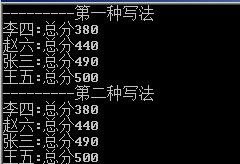
第一种写法很简单,只是根据下面分组。
- //分组,根据姓名,统计Sum的分数,统计结果放在匿名对象中。两种写法。
- //第一种写法
- Console.WriteLine("---------第一种写法");
- var studentSumScore_1 = (from l in lst
- group l by l.Name into grouped
- orderby grouped.Sum(m => m.Score)
- select new { Name = grouped.Key, Scores = grouped.Sum(m => m.Score) }).ToList();
- foreach (var l in studentSumScore_1)
- {
- Console.WriteLine("{0}:总分{1}", l.Name, l.Scores);
- }
- 第二种写法和第一种其实是等价的。
- //第二种写法
- Console.WriteLine("---------第二种写法");
- var studentSumScore_2 = lst.GroupBy(m => m.Name)
- .Select(k => new { Name = k.Key, Scores = k.Sum(l => l.Score) })
- .OrderBy(m => m.Scores).ToList();
- foreach (var l in studentSumScore_2)
- {
- Console.WriteLine("{0}:总分{1}", l.Name, l.Scores);
- }
示例二
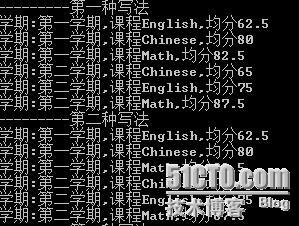
当分组的字段是多个的时候,通常把这多个字段合并成一个匿名对象,然后group by这个匿名对象。
注意:groupby后将数据放到grouped这个变量中,grouped 其实是IGrouping<TKey, TElement>类型的,IGrouping<out TKey, out TElement>继承了IEnumerable<TElement>,并且多了一个属性就是Key,这个Key就是当初分组的关键字,即那些值都相同的字段,此处就是该匿名对象。可以在后续的代码中取得这个Key,便于我们编程。
orderby多个字段的时候,在SQL中是用逗号分割多个字段,在Linq中就直接多写几个orderby。
- //分组,根据2个条件学期和课程,统计各科均分,统计结果放在匿名对象中。两种写法。
- Console.WriteLine("---------第一种写法");
- var TermAvgScore_1 = (from l in lst
- group l by new { Term = l.Term, Course = l.Course } into grouped
- orderby grouped.Average(m => m.Score) ascending
- orderby grouped.Key.Term descending
- select new { Term = grouped.Key.Term, Course = grouped.Key.Course, Scores = grouped.Average(m => m.Score) }).ToList();
- foreach (var l in TermAvgScore_1)
- {
- Console.WriteLine("学期:{0},课程{1},均分{2}", l.Term, l.Course, l.Scores);
- }
- Console.WriteLine("---------第二种写法");
- var TermAvgScore_2 = lst.GroupBy(m => new { Term = m.Term, Course = m.Course })
- .Select(k => new { Term = k.Key.Term, Course = k.Key.Course, Scores = k.Average(m => m.Score) })
- .OrderBy(l => l.Scores).OrderByDescending(l => l.Term);
- foreach (var l in TermAvgScore_2)
- {
- Console.WriteLine("学期:{0},课程{1},均分{2}", l.Term, l.Course, l.Scores);
- }
示例三
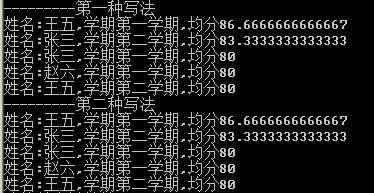
Linq中没有SQL中的Having语句,因此是采用where语句对Group后的结果过滤。
- //分组,带有Having的查询,查询均分>80的学生
- Console.WriteLine("---------第一种写法");
- var AvgScoreGreater80_1 = (from l in lst
- group l by new { Name = l.Name, Term = l.Term } into grouped
- where grouped.Average(m => m.Score)>=80
- orderby grouped.Average(m => m.Score) descending
- select new { Name = grouped.Key.Name, Term = grouped.Key.Term, Scores = grouped.Average(m => m.Score) }).ToList();
- foreach (var l in AvgScoreGreater80_1)
- {
- Console.WriteLine("姓名:{0},学期{1},均分{2}", l.Name, l.Term, l.Scores);
- }
- Console.WriteLine("---------第二种写法");
- //此写法看起来较为复杂,第一个Groupby,由于是要对多个字段分组的,因此构建一个匿名对象,
- 对这个匿名对象分组,分组得到的其实是一个IEnumberable<IGrouping<匿名类型,StudentScore>>这样一个类型。
- Where方法接受,和返回的都同样是IEnumberable<IGrouping<匿名类型,StudentScore>>类型,
- 其中Where方法签名Func委托的类型也就成了Func<IGrouping<匿名类型,StudentScore>,bool>,
- 之前说到,IGrouping<out TKey, out TElement>继承了IEnumerable<TElement>,
- 因此这种类型可以有Average,Sum等方法。
- var AvgScoreGreater80_2 = lst.GroupBy(l => new { Name = l.Name, Term = l.Term })
- .Where(m => m.Average(x => x.Score) >= 80)
- .OrderByDescending(l=>l.Average(x=>x.Score))
- .Select(l => new { Name = l.Key.Name, Term = l.Key.Term, Scores = l.Average(m => m.Score) }).ToList();
- foreach (var l in AvgScoreGreater80_2)
- {
- Console.WriteLine("姓名:{0},学期{1},均分{2}", l.Name, l.Term, l.Scores);
- }
转载Linq中GroupBy方法的使用总结的更多相关文章
- Linq中GroupBy方法的使用总结(转载)
from:https://www.cnblogs.com/zhouzangood/articles/4565466.html Group在SQL经常使用,通常是对一个字段或者多个字段分组,求其总和,均 ...
- Linq中GroupBy方法的使用总结(转)
Group在SQL经常使用,通常是对一个字段或者多个字段分组,求其总和,均值等. Linq中的Groupby方法也有这种功能.具体实现看代码: 假设有如下的一个数据集: public class St ...
- [转]Linq中GroupBy方法的使用总结
Demo模型类: public class StudentScore { public int ID { set; get; } public string Name { set; get; } pu ...
- 转载有个小孩跟我说LINQ(重点讲述Linq中GroupBy的原理及用法)
转载原出处: http://www.cnblogs.com/AaronYang/archive/2013/04/02/2994635.html 小孩LINQ系列导航:(一)(二)(三)(四)(五)(六 ...
- [转载]LINQ 中的 select
下面通过一些例子来说明怎样使用select,参考自:LINQ Samples 1. 可以对查询出来的结果做一些转换,下面的例子在数组中查找以"B"开头的名字,然后全部转成小写输出 ...
- Linq 中 Distinct 方法扩展
原文链接 http://www.cnblogs.com/A_ming/archive/2013/05/24/3097062.html public static class LinqEx { publ ...
- linq 中执行方法
Database1Entities db = new Database1Entities(); protected void Page_Load(object sender, EventArgs e) ...
- 基础才是重中之重~理解linq中的groupby
linq将大部分SQL语句进行了封装,这使得它们更加面向对象了,对于开发者来说,这是一件好事,下面我从基础层面来说一下GroupBy在LINQ中的使用. 对GroupBy的多字段分组,可以看我的这篇文 ...
- C#3.0新增功能09 LINQ 基础07 LINQ 中的查询语法和方法语法
连载目录 [已更新最新开发文章,点击查看详细] 介绍性的语言集成查询 (LINQ) 文档中的大多数查询是使用 LINQ 声明性查询语法编写的.但是在编译代码时,查询语法必须转换为针对 .NET ...
随机推荐
- C++动态链接库测试实例
前话 上一章节我导出了一个动态链接库 要使用该链接库,我们还需要该链接库对外公开的函数,即头文件 下面开始实例 测试实例 第一步--将动态链接库的dll.lib.和头文件导入项目中 文件目录如下: 项 ...
- clone函数
http://blog.csdn.net/caianye/article/details/5947282 http://wenku.baidu.com/link?url=qnq7laYDYm1V8tl ...
- matlab 怎么保存plot的图 到指定文件夹
%%使用print函数,第一个参数一定是figure的句柄,第二个参数设置格式,第三个参数是指定文件夹 %代码如下 h=figure; plot(1:10); print(h,'-djpeg','F: ...
- Windbg调试命令详解(3)
3 进程与线程 既可以显示进程和线程列表,又可以显示指定进程或线程的详细信息.调试命令可以提供比taskmgr更详尽的进程资料,在调试过程中不可或缺. 3.1 进程命令 进程命令包括这些内容:显示进程 ...
- Android init进程概述
init进程,其程序位于根文件系统中,在kernle自行启动后,其中的 start_kernel 函数把根文件系统挂载到/目录后,在 rest_init 函数中通过 kernel_thread(ker ...
- Android开发之Service的写法以及与Activity的通信
Service的总结: 1.按运行地点分类: 类别 区别 优点 缺点 应用 本地服务(Local) 该服务依附在主进程上, 服务依附在主进程上而不是独立的进程,这样在一定程度上节约了资源,另外 ...
- Android开发之隐式Intent中Intent-filter的三个属性-action,category,data
使用隐式Intent时,需要使用到意图过滤器Intent-filter.Intent-filter含有三个属性:action,category,data.通过这三个属性的组合,可以启动想要启动的act ...
- codevs3731 寻找道路
方向dfs判定是否可行,spfa跑最短路. noip水题,wa好几次. #include<cstdio> #include<algorithm> #include<cst ...
- CentOS6脱机rpm安装MariaDB10
转载请保存原文链接:http://www.wlm.so/Article/Detail/lmb4cijci5mc900000 1.卸载原有mysql安装包,避免安装文件冲突 #查找所有的mysql包 r ...
- BZOJ_1022_[SHOI2008]_小约翰的游戏John_(博弈论_反Nim游戏)
描述 http://www.lydsy.com/JudgeOnline/problem.php?id=1022 反Nim游戏裸题.详见论文<组合游戏略述——浅谈SG游戏的若干拓展及变形>. ...