
下篇 | 使用 🤗 Transformers 进行概率时间序列预测
在《使用 Transformers 进行概率时间序列预测》的第一部分里,我们为大家介绍了传统时间序列预测和基于 Transformers 的方法,也一步步准备好了训练所需的数据集并定义了环境、模型、转换和 InstanceSplitter。本篇内容将包含从数据加载器,到前向传播、训练、推理和展望未来发展等精彩内容。
创建 PyTorch 数据加载器
有了数据,下一步需要创建 PyTorch DataLoaders。它允许我们批量处理成对的 (输入, 输出) 数据,即 (past_values , future_values)。
from gluonts.itertools import Cyclic, IterableSlice, PseudoShuffled

from gluonts.torch.util import IterableDataset

from torch.utils.data import DataLoader

from typing import Iterable

def create_train_dataloader(

    config: PretrainedConfig,

    freq,

    data,

    batch_size: int,

    num_batches_per_epoch: int,

    shuffle_buffer_length: Optional[int] = None,

    **kwargs,

) -> Iterable:

    PREDICTION_INPUT_NAMES = [

        "static_categorical_features",

        "static_real_features",

        "past_time_features",

        "past_values",

        "past_observed_mask",

        "future_time_features",

        ]

    TRAINING_INPUT_NAMES = PREDICTION_INPUT_NAMES + [

        "future_values",

        "future_observed_mask",

        ]

    transformation = create_transformation(freq, config)

    transformed_data = transformation.apply(data, is_train=True)

    # we initialize a Training instance

    instance_splitter = create_instance_splitter(

        config, "train"

    ) + SelectFields(TRAINING_INPUT_NAMES)

    # the instance splitter will sample a window of

    # context length + lags + prediction length (from the 366 possible transformed time series)

    # randomly from within the target time series and return an iterator.

    training_instances = instance_splitter.apply(

        Cyclic(transformed_data)

        if shuffle_buffer_length is None

        else PseudoShuffled(

            Cyclic(transformed_data),

            shuffle_buffer_length=shuffle_buffer_length,

        )

    )

    # from the training instances iterator we now return a Dataloader which will

    # continue to sample random windows for as long as it is called

    # to return batch_size of the appropriate tensors ready for training!

    return IterableSlice(

        iter(

            DataLoader(

                IterableDataset(training_instances),

                batch_size=batch_size,

                **kwargs,

            )

        ),

        num_batches_per_epoch,

    )
def create_test_dataloader(

    config: PretrainedConfig,

    freq,

    data,

    batch_size: int,

    **kwargs,

):

    PREDICTION_INPUT_NAMES = [

        "static_categorical_features",

        "static_real_features",

        "past_time_features",

        "past_values",

        "past_observed_mask",

        "future_time_features",

        ]

    transformation = create_transformation(freq, config)

    transformed_data = transformation.apply(data, is_train=False)

    # we create a Test Instance splitter which will sample the very last

    # context window seen during training only for the encoder.

    instance_splitter = create_instance_splitter(

        config, "test"

    ) + SelectFields(PREDICTION_INPUT_NAMES)

    # we apply the transformations in test mode

    testing_instances = instance_splitter.apply(transformed_data, is_train=False)

    # This returns a Dataloader which will go over the dataset once.

    return DataLoader(IterableDataset(testing_instances), batch_size=batch_size, **kwargs)
train_dataloader = create_train_dataloader(

    config=config,

    freq=freq,

    data=train_dataset,

    batch_size=256,

    num_batches_per_epoch=100,

)

test_dataloader = create_test_dataloader(

    config=config,

    freq=freq,

    data=test_dataset,

    batch_size=64,

)
让我们检查第一批:
batch = next(iter(train_dataloader))

for k,v in batch.items():

  print(k,v.shape, v.type())

>>> static_categorical_features torch.Size([256, 1]) torch.LongTensor

    static_real_features torch.Size([256, 1]) torch.FloatTensor

    past_time_features torch.Size([256, 181, 2]) torch.FloatTensor

    past_values torch.Size([256, 181]) torch.FloatTensor

    past_observed_mask torch.Size([256, 181]) torch.FloatTensor

    future_time_features torch.Size([256, 24, 2]) torch.FloatTensor

    future_values torch.Size([256, 24]) torch.FloatTensor

    future_observed_mask torch.Size([256, 24]) torch.FloatTensor
可以看出,我们没有将 input_ids 和 attention_mask 提供给编码器 (训练 NLP 模型时也是这种情况),而是提供 past_values,以及 past_observed_mask、past_time_features、static_categorical_features 和 static_real_features 几项数据。
解码器的输入包括 future_values、future_observed_mask 和 future_time_features。 future_values 可以看作等同于 NLP 训练中的 decoder_input_ids。
我们可以参考 Time Series Transformer 文档 以获得对它们中每一个的详细解释。
前向传播
让我们对刚刚创建的批次执行一次前向传播:
# perform forward pass

outputs = model(

    past_values=batch["past_values"],

    past_time_features=batch["past_time_features"],

    past_observed_mask=batch["past_observed_mask"],

    static_categorical_features=batch["static_categorical_features"],

    static_real_features=batch["static_real_features"],

    future_values=batch["future_values"],

    future_time_features=batch["future_time_features"],

    future_observed_mask=batch["future_observed_mask"],

    output_hidden_states=True

)
print("Loss:", outputs.loss.item())

>>> Loss: 9.141253471374512
目前,该模型返回了损失值。这是由于解码器会自动将 future_values 向右移动一个位置以获得标签。这允许计算预测结果和标签值之间的误差。
另请注意,解码器使用 Causal Mask 来避免预测未来,因为它需要预测的值在 future_values 张量中。
训练模型
是时候训练模型了!我们将使用标准的 PyTorch 训练循环。
这里我们用到了 Accelerate 库,它会自动将模型、优化器和数据加载器放置在适当的 device 上。
from accelerate import Accelerator

from torch.optim import Adam

accelerator = Accelerator()

device = accelerator.device

model.to(device)

optimizer = Adam(model.parameters(), lr=1e-3)

model, optimizer, train_dataloader = accelerator.prepare(

    model, optimizer, train_dataloader,

)

for epoch in range(40):

    model.train()

    for batch in train_dataloader:

        optimizer.zero_grad()

        outputs = model(

            static_categorical_features=batch["static_categorical_features"].to(device),

            static_real_features=batch["static_real_features"].to(device),

            past_time_features=batch["past_time_features"].to(device),

            past_values=batch["past_values"].to(device),

            future_time_features=batch["future_time_features"].to(device),

            future_values=batch["future_values"].to(device),

            past_observed_mask=batch["past_observed_mask"].to(device),

            future_observed_mask=batch["future_observed_mask"].to(device),

        )

        loss = outputs.loss

        # Backpropagation

        accelerator.backward(loss)

        optimizer.step()

        print(loss.item())
推理
在推理时,建议使用 generate() 方法进行自回归生成,类似于 NLP 模型。
预测的过程会从测试实例采样器中获得数据。采样器会将数据集的每个时间序列的最后 context_length 那么长时间的数据采样出来,然后输入模型。请注意,这里需要把提前已知的 future_time_features 传递给解码器。
该模型将从预测分布中自回归采样一定数量的值,并将它们传回解码器最终得到预测输出:
model.eval()

forecasts = []

for batch in test_dataloader:

    outputs = model.generate(

        static_categorical_features=batch["static_categorical_features"].to(device),

        static_real_features=batch["static_real_features"].to(device),

        past_time_features=batch["past_time_features"].to(device),

        past_values=batch["past_values"].to(device),

        future_time_features=batch["future_time_features"].to(device),

        past_observed_mask=batch["past_observed_mask"].to(device),

    )

    forecasts.append(outputs.sequences.cpu().numpy())
该模型输出一个表示结构的张量 (batch_size, number of samples, prediction length)。
下面的输出说明: 对于大小为 64 的批次中的每个示例,我们将获得接下来 24 个月内的 100 个可能的值:
forecasts[0].shape

>>> (64, 100, 24)
我们将垂直堆叠它们,以获得测试数据集中所有时间序列的预测:
forecasts = np.vstack(forecasts)

print(forecasts.shape)

>>> (366, 100, 24)
我们可以根据测试集中存在的样本值,根据真实情况评估生成的预测。这里我们使用数据集中的每个时间序列的 MASE 和 sMAPE 指标 (metrics) 来评估:
from evaluate import load

from gluonts.time_feature import get_seasonality

mase_metric = load("evaluate-metric/mase")

smape_metric = load("evaluate-metric/smape")

forecast_median = np.median(forecasts, 1)

mase_metrics = []

smape_metrics = []

for item_id, ts in enumerate(test_dataset):

    training_data = ts["target"][:-prediction_length]

    ground_truth = ts["target"][-prediction_length:]

    mase = mase_metric.compute(

        predictions=forecast_median[item_id],

        references=np.array(ground_truth),

        training=np.array(training_data),

        periodicity=get_seasonality(freq))

    mase_metrics.append(mase["mase"])

    smape = smape_metric.compute(

        predictions=forecast_median[item_id],

        references=np.array(ground_truth),

    )

    smape_metrics.append(smape["smape"])
print(f"MASE: {np.mean(mase_metrics)}")

>>> MASE: 1.361636922541396

print(f"sMAPE: {np.mean(smape_metrics)}")

>>> sMAPE: 0.17457818831512306
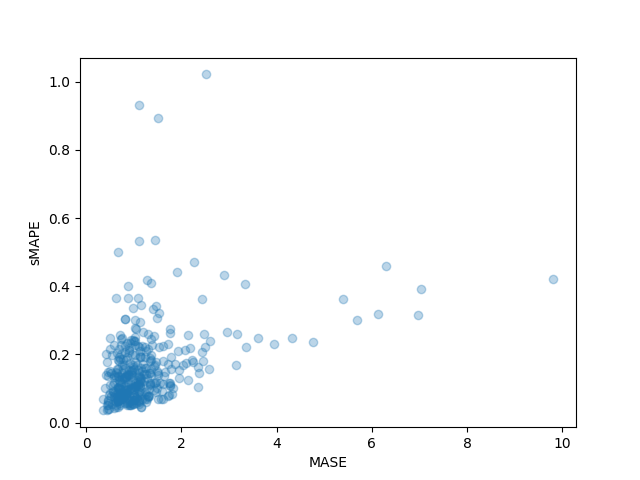
我们还可以单独绘制数据集中每个时间序列的结果指标,并观察到其中少数时间序列对最终测试指标的影响很大:
plt.scatter(mase_metrics, smape_metrics, alpha=0.3)

plt.xlabel("MASE")

plt.ylabel("sMAPE")

plt.show()
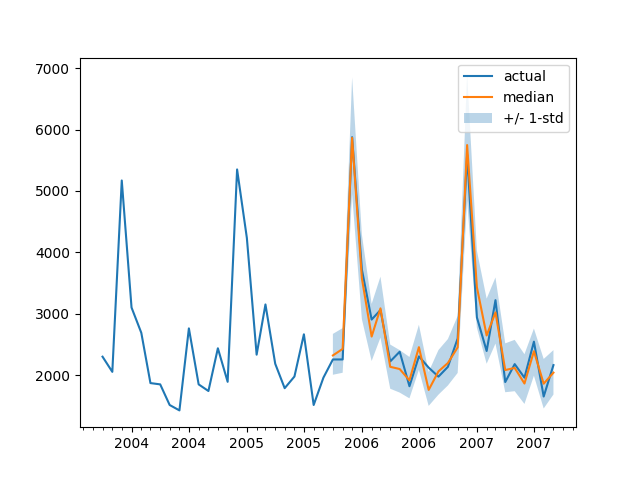
为了根据基本事实测试数据绘制任何时间序列的预测,我们定义了以下辅助绘图函数:
import matplotlib.dates as mdates

def plot(ts_index):

    fig, ax = plt.subplots()

    index = pd.period_range(

        start=test_dataset[ts_index][FieldName.START],

        periods=len(test_dataset[ts_index][FieldName.TARGET]),

        freq=freq,

    ).to_timestamp()

    # Major ticks every half year, minor ticks every month,

    ax.xaxis.set_major_locator(mdates.MonthLocator(bymonth=(1, 7)))

    ax.xaxis.set_minor_locator(mdates.MonthLocator())

    ax.plot(

        index[-2*prediction_length:],

        test_dataset[ts_index]["target"][-2*prediction_length:],

        label="actual",

    )

    plt.plot(

        index[-prediction_length:],

        np.median(forecasts[ts_index], axis=0),

        label="median",

    )

    plt.fill_between(

        index[-prediction_length:],

        forecasts[ts_index].mean(0) - forecasts[ts_index].std(axis=0),

        forecasts[ts_index].mean(0) + forecasts[ts_index].std(axis=0),

        alpha=0.3,

        interpolate=True,

        label="+/- 1-std",

    )

    plt.legend()

    plt.show()
例如:
plot(334)
我们如何与其他模型进行比较? Monash Time Series Repository 有一个测试集 MASE 指标的比较表。我们可以将自己的结果添加到其中作比较:
| Dataset | SES | Theta | TBATS | ETS | (DHR-)ARIMA | PR | CatBoost | FFNN | DeepAR | N-BEATS | WaveNet | Transformer (Our) |
|---|---|---|---|---|---|---|---|---|---|---|---|---|
| Tourism Monthly | 3.306 | 1.649 | 1.751 | 1.526 | 1.589 | 1.678 | 1.699 | 1.582 | 1.409 | 1.574 | 1.482 | 1.361 |
请注意,我们的模型击败了所有已知的其他模型 (另请参见相应 论文 中的表 2) ,并且我们没有做任何超参数优化。我们仅仅花了 40 个完整训练调参周期来训练 Transformer。
当然,我们应该谦虚。从历史发展的角度来看,现在认为神经网络解决时间序列预测问题是正途,就好比当年的论文得出了 “你需要的就是 XGBoost” 的结论。我们只是很好奇,想看看神经网络能带我们走多远,以及 Transformer 是否会在这个领域发挥作用。这个特定的数据集似乎表明它绝对值得探索。
下一步
我们鼓励读者尝试我们的 Jupyter Notebook 和来自 Hugging Face Hub 的其他时间序列数据集,并替换适当的频率和预测长度参数。对于您的数据集,需要将它们转换为 GluonTS 的惯用格式,在他们的 文档 里有非常清晰的说明。我们还准备了一个示例 Notebook,向您展示如何将数据集转换为 Hugging Face 数据集格式。
正如时间序列研究人员所知,人们对“将基于 Transformer 的模型应用于时间序列”问题很感兴趣。传统 vanilla Transformer 只是众多基于注意力 (Attention) 的模型之一,因此需要向库中补充更多模型。
目前没有什么能妨碍我们继续探索对多变量时间序列 (multivariate time series) 进行建模,但是为此需要使用多变量分布头 (multivariate distribution head) 来实例化模型。目前已经支持了对角独立分布 (diagonal independent distributions),后续会增加其他多元分布支持。请继续关注未来的博客文章以及其中的教程。
路线图上的另一件事是时间序列分类。这需要将带有分类头的时间序列模型添加到库中,例如用于异常检测这类任务。
当前的模型会假设日期时间和时间序列值都存在,但在现实中这可能不能完全满足。例如 WOODS 给出的神经科学数据集。因此,我们还需要对当前模型进行泛化,使某些输入在整个流水线中可选。
最后,NLP/CV 领域从大型预训练模型 中获益匪浅,但据我们所知,时间序列领域并非如此。基于 Transformer 的模型似乎是这一研究方向的必然之选,我们迫不及待地想看看研究人员和从业者会发现哪些突破!
英文原文: Probabilistic Time Series Forecasting with Transformers
译者、排版: zhongdongy (阿东)
下篇 | 使用 🤗 Transformers 进行概率时间序列预测的更多相关文章
- facebook开源的prophet时间序列预测工具---识别多种周期性、趋势性(线性,logistic)、节假日效应,以及部分异常值
简单使用 代码如下 这是官网的quickstart的内容,csv文件也可以下到,这个入门以后后面调试加入其它参数就很简单了. import pandas as pd import numpy as n ...
- Python中利用LSTM模型进行时间序列预测分析
时间序列模型 时间序列预测分析就是利用过去一段时间内某事件时间的特征来预测未来一段时间内该事件的特征.这是一类相对比较复杂的预测建模问题,和回归分析模型的预测不同,时间序列模型是依赖于事件发生的先后顺 ...
- 时间序列预测之--ARIMA模型
什么是 ARIMA模型 ARIMA模型的全称叫做自回归移动平均模型,全称是(ARIMA, Autoregressive Integrated Moving Average Model).也记作ARIM ...
- Kesci: Keras 实现 LSTM——时间序列预测
博主之前参与的一个科研项目是用 LSTM 结合 Attention 机制依据作物生长期内气象环境因素预测作物产量.本篇博客将介绍如何用 keras 深度学习的框架搭建 LSTM 模型对时间序列做预测. ...
- 使用tensorflow的lstm网络进行时间序列预测
https://blog.csdn.net/flying_sfeng/article/details/78852816 版权声明:本文为博主原创文章,未经博主允许不得转载. https://blog. ...
- 基于 Keras 用 LSTM 网络做时间序列预测
目录 基于 Keras 用 LSTM 网络做时间序列预测 问题描述 长短记忆网络 LSTM 网络回归 LSTM 网络回归结合窗口法 基于时间步的 LSTM 网络回归 在批量训练之间保持 LSTM 的记 ...
- (数据科学学习手札40)tensorflow实现LSTM时间序列预测
一.简介 上一篇中我们较为详细地铺垫了关于RNN及其变种LSTM的一些基本知识,也提到了LSTM在时间序列预测上优越的性能,本篇就将对如何利用tensorflow,在实际时间序列预测任务中搭建模型来完 ...
- Pytorch循环神经网络LSTM时间序列预测风速
#时间序列预测分析就是利用过去一段时间内某事件时间的特征来预测未来一段时间内该事件的特征.这是一类相对比较复杂的预测建模问题,和回归分析模型的预测不同,时间序列模型是依赖于事件发生的先后顺序的,同样大 ...
- 腾讯技术工程 | 基于Prophet的时间序列预测
预测未来永远是一件让人兴奋而又神奇的事.为此,人们研究了许多时间序列预测模型.然而,大部分的时间序列模型都因为预测的问题过于复杂而效果不理想.这是因为时间序列预测不光需要大量的统计知识,更重要的是它需 ...
- TensorFlow实现时间序列预测
常常会碰到各种各样时间序列预测问题,如商场人流量的预测.商品价格的预测.股价的预测,等等.TensorFlow新引入了一个TensorFlow Time Series库(以下简称为TFTS),它可以帮 ...
随机推荐
- eclipse 无法将节点解析到句柄
将 干掉即可
- Js前端导出csv
var myMemory = myObjectStore.objectStore; var myDataArray = myMemory.data; var myCsvString = "\ ...
- ArcObjects SDK开发 008 从mxd地图文件说起
1.Mxd文件介绍 ArcGIS的地图文件为.mxd扩展名.Mxd文件的是有版本的,和ArcGIS的版本对应.可以在ArcMap中的File-Save A Copy,保存一个地图拷贝的时候选择Mxd文 ...
- C++四舍五入并且保留7为小数
问题描述给定圆的半径r,求圆的面积.输入格式输入包含一个整数r,表示圆的半径.输出格式输出一行,包含一个实数,四舍五入保留小数点后7位,表示圆的面积.说明:在本题中,输入是一个整数,但是输出是一个实数 ...
- 静态文件配置 django连接MySQL django模型层初识 ORM基本语句
目录 静态文件配置 1. 问题描述 2. 静态文件 3. 资源访问 form表单属性补充 action method 请求方法 get请求 post请求 views层 request对象 reques ...
- 《HTTP权威指南》– 10.安全HTTP
HTTPS的概念 HTTPS 是最流行的HTTP安全模式,由网景公司首创,所有主流浏览器和服务器都支持此协议.HTTPS方案 的URL以 https:// 开头,使用 HTTPS 时,所有的HTTP请 ...
- 【机器学习】李宏毅——自注意力机制(Self-attention)
前面我们所讲的模型,输入都是一个向量,但有没有可能在某些场景中输入是多个向量,即一个向量集合,并且这些向量的数目并不是固定的呢? 这一类的场景包括文字识别.语音识别.图网络等等. 那么先来考虑输出的类 ...
- SQL 之 SELECT语句
1.展示所有列语法 select * from table; #table表示表名 示例: select * from a 2.展示指定列语法 select column1, column2, ... ...
- 分享一个项目中在用的图片处理工具类(图片缩放,旋转,画布格式,字节,image,bitmap转换等)
using System; using System.Collections.Generic; using System.IO; using System.Text; using System.Dra ...
- vs code .net core Linux下离线安装Nuget包
本人第一次使用 vs code在linux下开发.net core项目,由于处于内网,无法通过在线安装,所以在遇见离线安装Nuget包时,耗费了一番功夫,网上也没有相关的,最后还是多个思路结合才解决的 ...