
(原创)Stanford Machine Learning (by Andrew NG) --- (week 1) Introduction
最近学习了coursera上面Andrew NG的Machine learning课程,课程地址为:https://www.coursera.org/course/ml
在Introduction部分NG较为系统的概括了Machine learning的一些基本概念,也让我接触了一些新的名词,这些名词在后续课程中会频繁出现:
| Machine Learning | Supervised Learning | Unsupervised Learning | Regression Problem | Classification Problem | Octave |
| 机器学习 | 有监督学习 | 无监督学习 | 回归问题 | 分类问题 | Octave |
What is Machine Learning
Definition: A computer program is said to learn from experience E with respect to some task T and some performance measure P, if its performance on T, as measured by P, improves with experience E.
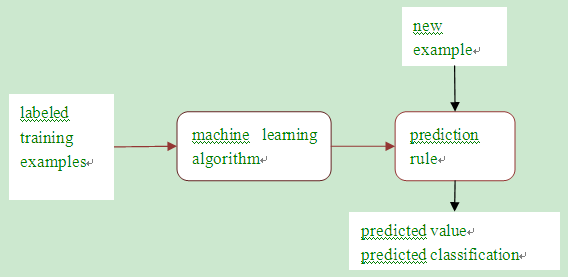
Example of Machine Learning
Suppose your email program watches which emails you do or do not mark as spam, and based on that learns how to better filter spam.
T: Classifying emails as spam or not spam; (目标)
E: Watching you label emails as spam or not spam; (算法 + 数据)
P: The number (or fraction) of emails correctly classified as spam/not spam. (评价方法->损失函数)
Supervised Learning
Definition: The goal is, given a labeled training data, to learn a function h so that h(x) is a “good” predictor for the corresponding value of y. A pair (x, y) is called a training example, x denoting “input” variables, also called features, and y denoting “output” or target variable that we are trying to predict.
When the target variable that we are trying to predict is continuous, we call the learning problem a regression problem. When the target can take on only a small number of discrete values, the learning problem is called a classification problem.
A.Example of Regression Problem
Suppose we have a dataset giving the living areas and prices of 11 houses from Portland, Oregon:
| Living area (feet2) | Price (1000$s) |
| 450 | 100 |
| 600 | 140 |
| 620 | 210 |
| ... | ... |
We can plot this data:
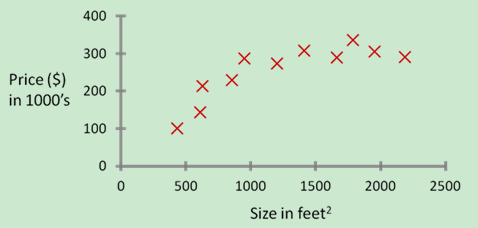
So regression problem is to find a function h to fit these points.
B.Example of Classification Problem
Suppose we have a dataset giving the tumor size, patient age and malignant or benign, we plot these data as follows:
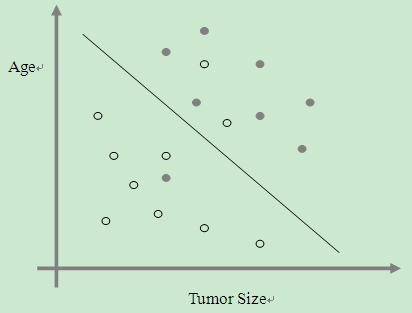
So classification problem is to find a function h to sperate these points.
PS: 回归就是找出那个可以拟合样本的函数(平面,空间,...),分类就是找到那个可以把不同类别的样本分开的函数(平面,空间,...);在特定问题下,比如逻辑回归问题,分类问题就可以被视作回归问题来解决。
Unsupervised Learning
In the clustering problem, we are given a training set {x(1), . . . , x(m)}, and want to group the data into a few cohesive “clusters”. Here, no labels y(i) are given. So, this is an unsupervised learning problem.
PS: 无监督学习很多时候都暗指聚类算法,聚类算法又分硬聚类(K-means, 分层聚类,基于密度的等等)和软聚类(EM算法)。
(原创)Stanford Machine Learning (by Andrew NG) --- (week 1) Introduction的更多相关文章
- (原创)Stanford Machine Learning (by Andrew NG) --- (week 10) Large Scale Machine Learning & Application Example
本栏目来源于Andrew NG老师讲解的Machine Learning课程,主要介绍大规模机器学习以及其应用.包括随机梯度下降法.维批量梯度下降法.梯度下降法的收敛.在线学习.map reduce以 ...
- (原创)Stanford Machine Learning (by Andrew NG) --- (week 8) Clustering & Dimensionality Reduction
本周主要介绍了聚类算法和特征降维方法,聚类算法包括K-means的相关概念.优化目标.聚类中心等内容:特征降维包括降维的缘由.算法描述.压缩重建等内容.coursera上面Andrew NG的Mach ...
- (原创)Stanford Machine Learning (by Andrew NG) --- (week 7) Support Vector Machines
本栏目内容来源于Andrew NG老师讲解的SVM部分,包括SVM的优化目标.最大判定边界.核函数.SVM使用方法.多分类问题等,Machine learning课程地址为:https://www.c ...
- (原创)Stanford Machine Learning (by Andrew NG) --- (week 9) Anomaly Detection&Recommender Systems
这部分内容来源于Andrew NG老师讲解的 machine learning课程,包括异常检测算法以及推荐系统设计.异常检测是一个非监督学习算法,用于发现系统中的异常数据.推荐系统在生活中也是随处可 ...
- (原创)Stanford Machine Learning (by Andrew NG) --- (week 4) Neural Networks Representation
Andrew NG的Machine learning课程地址为:https://www.coursera.org/course/ml 神经网络一直被认为是比较难懂的问题,NG将神经网络部分的课程分为了 ...
- (原创)Stanford Machine Learning (by Andrew NG) --- (week 1) Linear Regression
Andrew NG的Machine learning课程地址为:https://www.coursera.org/course/ml 在Linear Regression部分出现了一些新的名词,这些名 ...
- (原创)Stanford Machine Learning (by Andrew NG) --- (week 3) Logistic Regression & Regularization
coursera上面Andrew NG的Machine learning课程地址为:https://www.coursera.org/course/ml 我曾经使用Logistic Regressio ...
- (原创)Stanford Machine Learning (by Andrew NG) --- (week 5) Neural Networks Learning
本栏目内容来自Andrew NG老师的公开课:https://class.coursera.org/ml/class/index 一般而言, 人工神经网络与经典计算方法相比并非优越, 只有当常规方法解 ...
- (原创)Stanford Machine Learning (by Andrew NG) --- (week 6) Advice for Applying Machine Learning & Machine Learning System Design
(1) Advice for applying machine learning Deciding what to try next 现在我们已学习了线性回归.逻辑回归.神经网络等机器学习算法,接下来 ...
随机推荐
- hdu 1281 棋盘游戏(二分匹配)
题目链接:http://acm.hdu.edu.cn/showproblem.php?pid=1281 棋盘游戏 Time Limit: 2000/1000 MS (Java/Others) M ...
- python中BeautifulSoup模块
BeautifulSoup模块是干嘛的? 答:通过html标签去快速匹配标签中的内容.效率相对比正则会好的多.效率跟xpath模块应该差不多. 一:解析器: BeautifulSoup(html,&q ...
- 【Python学习】解决pandas中打印DataFrame行列显示不全的问题
在使用pandas的DataFrame打印时,如果表太长或者太宽会自动只给前后一些行列,但有时候因为一些需要,可能想看到所有的行列. 所以只需要加一下的代码就行了. #显示所有列 pd.set_opt ...
- 基于ARM 构架(带MMU)的copy_from_user与copy_to_user详细分析
[转自:http://blog.chinaunix.net/uid-20543672-id-3195249.html] 在学习Linux内核驱动的时候,一开始就会碰到copy_from_use ...
- centos_7.1.1503_src_3
http://vault.centos.org/7.1.1503/os/Source/SPackages/ kdf-4.10.5-3.el7.src.rpm 05-Jul-2014 13:28 161 ...
- 集合类---set
定义:一个不包含重复元素的collection.set 不包含满足 e1.equals(e2) 的元素对 e1 和 e2,并且最多包含一个 null 元素,不保证集合里元素的顺序. 方法使用详解: 1 ...
- Java GC策略
本文转自https://blog.csdn.net/rabbit_in_android/article/details/50386954 内存管理和垃圾回收 JVM内存组成结构 JVM栈由堆.栈.本地 ...
- caffe Python API 之Dropout
net.pool1 = caffe.layers.Pooling(net.myconv, pool=caffe.params.Pooling.MAX, kernel_size=2, stride=2) ...
- Leetcode 之Binary Tree Postorder Traversal(45)
层序遍历,使用队列将每层压入,定义两个队列来区分不同的层. vector<vector<int>> levelorderTraversal(TreeNode *root) { ...
- 通过IP地址和子网掩码计算主机数
知道ip地址和子网掩码后可以算出: 1. 网络地址 2. 广播地址 3. 地址范围 4. 本网有几台主机 例1:下面例子IP地址为192·168·100·5 子网掩码是255·255·255·0.算出 ...