COMPUTER ORGANIZATION AND ARCHITECTURE DESIGNING FOR PERFORMANCE NINTH EDITION
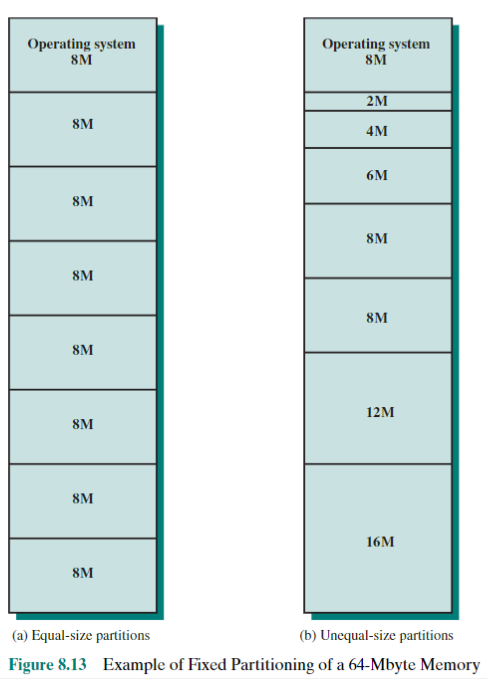
The simplest scheme for partitioning available memory is to use
fixed-size partitions,
as shown in Figure 8.13. Note that, although the partitions are of fixed size,
they need not be of equal size. When a process is brought into memory, it is placed
in the smallest available partition that will hold it.
 
Even with the use of unequal fixed-size partitions, there will be wasted memory.
In most cases, a process will not require exactly as much memory as provided by
the

partition. For example, a process that requires 3M bytes of memory would be placed
in the 4M partition of Figure 8.13b, wasting 1M that could be used by another process.
 
A more efficient approach is to use variable-size partitions. When a process is
brought into memory, it is allocated exactly as much memory as it requires and no more.
 
 
Example 8.2
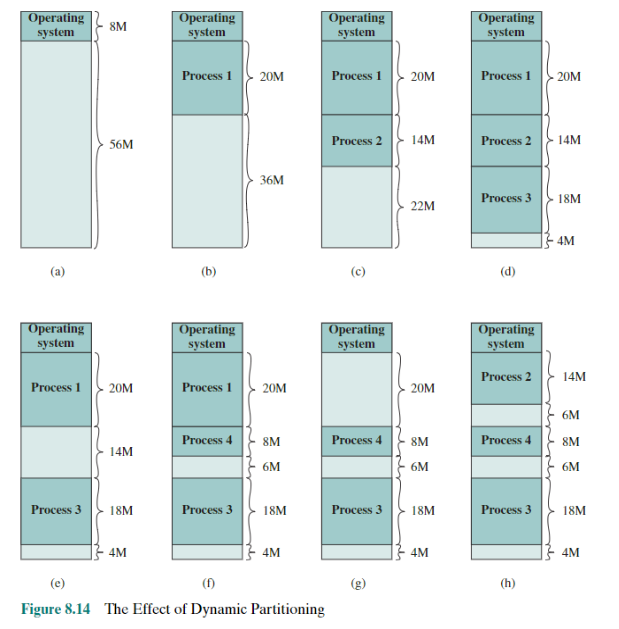
An example, using 64 Mbytes of main memory, is shown in Figure 8.14.
Initially, main memory is empty, except for the OS (a). The first three processes are loaded
in, starting where the OS ends and occupying just enough space for each process (b, c, d).
This leaves a “hole” at the end of memory that is too small for a fourth process. At some
point, none of the processes in memory is ready. The OS swaps out process 2 (e), which
leaves sufficient room to load a new process, process 4 (f). Because process 4 is smaller
than process 2, another small hole is created. Later, a point is reached at which none of the
processes in main memory is ready, but process 2, in the Ready-Suspend state, is available.
Because there is insufficient room in memory for process 2, the OS swaps process 1 out (g)
and swaps process 2 back in (h).


As this example shows, this method starts out well, but eventually it leads to a
situation in which there are a lot of small holes in memory. As time goes on, mem-
ory becomes more and more fragmented, and memory utilization declines. One
technique for overcoming this problem is
compaction
: From time to time, the OS
shifts the processes in memory to place all the free memory together in one block.
This is a time-consuming procedure, wasteful of processor time.
 
Before we consider ways of dealing with the shortcomings of partitioning, we
must clear up one loose end. Consider Figure 8.14; it should be obvious that a proc-
ess is not likely to be loaded into the same place in main memory each time it is
swapped in. Furthermore, if compaction is used, a process may be shifted while in
main memory. A process in memory consists of instructions plus data. The instruc-
tions will contain addresses for memory locations of two types:
Addresses of data items
Addresses of instructions, used for branching instruction
 
But these addresses are not fixed. They will change each time a process is
swapped in. To solve this problem, a distinction is made between logical addresses
and physical addresses. A logical address is expressed as a location relative to the
beginning of the program. Instructions in the program contain only logical addresses.
A physical address is an actual location in main memory. When the processor exe-
cutes a process, it automatically converts from logical to physical address by adding
the current starting location of the process, called its base address, to each logical
address. This is another example of a processor hardware feature designed to meet
an OS requirement. The exact nature of this hardware feature depends on the mem-
ory management strategy in use. We will see several examples later in this chapter.

Partitioning的更多相关文章

  1. [LeetCode] Palindrome Partitioning II 拆分回文串之二

    Given a string s, partition s such that every substring of the partition is a palindrome. Return the ...

  2. [LeetCode] Palindrome Partitioning 拆分回文串

    Given a string s, partition s such that every substring of the partition is a palindrome. Return all ...

  3. Leetcode: Palindrome Partitioning II

    参考:http://www.cppblog.com/wicbnu/archive/2013/03/18/198565.html 我太喜欢用dfs和回溯法了,但是这些暴力的方法加上剪枝之后复杂度依然是很 ...

  4. 測試大型資料表的 Horizontal Partitioning 水平切割

    FileGroup 檔案群組 :一個「資料庫(database)」可對應一或多個 FileGroup,一個 FileGroup 可由一或多個 file (.ndf) 構成. FileGroup 可讓 ...

  5. UVA - 11584 Partitioning by Palindromes[序列DP]

    UVA - 11584 Partitioning by Palindromes We say a sequence of char- acters is a palindrome if it is t ...

  6. LintCode Palindrome Partitioning II

    Given a string s, cut s into some substrings such that every substring is a palindrome. Return the m ...

  7. How to Remove Table Partitioning in SQL Server

    In this article we will see how we can remove partitions from a table in a database in SQL server. I ...

  8. Partitioning & Archiving tables in SQL Server (Part 2: Split, Merge and Switch partitions)

    Reference: http://blogs.msdn.com/b/felixmar/archive/2011/08/29/partitioning-amp-archiving-tables-in- ...

  9. Partitioning & Archiving tables in SQL Server (Part 1: The basics)

    Reference: http://blogs.msdn.com/b/felixmar/archive/2011/02/14/partitioning-amp-archiving-tables-in- ...

  10. LeetCode(131)Palindrome Partitioning

    题目 Given a string s, partition s such that every substring of the partition is a palindrome. Return ...

随机推荐

  1. jquery 展开折叠菜单

    jquery 展开折叠菜单 <!DOCTYPE HTML PUBLIC "-//W3C//DTD HTML 4.01 Transitional//EN"> <ht ...

  2. 必应缤纷桌面的必应助手-软件分析和用户市场需求之-----二.体验部分 Ryan Mao (毛宇11061171) (完整版本请参考团队博客)

    <必应缤纷桌面的必应助手> 2.体验部分 Ryan Mao (毛宇11061171) (完整分析报告请参考团队博客http://www.cnblogs.com/Z-XML/) 我花了2天的 ...

  3. 神经网络:多层网络与C++实现

    相关源码可参考最新的实现:https://github.com/ronnyyoung/EasyML ,中的neural_network模块,后持续更新,包括加入CNN的结构. 一.引言 在前一篇关于神 ...

  4. POJ 2299 逆序对

    Crossings Time Limit: 2 Sec Memory Limit: 256 MB 题目连接 http://codeforces.com/gym/100463 Description I ...

  5. asp.net控件开发基础(1)(转)原文更多内容

    asp.net本身提供了很多控件,提供给我们这些比较懒惰的人使用,我认为控件的作用就在此,因为我们不想重复工作,所以要创建它,这个本身便是一个需求的关系,所以学习控件开发很有意思. wrox网站上有本 ...

  6. git学习 本地常用操作01

    注意: Microsoft的Word格式是二进制格式,因此,版本控制系统是没法跟踪Word文件的改动 不要使用Windows自带的记事本编辑任何文本文件 开始git项目: 初始化本地项目: 初始化:g ...

  7. POJ2125 Destroying The Graph(二分图最小点权覆盖集)

    最小点权覆盖就是,对于有点权的有向图,选出权值和最少的点的集合覆盖所有的边. 解二分图最小点权覆盖集可以用最小割: vs-X-Y-vt这样连边,vs和X部点的连边容量为X部点的权值,Y部和vt连边容量 ...

  8. BZOJ3847 : ZCC loves march

    注意到集结操作相当于合并一些点 于是我们可以使用并查集 对于每一行.每一列维护一个链表,储存里面的点 查询x时,在并查集中找到x的祖先u,此时x的坐标就是u的坐标 然后扫描u所在行列的链表,依次删除每 ...

  9. 【BZOJ】1458: 士兵占领(上下界网络流)

    http://www.lydsy.com/JudgeOnline/problem.php?id=1458 是不是我脑洞太小了.......直接弄上下界最小流........(就当复习了.. 二分图X和 ...

  10. 【POJ】2299 Ultra-QuickSort(逆序对)

    http://poj.org/problem?id=2299 在两个元素相同的数列里,其中一个数列要移动到另一个数列相同元素相同的位置,那么要移动的次数就是这个数列关于另一个数列的逆序对数(hash后 ...