
uva 1660 & poj 1966(点连通度)
| Time Limit: 1000MS | Memory Limit: 30000K | |
| Total Submissions: 4267 | Accepted: 2003 |
Description
1. n, if the net remains connected regardless the number of relays removed from the net.
2. The minimal number of relays that disconnect the network when removed.
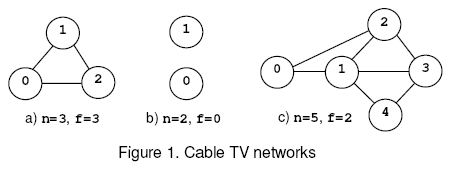
For example, consider the nets from figure 1, where the circles mark the relays and the solid lines correspond to interconnection cables. The network (a) is connected regardless the number of relays that are removed and, according to rule (1), f=n=3. The network (b) is disconnected when 0 relays are removed, hence f=0 by rule (2). The network (c) is disconnected when the relays 1 and 2 or 1 and 3 are removed. The safety factor is 2.
Input
Output
Sample Input
0 0

1 0

3 3 (0,1) (0,2) (1,2)

2 0

5 7 (0,1) (0,2) (1,3) (1,2) (1,4) (2,3) (3,4)
Sample Output
0

1

3

0

2
Hint
Source

图的连通度问题是指:在图中删去部分元素(点或边),使得图中指定的两个点s和t不连通 (不存在从s到t的路径),求至少要删去几个元素。
图的连通度分为点连通度和边连通度:
(1)点连通度:只许删点,求至少要删掉几个点(当然,s和t不能删去,这里保证原图中至少有三个点);
(2)边连通度:只许删边,求至少要删掉几条边。
并且,有向图和无向图的连通度求法不同,因此还要分开考虑(对于混合图,只需将其中所有的无向边按照
无向图的办法处理、有向边按照有向图的办法处理即可)。
【1】有向图的边连通度:
这个其实就是最小割问题。以s为源点,t为汇点建立网络,原图中的每条边在网络中仍存在,容量为1,求该网络的最小割(也就是最大流)的值即为原图的边连通度。
【2】有向图的点连通度:
需要拆点。建立一个网络,原图中的每个点i在网络中拆成i'与i'',有一条边<i', i''>,容量为1 (<s', s''>和<t', t''>例外,容量为正无穷)。原图中的每条边<i, j>在网络中为边<i'', j'>,
容量为正无穷。以s'为源点、t''为汇点求最大流,最大流的值即为原图的点连通度。
说明:最大流对应的是最小割。显然,容量为正无穷的边不可能通过最小割,也就是原图中的边和s、t两个点不能删去;若边<i, i''>通过最小割,则表示将原图中的点i删去。
【3】无向图的边连通度:
将图中的每条边(i, j)拆成<i, j>和<j, i>两条边,再按照有向图的办法(【1】)处理;
【4】无向图的点连通度:
将图中的每条边(i, j)拆成<i, j>和<j, i>两条边,再按照有向图的办法(【2】)处理。
关键就是建图,然而我并不懂为什么这样建。。。
#include <cstdio>

#include <iostream>

#include <sstream>

#include <cmath>

#include <cstring>

#include <cstdlib>

#include <string>

#include <vector>

#include <map>

#include <set>

#include <queue>

#include <stack>

#include <algorithm>

using namespace std;

#define ll long long

#define _cle(m, a) memset(m, a, sizeof(m))

#define repu(i, a, b) for(int i = a; i < b; i++)

#define repd(i, a, b) for(int i = b; i >= a; i--)

#define sfi(n) scanf("%d", &n)

#define pfi(n) printf("%d\n", n)

#define sfi2(n, m) scanf("%d%d", &n, &m)

#define pfi2(n, m) printf("%d %d\n", n, m)

#define pfi3(a, b, c) printf("%d %d %d\n", a, b, c)

#define MAXN 105

#define V 55

const int INF = 0x3f3f3f3f;

int edge[V][V];

int N,M;

int n,m;

#define maxn 210

const int inf = 0x3f3f3f3f;

struct EK

{

    int cap[maxn][maxn];

    int flow[maxn][maxn];

    int n;

    void init(int n)

    {

        this->n = n;

        memset(cap, , sizeof(cap));

    }

    void addCap(int i, int j, int val)

    {

        cap[i][j] = val;

    }

    int solve(int source, int sink)

    {

        if(source == sink)    return inf;///源=汇, 流量无穷大!

        static int que[maxn], pre[maxn], d[maxn];

///bfs时的队列; bfs时某点的前驱; 增光路径的流量

        int p, q, t;///bfs时的队列底、顶; bfs时当前元素

        memset(flow, , sizeof(flow));

        while(true)

        {

            memset(pre, , sizeof(pre));

            d[source] = inf;

            p = q = ;

            que[q ++] = source;

            while(p<q && pre[sink]==-)

            {

                t = que[p ++];

                for(int i = ; i < n; i ++)  //注意下标

                {

                    if(pre[i]==- && cap[t][i]-flow[t][i]>)

                    {

///残余=cap-flow

                        pre[i] = t;

                        que[q++]=i;

                        d[i] = min(d[t], cap[t][i]-flow[t][i]);

                    }

                }

            }

            if(pre[sink]==-)    break;///没有增广路径了!

            for(int i = sink; i != source; i = pre[i])

            {

                flow[pre[i]][i] += d[sink];

                flow[i][pre[i]] -= d[sink];

            }

        }

        t = ;///当做网络流量

        for(int i = ; i < n; i ++)

            t += flow[source][i];

        return t;

    }

}ek;

char s[];

//void init()

//{

//    _cle(vis, 0);

//    _cle(pre, 0);

//    _cle(anc, 0);

//    _cle(deg, 0);

//    _cle(edge, 0);

//}

int main()

{

    int n, m;

    while(~sfi2(n, m))

    {

        //init();

        _cle(edge, );

        ek.init( * n);

        repu(i, , m)

        {

            scanf("%s", s);

            int x = , y = ;

            if(s[] == ',')

            {

                x = s[] - '';

                if(s[] == ')') y = s[] - '';

                else y = (s[] - '') *  + s[] - '';

            }

            else

            {

                x = (s[] - '') *  + s[] - '';

                if(s[] == ')') y = s[] - '';

                else y = (s[] - '') *  + s[] - '';

            }

            edge[x][y] = edge[y][x] = ;

            //pfi2(x, y);

        }

        //repu(i, 0, n) pfi2(i, deg[i]);

        repu(i, , n) ek.addCap(i, i + n, );

        repu(i, , n) repu(j, , n)

        if(edge[i][j]) ek.addCap(i + n, j, inf);

        int minn = n, ans;

        repu(i, , n) repu(j, , n)

        {

            ek.addCap(i, i + n, inf);

            ek.addCap(j, j + n, inf);

            ans = ek.solve(i, j);

            ek.addCap(i, i + n, );

            ek.addCap(j, j + n, );

            //pfi(ans);

            minn = min(ans, minn);

        }

        pfi(minn);

    }

    return ;

}
uva 1660 & poj 1966(点连通度)的更多相关文章
- UVa 1660 电视网络(点连通度+最小割最大流+Dinic)
https://vjudge.net/problem/UVA-1660 题意:给出一个无向图,求出点连通度.即最少删除多少个点,使得图不连通. 思路: 如果求线连通度的话,直接求个最大流就可以了.但这 ...
- 括号序列问题 uva 1626 poj 1141【区间dp】
首先考虑下面的问题:Code[VS] 3657 我们用以下规则定义一个合法的括号序列: (1)空序列是合法的 (2)假如S是一个合法的序列,则 (S) 和[S]都是合法的 (3)假如A 和 B 都是合 ...
- poj 1966(求点连通度,边连通度的一类方法)
题目链接:http://poj.org/problem?id=1966 思路:从网上找了一下大牛对于这类问题的总结:图的连通度问题是指:在图中删去部分元素(点或边),使得图中指定的两个点s和t不连通 ...
- POJ 1966 Cable TV Network (无向图点连通度)
[题意]给出一个由n个点,m条边组成的无向图.求最少去掉多少点才能使得图中存在两点,它们之间不连通. [思路]回想一下s->t的最小点割,就是去掉多少个点能使得s.t不连通.那么求点连通度就枚举 ...
- UVA 1660 Cable TV Network 电视网络(无向图,点连通度,最大流)
题意:给一个无向图,求其点连通度?(注意输入问题) 思路: 如果只有1个点,那么输出“1”: 如果有0条边,那么输出“0”: 其他情况:用最大流解决.下面讲如何建图: 图的连通度问题是指:在图中删去部 ...
- POJ 1966 Cable TV Network (点连通度)【最小割】
<题目链接> 题目大意: 给定一个无向图,求点连通度,即最少去掉多少个点使得图不连通. 解题分析: 解决点连通度和边连通度的一类方法总结见 >>> 本题是求点连通度, ...
- POJ - 1966 Cable TV Network (最大流求点连通度)
题意:求一个无向图的点连通度.点联通度是指,一张图最少删掉几个点使该图不连通:若本身是非连通图,则点连通度为0. 分析:无向图的点连通度可以转化为最大流解决.方法是:1.任意选择一个点作为源点:2.枚 ...
- POJ 1966 求无向图点连通度
思路: n^2枚举(必须要n^2枚举啊)+拆点 特此嘲讽网上诸多垃圾题解,你们许多都是错的 -yyh //By SiriusRen #include <queue> #include &l ...
- UVA 820 --- POJ 1273 最大流
找了好久这两个的区别...UVA820 WA了 好多次.不过以后就做模板了,可以求任意两点之间的最大流. UVA 是无向图,因此可能有重边,POJ 1273是有向图,而且是单源点求最大流,因此改模板的 ...
随机推荐
- Leetcode: Sort Characters By Frequency
Given a string, sort it in decreasing order based on the frequency of characters. Example 1: Input: ...
- Centos7中源码安装Nodejs
Step 1.确认服务器有nodejs编译及依赖相关软件,如果没有可通过运行以下命令安装. [root@BobServerStation local]# yum -y install gcc gcc- ...
- bzoj1741 [Usaco2005 nov]Asteroids 穿越小行星群
网络流,对于每一个行星,将行星所在行到行星连一条流量为1的边,将行星到其所在列连一条流量为1的边,从源点到所有行连一条流量为1的边,将所有列到汇点都连一条流量为1的边,最大流即为答案. 代码 #inc ...
- Java中内存中的Heap、Stack与程序运行的关系
堆和栈的内存管理 栈的内存管理是顺序分配的,而且定长,不存在内存回收问题:而堆 则是随机分配内存,不定长度,存在内存分配和回收的问题:堆内存和栈内存的区别可以用如下的比喻来看出:使用堆内存就象是自己动 ...
- 十九、Java基础--------IO流之字节流
在上一篇文章中介绍了IO体系以及一些基本概念和字符流的相关应用,本文着重介绍字节流的相关操作. 字节流 它的操作与字符流类似,可以参与字符流的定义.读取.写入.处理异常的格式,只不过是处理的数据不同, ...
- h5移动端前端性能优化
1.脚本优化 (1)减少重绘和回流 (2)缓存Dom选择与计算 (3)缓存列表length (4)尽量使用事件代码,避免批量绑定事件 (5)尽量使用ID选择器 (6)使用touchstart.touc ...
- winform插件机制学习
这两天在看自定义控件,原来有太多知识没有掌握.今天看到插件机制,心里突然一亮,这个东西听了不少次,就是不知道是啥回事.这次有幸书里包含一个案例,我就跟着它一步步来.终于知道是什么回事了.这个应该在软件 ...
- Oracle分组排序查询
用sql查询每个分组中amount最大的前两条记录: SELECT *FROM HW trWHERE(SELECT COUNT(*) FROM HW WHERE tr.DEPID=DEPID AND ...
- YTU 2346: 中序遍历二叉树
原文链接:https://www.dreamwings.cn/ytu2346/2606.html 2346: 中序遍历二叉树 时间限制: 1 Sec 内存限制: 128 MB 提交: 12 解决: ...
- Hadoop学习笔记:MapReduce框架详解
开始聊mapreduce,mapreduce是hadoop的计算框架,我学hadoop是从hive开始入手,再到hdfs,当我学习hdfs时候,就感觉到hdfs和mapreduce关系的紧密.这个可能 ...