
row_number() OVER(PARTITION BY)函数介绍
OVER(PARTITION BY)函数介绍
Oracle从8.1.6开始提供分析函数,分析函数用于计算基于组的某种聚合值,它和聚合函数的不同之处是:对于每个组返回多行,而聚合函数对于每个组只返回一行。
开窗函数指定了分析函数工作的数据窗口大小,这个数据窗口大小可能会随着行的变化而变化,举例如下:
1:over后的写法:
over(order by salary) 按照salary排序进行累计,order by是个默认的开窗函数
over(partition by deptno)按照部门分区
2:开窗的窗口范围:
over(order by salary range between 5 preceding and 5 following):窗口范围为当前行数据幅度减5加5后的范围内的。
举例:
--sum(s)over(order by s range between 2 preceding and 2 following) 表示加2或2的范围内的求和
select name,class,s, sum(s)over(order by s range between 2 preceding and 2 following) mm from t2
adf 3 45 45 --45加2减2即43到47,但是s在这个范围内只有45
asdf 3 55 55
cfe 2 74 74
3dd 3 78 158 --78在76到80范围内有78,80,求和得158
fda 1 80 158
gds 2 92 92
ffd 1 95 190
dss 1 95 190
ddd 3 99 198
gf 3 99 198
举例:
select name,class,s, sum(s)over(order by s rows between 2 preceding and 2 following) mm from t2
adf 3 45 174 (45+55+74=174)
asdf 3 55 252 (45+55+74+78=252)
cfe 2 74 332 (74+55+45+78+80=332)
3dd 3 78 379 (78+74+55+80+92=379)
fda 1 80 419
gds 2 92 440
ffd 1 95 461
dss 1 95 480
ddd 3 99 388
gf 3 99 293
3、与over函数结合的几个函数介绍
下面以班级成绩表t2来说明其应用
t2表信息如下:
cfe 2 74
dss 1 95
ffd 1 95
fda 1 80
gds 2 92
gf 3 99
ddd 3 99
adf 3 45
asdf 3 55
3dd 3 78
select * from
(
select name,class,s,rank()over(partition by class order by s desc) mm from t2
)
where mm=1;
得到的结果是:
dss 1 95 1
ffd 1 95 1
gds 2 92 1
gf 3 99 1
ddd 3 99 1
注意:
1.在求第一名成绩的时候,不能用row_number(),因为如果同班有两个并列第一,row_number()只返回一个结果;
select * from
(
select name,class,s,row_number()over(partition by class order by s desc) mm from t2
)
where mm=1;
1 95 1 --95有两名但是只显示一个
2 92 1
3 99 1 --99有两名但也只显示一个
2.rank()和dense_rank()可以将所有的都查找出来:
如上可以看到采用rank可以将并列第一名的都查找出来;
rank()和dense_rank()区别:
--rank()是跳跃排序,有两个第二名时接下来就是第四名;
select name,class,s,rank()over(partition by class order by s desc) mm from t2
dss 1 95 1
ffd 1 95 1
fda 1 80 3 --直接就跳到了第三
gds 2 92 1
cfe 2 74 2
gf 3 99 1
ddd 3 99 1
3dd 3 78 3
asdf 3 55 4
adf 3 45 5
--dense_rank()l是连续排序,有两个第二名时仍然跟着第三名
select name,class,s,dense_rank()over(partition by class order by s desc) mm from t2
dss 1 95 1
ffd 1 95 1
fda 1 80 2 --连续排序(仍为2)
gds 2 92 1
cfe 2 74 2
gf 3 99 1
ddd 3 99 1
3dd 3 78 2
asdf 3 55 3
adf 3 45 4
--sum()over()的使用
select name,class,s, sum(s)over(partition by class order by s desc) mm from t2 --根据班级进行分数求和
dss 1 95 190 --由于两个95都是第一名,所以累加时是两个第一名的相加
ffd 1 95 190
fda 1 80 270 --第一名加上第二名的
gds 2 92 92
cfe 2 74 166
gf 3 99 198
ddd 3 99 198
3dd 3 78 276
asdf 3 55 331
adf 3 45 376
first_value() over()和last_value() over()的使用
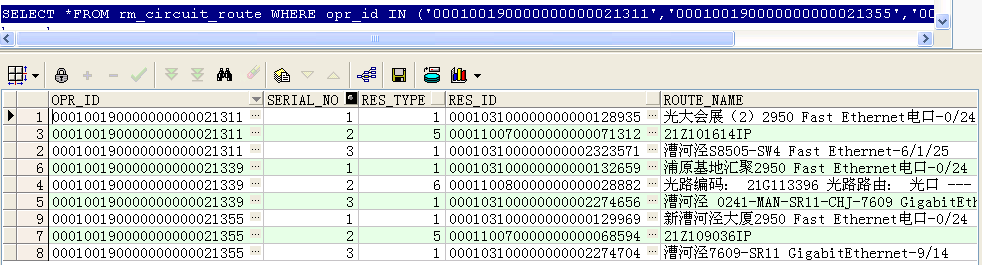
--找出这三条电路每条电路的第一条记录类型和最后一条记录类型
first_value(res_type) over(PARTITION BY opr_id ORDER BY res_type) low,
last_value(res_type) over(PARTITION BY opr_id ORDER BY res_type rows BETWEEN unbounded preceding AND unbounded following) high
FROM rm_circuit_route
WHERE opr_id IN ('000100190000000000021311','000100190000000000021355','000100190000000000021339')
ORDER BY opr_id;
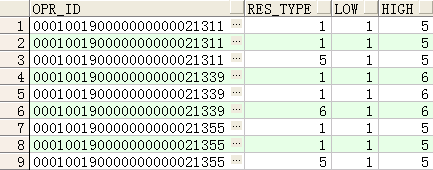
注:rows BETWEEN unbounded preceding AND unbounded following 的使用
--取last_value时不使用rows BETWEEN unbounded preceding AND unbounded following的结果
first_value(res_type) over(PARTITION BY opr_id ORDER BY res_type) low,
last_value(res_type) over(PARTITION BY opr_id ORDER BY res_type) high
FROM rm_circuit_route
WHERE opr_id IN ('000100190000000000021311','000100190000000000021355','000100190000000000021339')
ORDER BY opr_id;
如下图可以看到,如果不使用

数据如下:

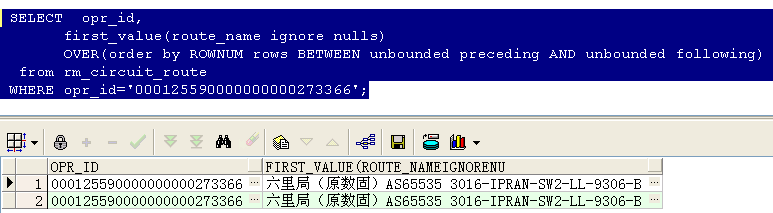
取出该电路的第一条记录,加上ignore nulls后,如果第一条是判断的那个字段是空的,则默认取下一条,结果如下所示:

lag(expresstion,<offset>,<default>)
with a as
(select 1 id,'a' name from dual
union
select 2 id,'b' name from dual
union
select 3 id,'c' name from dual
union
select 4 id,'d' name from dual
union
select 5 id,'e' name from dual
)
select id,name,lag(id,1,'')over(order by name) from a;
--lead() over()函数用法(取出后N行数据)
lead(expresstion,<offset>,<default>)
with a as
(select 1 id,'a' name from dual
union
select 2 id,'b' name from dual
union
select 3 id,'c' name from dual
union
select 4 id,'d' name from dual
union
select 5 id,'e' name from dual
)
select id,name,lead(id,1,'')over(order by name) from a;
--ratio_to_report(a)函数用法 Ratio_to_report() 括号中就是分子,over() 括号中就是分母
with a as (select 1 a from dual
union all
select 1 a from dual
union all
select 1 a from dual
union all
select 2 a from dual
union all
select 3 a from dual
union all
select 4 a from dual
union all
select 4 a from dual
union all
select 5 a from dual
)
select a, ratio_to_report(a)over(partition by a) b from a
order by a;
with a as (select 1 a from dual
union all
select 1 a from dual
union all
select 1 a from dual
union all
select 2 a from dual
union all
select 3 a from dual
union all
select 4 a from dual
union all
select 4 a from dual
union all
select 5 a from dual
)
select a, ratio_to_report(a)over() b from a --分母缺省就是整个占比
order by a;
with a as (select 1 a from dual
union all
select 1 a from dual
union all
select 1 a from dual
union all
select 2 a from dual
union all
select 3 a from dual
union all
select 4 a from dual
union all
select 4 a from dual
union all
select 5 a from dual
)
select a, ratio_to_report(a)over() b from a
group by a order by a;--分组后的占比
row_number() OVER(PARTITION BY)函数介绍的更多相关文章
- oracle下的OVER(PARTITION BY)函数介绍
转自:http://www.cnblogs.com/lanzi/archive/2010/10/26/1861338.html OVER(PARTITION BY)函数介绍 开窗函数 ...
- OVER(PARTITION BY)函数介绍
问题场景 最近在项目中遇到了对每一个类型进行求和并且求该类型所占的比例,当时考虑求出每种类型的和,并在java中分别对每一种类型的和与总和相除求出所占比例.后来,想到这样有点麻烦,并且项目中持久层使用 ...
- SQL row_number() over(partition by函数
1)row_number() over(partition by 列名1 order by 列名2 desc)的使用 表示根据 列名1 分组,然后在分组内部根据 列名2 排序,而此函数计算的值就表示每 ...
- 【Oracle】row_number() over(partition by )函数用法
row_number() OVER (PARTITION BY COL1 ORDER BY COL2) 表示根据COL1分组,在分组内部根据 COL2排序,而此函数计算的值就表示每组内部排序后的顺序编 ...
- HIVE-利用ow_number() OVER(PARTITION BY)函数介绍求TOP-K
http://blog.csdn.net/631799/article/details/7419797 第一句话: select row_number() over (partition by mon ...
- OVER(PARTITION BY)函数用法
OVER(PARTITION BY)函数介绍 开窗函数 Oracle从8.1.6开始提供分析函数,分析函数用于计算基于组的某种聚合值,它和聚合函数的不同之处是:对于每个组返 ...
- 获得供应商最近一次报价:OVER(PARTITION BY)函数用法的实际用法
利用rownumber ,关键字partition进行小范围分页 方法一: --所有供应商对该产品最近的一次报价with oa as(select a.SupplierId ,UnitPrice,Pr ...
- sql server ,OVER(PARTITION BY)函数用法,开窗函数,over子句,over开窗函数
https://technet.microsoft.com/zh-cn/library/ms189461(v=sql.105).aspx https://social.msdn.microsoft.c ...
- oracle OVER(PARTITION BY) 函数
OVER(PARTITION BY)函数介绍 开窗函数 Oracle从8.1.6开始提供分析函数,分析函数用于计算基于组的某种聚合值,它和聚合函数的不同之处是:对于每个组返 ...
随机推荐
- App Store有哪些原因会影响app应用上架呢?(分享)
App Store对于应用上架的审核是非常严格的,很可能一个没有注意到的细节,或者一个你根本没想想到的原因就会导致你的应用上架失败.而排除这些无可避免的错误以外,还有一些导致应用上架失败的原因,非常常 ...
- Leetcode: Path Sum III
You are given a binary tree in which each node contains an integer value. Find the number of paths t ...
- poi jar包的作用
目前POI的最新发布版本是3.10_FINAL.该版本保护的jar包有: Maven artifactId Prerequisites JAR poi commons-logging, commons ...
- IOS调试lldb命令常用,po,
lldb命令常用(备忘) 假如你准备在模拟器里面运行这个,你可以在"(lldb)"提示的后面输入下面的: (lldb) po $eax LLDB在xcode4.3或者之后的版本里面 ...
- Linux top和负载的说明
转自:http://bbs.linuxtone.org/thread-1684-1-1.html top命令是Linux下常用的性能分析工具,能够实时显示系统中各个进程的资源占用状况,类似于Windo ...
- Double Buffering Windows Forms
Double Buffering Windows Forms As much as we would like it not to be the case, graphics can be slow ...
- 【Spring】Spring的定时任务
> 参考的优秀文章 Task Execution and Scheduling > 版本说明 <dependencies> <dependency> <gro ...
- jquery总结03-遍历节点
这是用的最多的 向下遍历节点 children() 第一级子元素 相当于li>span find() 多级子孙元素 相当于li span 注意:.filter(':contains(&qu ...
- aws在线技术峰会笔记-主会场
容器服务:Elastic container service IoT可以采用无服务器架构.
- chain.doFilter(req, resp)
web中的Filiter过滤器: 当req不改变时,filiter在web中的配置和顺序没有关系: 但当在filiter中将其改变类型时,会导致其改变的request类型包装层次过多,无法获取其中的参 ...