
Andrew Ng机器学习 四:Neural Networks Learning
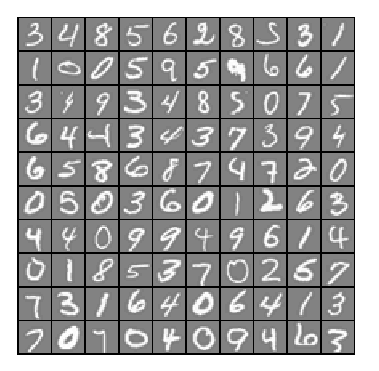
背景:跟上一讲一样,识别手写数字,给一组数据集ex4data1.mat,,每个样例都为灰度化为20*20像素,也就是每个样例的维度为400,加载这组数据后,我们会有5000*400的矩阵X(5000个样例),5000*1的矩阵y(表示每个样例所代表的数据)。现在让你拟合出一个模型,使得这个模型能很好的预测其它手写的数字。
(注意:我们用10代表0(矩阵y也是这样),因为Octave的矩阵没有0行)
一:神经网络( Neural Networks)
神经网络脚本ex4.m:
%% Machine Learning Online Class - Exercise  Neural Network Learning

%  Instructions

%  ------------

%

%  This file contains code that helps you get started on the

%  linear exercise. You will need to complete the following functions

%  in this exericse:

%

%     sigmoidGradient.m

%     randInitializeWeights.m

%     nnCostFunction.m

%

%  For this exercise, you will not need to change any code in this file,

%  or any other files other than those mentioned above.

%

%% Initialization

clear ; close all; clc

%% Setup the parameters you will use for this exercise

input_layer_size  = ;  % 20x20 Input Images of Digits

hidden_layer_size = ;   %  hidden units

num_labels = ;          %  labels, from  to

                          % (note that we have mapped "" to label )

%% =========== Part : Loading and Visualizing Data =============

%  We start the exercise by first loading and visualizing the dataset.

%  You will be working with a dataset that contains handwritten digits.

%

% Load Training Data

fprintf('Loading and Visualizing Data ...\n')

load('ex4data1.mat');

m = size(X, );

% Randomly select  data points to display

sel = randperm(size(X, ));

sel = sel(:);

displayData(X(sel, :));

fprintf('Program paused. Press enter to continue.\n');

pause;

%% ================ Part : Loading Parameters ================

% In this part of the exercise, we load some pre-initialized

% neural network parameters.

fprintf('\nLoading Saved Neural Network Parameters ...\n')

% Load the weights into variables Theta1(25x401) and Theta2(10x26)

load('ex4weights.mat');

% Unroll parameters

nn_params = [Theta1(:) ; Theta2(:)];

%% ================ Part : Compute Cost (Feedforward) ================

%  To the neural network, you should first start by implementing the

%  feedforward part of the neural network that returns the cost only. You

%  should complete the code in nnCostFunction.m to return cost. After

%  implementing the feedforward to compute the cost, you can verify that

%  your implementation is correct by verifying that you get the same cost

%  as us for the fixed debugging parameters.

%

%  We suggest implementing the feedforward cost *without* regularization

%  first so that it will be easier for you to debug. Later, in part , you

%  will get to implement the regularized cost.

%

fprintf('\nFeedforward Using Neural Network ...\n')

% Weight regularization parameter (we set this to  here).

lambda = ;

J = nnCostFunction(nn_params, input_layer_size, hidden_layer_size, ...

                   num_labels, X, y, lambda);

fprintf(['Cost at parameters (loaded from ex4weights): %f '...

         '\n(this value should be about 0.287629)\n'], J);

fprintf('\nProgram paused. Press enter to continue.\n');

pause;

%% =============== Part : Implement Regularization ===============

%  Once your cost function implementation is correct, you should now

%  continue to implement the regularization with the cost.

%

fprintf('\nChecking Cost Function (w/ Regularization) ... \n')

% Weight regularization parameter (we set this to  here).

lambda = ;

J = nnCostFunction(nn_params, input_layer_size, hidden_layer_size, ...

                   num_labels, X, y, lambda);

fprintf(['Cost at parameters (loaded from ex4weights): %f '...

         '\n(this value should be about 0.383770)\n'], J);

fprintf('Program paused. Press enter to continue.\n');

pause;

%% ================ Part : Sigmoid Gradient  ================

%  Before you start implementing the neural network, you will first

%  implement the gradient for the sigmoid function. You should complete the

%  code in the sigmoidGradient.m file.

%

fprintf('\nEvaluating sigmoid gradient...\n')

g = sigmoidGradient([- -0.5  0.5 ]);

fprintf('Sigmoid gradient evaluated at [-1 -0.5 0 0.5 1]:\n  ');

fprintf('%f ', g);

fprintf('\n\n');

fprintf('Program paused. Press enter to continue.\n');

pause;

%% ================ Part : Initializing Pameters ================

%  In this part of the exercise, you will be starting to implment a two

%  layer neural network that classifies digits. You will start by

%  implementing a function to initialize the weights of the neural network

%  (randInitializeWeights.m)

fprintf('\nInitializing Neural Network Parameters ...\n')

initial_Theta1 = randInitializeWeights(input_layer_size, hidden_layer_size);

initial_Theta2 = randInitializeWeights(hidden_layer_size, num_labels);

% Unroll parameters

initial_nn_params = [initial_Theta1(:) ; initial_Theta2(:)];

%% =============== Part : Implement Backpropagation ===============

%  Once your cost matches up with ours, you should proceed to implement the

%  backpropagation algorithm for the neural network. You should add to the

%  code you've written in nnCostFunction.m to return the partial

%  derivatives of the parameters.

%

fprintf('\nChecking Backpropagation... \n');

%  Check gradients by running checkNNGradients

checkNNGradients;

fprintf('\nProgram paused. Press enter to continue.\n');

pause;

%% =============== Part : Implement Regularization ===============

%  Once your backpropagation implementation is correct, you should now

%  continue to implement the regularization with the cost and gradient.

%

fprintf('\nChecking Backpropagation (w/ Regularization) ... \n')

%  Check gradients by running checkNNGradients

lambda = ;

checkNNGradients(lambda);

% Also output the costFunction debugging values

debug_J  = nnCostFunction(nn_params, input_layer_size, ...

                          hidden_layer_size, num_labels, X, y, lambda);

fprintf(['\n\nCost at (fixed) debugging parameters (w/ lambda = %f): %f ' ...

         '\n(for lambda = 3, this value should be about 0.576051)\n\n'], lambda, debug_J);

fprintf('Program paused. Press enter to continue.\n');

pause;

%% =================== Part : Training NN ===================

%  You have now implemented all the code necessary to train a neural

%  network. To train your neural network, we will now use "fmincg", which

%  is a function which works similarly to "fminunc". Recall that these

%  advanced optimizers are able to train our cost functions efficiently as

%  long as we provide them with the gradient computations.

%

fprintf('\nTraining Neural Network... \n')

%  After you have completed the assignment, change the MaxIter to a larger

%  value to see how more training helps.

options = optimset('MaxIter', );

%  You should also try different values of lambda

lambda = ;

% Create "short hand" for the cost function to be minimized

costFunction = @(p) nnCostFunction(p, ...

                                   input_layer_size, ...

                                   hidden_layer_size, ...

                                   num_labels, X, y, lambda);

% Now, costFunction is a function that takes in only one argument (the

% neural network parameters)

[nn_params, cost] = fmincg(costFunction, initial_nn_params, options);

% Obtain Theta1 and Theta2 back from nn_params

Theta1 = reshape(nn_params(:hidden_layer_size * (input_layer_size + )), ...

                 hidden_layer_size, (input_layer_size + ));

Theta2 = reshape(nn_params(( + (hidden_layer_size * (input_layer_size + ))):end), ...

                 num_labels, (hidden_layer_size + ));

fprintf('Program paused. Press enter to continue.\n');

pause;

%% ================= Part : Visualize Weights =================

%  You can now "visualize" what the neural network is learning by

%  displaying the hidden units to see what features they are capturing in

%  the data.

fprintf('\nVisualizing Neural Network... \n')

displayData(Theta1(:, :end));

fprintf('\nProgram paused. Press enter to continue.\n');

pause;

%% ================= Part : Implement Predict =================

%  After training the neural network, we would like to use it to predict

%  the labels. You will now implement the "predict" function to use the

%  neural network to predict the labels of the training set. This lets

%  you compute the training set accuracy.

pred = predict(Theta1, Theta2, X);

fprintf('\nTraining Set Accuracy: %f\n', mean(double(pred == y)) * );
ex4.m
1,通过可视化数据,可以看到如下图所示:
2,前向传播代价函数(Feedforward and cost function)
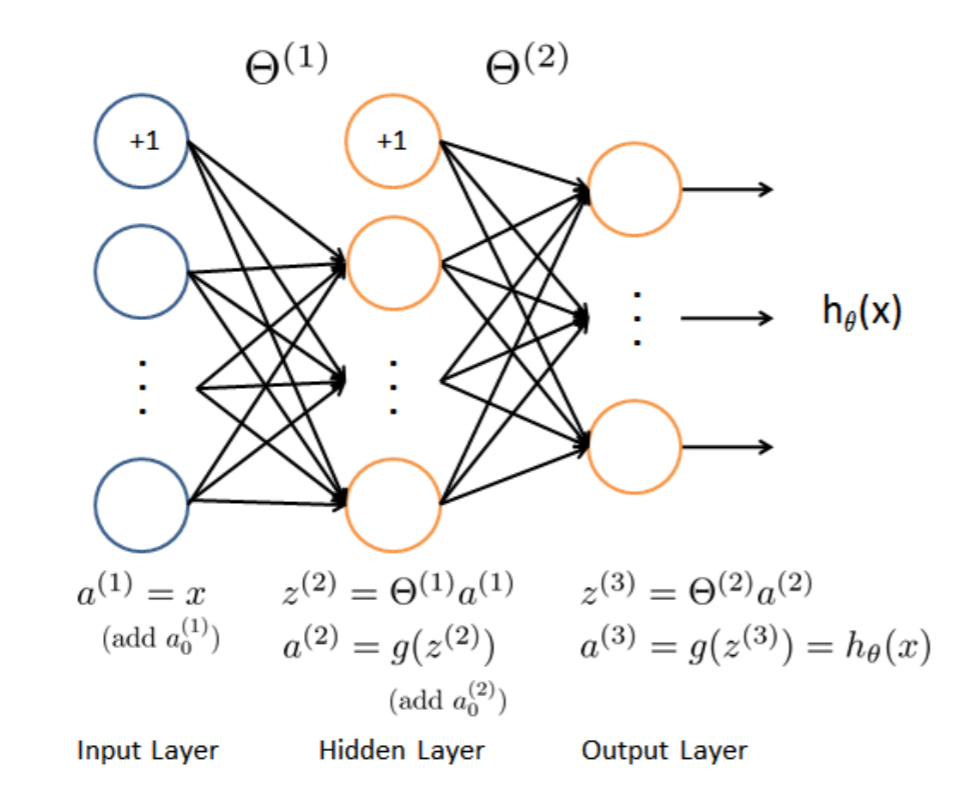
$J(\Theta)=-\frac{1}{m}\sum_{i=1}^{m}\sum_{k=1}^{K}[y^{(i)}_k(log(h_\Theta(x^{(i)}))_k)+(1-y^{(i)}_k)log(1-(h_{\Theta}(x^{(i)}))_k)]$
$+\frac{\lambda }{2m}\sum_{l=1}^{L-1}\sum_{i=1}^{s_l}\sum_{j=1}^{s_l+1}(\Theta_{ji}^{l})^{2}$
注意:$(h_\Theta(x^{(i)}))_k=a^{(3)}_k$,第k个输出单元。

该代价函数正则化时忽略偏差项,最里层的循环$
Andrew Ng机器学习 四:Neural Networks Learning的更多相关文章
- (原创)Stanford Machine Learning (by Andrew NG) --- (week 5) Neural Networks Learning
本栏目内容来自Andrew NG老师的公开课:https://class.coursera.org/ml/class/index 一般而言, 人工神经网络与经典计算方法相比并非优越, 只有当常规方法解 ...
- (原创)Stanford Machine Learning (by Andrew NG) --- (week 4) Neural Networks Representation
Andrew NG的Machine learning课程地址为:https://www.coursera.org/course/ml 神经网络一直被认为是比较难懂的问题,NG将神经网络部分的课程分为了 ...
- [C4] Andrew Ng - Improving Deep Neural Networks: Hyperparameter tuning, Regularization and Optimization
About this Course This course will teach you the "magic" of getting deep learning to work ...
- 斯坦福大学公开课机器学习: neural networks learning - autonomous driving example(通过神经网络实现自动驾驶实例)
使用神经网络来实现自动驾驶,也就是说使汽车通过学习来自己驾驶. 下图是通过神经网络学习实现自动驾驶的图例讲解: 左下角是汽车所看到的前方的路况图像.左上图,可以看到一条水平的菜单栏(数字4所指示方向) ...
- 【原】Coursera—Andrew Ng机器学习—课程笔记 Lecture 9_Neural Networks learning
神经网络的学习(Neural Networks: Learning) 9.1 代价函数 Cost Function 参考视频: 9 - 1 - Cost Function (7 min).mkv 假设 ...
- Andrew Ng机器学习课程笔记(四)之神经网络
Andrew Ng机器学习课程笔记(四)之神经网络 版权声明:本文为博主原创文章,转载请指明转载地址 http://www.cnblogs.com/fydeblog/p/7365730.html 前言 ...
- Andrew Ng机器学习课程11之使用machine learning的建议
Andrew Ng机器学习课程11之使用machine learning的建议 声明:引用请注明出处http://blog.csdn.net/lg1259156776/ 2015-9-28 艺少
- 【原】Coursera—Andrew Ng机器学习—编程作业 Programming Exercise 4—反向传播神经网络
课程笔记 Coursera—Andrew Ng机器学习—课程笔记 Lecture 9_Neural Networks learning 作业说明 Exercise 4,Week 5,实现反向传播 ba ...
- Machine Learning - 第5周(Neural Networks: Learning)
The Neural Network is one of the most powerful learning algorithms (when a linear classifier doesn't ...
随机推荐
- Swift编码总结8
1.判断当前控制器是否在显示: // 判断当前控制器是否在显示 func isCurrentViewControllerVisible() -> Bool { return (self.isVi ...
- Jq如何获取并操作iframe中的元素?
<!DOCTYPE html> <html xmlns="http://www.w3.org/1999/xhtml"> <head> <m ...
- JQuery EasyUI更新说明
JQuery EasyUI 1.3.6版本更新内容: Bug(修复) treegrid:修复“getChecked”方法不能正确的返回被选择的行的问题: tree:修复在“onlyLeafCheck” ...
- [LeetCode] 188. Best Time to Buy and Sell Stock IV 买卖股票的最佳时间 IV
Say you have an array for which the ith element is the price of a given stock on day i. Design an al ...
- WPF外包团队:2019 WPF数据监控系统案例演示
项目版权均为客户所有,如有WPF项目外包欢迎联系我们. QQ:372900288 TEL:13911652504 WX:Liuxiang0884
- 记一次Docker中部署Asp.Net Core 3.0的踩坑过程
最近公司打算重构目前直销报单系统到微信小程序中,目前的系统只能在PC上面使用,这两年也搞过App端,但是由于人员流动和公司架构调整最后都不了了之,只留下一堆写了一半的接口.以前的接口依然是使用Asp. ...
- proc 目录介绍
/proc/apm 高级电源管理(APM)版本信息及电池相关状态信息,通常由apm命令使用: /proc/buddyinfo 用于诊断内存碎片问题的相关信息文件: /proc/cmdline 在 ...
- 2.Netty 与 NIO 之前世今生
2.Netty 与 NIO 之前世今生 本文围绕一下几点阐述: 1. NIO 的核心组件 Buffer.Selector.Channel. 2.何谓多路复用? 3.Netty 支持的功能与特性. ...
- Keil 5出现Error: L6218E: Undefined symbol解决方法
首先列出网上百度到比较好的blog: blog1:https://blog.csdn.net/super_demo/article/details/32131379 总结了代码中可能因为几种初级或者粗 ...
- win server 检查是否是ntfs文件系统
fsutil fsinfo volumeinfo c: | findstr /i "文件系统名"