
AlexNet: ImageNet Classification with Deep Convolutional Neural Networks
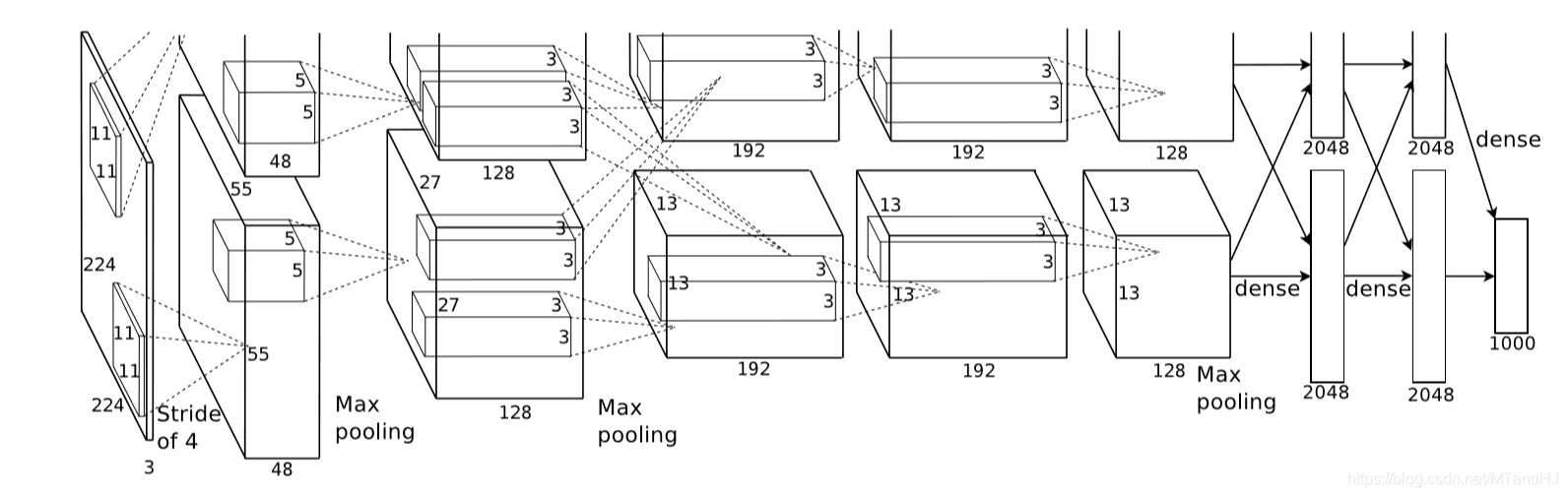
上图是论文的网络的结构图,包括5个卷积层和3个全连接层,作者还特别强调,depth的重要性,少一层结果就会变差,所以这种超参数的调节可真是不简单.
激活函数
首先讨论的是激活函数,作者选择的不是\(f(x)=\mathrm{tanh}(x)=(1+e^{-x})^{-1}\),而是ReLUs ( Rectified Linear Units)——\(f(x)=\max (0, x)\), 当然,作者考虑的问题是比赛的那个数据集,其网络的收敛速度为:
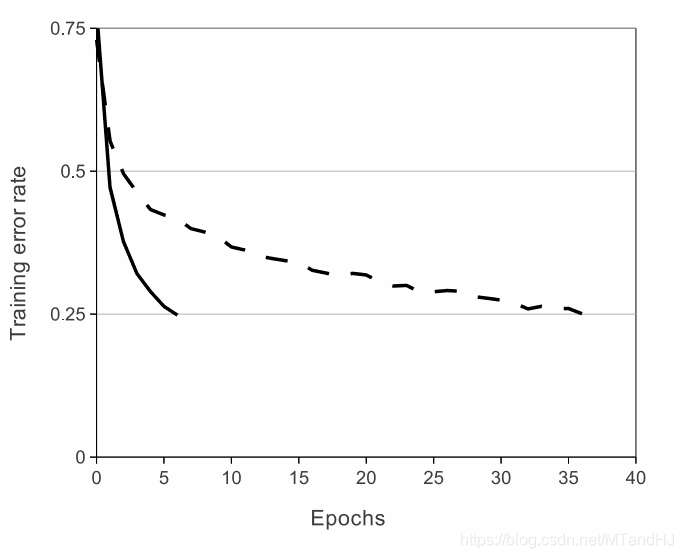
接下来,作者讨论了标准化的问题,说ReLUs是不需要进行这一步的,论文中的那句话我感觉理解的怪怪的:
ReLUs have the desirable property that they do not require input normalization to prevent them fromsaturating.
饱和?
作者说,也可以对ReLUs进行扩展,使得其更有泛化性,把多个核进行标准化处理:

\(i\)表示核的顺序,\(a_{x,y}^i\)则是其值, 说实话,这部分也没怎么弄懂.
然后是关于池化层的部分,一般的池化层的核是不用重叠的,作者这部分也考虑进去了.
防止过拟合
为了防止过拟合,作者提出了他的几点经验.
增加数据
这个数据不是简单的多找点数据,而是通过一些变换使得数据增加.
比如对图片进行旋转,以及PCA提主成分,改变score等.
Dropout
多个模型,进行综合评价是防止过拟合的好方法,但是训练网络不易,dropout, 即让隐层的神经元以一定的概率输出为0来,所以每一次训练,网络的结构实际上都是不一样的,但是整个网络是共享参数的,所以可以一次性训练多个模型?
细节
batch size: 128
momentum: 0.9
weight decay: 0.0005
一般的随机梯度下降好像是没有weight decay这一部分的,但是作者说,实验中这个的选择还是蛮有效的.
代码
"""

epochs: 50

lr: 0.001

batch_size = 128

在训练集上的正确率达到了97%,

在测试集上的正确率为83%.

"""

import torch

import torch.nn as nn

import torchvision

import torchvision.transforms as transforms

import os

class AlexNet(nn.Module):

    def __init__(self, output_size=10):

        super(AlexNet, self).__init__()

        self.conv1 = nn.Sequential(  # 3 x 227 x 227

            nn.Conv2d(3, 96, 11, 4, 0),  # 3通道 输出96通道 卷积核为11 x 11 滑动为4 不补零

            nn.BatchNorm2d(96),

            nn.ReLU()

        )

        self.conv2 = nn.Sequential(  # 96 x 55 x 55

            nn.Conv2d(48, 128, 5, 1, 2),

            nn.BatchNorm2d(128),

            nn.ReLU(),

            nn.MaxPool2d(3, 2)

        )

        self.conv3 = nn.Sequential(  # 256 x 27 x 27

            nn.Conv2d(256, 192, 3, 1, 1),

            nn.BatchNorm2d(192),

            nn.ReLU(),

            nn.MaxPool2d(3, 2)

        )

        self.conv4 = nn.Sequential(  # 384 x 13 x 13

            nn.Conv2d(192, 192, 3, 1, 1),

            nn.BatchNorm2d(192),

            nn.ReLU()

        )

        self.conv5 = nn.Sequential(  # 384 x 13 x 13

            nn.Conv2d(192, 128, 3, 1, 1),

            nn.BatchNorm2d(128),

            nn.ReLU(),

            nn.MaxPool2d(3, 2)

        )

        self.dense = nn.Sequential(

            nn.Linear(9216, 4096),

            nn.BatchNorm1d(4096),

            nn.ReLU(),

            nn.Dropout(0.5),

            nn.Linear(4096, 4096),

            nn.BatchNorm1d(4096),

            nn.ReLU(),

            nn.Dropout(0.5),

            nn.Linear(4096, output_size)

        )

    def forward(self, input):

        x = self.conv1(input)

        x1, x2 = x[:, :48, :, :], x[:, 48:, :, :]  # 拆分

        x1 = self.conv2(x1)

        x2 = self.conv2(x2)

        x = torch.cat((x1, x2), 1)  # 合并

        x1 = self.conv3(x)

        x2 = self.conv3(x)

        x1 = self.conv4(x1)

        x2 = self.conv4(x2)

        x1 = self.conv5(x1)

        x2 = self.conv5(x2)

        x = torch.cat((x1, x2), 1)

        x = x.view(-1, 9216)

        output = self.dense(x)

        return output

class Train:

    def __init__(self, lr=0.001, momentum=0.9, weight_decay=0.0005):

        self.net = AlexNet()

        self.criterion = nn.CrossEntropyLoss()

        self.opti = torch.optim.SGD(self.net.parameters(),

                                    lr=lr, momentum=momentum,

                                    weight_decay=weight_decay)

        self.generate_path()

    def gpu(self):

        self.device = torch.device("cuda:0" if torch.cuda.is_available() else "cpu")

        if torch.cuda.device_count() > 1:

            print("Let'us use %d GPUs" % torch.cuda.device_count())

            self.net = nn.DataParallel(self.net)

        self.net = self.net.to(self.device)

    def generate_path(self):

        """

        生成保存数据的路径

        :return:

        """

        try:

            os.makedirs('./paras')

            os.makedirs('./logs')

            os.makedirs('./images')

        except FileExistsError as e:

            pass

        name = self.net.__class__.__name__

        paras = os.listdir('./paras')

        self.para_path = "./paras/{0}{1}.pt".format(

            name,

            len(paras)

        )

        logs = os.listdir('./logs')

        self.log_path = "./logs/{0}{1}.txt".format(

            name,

            len(logs)

        )

    def log(self, strings):

        """

        运行日志

        :param strings:

        :return:

        """

        # a 往后添加内容

        with open(self.log_path, 'a', encoding='utf8') as f:

            f.write(strings)

    def save(self):

        """

        保存网络参数

        :return:

        """

        torch.save(self.net.state_dict(), self.para_path)

    def derease_lr(self, multi=10):

        """

        降低学习率

        :param multi:

        :return:

        """

        self.opti.param_groups()[0]['lr'] /= multi

    def train(self, trainloder, epochs=50):

        data_size = len(trainloder) * trainloder.batch_size

        for epoch in range(epochs):

            running_loss = 0.

            acc_count = 0.

            if (epoch + 1) % 10 is 0:

                self.derease_lr()

                self.log(

                    "learning rate change!!!\n"

                )

            for i, data in enumerate(trainloder):

                imgs, labels = data

                imgs = imgs.to(self.device)

                labels = labels.to(self.device)

                out = self.net(imgs)

                loss = self.criterion(out, labels)

                _, pre = torch.max(out, 1)  #判断是否判断正确

                acc_count += (pre == labels).sum().item() #加总对的个数

                self.opti.zero_grad()

                loss.backward()

                self.opti.step()

                running_loss += loss.data

                if (i+1) % 10 is 0:

                    strings = "epoch {0:<3} part {1:<5} loss: {2:<.7f}\n".format(

                        epoch, i, running_loss * 50

                    )

                    self.log(strings)

                    running_loss = 0.

            self.log(

                "Accuracy of the network on %d train images: %d %%\n" %(

                    data_size, acc_count / data_size * 100

                )

            )

            self.save()
class Test:

    def __init__(self, classes, path=0):

        self.net = AlexNet()

        self.classes = classes

        self.load(path)

    def load(self, path=0):

        if isinstance(path, int):

            name = self.net.__class__.__name__

            path = "./paras/{0}{1}.pt".format(

                name, path

            )

        #加载参数, map_location 因为是用GPU训练的, 保存的是是GPU的模型

        #如果需要在cpu的情况下测试, 选择map_location="cpu".

        self.net.load_state_dict(torch.load(path, map_location="cpu"))

        self.net.eval()

    def showimgs(self, imgs, labels):

        n = imgs.size(0)

        pres = self.__call__(imgs)

        n = max(n, 7)

        fig, axs = plt.subplots(n)

        for i, ax in enumerate(axs):

            img = imgs[i].numpy().transpose((1, 2, 0))

            img = img / 2 + 0.5

            label = self.classes[labels[i]]

            pre = self.classes[pres[i]]

            ax.set_title("{0}|{1}".format(

                label, pre

            ))

            ax.plot(img)

            ax.get_xaxis().set_visible(False)

            ax.get_yaxis().set_visible(False)

        plt.tight_layout()

        plt.show()

    def acc_test(self, testloader):

        data_size = len(testloader) * testloader.batch_size

        acc_count = 0.

        for (imgs, labels) in testloader:

            pre = self.__call__(imgs)

            acc_count += (pre == labels).sum().item()

        return acc_count / data_size

    def __call__(self, imgs):

        out = self.net(imgs)

        _, pre = torch.max(out, 1)

        return pre
AlexNet: ImageNet Classification with Deep Convolutional Neural Networks的更多相关文章
- AlexNet论文翻译-ImageNet Classification with Deep Convolutional Neural Networks
ImageNet Classification with Deep Convolutional Neural Networks 深度卷积神经网络的ImageNet分类 Alex Krizhevsky ...
- 《ImageNet Classification with Deep Convolutional Neural Networks》 剖析
<ImageNet Classification with Deep Convolutional Neural Networks> 剖析 CNN 领域的经典之作, 作者训练了一个面向数量为 ...
- ImageNet Classification with Deep Convolutional Neural Networks(译文)转载
ImageNet Classification with Deep Convolutional Neural Networks Alex Krizhevsky, Ilya Sutskever, Geo ...
- 中文版 ImageNet Classification with Deep Convolutional Neural Networks
ImageNet Classification with Deep Convolutional Neural Networks 摘要 我们训练了一个大型深度卷积神经网络来将ImageNet LSVRC ...
- Understanding the Effective Receptive Field in Deep Convolutional Neural Networks
Understanding the Effective Receptive Field in Deep Convolutional Neural Networks 理解深度卷积神经网络中的有效感受野 ...
- Deep learning_CNN_Review:A Survey of the Recent Architectures of Deep Convolutional Neural Networks——2019
CNN综述文章 的翻译 [2019 CVPR] A Survey of the Recent Architectures of Deep Convolutional Neural Networks 翻 ...
- Image Scaling using Deep Convolutional Neural Networks
Image Scaling using Deep Convolutional Neural Networks This past summer I interned at Flipboard in P ...
- 深度卷积神经网络用于图像缩放Image Scaling using Deep Convolutional Neural Networks
This past summer I interned at Flipboard in Palo Alto, California. I worked on machine learning base ...
- [论文阅读] ImageNet Classification with Deep Convolutional Neural Networks(传说中的AlexNet)
这篇文章使用的AlexNet网络,在2012年的ImageNet(ILSVRC-2012)竞赛中获得第一名,top-5的测试误差为15.3%,相比于第二名26.2%的误差降低了不少. 本文的创新点: ...
随机推荐
- 我好像发现了一个Go的Bug?
从一次重构说起 这事儿还得从一次重构优化说起. 最近在重构一个路由功能,由于路由比较复杂,需求变化也多,于是想通过责任链模式来重构,刚好这段时间也在 Sentinel-Go 中看到相关源码. 用责任链 ...
- HTML5 之 FileReader 的使用 (网页上图片拖拽并且预显示可在这里学到) [转载]
转载至 : http://www.360doc.com/content/14/0214/18/1457948_352511416.shtml FileReader 资料(英文) : https://d ...
- ping (网络诊断工具)
Ping是Windows.Unix和Lnix系统下的一个命令,ping也属于一个通信协议,是TCP/IP协议的一部分,利用Ping命令可以检查网络是否连通,可以很好地帮助我们分析和判定网络故障.应用格 ...
- [项目总结]怎么获取TextView行数,为什么TextView获取行数为0?
1 final TextView textView = new TextView(this); 2 ViewTreeObserver viewTreeObserver = textView.getVi ...
- 【Linux】【Services】【Package】rpm
CentOS系统上rpm命令管理程序包: 安装.升级.卸载.查询和校验.数据库维护 rpm命令:rpm [OPTIONS] [PACKAGE_F ...
- 【Word】自动化参考文献-交叉引用
第一步:设置参考文献标号 开始-定义新编号格式中,定义参考文献式的方框编号: 这里注意不要把他原来的数字去掉 第二步:选择交叉引用 插入-交叉引用: 第三步:更新标号 如果更新标号,使用右键-更新域. ...
- C语言static关键字
C语言static关键字 static关键字的作用,主要从在程序的生存周期.作用域和在代码段中的位置起作用. 全局变量 静态全局变量 局部变量 静态局部量 生存周期 程序运行到结束 程序运行到结束 函 ...
- 记一次 .NET 某妇产医院 WPF内存溢出分析
一:背景 1. 讲故事 上个月有位朋友通过博客园的短消息找到我,说他的程序存在内存溢出情况,寻求如何解决. 要解决还得通过 windbg 分析啦. 二:Windbg 分析 1. 为什么会内存溢出 大家 ...
- CSAPP 并发编程读书笔记
CSAPP 并发编程笔记 并发和并行 并发:Concurrency,只要时间上重叠就算并发,可以是单处理器交替处理 并行:Parallel,属于并发的一种特殊情况(真子集),多核/多 CPU 同时处理 ...
- CF977C Less or Equal 题解
Content 给定一个 \(n\) 个数的数列 \(a_1,a_2,a_3,...,a_n\) 和一个数 \(k\),试找出这样的一个数 \(x\),使得数列中有 \(k\) 个数小于等于 \(x\ ...