
poj 1265 Area (Pick定理+求面积)
链接:http://poj.org/problem?id=1265
| Time Limit: 1000MS | Memory Limit: 10000K | |
| Total Submissions: 4969 | Accepted: 2231 |
Description
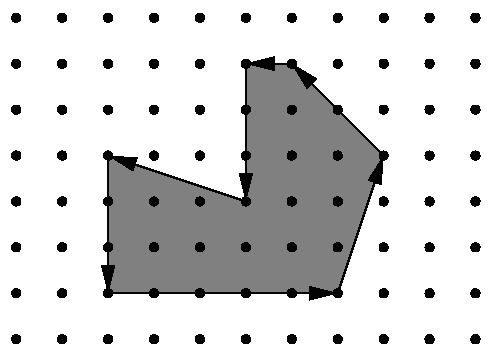
Figure 1: Example area.
You are hired to write a program that calculates the area occupied by the new facility from the movements of a robot along its walls. You can assume that this area is a polygon with corners on a rectangular grid. However, your boss insists that you use a formula he is so proud to have found somewhere. The formula relates the number I of grid points inside the polygon, the number E of grid points on the edges, and the total area A of the polygon. Unfortunately, you have lost the sheet on which he had written down that simple formula for you, so your first task is to find the formula yourself.
Input
For each scenario, you are given the number m, 3 <= m < 100, of movements of the robot in the first line. The following m lines contain pairs 揹x dy�of integers, separated by a single blank, satisfying .-100 <= dx, dy <= 100 and (dx, dy) != (0, 0). Such a pair means that the robot moves on to a grid point dx units to the right and dy units upwards on the grid (with respect to the current position). You can assume that the curve along which the robot moves is closed and that it does not intersect or even touch itself except for the start and end points. The robot moves anti-clockwise around the building, so the area to be calculated lies to the left of the curve. It is known in advance that the whole polygon would fit into a square on the grid with a side length of 100 units.
Output
Sample Input
2

4

1 0

0 1

-1 0

0 -1

7

5 0

1 3

-2 2

-1 0

0 -3

-3 1

0 -3
Sample Output
Scenario #1:

0 4 1.0

Scenario #2:

12 16 19.0
Source
-=-=-=-=-=-=-=-=-=-=-=-=-=-=-=-=-=-=-=-=-=-=-=-=-=-=-=-=-=
Pick定理的证明推荐个网址:episte.math.ntu.edu.tw/articles/sm/sm_25_10_1/page2.html
Area=i + b/2 - 1
i为内点 b为边上点
还有点在多边形边上运用GCD的证明,确实不会,希望大神看到给我解释一下
超时代码:
 #include <stdio.h>

 #include <math.h>

 #include <string.h>

 #include <stdlib.h>

 #include <iostream>

 #include <algorithm>

 #define eps 1e-8

 #define MAXX 210

 using namespace std;

 typedef struct point

 {

     double x;

     double y;

 }point;

 typedef struct line

 {

     point st;

     point ed;

 }line;

 bool dy(double x,double y)

 {

     return x>y+eps;

 }

 bool xy(double x,double y)

 {

     return x<y-eps;

 }

 bool dyd(double x,double y)

 {

     return x>y-eps;

 }

 bool xyd(double x,double y)

 {

     return x<y+eps;

 }

 bool dd(double x,double y)

 {

     return fabs(x-y)<eps;

 }

 double crossProduct(point a,point b,point c)//ac -> ab

 {

     return (c.x-a.x)*(b.y-a.y)-(c.y-a.y)*(b.x-a.x);

 }

 double dist(point a,point b)

 {

     return sqrt((a.x-b.x)*(a.x-b.x)+(a.y-b.y)*(a.y-b.y));

 }

 bool onSegment_1(point a,point b,point c)

 {

     double maxx=max(a.x,b.x);

     double minx=min(a.x,b.x);

     double maxy=max(a.y,b.y);

     double miny=min(a.y,b.y);

     if(dd(crossProduct(a,b,c),0.0) && xyd(c.x,maxx) && dyd(c.x,minx)

        && xyd(c.y,maxy) && dyd(c.y,miny))

         return true;

     return false;

 }

 bool segIntersect_1(point p1,point p2,point p3,point p4)

 {

     double d1=crossProduct(p3,p4,p1);

     double d2=crossProduct(p3,p4,p2);

     double d3=crossProduct(p1,p2,p3);

     double d4=crossProduct(p1,p2,p4);

     if(xy(d1*d2,0.0) && xy(d3*d4,0.0))

         return true;

     if(dd(d1,0.0) && onSegment_1(p3,p4,p1))

         return true;

     if(dd(d2,0.0) && onSegment_1(p3,p4,p2))

         return true;

     if(dd(d3,0.0) && onSegment_1(p1,p2,p3))

         return true;

     if(dd(d4,0.0) && onSegment_1(p1,p2,p4))

         return true;

     return false;

 }

 point p[MAXX];

 line li[MAXX];

 int n;

 bool inPolygon_1(point pot)

 {

     int count=;

     line l;

     l.st=pot;

     l.ed.x=1e10;

     l.ed.y=pot.y;

     p[n]=p[];

     for(int i=; i<n; i++)

     {

         if( onSegment_1(p[i],p[i+],pot ))

             return true;

         if(!dd(p[i].y,p[i+].y))

         {

             int tmp=-;

             if(onSegment_1(l.st,l.ed,p[i]))

                 tmp=i;

             else if(onSegment_1(l.st,l.ed,p[i+]))

                 tmp=i+;

             if(tmp != - && dd(p[tmp].y,max(p[i].y,p[i+].y)))

                 count++;

             else if(tmp == - && segIntersect_1(p[i],p[i+],l.st,l.ed))

                 count++;

         }

     }

     if(count %  ==)

         return true;

     return false;

 }

 bool inPolygon_2(point pot)

 {

     int count=;

     line l;

     l.st=pot;

     l.ed.x=1e10;

     l.ed.y=pot.y;

     p[n]=p[];

     for(int i=; i<n; i++)

     {

         if( onSegment_1(p[i],p[i+],pot ))

             return false;

         if(!dd(p[i].y,p[i+].y))

         {

             int tmp=-;

             if(onSegment_1(l.st,l.ed,p[i]))

                 tmp=i;

             else if(onSegment_1(l.st,l.ed,p[i+]))

                 tmp=i+;

             if(tmp != - && dd(p[tmp].y,max(p[i].y,p[i+].y)))

                 count++;

                 else if(tmp == - && segIntersect_1(p[i],p[i+],l.st,l.ed))

                 count++;

         }

     }

     if(count %  ==)

         return true;

     return false;

 }

 double Area(int n)

 {

     if(n<)return ;

     int i;

     double ret=0.0;

     for(i=; i<=n; i++)

     {

         ret+=(crossProduct(p[],p[i-],p[i]));

     }

     return fabs(ret)/2.0;

 }

 int main()

 {

     int m,i,j;

     int ttmp=;

     scanf("%d",&m);

     while(m--)

     {

         scanf("%d",&n);

         p[].x=;p[].y=;

         double x,y;

         double maxx=-,maxy=-,minx=,miny=;

         for(i=; i<=n; i++)

         {

             scanf("%lf%lf",&x,&y);

             p[i].x=p[i-].x+x;

             p[i].y=p[i-].y+y;//printf("%lf %lf^^",p[i].x,p[i].y);

         }

         for(i=; i<=n; i++)

         {

             maxx=maxx>p[i].x?maxx:p[i].x;

             maxy=maxy>p[i].y?maxy:p[i].y;

             minx=minx<p[i].x?minx:p[i].x;

             miny=miny<p[i].y?miny:p[i].y;

         }//printf("%lf %lf^^%lf %lf**",minx,maxx,miny,maxy);

         int in=,edge=,sum=;

         point cas;

         for(i=minx; i<=maxx; i++)

         {

             for(j=miny; j<=maxy; j++)

             {

                 cas.x=i;cas.y=j;

                 if(inPolygon_1(cas))

                 {

                     sum++;

                 }

                 if(inPolygon_2(cas))

                 {

                     in++;

                 }

             }

         }

         double area=Area(n);

         edge=sum-in;

         printf("Scenario #%d:\n",ttmp++);

         printf("%d %d %.1lf\n",in,edge,area);

     }

     return ;

 }
Pick定理运用
 #include <stdio.h>

 #include <math.h>

 #include <string.h>

 #include <stdlib.h>

 #include <iostream>

 #include <algorithm>

 #define eps 1e-8

 #define MAXX 210

 typedef struct point

 {

     double x;

     double y;

 }point;

 int gcd(int a,int b)

 {

     return b ? gcd(b,a%b) : a;

 }

 double crossProduct(point a,point b,point c)

 {

     return (c.x-a.x)*(b.y-a.y)-(c.y-a.y)*(b.x-a.x);

 }

 point p[MAXX];

 int onBorder(int n)

 {

     int sum=;

     for(int i=; i<n; i++)

     {

         sum+=gcd(abs((int)(p[i].x-p[i+].x)),abs((int)(p[i].y-p[i+].y)));

     }

     return sum;

 }

 double area(int n)

 {

     double ans=0.0;

     for(int i=; i<=n; i++)

     {

         ans+=crossProduct(p[],p[i-],p[i]);

     }

     return fabs(ans)/2.0;

 }

 int main()

 {

     int n,m,i,j;

     scanf("%d",&n);

     int cas=;

     while(n--)

     {

         scanf("%d",&m);

         p[].x=;p[].y=;

         double x,y;

         for(i=; i<=m; i++)

         {

             scanf("%lf%lf",&x,&y);

             p[i].x=p[i-].x+x;

             p[i].y=p[i-].y+y;

         }

         double are=area(m);

         int edge=onBorder(m);

         printf("Scenario #%d:\n",cas++);

         printf("%d %d %.1lf\n\n",(int)are+-edge/,edge,are);

     }

     return ;

 }
poj 1265 Area (Pick定理+求面积)的更多相关文章
- POJ 1265 Area (Pick定理 & 多边形面积)
题目链接:POJ 1265 Problem Description Being well known for its highly innovative products, Merck would d ...
- poj 1265 Area(pick定理)
Area Time Limit: 1000MS Memory Limit: 10000K Total Submissions: 4373 Accepted: 1983 Description Bein ...
- [poj 1265]Area[Pick定理][三角剖分]
题意: 给出机器人移动的向量, 计算包围区域的内部整点, 边上整点, 面积. 思路: 面积是用三角剖分, 边上整点与GCD有关, 内部整点套用Pick定理. S = I + E / 2 - 1 I 为 ...
- Area - POJ 1265(pick定理求格点数+求多边形面积)
题目大意:以原点为起点然后每次增加一个x,y的值,求出来最后在多边形边上的点有多少个,内部的点有多少个,多边形的面积是多少. 分析: 1.以格子点为顶点的线段,覆盖的点的个数为GCD(dx,dy),其 ...
- poj 1265 Area( pick 定理 )
题目:http://poj.org/problem?id=1265 题意:已知机器人行走步数及每一步的坐标 变化量 ,求机器人所走路径围成的多边形的面积.多边形边上和内部的点的数量. 思路:1.以 ...
- POJ1265——Area(Pick定理+多边形面积)
Area DescriptionBeing well known for its highly innovative products, Merck would definitely be a goo ...
- poj 1654 Area (多边形求面积)
链接:http://poj.org/problem?id=1654 Area Time Limit: 1000MS Memory Limit: 10000K Total Submissions: ...
- POJ 1265 Area (pick定理)
题目大意:已知机器人行走步数及每一步的坐标变化量,求机器人所走路径围成的多边形的面积.多边形边上和内部的点的数量. 思路:叉积求面积,pick定理求点. pick定理:面积=内部点数+边上点数/2-1 ...
- poj 1265 Area 面积+多边形内点数
Area Time Limit: 1000MS Memory Limit: 10000K Total Submissions: 5861 Accepted: 2612 Description ...
随机推荐
- 由于 add 运算符中“Chinese_PRC_CI_AS”和“Chinese_PRC_CS_AS_WS”之间的排序规则冲突
有一个字段的排序规则是 Chinese_PRC_CS_AS_WS,字符串连接的时候报错. 处理方案 cast(columnName as varbinary) 即可
- Linux程序存储结构与进程结构堆和栈的区别【转】
转自:http://www.hongkevip.com/caozuoxitong/Unix_Linux/24581.html 红客VIP(http://www.hongkevip.com):Linux ...
- SPOOL、SQLLOADER数据导出导入的一点小总结
1.SQLLOADER的CONTROL文件 //**************************************************************************** ...
- shell获取目录下最新的文件,文件是以日期命名
如果你为每个文件按日期命名的格式都一致的话,那么 "ls -l" 命令列出的文件列表就是默认按文件名称(日期先后)排序的.那么最后一个就是最新的,文件名可以用以下方式获取.file ...
- yii2框架安装
注意:先把php.ini里面的php_openssl.dll扩展打开 1.下载yii2框架的文件包yii-advanced-app-2.0.7 2.打开路径为advanced下面的init.bat ...
- 杭电1009-FatMouse' Trade
FatMouse' Trade Time Limit: 2000/1000 MS (Java/Others) Memory Limit: 65536/32768 K (Java/Others) ...
- java 类加载顺序
1.虚拟机在首次加载Java类时,会对静态初始化块.静态成员变量.静态方法进行一次初始化 2.只有在调用new方法时才会创建类的实例 3.类实例创建过程:按照父子继承关系进行初始化,首先执行父类的初始 ...
- 简单LRU算法实现缓存
最简单的LRU算法实现,就是利用jdk的LinkedHashMap,覆写其中的removeEldestEntry(Map.Entry)方法即可,如下所示: java 代码 import java.ut ...
- 【20160924】GOCVHelper MFC增强算法(3)
//获得当前目录路径 static CString GetLocalPath(){ CString csCfgFilePath; GetModuleFi ...
- 三种常见设计模式 - Factory
创建型模型 一.简单工厂模式 靠 if else 或者 select case 等分支去控制不同对象的创建,难以维护 二.工厂方法模式 Factory 实现方式:将创建对象的方法定义成一个接口,通过 ...