
Gradient Boosted Regression Trees 2
Gradient Boosted Regression Trees 2
Regularization
GBRT provide three knobs to control overfitting: tree structure, shrinkage, and randomization.
Tree Structure
The depth of the individual trees is one aspect of model complexity. The depth of the trees basically control the degree of feature interactions that your model can fit. For example, if you want to capture the interaction between a feature latitude and a feature longitude your trees need a depth of at least two to capture this. Unfortunately, the degree of feature interactions is not known in advance but it is usually fine to assume that it is faily low -- in practise, a depth of 4-6 usually gives the best results. In scikit-learn you can constrain the depth of the trees using the max_depth argument.
Another way to control the depth of the trees is by enforcing a lower bound on the number of samples in a leaf: this will avoid inbalanced splits where a leaf is formed for just one extreme data point. In scikit-learn you can do this using the argument min_samples_leaf. This is effectively a means to introduce bias into your model with the hope to also reduce variance as shown in the example below:
def fmt_params(params):
    return ", ".join("{0}={1}".format(key, val) for key, val in params.iteritems())fig = plt.figure(figsize=(8, 5))ax = plt.gca()for params, (test_color, train_color) in [({}, ('#d7191c', '#2c7bb6')),
                                          ({'min_samples_leaf': 3},
                                           ('#fdae61', '#abd9e9'))]:
    est = GradientBoostingRegressor(n_estimators=n_estimators, max_depth=1, learning_rate=1.0)
    est.set_params(**params)
    est.fit(X_train, y_train)

    test_dev, ax = deviance_plot(est, X_test, y_test, ax=ax, label=fmt_params(params),
                                 train_color=train_color, test_color=test_color)
    ax.annotate('Higher bias', xy=(900, est.train_score_[899]), xycoords='data',
            xytext=(600, 0.3), textcoords='data',
            arrowprops=dict(arrowstyle="->", connectionstyle="arc"),
            )ax.annotate('Lower variance', xy=(900, test_dev[899]), xycoords='data',
            xytext=(600, 0.4), textcoords='data',
            arrowprops=dict(arrowstyle="->", connectionstyle="arc"),
            )plt.legend(loc='upper right')
Shrinkage
The most important regularization technique for GBRT is shrinkage: the idea is basically to do slow learning by shrinking the predictions of each individual tree by some small scalar, the learning_rate. By doing so the model has to re-enforce concepts. A lower learning_rate requires a higher number of n_estimatorsto get to the same level of training error -- so its trading runtime against accuracy.
fig = plt.figure(figsize=(8, 5))ax = plt.gca()for params, (test_color, train_color) in [({}, ('#d7191c', '#2c7bb6')),
                                          ({'learning_rate': 0.1},
                                           ('#fdae61', '#abd9e9'))]:
    est = GradientBoostingRegressor(n_estimators=n_estimators, max_depth=1, learning_rate=1.0)
    est.set_params(**params)
    est.fit(X_train, y_train)

    test_dev, ax = deviance_plot(est, X_test, y_test, ax=ax, label=fmt_params(params),
                                 train_color=train_color, test_color=test_color)
    ax.annotate('Requires more trees', xy=(200, est.train_score_[199]), xycoords='data',
            xytext=(300, 1.0), textcoords='data',
            arrowprops=dict(arrowstyle="->", connectionstyle="arc"),
            )ax.annotate('Lower test error', xy=(900, test_dev[899]), xycoords='data',
            xytext=(600, 0.5), textcoords='data',
            arrowprops=dict(arrowstyle="->", connectionstyle="arc"),
            )plt.legend(loc='upper right')
Stochastic Gradient Boosting
Similar to RandomForest, introducing randomization into the tree building process can lead to higher accuracy. Scikit-learn provides two ways to introduce randomization: a) subsampling the training set before growing each tree (subsample) and b) subsampling the features before finding the best split node (max_features). Experience showed that the latter works better if there is a sufficient large number of features (>30). One thing worth noting is that both options reduce runtime.
Below we show the effect of using subsample=0.5, ie. growing each tree on 50% of the training data, on our toy example:
fig = plt.figure(figsize=(8, 5))ax = plt.gca()for params, (test_color, train_color) in [({}, ('#d7191c', '#2c7bb6')),
                                          ({'learning_rate': 0.1, 'subsample': 0.5},
                                           ('#fdae61', '#abd9e9'))]:
    est = GradientBoostingRegressor(n_estimators=n_estimators, max_depth=1, learning_rate=1.0,
                                    random_state=1)
    est.set_params(**params)
    est.fit(X_train, y_train)
    test_dev, ax = deviance_plot(est, X_test, y_test, ax=ax, label=fmt_params(params),
                                 train_color=train_color, test_color=test_color)
    ax.annotate('Even lower test error', xy=(400, test_dev[399]), xycoords='data',
            xytext=(500, 0.5), textcoords='data',
            arrowprops=dict(arrowstyle="->", connectionstyle="arc"),
            )est = GradientBoostingRegressor(n_estimators=n_estimators, max_depth=1, learning_rate=1.0,
                                subsample=0.5)est.fit(X_train, y_train)test_dev, ax = deviance_plot(est, X_test, y_test, ax=ax, label=fmt_params({'subsample': 0.5}),
                             train_color='#abd9e9', test_color='#fdae61', alpha=0.5)ax.annotate('Subsample alone does poorly', xy=(300, test_dev[299]), xycoords='data',
            xytext=(250, 1.0), textcoords='data',
            arrowprops=dict(arrowstyle="->", connectionstyle="arc"),
            )plt.legend(loc='upper right', fontsize='small')
Hyperparameter tuning
We now have introduced a number of hyperparameters -- as usual in machine learning it is quite tedious to optimize them. Especially, since they interact with each other (learning_rate and n_estimators, learning_rate and subsample, max_depth and max_features).
We usually follow this recipe to tune the hyperparameters for a gradient boosting model:
Choose
lossbased on your problem at hand (ie. target metric)Pick
n_estimatorsas large as (computationally) possible (e.g. 3000).Tune
max_depth,learning_rate,min_samples_leaf, andmax_featuresvia grid search.Increase
n_estimatorseven more and tunelearning_rateagain holding the other parameters fixed.
Scikit-learn provides a convenient API for hyperparameter tuning and grid search:
from sklearn.grid_search import GridSearchCVparam_grid = {'learning_rate': [0.1, 0.05, 0.02, 0.01],
              'max_depth': [4, 6],
              'min_samples_leaf': [3, 5, 9, 17],
              # 'max_features': [1.0, 0.3, 0.1] ## not possible in our example (only 1 fx)
              }est = GradientBoostingRegressor(n_estimators=3000)# this may take some minutesgs_cv = GridSearchCV(est, param_grid, n_jobs=4).fit(X_train, y_train)# best hyperparameter settinggs_cv.best_params_
Out:{'learning_rate': 0.05, 'max_depth': 6, 'min_samples_leaf': 5}
Use-case: California Housing
This use-case study shows how to apply GBRT to a real-world dataset. The task is to predict the log median house value for census block groups in California. The dataset is based on the 1990 censues comprising roughly 20.000 groups. There are 8 features for each group including: median income, average house age, latitude, and longitude. To be consistent with [Hastie et al., The Elements of Statistical Learning, Ed2] we use Mean Absolute Error as our target metric and evaluate the results on an 80-20 train-test split.
import pandas as pdfrom sklearn.datasets.california_housing import fetch_california_housingcal_housing = fetch_california_housing()# split 80/20 train-testX_train, X_test, y_train, y_test = train_test_split(cal_housing.data,
                                                    np.log(cal_housing.target),
                                                    test_size=0.2,
                                                    random_state=1)names = cal_housing.feature_names
Some of the aspects that make this dataset challenging are: a) heterogenous features (different scales and distributions) and b) non-linear feature interactions (specifically latitude and longitude). Furthermore, the data contains some extreme values of the response (log median house value) -- such a dataset strongly benefits from robust regression techniques such as huberized loss functions.
Below you can see histograms for some of the features and the response. You can see that they are quite different: median income is left skewed, latitude and longitude are bi-modal, and log median house value is right skewed.
import pandas as pdX_df = pd.DataFrame(data=X_train, columns=names)X_df['LogMedHouseVal'] = y_train_ = X_df.hist(column=['Latitude', 'Longitude', 'MedInc', 'LogMedHouseVal'])
est = GradientBoostingRegressor(n_estimators=3000, max_depth=6, learning_rate=0.04,
                                loss='huber', random_state=0)est.fit(X_train, y_train)
GradientBoostingRegressor(alpha=0.9, init=None, learning_rate=0.04,
             loss='huber', max_depth=6, max_features=None,
             max_leaf_nodes=None, min_samples_leaf=1, min_samples_split=2,
             n_estimators=3000, random_state=0, subsample=1.0, verbose=0,
             warm_start=False)
from sklearn.metrics import mean_absolute_errormae = mean_absolute_error(y_test, est.predict(X_test))print('MAE: %.4f' % mae)
Feature importance
Often features do not contribute equally to predict the target response. When interpreting a model, the first question usually is: what are those important features and how do they contributing in predicting the target response?
A GBRT model derives this information from the fitted regression trees which intrinsically perform feature selection by choosing appropriate split points. You can access this information via the instance attribute est.feature_importances_.
# sort importancesindices = np.argsort(est.feature_importances_)# plot as bar chartplt.barh(np.arange(len(names)), est.feature_importances_[indices])plt.yticks(np.arange(len(names)) + 0.25, np.array(names)[indices])_ = plt.xlabel('Relative importance')
Partial dependence
Partial dependence plots show the dependence between the response and a set of features, marginalizing over the values of all other features. Intuitively, we can interpret the partial dependence as the expected response as a function of the features we conditioned on.
The plot below contains 4 one-way partial depencence plots (PDP) each showing the effect of an idividual feature on the repsonse. We can see that median incomeMedInc has a linear relationship with the log median house value. The contour plot shows a two-way PDP. Here we can see an interesting feature interaction. It seems that house age itself has hardly an effect on the response but when AveOccup is small it has an effect (the older the house the higher the price).
from sklearn.ensemble.partial_dependence import plot_partial_dependencefeatures = ['MedInc', 'AveOccup', 'HouseAge', 'AveRooms',
('AveOccup', 'HouseAge')]fig, axs = plot_partial_dependence(est, X_train, features,
feature_names=names, figsize=(8, 6))
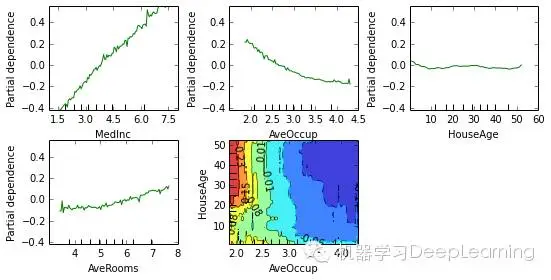
Scikit-learn provides a convenience function to create such plots: sklearn.ensemble.partial_dependence.plot_partial_dependence or a low-level function that you can use to create custom partial dependence plots (e.g. map overlays or 3d
Gradient Boosted Regression Trees 2的更多相关文章
- Facebook Gradient boosting 梯度提升 separate the positive and negative labeled points using a single line 梯度提升决策树 Gradient Boosted Decision Trees (GBDT)
https://www.quora.com/Why-do-people-use-gradient-boosted-decision-trees-to-do-feature-transform Why ...
- Gradient Boosted Regression
3.2.4.3.6. sklearn.ensemble.GradientBoostingRegressor class sklearn.ensemble.GradientBoostingRegress ...
- Gradient Boosting, Decision Trees and XGBoost with CUDA ——GPU加速5-6倍
xgboost的可以参考:https://xgboost.readthedocs.io/en/latest/gpu/index.html 整体看加速5-6倍的样子. Gradient Boosting ...
- Parallel Gradient Boosting Decision Trees
本文转载自:链接 Highlights Three different methods for parallel gradient boosting decision trees. My algori ...
- 关于Additive Ensembles of Regression Trees模型的快速打分预测
一.论文<QuickScorer:a Fast Algorithm to Rank Documents with Additive Ensembles of Regression Trees&g ...
- 机器学习技法:11 Gradient Boosted Decision Tree
Roadmap Adaptive Boosted Decision Tree Optimization View of AdaBoost Gradient Boosting Summary of Ag ...
- 机器学习技法笔记:11 Gradient Boosted Decision Tree
Roadmap Adaptive Boosted Decision Tree Optimization View of AdaBoost Gradient Boosting Summary of Ag ...
- 【Gradient Boosted Decision Tree】林轩田机器学习技术
GBDT之前实习的时候就听说应用很广,现在终于有机会系统的了解一下. 首先对比上节课讲的Random Forest模型,引出AdaBoost-DTree(D) AdaBoost-DTree可以类比Ad ...
- [11-3] Gradient Boosting regression
main idea:用adaboost类似的方法,选出g,然后选出步长 Gredient Boosting for regression: h控制方向,eta控制步长,需要对h的大小进行限制 对(x, ...
随机推荐
- 十步完全理解 SQL(转载)
英文出处:Lukas Eder. 很多程序员视 SQL 为洪水猛兽.SQL 是一种为数不多的声明性语言,它的运行方式完全不同于我们所熟知的命令行语言.面向对象的程序语言.甚至是函数语言(尽管有些人认为 ...
- 使用mysql profiling功能剖析单条查询
5.1版本开始引入show profile剖析单条语句功能,支持show profiles和show profile语句,参数have_profiling;控制是否开启: 查看是否支持这个功能(查询为 ...
- SQLite详解
一.新建SQLite操作类(继承SQLiteOpenHelper) public class SQLiteTest extends SQLiteOpenHelper { final static St ...
- HDU 1402:A * B Problem Plus
A * B Problem Plus Time Limit: 2000/1000 MS (Java/Others) Memory Limit: 65536/32768 K (Java/Other ...
- python抓取中文网页乱码通用解决方法
注:转载自http://www.cnpythoner.com/ 我们经常通过python做采集网页数据的时候,会碰到一些乱码问题,今天给大家分享一个解决网页乱码,尤其是中文网页的通用方法. 首页我们需 ...
- ExecutorService线程池讲解
ExecutorService 建立多线程的步骤: 1.定义线程类 class Handler implements Runnable{ } 2.建立ExecutorService线程池 Execut ...
- 无边框窗体、用户控件、Timer控件
一.无边框窗体1 最大化.最小化以及关闭按钮制作实际上就是更换点击前.指向时.点击时的图片 (1)将图片放在该文件夹的Debug中,获取图片的路径Application.StartupPath + & ...
- 关于MYSQL group by 分组按时间取最大值的实现方法!
类如 有一个帖子的回复表,posts( id , tid , subject , message , dateline ) , id 为 自动增长字段, tid为该回复的主题帖子的id(外键关联), ...
- 【leetcode❤python】263. Ugly Number
class Solution(object): def isUgly(self, num): if num<=0:return False comlist=[2 ...
- DirectX 3d 取景变换
在世界坐标系中,几何体和摄像机都是相对于世界坐标系定义的.但是当摄像机的位置和朝向任意时,投影变换及其它类型的变的就略显困难或效率不高.为了简化运算,我们将摄像机变的至世界坐标系原点,并将其旋转,使摄 ...