
HDU 4121 Xiangqi 我老了?
Xiangqi
Time Limit: 2000/1000 MS (Java/Others) Memory Limit: 32768/32768 K (Java/Others)
Total Submission(s): 3193 Accepted Submission(s): 780
Now we introduce some basic rules of Xiangqi. Xiangqi is played on a 10×9 board and the pieces are placed on the intersections (points). The top left point is (1,1) and the bottom right point is (10,9). There are two groups of pieces marked by black or red Chinese characters, belonging to the two players separately. During the game, each player in turn moves one piece from the point it occupies to another point. No two pieces can occupy the same point at the same time. A piece can be moved onto a point occupied by an enemy piece, in which case the enemy piece is "captured" and removed from the board. When the general is in danger of being captured by the enemy player on the enemy player’s next move, the enemy player is said to have "delivered a check". If the general's player can make no move to prevent the general's capture by next enemy move, the situation is called “checkmate”.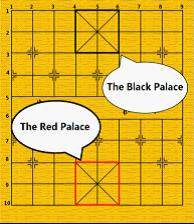
We only use 4 kinds of pieces introducing as follows: General: the generals can move and capture one point either vertically or horizontally and cannot leave the “palace” unless the situation called “flying general” (see the figure above). “Flying general” means that one general can “fly” across the board to capture the enemy general if they stand on the same line without intervening pieces.
 Chariot: the chariots can move and capture vertically and horizontally by any distance, but may not jump over intervening pieces
 Cannon: the cannons move like the chariots, horizontally and vertically, but capture by jumping exactly one piece (whether it is friendly or enemy) over to its target.
 Horse: the horses have 8 kinds of jumps to move and capture shown in the left figure. However, if there is any pieces lying on a point away from the horse horizontally or vertically it cannot move or capture in that direction (see the figure below), which is called “hobbling the horse’s leg”.
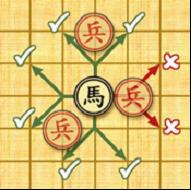
Now you are given a situation only containing a black general, a red general and several red chariots, cannons and horses, and the red side has delivered a check. Now it turns to black side’s move. Your job is to determine that whether this situation is “checkmate”.
There is a blank line between two test cases. The input ends by 0 0 0.
G 10 5
R 6 4
3 1 5
H 4 5
G 10 5
C 7 5
0 0 0
NO
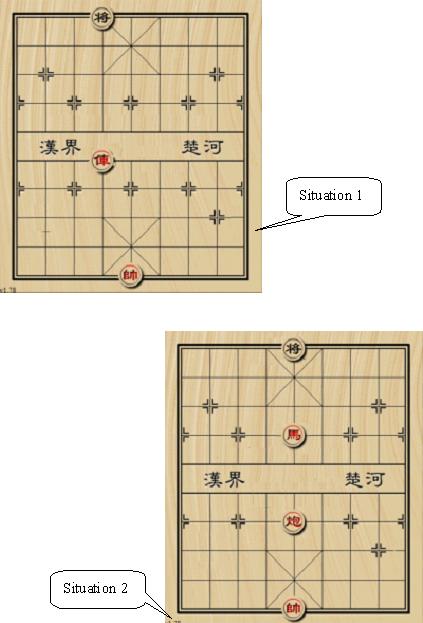
In the first situation, the black general is checked by chariot and “flying general”.
In the second situation, the black general can move to (1, 4) or (1, 6) to stop check.
See the figure above.

#include <iostream>

#include <stdio.h>

#include <string>

#include <string.h>

#include <algorithm>

#include <stdlib.h>

#include <math.h>

#include <vector>

#include <map>

using namespace std;

int d[][]={{,},{-,},{,},{,-}};

struct Node{

    int x;

    int y;

    char ch;

}node[];

char grid[][];

int n;

bool put[][];

bool cango(int x,int y){

   if(x<||x>||y<||y>)

     return ;

   return ;

}

bool judge(int x,int y){

    int i,j,xx,yy;

    for(i=;i<=n;i++){

        if(node[i].x==x&&node[i].y==y)

            continue;

       if(node[i].ch=='R'||node[i].ch=='G'){

           for(j=;j<;j++){

               xx=node[i].x+d[j][];

               yy=node[i].y+d[j][];

             while(cango(xx,yy)&&put[xx][yy]==){

               if(xx==x&&yy==y)

                  return ;

               xx+=d[j][];

               yy+=d[j][];

             }

           }

       }

       else if(node[i].ch=='C'){

           for(j=;j<;j++){

               xx=node[i].x+d[j][];

               yy=node[i].y+d[j][];

             while(cango(xx,yy)&&put[xx][yy]==){

               xx+=d[j][];

               yy+=d[j][];

             }

               xx+=d[j][];

               yy+=d[j][];

             while(cango(xx,yy)&&put[xx][yy]==){

               if(xx==x&&yy==y)

                  return ;

               xx+=d[j][];

               yy+=d[j][];

             }

           }

       }

       else if(node[i].ch=='H'){

           int X=node[i].x ,h_x;

           int Y=node[i].y ,h_y;

           if(cango(X-,Y)&&put[X-][Y]==){

              h_x=X-;

              h_y=Y+;

             if(cango(h_x,h_y)&&put[h_x][h_y]==){

                 if(h_x==x&&h_y==y)

                    return ;

             }

              h_x=X-;

              h_y=Y-;

             if(cango(h_x,h_y)&&put[h_x][h_y]==){

                 if(h_x==x&&h_y==y)

                  return ;

             }

           }

           if(cango(X+,Y)&&put[X+][Y]==){

              h_x=X+;

              h_y=Y+;

              if(cango(h_x,h_y)&&put[h_x][h_y]==){

                 if(h_x==x&&h_y==y)

                  return ;

              }

              h_x=X+;

              h_y=Y-;

              if(cango(h_x,h_y)&&put[h_x][h_y]==){

                 if(h_x==x&&h_y==y)

                  return ;

              }

           }

           if(cango(X,Y-)&&put[X][Y-]==){

              h_x=X+;

              h_y=Y-;

             if(cango(h_x,h_y)&&put[h_x][h_y]==){

                 if(h_x==x&&h_y==y)

                  return ;

              }

              h_x=X-;

              h_y=Y-;

             if(cango(h_x,h_y)&&put[h_x][h_y]==){

                 if(h_x==x&&h_y==y)

                  return ;

             }

           }

            if(cango(X,Y+)&&put[X][Y+]==){

              h_x=X+;

              h_y=Y+;

              if(cango(h_x,h_y)&&put[h_x][h_y]==){

                 if(h_x==x&&h_y==y)

                  return ;

             }

              h_x=X-;

              h_y=Y+;

              if(cango(h_x,h_y)&&put[h_x][h_y]==){

                 if(h_x==x&&h_y==y)

                  return ;

             }

           }

       }

     }

   return ;

}

int main(){

   int ch,i,j,xx,yy,x,y,flag,sum,f;

   while(scanf("%d%d%d",&n,&x,&y)){

       if(n==&&x==&&y==)

          break;

        memset(put,,sizeof(put));

        for(i=;i<=;i++)

          for(j=;j<=;j++)

             grid[i][j]='#';

       for(i=;i<=n;i++){

          cin>>node[i].ch>>node[i].x>>node[i].y;

          put[node[i].x][node[i].y]=;

          grid[node[i].x][node[i].y]=node[i].ch;

       }

       f=;

       xx=x;

       yy=y;

       while(cango(xx,yy)){

            xx+=;

          if(grid[xx][yy]=='G'){

               f=;

          }

          else  if(grid[xx][yy]!='#')

            break;

       }

       if(f){

          printf("NO\n");

          continue;

       }

       sum=flag=;

      for(i=;i<;i++){

         xx=x+d[i][];

         yy=y+d[i][];

         if(xx>=&&xx<=&&yy>=&&yy<=){

           sum++;

           put[xx][yy]=;

           if(judge(xx,yy))

              flag++;

           if(grid[xx][yy]!='#')

            put[xx][yy]=;

         }

      }

      //printf("sum %d   flag %d\n",sum,flag);

     if(flag==sum)

       printf("YES\n");

     else

       printf("NO\n");

   }

  return ;

}
13年

#include <iostream>

#include <string>

#include <string.h>

#include <map>

#include <stdio.h>

#include <algorithm>

#include <queue>

#include <vector>

#include <math.h>

#include <set>

#define Max(a,b) ((a)>(b)?(a):(b))

#define Min(a,b) ((a)<(b)?(a):(b))

#pragma comment(linker, "/STACK:16777216")

using namespace std ;

typedef long long LL ;

struct Point{  /*坐标点*/

       int X ;

       int Y ;

       Point(){} ;

       Point(int x,int y):X(x),Y(y){} ;

};

struct Chess{   /*棋子数据*/

     string S ;

     Point P ;

     Chess(){} ;

     Chess(string s ,Point p):S(s),P(p){} ;

};

class Man{   /*玩家*/

   private :

       static int d_horse[][] ;

       static int d_obstacle[][] ;

       int N ;

       int black_x ,black_y ;

       bool grid[][] ;

       vector<Chess> Genaral_Or_Che_Pao ;  //将 or 车 or 炮

       vector<Chess> Horse ;  //马

   public  :

             Man() ;

       void  read(vector<Chess> ,int ,int) ;

       int   cango(int,int) ;

       int   ok_genaral_or_che_pao() ;

       int   ok_horse()  ;

       int   win() ; //是否必胜

};

int Man::d_horse[][]={{-,-},{-,},{-,},{,},

                        {,-},{,},{-,-},{,-} } ;

int Man::d_obstacle[][]={{-,},{,},{,},{,-}};

Man::Man(){

}

int Man::cango(int x ,int y){

    return  <= x && x<=  &&  <= y && y <=  ;

}

void Man::read(vector<Chess> chess,int b_x ,int b_y){

    black_x = b_x ;

    black_y = b_y ;

    memset(grid,,sizeof(grid)) ;

    Genaral_Or_Che_Pao.clear() ;

    grid[black_x][black_y] =  ;

    string s ;

    int x ,y ;

    for(int i =  ;i < chess.size() ;i++){

        s = chess[i].S ;

        x = chess[i].P.X ;

        y = chess[i].P.Y ;

        if(x == black_x && y == black_y)

          continue ;

        grid[x][y] =  ;

        if(s == "H")

           Horse.push_back(chess[i]) ;

        else

           Genaral_Or_Che_Pao.push_back(chess[i]) ;

    }

}

int Man::ok_genaral_or_che_pao(){

   int x ,y ,L ,R ,k;

   string s ;

   for(int i =  ;i < Genaral_Or_Che_Pao.size() ;i++){

       x = Genaral_Or_Che_Pao[i].P.X ;

       y = Genaral_Or_Che_Pao[i].P.Y ;

       s = Genaral_Or_Che_Pao[i].S ;

       if(x == black_x){

          L = Min(y ,black_y) +  ;

          R = Max(y ,black_y) -  ;

          int dot =  ;

          for(k = L ;k <= R ;k++)

              dot += grid[x][k] ;

          if(dot ==  && s == "C")

             return  ;

          if(dot ==  && s!= "C")

             return  ;

       }

       if(y == black_y){

          L = Min(x ,black_x) +  ;

          R = Max(x ,black_x) -  ;

          int dot =  ;

          for(k = L ;k <= R ;k++)

              dot += grid[k][y] ;

          if(dot ==  && s == "C")

             return  ;

          if(dot ==  && s!= "C")

             return  ;

       }

   }

   return  ;

}

int Man::ok_horse(){

    int x ,y ,k ,x2 ,y2 ,x1,y1;

    for(int i =  ;i < Horse.size() ;i++){

       x = Horse[i].P.X ;

       y = Horse[i].P.Y ;

       for(k =  ;k <  ;k++){

           x2 = d_horse[k][] + x ;

           y2 = d_horse[k][] + y ;

           x1 = d_obstacle[k>>][] + x ;

           y1 = d_obstacle[k>>][] + y ;

           if(!cango(x2,y2)||!cango(x1,y1))

               continue  ;

           if(!grid[x1][y1] && black_x == x2 && black_y == y2)

              return  ;

       }

    }

    return  ;

}

int Man::win(){

    if(ok_genaral_or_che_pao())

       return  ;

    if(ok_horse())

       return  ;

    return  ;

}

class App{

  private :

     vector<Chess> chess ;

     bool mat[][] ;

     static int d[][] ;

     int N ;

     int black_x ;

     int black_y ;

     int red_x ;

     int red_y ;

  public  :

     App(){};

     App(int ,int ,int) ;

     int cango(int ,int) ;

     int judge() ;

     void read() ;

};

App::App(int n ,int x , int y):N(n),black_x(x),black_y(y){

    chess.clear() ;

    memset(mat,,sizeof(mat)) ;

};

int App::d[][]={{,},{-,},{,-},{,}} ;

int App::cango(int x ,int y){

    return  <= x && x<=  &&  <= y && y<=  ;

}

void App::read(){

    chess.clear() ;

    string s ;

    int x ,y ;

    for(int i =  ;i <= N ;i++){

        cin>>s>>x>>y ;

        mat[x][y] =  ;

        chess.push_back(Chess(s,Point(x,y))) ;

        if(s == "G"){

            red_x = x ;

            red_y = y ;

        }

    }

}

int App::judge(){

     if(black_y == red_y){   //黑方 将 直接 干死 红方 将

        int dot = ;

        for(int i = black_x +  ;i <= red_x- ;i++)

            dot += mat[i][red_y] ;

        if(dot == )

           return  ;

     }

     int sum =  ;

     for(int i =  ; i <  ;i++){   //黑方 将 四个方向逃跑

        int x = black_x + d[i][] ;

        int y = black_y + d[i][] ;

        if(!cango(x,y))

           continue ;

        Man red ;

        red.read(chess,x,y) ;   //传递数据,(x,y)为此时黑方的将

        if(!red.win())        //只要红方不能赢 则不是 死局

           return  ;

     }

     return  ;

}

int main(){

   int n ,x, y;

   while(cin>>n>>x>>y){

       if(n==&&x==&&y==)

          break ;

       App app(n,x,y) ;

       app.read() ;

       if(app.judge())

          puts("NO") ;

       else

          puts("YES") ;

   }

   return   ;

}
SR~046NDV.jpg)
HDU 4121 Xiangqi 我老了?的更多相关文章
- HDU 4121 Xiangqi 模拟题
Xiangqi Time Limit: 20 Sec Memory Limit: 256 MB 题目连接 http://acm.hdu.edu.cn/showproblem.php?pid=4121 ...
- HDU 4121 Xiangqi (算是模拟吧)
传送门:http://acm.hdu.edu.cn/showproblem.php?pid=4121 题意:中国象棋对决,黑棋只有一个将,红棋有一个帅和不定个车 马 炮冰给定位置,这时当黑棋走,问你黑 ...
- HDU 4121 Xiangqi --模拟
题意: 给一个象棋局势,问黑棋是否死棋了,黑棋只有一个将,红棋可能有2~7个棋,分别可能是车,马,炮以及帅. 解法: 开始写法是对每个棋子,都处理处他能吃的地方,赋为-1,然后判断将能不能走到非-1的 ...
- HDU 4121 Xiangqi
模拟吧,算是... 被这个题wa到哭,真是什么都不想说了...上代码 #include <iostream> #include <cstring> using namespac ...
- HDU 4121
http://www.bnuoj.com/v3/problem_show.php?pid=10277 //#pragma comment(linker, "/STACK:16777216&q ...
- HDU 4461:The Power of Xiangqi(水题)
http://acm.hdu.edu.cn/showproblem.php?pid=4461 题意:每个棋子有一个权值,给出红方的棋子情况,黑方的棋子情况,问谁能赢. 思路:注意“ if a play ...
- HDU 4461 The Power of Xiangqi (水题)
题意:给定一些字母,每个字母都代表一值,如果字母中没有B,或者C,那么就在总值大于1的条件下删除1,然后比较大小. 析:没什么好说的,加起来比较就好了. 代码如下: #pragma comment(l ...
- *HDU 2108 计算几何
Shape of HDU Time Limit: 3000/1000 MS (Java/Others) Memory Limit: 32768/32768 K (Java/Others)Tota ...
- hdu 1010 深搜+剪枝
深度搜索 剪枝 还不是很理解 贴上众神代码 //http://blog.csdn.net/vsooda/article/details/7884772#include<iostream> ...
随机推荐
- ajax用户名案例(重点)
要求:失去焦点时如下效果 主页代码 <body> 用户名:<input type="text" id="a" /><div i ...
- 按后退键退出Android程序
主要的目的是按后退键的时候,让程序能够退出. 实现起来的思路: 1.捕获后退键被按了这个事件. Java代码 @Override public boolean onKeyDown(int keyCo ...
- mongodb基本语句使用
mongodb学习:##mongodb基础##数据库常用命令##用户相关##修改.添加.删除集合数据##条件操作符##创建表 ------------------------------------- ...
- Linux下编译OpenSSL
编译环境 操作系统: Red Hat Enterprise Linux Server release 5.4 64-bit 编译工具: gcc (GCC) 4.1.2 20080704 (Red Ha ...
- 成功移植SQLite3到ARM Linux开发板
SQLite,是一款轻型的数据库,是遵守ACID的关联式数据库管理系统,它的设计目标是嵌入式的,而且目前已经在很多嵌入式产品中使用了它,它占用资源非常的低,在嵌入式设备中,可能只需要几百K的内存就够了 ...
- c++ 迭代器库
来自http://zh.cppreference.com/w/cpp/iterator 迭代器库提供了5种迭代器的定义,同时还提供了迭代器特征.适配器及其相关的工具函数. 迭代器共有5种:InputI ...
- 兼容所有浏览器---无缝上下左右交叉运动----原生js+css
<!doctype html> <html> <head> <meta charset="utf-8"> <title> ...
- butterknife 使用注意事项
写了个demo,一直报错 Caused by: java.lang.IllegalStateException: Required view 'tv1' with ID 2131492943 for ...
- VS 开发工具中的Remote Debug 功能远程调试程序经验分享
前言: 有时候我们Dev(开发人员)需要debug tester(测试人员)或者customer(客户)的环境,可tester的机器上没有Code,是不是有点着急? 而且是多版本应用且tester 发 ...
- IO - IOUtils
Commons IO is a library of utilities to assist with developing IO functionality. There are four main ...