
HDU 4121 Xiangqi 我老了?
Xiangqi
Time Limit: 2000/1000 MS (Java/Others) Memory Limit: 32768/32768 K (Java/Others)
Total Submission(s): 3193 Accepted Submission(s): 780
Now we introduce some basic rules of Xiangqi. Xiangqi is played on a 10×9 board and the pieces are placed on the intersections (points). The top left point is (1,1) and the bottom right point is (10,9). There are two groups of pieces marked by black or red Chinese characters, belonging to the two players separately. During the game, each player in turn moves one piece from the point it occupies to another point. No two pieces can occupy the same point at the same time. A piece can be moved onto a point occupied by an enemy piece, in which case the enemy piece is "captured" and removed from the board. When the general is in danger of being captured by the enemy player on the enemy player’s next move, the enemy player is said to have "delivered a check". If the general's player can make no move to prevent the general's capture by next enemy move, the situation is called “checkmate”.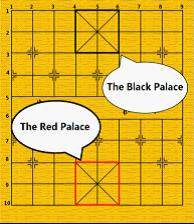
We only use 4 kinds of pieces introducing as follows: General: the generals can move and capture one point either vertically or horizontally and cannot leave the “palace” unless the situation called “flying general” (see the figure above). “Flying general” means that one general can “fly” across the board to capture the enemy general if they stand on the same line without intervening pieces.
 Chariot: the chariots can move and capture vertically and horizontally by any distance, but may not jump over intervening pieces
 Cannon: the cannons move like the chariots, horizontally and vertically, but capture by jumping exactly one piece (whether it is friendly or enemy) over to its target.
 Horse: the horses have 8 kinds of jumps to move and capture shown in the left figure. However, if there is any pieces lying on a point away from the horse horizontally or vertically it cannot move or capture in that direction (see the figure below), which is called “hobbling the horse’s leg”.
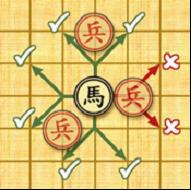
Now you are given a situation only containing a black general, a red general and several red chariots, cannons and horses, and the red side has delivered a check. Now it turns to black side’s move. Your job is to determine that whether this situation is “checkmate”.
There is a blank line between two test cases. The input ends by 0 0 0.
G 10 5
R 6 4
3 1 5
H 4 5
G 10 5
C 7 5
0 0 0
NO
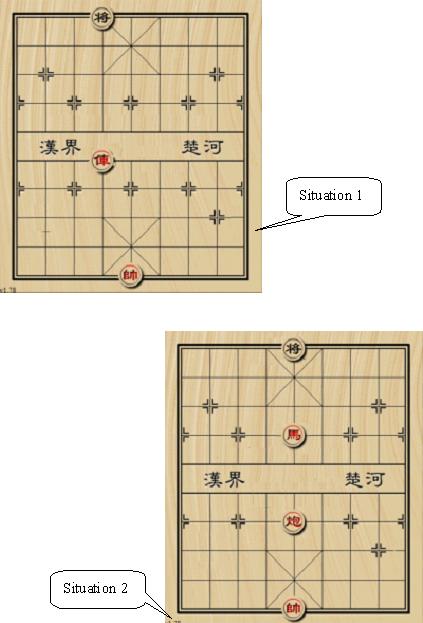
In the first situation, the black general is checked by chariot and “flying general”.
In the second situation, the black general can move to (1, 4) or (1, 6) to stop check.
See the figure above.

#include <iostream>

#include <stdio.h>

#include <string>

#include <string.h>

#include <algorithm>

#include <stdlib.h>

#include <math.h>

#include <vector>

#include <map>

using namespace std;

int d[][]={{,},{-,},{,},{,-}};

struct Node{

    int x;

    int y;

    char ch;

}node[];

char grid[][];

int n;

bool put[][];

bool cango(int x,int y){

   if(x<||x>||y<||y>)

     return ;

   return ;

}

bool judge(int x,int y){

    int i,j,xx,yy;

    for(i=;i<=n;i++){

        if(node[i].x==x&&node[i].y==y)

            continue;

       if(node[i].ch=='R'||node[i].ch=='G'){

           for(j=;j<;j++){

               xx=node[i].x+d[j][];

               yy=node[i].y+d[j][];

             while(cango(xx,yy)&&put[xx][yy]==){

               if(xx==x&&yy==y)

                  return ;

               xx+=d[j][];

               yy+=d[j][];

             }

           }

       }

       else if(node[i].ch=='C'){

           for(j=;j<;j++){

               xx=node[i].x+d[j][];

               yy=node[i].y+d[j][];

             while(cango(xx,yy)&&put[xx][yy]==){

               xx+=d[j][];

               yy+=d[j][];

             }

               xx+=d[j][];

               yy+=d[j][];

             while(cango(xx,yy)&&put[xx][yy]==){

               if(xx==x&&yy==y)

                  return ;

               xx+=d[j][];

               yy+=d[j][];

             }

           }

       }

       else if(node[i].ch=='H'){

           int X=node[i].x ,h_x;

           int Y=node[i].y ,h_y;

           if(cango(X-,Y)&&put[X-][Y]==){

              h_x=X-;

              h_y=Y+;

             if(cango(h_x,h_y)&&put[h_x][h_y]==){

                 if(h_x==x&&h_y==y)

                    return ;

             }

              h_x=X-;

              h_y=Y-;

             if(cango(h_x,h_y)&&put[h_x][h_y]==){

                 if(h_x==x&&h_y==y)

                  return ;

             }

           }

           if(cango(X+,Y)&&put[X+][Y]==){

              h_x=X+;

              h_y=Y+;

              if(cango(h_x,h_y)&&put[h_x][h_y]==){

                 if(h_x==x&&h_y==y)

                  return ;

              }

              h_x=X+;

              h_y=Y-;

              if(cango(h_x,h_y)&&put[h_x][h_y]==){

                 if(h_x==x&&h_y==y)

                  return ;

              }

           }

           if(cango(X,Y-)&&put[X][Y-]==){

              h_x=X+;

              h_y=Y-;

             if(cango(h_x,h_y)&&put[h_x][h_y]==){

                 if(h_x==x&&h_y==y)

                  return ;

              }

              h_x=X-;

              h_y=Y-;

             if(cango(h_x,h_y)&&put[h_x][h_y]==){

                 if(h_x==x&&h_y==y)

                  return ;

             }

           }

            if(cango(X,Y+)&&put[X][Y+]==){

              h_x=X+;

              h_y=Y+;

              if(cango(h_x,h_y)&&put[h_x][h_y]==){

                 if(h_x==x&&h_y==y)

                  return ;

             }

              h_x=X-;

              h_y=Y+;

              if(cango(h_x,h_y)&&put[h_x][h_y]==){

                 if(h_x==x&&h_y==y)

                  return ;

             }

           }

       }

     }

   return ;

}

int main(){

   int ch,i,j,xx,yy,x,y,flag,sum,f;

   while(scanf("%d%d%d",&n,&x,&y)){

       if(n==&&x==&&y==)

          break;

        memset(put,,sizeof(put));

        for(i=;i<=;i++)

          for(j=;j<=;j++)

             grid[i][j]='#';

       for(i=;i<=n;i++){

          cin>>node[i].ch>>node[i].x>>node[i].y;

          put[node[i].x][node[i].y]=;

          grid[node[i].x][node[i].y]=node[i].ch;

       }

       f=;

       xx=x;

       yy=y;

       while(cango(xx,yy)){

            xx+=;

          if(grid[xx][yy]=='G'){

               f=;

          }

          else  if(grid[xx][yy]!='#')

            break;

       }

       if(f){

          printf("NO\n");

          continue;

       }

       sum=flag=;

      for(i=;i<;i++){

         xx=x+d[i][];

         yy=y+d[i][];

         if(xx>=&&xx<=&&yy>=&&yy<=){

           sum++;

           put[xx][yy]=;

           if(judge(xx,yy))

              flag++;

           if(grid[xx][yy]!='#')

            put[xx][yy]=;

         }

      }

      //printf("sum %d   flag %d\n",sum,flag);

     if(flag==sum)

       printf("YES\n");

     else

       printf("NO\n");

   }

  return ;

}
13年

#include <iostream>

#include <string>

#include <string.h>

#include <map>

#include <stdio.h>

#include <algorithm>

#include <queue>

#include <vector>

#include <math.h>

#include <set>

#define Max(a,b) ((a)>(b)?(a):(b))

#define Min(a,b) ((a)<(b)?(a):(b))

#pragma comment(linker, "/STACK:16777216")

using namespace std ;

typedef long long LL ;

struct Point{  /*坐标点*/

       int X ;

       int Y ;

       Point(){} ;

       Point(int x,int y):X(x),Y(y){} ;

};

struct Chess{   /*棋子数据*/

     string S ;

     Point P ;

     Chess(){} ;

     Chess(string s ,Point p):S(s),P(p){} ;

};

class Man{   /*玩家*/

   private :

       static int d_horse[][] ;

       static int d_obstacle[][] ;

       int N ;

       int black_x ,black_y ;

       bool grid[][] ;

       vector<Chess> Genaral_Or_Che_Pao ;  //将 or 车 or 炮

       vector<Chess> Horse ;  //马

   public  :

             Man() ;

       void  read(vector<Chess> ,int ,int) ;

       int   cango(int,int) ;

       int   ok_genaral_or_che_pao() ;

       int   ok_horse()  ;

       int   win() ; //是否必胜

};

int Man::d_horse[][]={{-,-},{-,},{-,},{,},

                        {,-},{,},{-,-},{,-} } ;

int Man::d_obstacle[][]={{-,},{,},{,},{,-}};

Man::Man(){

}

int Man::cango(int x ,int y){

    return  <= x && x<=  &&  <= y && y <=  ;

}

void Man::read(vector<Chess> chess,int b_x ,int b_y){

    black_x = b_x ;

    black_y = b_y ;

    memset(grid,,sizeof(grid)) ;

    Genaral_Or_Che_Pao.clear() ;

    grid[black_x][black_y] =  ;

    string s ;

    int x ,y ;

    for(int i =  ;i < chess.size() ;i++){

        s = chess[i].S ;

        x = chess[i].P.X ;

        y = chess[i].P.Y ;

        if(x == black_x && y == black_y)

          continue ;

        grid[x][y] =  ;

        if(s == "H")

           Horse.push_back(chess[i]) ;

        else

           Genaral_Or_Che_Pao.push_back(chess[i]) ;

    }

}

int Man::ok_genaral_or_che_pao(){

   int x ,y ,L ,R ,k;

   string s ;

   for(int i =  ;i < Genaral_Or_Che_Pao.size() ;i++){

       x = Genaral_Or_Che_Pao[i].P.X ;

       y = Genaral_Or_Che_Pao[i].P.Y ;

       s = Genaral_Or_Che_Pao[i].S ;

       if(x == black_x){

          L = Min(y ,black_y) +  ;

          R = Max(y ,black_y) -  ;

          int dot =  ;

          for(k = L ;k <= R ;k++)

              dot += grid[x][k] ;

          if(dot ==  && s == "C")

             return  ;

          if(dot ==  && s!= "C")

             return  ;

       }

       if(y == black_y){

          L = Min(x ,black_x) +  ;

          R = Max(x ,black_x) -  ;

          int dot =  ;

          for(k = L ;k <= R ;k++)

              dot += grid[k][y] ;

          if(dot ==  && s == "C")

             return  ;

          if(dot ==  && s!= "C")

             return  ;

       }

   }

   return  ;

}

int Man::ok_horse(){

    int x ,y ,k ,x2 ,y2 ,x1,y1;

    for(int i =  ;i < Horse.size() ;i++){

       x = Horse[i].P.X ;

       y = Horse[i].P.Y ;

       for(k =  ;k <  ;k++){

           x2 = d_horse[k][] + x ;

           y2 = d_horse[k][] + y ;

           x1 = d_obstacle[k>>][] + x ;

           y1 = d_obstacle[k>>][] + y ;

           if(!cango(x2,y2)||!cango(x1,y1))

               continue  ;

           if(!grid[x1][y1] && black_x == x2 && black_y == y2)

              return  ;

       }

    }

    return  ;

}

int Man::win(){

    if(ok_genaral_or_che_pao())

       return  ;

    if(ok_horse())

       return  ;

    return  ;

}

class App{

  private :

     vector<Chess> chess ;

     bool mat[][] ;

     static int d[][] ;

     int N ;

     int black_x ;

     int black_y ;

     int red_x ;

     int red_y ;

  public  :

     App(){};

     App(int ,int ,int) ;

     int cango(int ,int) ;

     int judge() ;

     void read() ;

};

App::App(int n ,int x , int y):N(n),black_x(x),black_y(y){

    chess.clear() ;

    memset(mat,,sizeof(mat)) ;

};

int App::d[][]={{,},{-,},{,-},{,}} ;

int App::cango(int x ,int y){

    return  <= x && x<=  &&  <= y && y<=  ;

}

void App::read(){

    chess.clear() ;

    string s ;

    int x ,y ;

    for(int i =  ;i <= N ;i++){

        cin>>s>>x>>y ;

        mat[x][y] =  ;

        chess.push_back(Chess(s,Point(x,y))) ;

        if(s == "G"){

            red_x = x ;

            red_y = y ;

        }

    }

}

int App::judge(){

     if(black_y == red_y){   //黑方 将 直接 干死 红方 将

        int dot = ;

        for(int i = black_x +  ;i <= red_x- ;i++)

            dot += mat[i][red_y] ;

        if(dot == )

           return  ;

     }

     int sum =  ;

     for(int i =  ; i <  ;i++){   //黑方 将 四个方向逃跑

        int x = black_x + d[i][] ;

        int y = black_y + d[i][] ;

        if(!cango(x,y))

           continue ;

        Man red ;

        red.read(chess,x,y) ;   //传递数据,(x,y)为此时黑方的将

        if(!red.win())        //只要红方不能赢 则不是 死局

           return  ;

     }

     return  ;

}

int main(){

   int n ,x, y;

   while(cin>>n>>x>>y){

       if(n==&&x==&&y==)

          break ;

       App app(n,x,y) ;

       app.read() ;

       if(app.judge())

          puts("NO") ;

       else

          puts("YES") ;

   }

   return   ;

}
SR~046NDV.jpg)
HDU 4121 Xiangqi 我老了?的更多相关文章
- HDU 4121 Xiangqi 模拟题
Xiangqi Time Limit: 20 Sec Memory Limit: 256 MB 题目连接 http://acm.hdu.edu.cn/showproblem.php?pid=4121 ...
- HDU 4121 Xiangqi (算是模拟吧)
传送门:http://acm.hdu.edu.cn/showproblem.php?pid=4121 题意:中国象棋对决,黑棋只有一个将,红棋有一个帅和不定个车 马 炮冰给定位置,这时当黑棋走,问你黑 ...
- HDU 4121 Xiangqi --模拟
题意: 给一个象棋局势,问黑棋是否死棋了,黑棋只有一个将,红棋可能有2~7个棋,分别可能是车,马,炮以及帅. 解法: 开始写法是对每个棋子,都处理处他能吃的地方,赋为-1,然后判断将能不能走到非-1的 ...
- HDU 4121 Xiangqi
模拟吧,算是... 被这个题wa到哭,真是什么都不想说了...上代码 #include <iostream> #include <cstring> using namespac ...
- HDU 4121
http://www.bnuoj.com/v3/problem_show.php?pid=10277 //#pragma comment(linker, "/STACK:16777216&q ...
- HDU 4461:The Power of Xiangqi(水题)
http://acm.hdu.edu.cn/showproblem.php?pid=4461 题意:每个棋子有一个权值,给出红方的棋子情况,黑方的棋子情况,问谁能赢. 思路:注意“ if a play ...
- HDU 4461 The Power of Xiangqi (水题)
题意:给定一些字母,每个字母都代表一值,如果字母中没有B,或者C,那么就在总值大于1的条件下删除1,然后比较大小. 析:没什么好说的,加起来比较就好了. 代码如下: #pragma comment(l ...
- *HDU 2108 计算几何
Shape of HDU Time Limit: 3000/1000 MS (Java/Others) Memory Limit: 32768/32768 K (Java/Others)Tota ...
- hdu 1010 深搜+剪枝
深度搜索 剪枝 还不是很理解 贴上众神代码 //http://blog.csdn.net/vsooda/article/details/7884772#include<iostream> ...
随机推荐
- R(八): R分词统计-老九门
分析文本内容基本的步骤:提取文本中的词语 -> 统计词语频率 -> 词频属性可视化.词频:能反映词语在文本中的重要性,一般越重要的词语,在文本中出现的次数就会越多.词云:让词语的频率属性可 ...
- 【java】serialVersionUID作用
serialVersionUID适用于Java的序列化机制.简单来说,Java的序列化机制是通过判断类的serialVersionUID来验证版本一致性的.在进行反序列化时,JVM会把传来的字节流中的 ...
- innodb数据库批量转换表引擎为MyISAM
2013.0106 innodb数据库批量转换表引擎为MyISAM 来源:本站原创 PHP, 数据库, 系统技术 超过488名童鞋围观 1条评论 <?php //连接数据库 $host='lo ...
- 多线程编程之Linux环境下的多线程(三)
前面两篇文章都讲述了Linux环境下的多线程编程基础知识,也附带了典型实例.本文主要比较一下Linux环境与Windows环境下的多线程编程区别. 看待技术问题要瞄准其本质,不管是WIN32.Linu ...
- 剑指offer系列20--从上到下打印二叉树
* 20 [题目]从上往下打印出二叉树的每个节点,同层节点从左至右打印. * [思路]从根结点开始,先保存结点,再看根结点的左右结点有没有值. * 有,就将左右值放到集合中: * 根节点输出后,打印根 ...
- perl语言书籍教程推荐
互动出版网计算机频道.为您推荐关于perl语言的书籍教程.包括perl push.perl chomp以及perl python等perl语言内容. perl语言书籍一.<Perl语言编程 第四 ...
- 95. Unique Binary Search Trees II
Given an integer n, generate all structurally unique BST's (binary search trees) that store values 1 ...
- 49. Group Anagrams
Given an array of strings, group anagrams together. For example, given: ["eat", "tea& ...
- 单源最短路径——Floyd算法
正如我们所知道的,Floyd算法用于求最短路径.Floyd算法可以说是Warshall算法的扩展,三个for循环就可以解决问题,所以它的时间复杂度为O(n^3). Floyd算法的基本思想如下:从任意 ...
- 单源最短路径——dijkstra算法
dijkstra算法与prim算法的区别 1.先说说prim算法的思想: 众所周知,prim算法是一个最小生成树算法,它运用的是贪心原理(在这里不再证明),设置两个点集合,一个集合为要求的生成树的 ...