
MyBatis的增删改查。
数据库的经典操作:增删改查。
在这一章我们主要说明一下简单的查询和增删改,并且对程序接口做了一些调整,以及对一些问题进行了解答。
1、调整后的结构图:
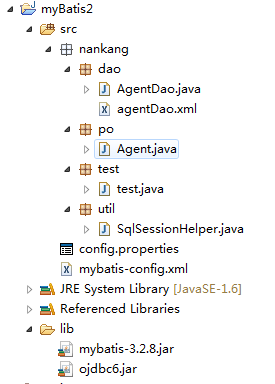
2、连接数据库文件配置分离:
一般的程序都会把连接数据库的配置单独放在.properties 文件中,然后在XML文件中引用,示例如下:
config.properties:
driver=oracle.jdbc.OracleDriver

url=jdbc:oracle:thin:@127.0.0.1:1521:orcl

username=phonesurvey

password=world
mybatis-config.xml:

<?xml version="1.0" encoding="UTF-8"?>

<!DOCTYPE configuration PUBLIC "-//mybatis.org//DTD Config 3.0//EN"

    "http://mybatis.org/dtd/mybatis-3-config.dtd">

<configuration>

    <properties resource="config.properties" />

    <environments default="development">

        <environment id="development">

            <transactionManager type="JDBC" />

            <dataSource type="POOLED">

                <property name="driver" value="${driver}"/>

                <property name="url" value="${url}"/>

                <property name="username" value="${username}"/>

                <property name="password" value="${password}"/>

            </dataSource>

        </environment>

    </environments>

    <mappers>

        <mapper resource="nankang/dao/agentDao.xml" />

    </mappers>

</configuration>
3、SqlSession分离:
SqlSeesion单独做成工具类,以便调用,示例如下:
SqlSessionHelper:
package nankang.util;

import java.io.InputStream;

import org.apache.ibatis.io.Resources;

import org.apache.ibatis.session.SqlSessionFactory;

import org.apache.ibatis.session.SqlSessionFactoryBuilder;

public class SqlSessionHelper {

    public static SqlSessionFactory getSessionFactory(){

        SqlSessionFactory sessionFactory = null;

        String resource= "mybatis-config.xml";

        try{

            InputStream inputStream = Resources.getResourceAsStream(resource);

            //Reader reader = Resources.getResourceAsReader(resource);

            sessionFactory = new SqlSessionFactoryBuilder().build(inputStream);

        }catch(Exception ex){

            ex.printStackTrace();

        }

        return sessionFactory;

    }

}
SqlSessionFactory创建时,根据Reader和InputStream都可以。
4、XML文件添加内容:
agentDao.xml:
<?xml version="1.0" encoding="UTF-8"?>

<!DOCTYPE mapper PUBLIC "-//mybatis.org//DTD Mapper 3.0//EN"

    "http://mybatis.org/dtd/mybatis-3-mapper.dtd">

<mapper namespace="nankang.dao.AgentDao">

    <!-- 根据Id查询 -->

    <select id="selectAgentById" parameterType="string" resultType="nankang.po.Agent">

        select * from Agent where AgentId=#{id}

    </select>

    <!-- 添加 -->

    <insert id="insertAgent" parameterType="nankang.po.Agent">

        insert into Agent(agentId, companyCode, LoginName, AgentPwd, AgentCode, Name, status,sysFlag)

        values(#{agentId},'SHNK',#{loginName},'D41D8CD98F00B204E9800998ECF8427E',#{agentCode},#{name},1,1)

    </insert>

    <!-- 删除 -->

    <delete id="deleteAgent" parameterType="string">

        delete from Agent where agentid=#{id}

    </delete>

    <!-- 修改 -->

    <update id="updateAgent" parameterType="nankang.po.Agent">

        update agent set name=#{name} where agentid=#{agentId}

    </update>

    <!-- 查询所有 -->

    <select id="selectAllAgent" resultType="nankang.po.Agent">

        select * from Agent

    </select>

    <!-- 查询所有无返回对象 -->

    <select id="selectAllAgent2" resultType="hashmap">

        select * from Agent

    </select>

</mapper>
AgentDao.java:
package nankang.dao;

import java.util.List;

import java.util.Map;

import nankang.po.Agent;

import org.apache.ibatis.annotations.Select;

public interface AgentDao {

    //根据Id查询

    public Agent selectAgentById(String Id);

    //根据名称查询

    @Select("select * from Agent where name=#{name}")

    public Agent selectAgentByName(String name);

    //添加

    public int insertAgent(Agent agent);

    //删除

    public int deleteAgent(String id);

    //修改

    public int updateAgent(Agent agent);

    //查询所有的

    public List<Agent> selectAllAgent();

    public List<Map<String, Object>> selectAllAgent2();

}
1、XML文件中的语句,可以直接写在接口文件中,如:根据名称查询;
2、其他参考示例。
几个问题说明:
1)如何查询数据集合?
使用ResultType设置,返回用List<T>即可
2)查询一条数据,如果为空,怎么判断?
如果没有查询到数据,返回为NULL,进行空对象判断即可
3)查询所有的集合,不放在构建对象的List中:
4)如何实现事务:
SqlSession:commit,rollback,close
5、测试
package nankang.test;

import java.util.List;

import java.util.Map;

import nankang.dao.AgentDao;

import nankang.util.SqlSessionHelper;

import org.apache.ibatis.session.SqlSession;

public class test {

    /**

     * @param args

     */

    public static void main(String[] args) {

        SqlSession sqlSession = SqlSessionHelper.getSessionFactory().openSession();

        try{

            AgentDao agentMapper = sqlSession.getMapper(AgentDao.class);

            //根据Id查询

//            Agent agent = agentMapper.selectAgentById("SHNKAG00000000051");

//            if(null != agent){

//                System.out.println(agent.getName());

//            }else{

//                System.out.println("不存在该用户");

//            }

//            agent = agentMapper.selectAgentByName("1001");

//            System.out.println(agent.getAgentId());

            //查询所有

            List<Map<String, Object>> agentList = agentMapper.selectAllAgent2();

            System.out.println(agentList.size());

            //添加

//            Format format = new SimpleDateFormat("00yyyyMMddhhmmss");

//            Calendar calendar = Calendar.getInstance();

//            String dateStr = format.format(calendar.getTime());

//            Agent agent = new Agent();

//            agent.setAgentId(dateStr);

//            agent.setLoginName("1111");

//            agent.setAgentCode("aaaa");

//            agent.setName("aaaa");

//            int num = agentMapper.insertAgent(agent);

//            System.out.println(num);

            //删除

//            int num = agentMapper.deleteAgent("0020150226093127");

//            System.out.println(num);

            //更新

//            Agent agent = new Agent();

//            agent.setAgentId("0020150226010005");

//            agent.setName("Test");

//            int num = agentMapper.updateAgent(agent);

//            System.out.println(num);

            //增删改,提交

            sqlSession.commit();

            System.out.println("完成");

        }catch(Exception ex){

            sqlSession.rollback();

            System.out.println(ex.getMessage());

        }finally{

            sqlSession.close();

        }

    }

}
这边需要注意的是:SqlSession一定要close
MyBatis的增删改查。的更多相关文章
- 学习MyBatis必知必会(5)~了解myBatis的作用域和生命周期并抽取工具类MyBatisUtil、mybatis执行增删改查操作
一.了解myBatis的作用域和生命周期[错误的使用会导致非常严重的并发问题] (1)SqlSessionFactoryBuilder [ 作用:仅仅是用来创建SqlSessionFactory,作用 ...
- MyBatis批量增删改查操作
前文我们介绍了MyBatis基本的增删该查操作,本文介绍批量的增删改查操作.前文地址:http://blog.csdn.net/mahoking/article/details/43673741 ...
- 上手spring boot项目(三)之spring boot整合mybatis进行增删改查的三种方式。
1.引入依赖. <!--springboot的web起步依赖--><dependency> <groupId>org.springframework.boot< ...
- 上手spring boot项目(三)之spring boot整合mybatis进行增删改查
使用mybatis框架进行增删改查大致有两种基础方式,一种扩展方式.两种基础方式分别是使用xml映射文件和使用方法注解.扩展方式是使用mybatis-plus的方式,其用法类似于spring-data ...
- 从0开始完成SpringBoot+Mybatis实现增删改查
1.准备知识: 1)需要掌握的知识: Java基础,JavaWeb开发基础,Spring基础(没有Spring的基础也可以,接触过Spring最好),ajax,Jquery,Mybatis. 2)项目 ...
- Spring Boot入门系列(六)如何整合Mybatis实现增删改查
前面介绍了Spring Boot 中的整合Thymeleaf前端html框架,同时也介绍了Thymeleaf 的用法.不清楚的朋友可以看看之前的文章:https://www.cnblogs.com/z ...
- Mybatis实例增删改查(二)
创建实体类: package com.test.mybatis.bean; public class Employee { private Integer id; private String las ...
- mybatis的增删改查返回值小析(六)
本文验证了通过mybatis访问数据库时的,增删改查的返回值情况. 直接看代码. 1.service层 /** *@Author: Administrator on 2020/3/12 15:15 * ...
- ssm 框架实现增删改查CRUD操作(Spring + SpringMVC + Mybatis 实现增删改查)
ssm 框架实现增删改查 SpringBoot 项目整合 一.项目准备 1.1 ssm 框架环境搭建 1.2 项目结构图如下 1.3 数据表结构图如下 1.4 运行结果 二.项目实现 1. Emplo ...
随机推荐
- hive的高级查询(group by、 order by、 join 、 distribute by、sort by、 clusrer by、 union all等)
查询操作 group by. order by. join . distribute by. sort by. clusrer by. union all 底层的实现 mapreduce 常见的聚合操 ...
- MySQL/MariaDB的锁
本文目录: 1.MariaDB/MySQL事务提交的方式 2.MariaDB/MySQL中的锁简介 2.1 不同存储引擎支持的锁级别 2.2 锁类型 2.3 锁兼容性 3.MyISAM的表级锁(loc ...
- Day4_生成器_三元表达式_列表解析_生成器表达式
生成器:在函数内部包含yield关键,那么该函数执行的结果就是生成器. 生成器就是迭代器. def func(): print('first') yield 111111 print('second' ...
- Retrofit 2.0 超能实践,完美支持Https传输
http://blog.csdn.NET/sk719887916/article/details/51597816 前阵子看到圈子里Retrofit 2.0,RxJava(Android), OkHt ...
- android点击返回键,如何做到不destory当前activity,只是stop。重新返回该activity的 时候可以直接使用,不需要创建新的activity实例
问题描述,如题目: android点击返回键,顺序执行 pause,stop,destory. 以至于想重新进入这个activity的时候还要重新执行onCreate()方法,那么如何解决不再重新执行 ...
- remove the nth node from the end of the list
problem description: remove the nth node from the end of the list for example: given: 1->2->3 ...
- ArcCore重构-Platform_Types.h实现辨析
AUTOSAR定义了一系列PlatformTypes,如uint8/uint16/uint32等等基本类型. It contains all platform dependent types and ...
- 重温《STL源码剖析》笔记 第五章
源码之前,了无秘密 ——侯杰 序列式容器 关联式容器 array(build in) RB-tree vector set heap map priority-queue multiset li ...
- 读《图解HTTP》有感-(了解web及网络基础)
写在前面 <图解HTTP>是由上野宣先生著,于均良先生译 闲暇之余!写写博文甚是高兴.如有不准确,望各位斧正.共同学习! 正文 HTTP协议是什么?能做什么? HTTP(超文本传输协议)实 ...
- 利用JavaScriptSerializer转json实用方法
项目中经常碰到需要输出的是json数据,使用JavaScriptSerializer转换,以前老的方法如下. JavaScriptSerializer jss = new JavaScriptSeri ...