
(线性回归)Liner Regression简单应用
警告:本文为小白入门学习笔记
数据连接:
数据集是(x(i),y(i))
x = load('ex2x.dat');

y = load('ex2y.dat');

plot(x, y, 'o');

假设函数(hypothesis function):

接下来用矩阵的形式表示x:
m = length(y); % store the number of training examples

x = [ones(m, 1), x]; % Add a column of ones to x

MATLAB实现:
function [jVal,gradient] = linerCost(theta)
x = load('ex2x.dat');
y = load('ex2y.dat');
m = length(y); % store the number of training examples
%x = [ones(m, 1), x]; % Add a column of ones to x
w = 0;
for i = 1:m
w = w + (theta(1) + theta(2) .* x(i) - y(i)).^2;
end
jVal = 1./2 .* m .* w;
gradient = zeros(2,1);
w = 0;
for i = 1:m
w = w + (theta(1) + theta(2) .* x(i) - y(i));
end
gradient(1) = w;
w = 0;
for i = 1:m
w = w + (theta(1) + theta(2) .* x(i) - y(i)).*x(i);
end
gradient(2) = w;
end
命令控制台:
>> options = optimset('GradObj','on','MaxIter',1000);
>> initialTheta = zeros(2,1);
>> [optTheta,functionVal,exitFlag] = fminunc(@costFunction,initialTheta ,options)
返回结果:
optTheta =
0.7502
0.0639
functionVal =
2.4677
exitFlag =
1
由于本案例只有一个feature,所以还可以在二维平面上查看结果,如果是高维度就无法看结果。

本实验中,theta的选择,和learning rate的选取都是由MATLAB自动实现的;
如果要自己手写
for i = 1:iter
theta = theta - X'*(X*theta-y)/m*alpha;
end
需要自己选取alpha,还有确定迭代的次数iter
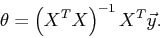
如果使用矩阵直接计算会更加快而且准确(对于本题而言):
入门菜鸟,错误地方欢迎指教!
补充
局部加权线性回归
如果是以下数据集

左图可以看出,这是一种欠拟合的现象,怎么才能使拟合的更好呢?
使用高斯核 的 局部加权线性回归
高斯函数是
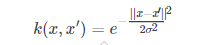
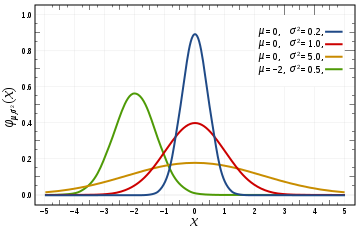
随着x与x′的距离的距离的增大,其高斯核函数值在单调递减。根据这个特点,可以对预测点在附近的每一点赋值,离预测点越近的点权重越大
用下面图说明
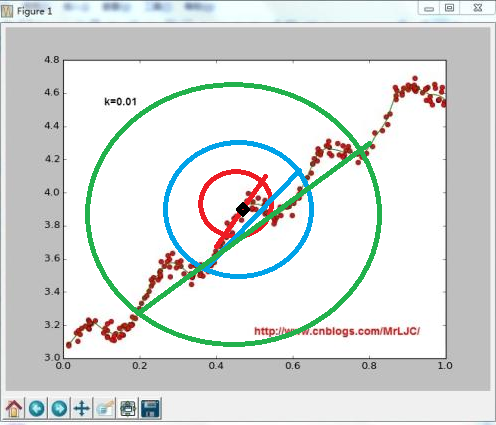
图中设黑色点是预测点,红色区域σ的值最小,随着σ的增大影响范围也在增大,而它的拟合曲线也在改变
所以可以通过改变σ的值来调整拟合的情况
整体来说,σ=1时把所有的点都包含,局部加权没有作用
当σ过小时会出现欠拟合现象
普通正规矩阵回归曲线
局部加权线性回归
岭回归
代码+注释
#coding=utf-8

from numpy import *

import matplotlib.pyplot as plt

#加载数据

def loadDataSet(fileName):

    numFeat = len(open(fileName).readline().split('\t')) - 1

    dataMat = []; labelMat = []

    fr = open(fileName)

    for line in fr.readlines():

        lineArr =[]

        curLine = line.strip().split('\t')

        for i in range(numFeat):

            lineArr.append(float(curLine[i]))

        dataMat.append(lineArr)

        labelMat.append(float(curLine[-1]))

    return dataMat,labelMat

#使用正规矩阵来计算回归系数w(w[0]是系数b,w[1]是斜率k)

def standRegres(xArr,yArr):

    xMat = mat(xArr); yMat = mat(yArr).T

    xTx = xMat.T*xMat

    #不可逆判断

    if linalg.det(xTx) == 0.0:

        print ("This matrix is singular, cannot do inverse")

        return

    ws = xTx.I * (xMat.T*yMat)

    return ws

#使用局部加权的线性回归

def lwlr(testPoint,xArr,yArr,k=1.0):

    xMat = mat(xArr); yMat = mat(yArr).T

    m = shape(xMat)[0]

    weights = mat(eye((m)))

    #为每一个样本点增加权重

    for j in range(m):

        diffMat = testPoint - xMat[j,:]

        #使用高斯核函数来加权

        weights[j,j] = exp(diffMat*diffMat.T/(-2.0*k**2))

    xTx = xMat.T * (weights * xMat)

    if linalg.det(xTx) == 0.0:

        print ("This matrix is singular, cannot do inverse")

        return

    ws = xTx.I * (xMat.T * (weights * yMat))

    return testPoint * ws

#循环测试每一个点testPoint

def lwlrTest(testArr,xArr,yArr,k=1.0):

    m = shape(testArr)[0]

    yHat = zeros(m)

    for i in range(m):

        yHat[i] = lwlr(testArr[i],xArr,yArr,k)

    return yHat

#岭回归

def rssError(yArr,yHatArr):

    return ((yArr-yHatArr)**2).sum()

def ridgeRegres(xMat,yMat,lam=0.2):

    xTx = xMat.T*xMat

    #增加一个m*m的单位矩阵乘lambda默认值是0.2

    denom = xTx + eye(shape(xMat)[1])*lam

    if linalg.det(denom) == 0.0:

        print ("This matrix is singular, cannot do inverse")

        return

    ws = denom.I * (xMat.T*yMat)

    return ws

#不断的调增lambd的取值(增加),测试结果

def ridgeTest(xArr,yArr):

    xMat = mat(xArr); yMat=mat(yArr).T

    yMean = mean(yMat,0)

    yMat = yMat - yMean     #to eliminate X0 take mean off of Y

    #regularize X's

    xMeans = mean(xMat,0)   #calc mean then subtract it off

    xVar = var(xMat,0)      #calc variance of Xi then divide by it

    xMat = (xMat - xMeans)/xVar

    numTestPts = 30

    wMat = zeros((numTestPts,shape(xMat)[1]))

    for i in range(numTestPts):

        ws = ridgeRegres(xMat,yMat,exp(i-10))

        wMat[i,:]=ws.T

    return wMat

#前向逐步向前线性回归

def regularize(xMat):#regularize by columns

    inMat = xMat.copy()

    inMeans = mean(inMat,0)   #calc mean then subtract it off

    inVar = var(inMat,0)      #calc variance of Xi then divide by it

    inMat = (inMat - inMeans)/inVar

    return inMat

def stageWise(xArr,yArr,eps=0.01,numIt=100):

    xMat = mat(xArr); yMat=mat(yArr).T

    yMean = mean(yMat,0)

    yMat = yMat - yMean     #can also regularize ys but will get smaller coef

    xMat = regularize(xMat)

    m,n=shape(xMat)

    #returnMat = zeros((numIt,n)) #testing code remove

    ws = zeros((n,1)); wsTest = ws.copy(); wsMax = ws.copy()

    for i in range(numIt):

        print ws.T

        lowestError = inf;

        for j in range(n):

            for sign in [-1,1]:

                wsTest = ws.copy()

                wsTest[j] += eps*sign

                yTest = xMat*wsTest

                rssE = rssError(yMat.A,yTest.A)

                if rssE < lowestError:

                    lowestError = rssE

                    wsMax = wsTest

        ws = wsMax.copy()

        returnMat[i,:]=ws.T

    return returnMat

def test1():

    xArr,yArr = loadDataSet('ex0.txt')

    ws = standRegres(xArr,yArr)

    xMat = mat(xArr)

    yMat = mat(yArr)

    yHat = xMat * ws

    #绘制数据集的散点图

    fig = plt.figure()

    ax = fig.add_subplot(111)

    ax.scatter(xMat[:,1].flatten().A[0],yMat.T[:,0].flatten().A[0])

    #绘制回归曲线

    xCopy = xMat.copy()

    xCopy.sort(0)

    yHat = xCopy * ws

    ax.plot(xCopy[:,1],yHat)

    plt.show()

#-------------分割线-----以上是普通线性回归曲线------------------------

def test2():

    xArr,yArr = loadDataSet('ex0.txt')

    print (yArr[0])

    #测试点xArr[0],在不同取值k下的ws

    lwlr(xArr[0],xArr,yArr,1.0)

    lwlr(xArr[0],xArr,yArr,0.001)

    #调整k的取值来获得不同的拟合曲线

    yHat = lwlrTest(xArr,xArr,yArr,0.003)

    xMat = mat(xArr)

    strInd = xMat[:,1].argsort(0)

    xSort = xMat[strInd][:,0,:]

    #绘制数据集的散点图

    fig = plt.figure()

    ax = fig.add_subplot(111)

    #绘制回归曲线

    ax.plot(xSort[:,1],yHat[strInd])

    ax.scatter(xMat[:,1].flatten().A[0],mat(yArr).T.flatten().A[0],s=2,c='red')

    plt.show()

#-------------分割线-----以上是局部加权线性回归曲线------------------------

def test3():

    abX,abY = loadDataSet('abalone.txt')

    ridgeWeights = ridgeTest(abX,abY)

    fig = plt.figure()

    ax = fig.add_subplot(111)

    #画出lambda的变化过程

    ax.plot(ridgeWeights)

    plt.show() #当lambda很小时,系数和普通回归一样,随着lambda增大,回归系数减小为零,可以在中间得到一个预测结果较好的lambda
(线性回归)Liner Regression简单应用的更多相关文章
- 机器学习(三)--------多变量线性回归(Linear Regression with Multiple Variables)
机器学习(三)--------多变量线性回归(Linear Regression with Multiple Variables) 同样是预测房价问题 如果有多个特征值 那么这种情况下 假设h表示 ...
- 机器学习方法:回归(一):线性回归Linear regression
欢迎转载,转载请注明:本文出自Bin的专栏blog.csdn.net/xbinworld. 开一个机器学习方法科普系列:做基础回顾之用,学而时习之:也拿出来与大家分享.数学水平有限,只求易懂,学习与工 ...
- 斯坦福CS229机器学习课程笔记 Part1:线性回归 Linear Regression
机器学习三要素 机器学习的三要素为:模型.策略.算法. 模型:就是所要学习的条件概率分布或决策函数.线性回归模型 策略:按照什么样的准则学习或选择最优的模型.最小化均方误差,即所谓的 least-sq ...
- ML 线性回归Linear Regression
线性回归 Linear Regression MOOC机器学习课程学习笔记 1 单变量线性回归Linear Regression with One Variable 1.1 模型表达Model Rep ...
- TensorFlow 学习笔记(1)----线性回归(linear regression)的TensorFlow实现
此系列将会每日持续更新,欢迎关注 线性回归(linear regression)的TensorFlow实现 #这里是基于python 3.7版本的TensorFlow TensorFlow是一个机器学 ...
- AI-IBM-cognitive class --Liner Regression
Liner Regression import matplotlib.pyplot as plt import pandas as pd import pylab as pl import numpy ...
- 通俗理解线性回归(Linear Regression)
线性回归, 最简单的机器学习算法, 当你看完这篇文章, 你就会发现, 线性回归是多么的简单. 首先, 什么是线性回归. 简单的说, 就是在坐标系中有很多点, 线性回归的目的就是找到一条线使得这些点都在 ...
- Stanford机器学习---第二讲. 多变量线性回归 Linear Regression with multiple variable
原文:http://blog.csdn.net/abcjennifer/article/details/7700772 本栏目(Machine learning)包括单参数的线性回归.多参数的线性回归 ...
- (三)用Normal Equation拟合Liner Regression模型
继续考虑Liner Regression的问题,把它写成如下的矩阵形式,然后即可得到θ的Normal Equation. Normal Equation: θ=(XTX)-1XTy 当X可逆时,(XT ...
随机推荐
- SpringBoot之文件下载
package org.springboot.controller; import org.springboot.constant.Constant; import org.springframewo ...
- 学习 Spring (八) 注解之 Bean 的定义及作用域
Spring入门篇 学习笔记 Classpath 扫描与组件管理 从 Spring 3.0 开始,Spring JavaConfig 项目提供了很多特性,包括使用 java 而不是 XML 定义 be ...
- Atcoder Beginner Contest 118 D-Match Matching(完全背包)
题目链接 题意就是给N根火柴,M个数(M只能是1到9,对应的数字也只能是1到9),只能用这M个出现过的数(但每个数可以随便用多少个,只要火柴够)来拼出一个数字(拼出1,2,3,4,5,6,7,8,9分 ...
- poj-2823(单调队列)
题意:给你长度位n的数组,问每个长度为m的段的最值: 解题思路:这道题是单调队列的入门题: #include<iostream> #include<algorithm> #in ...
- MySQL的my.cnf文件(解决5.7.18下没有my-default.cnf)
官网说:从5.7.18开始不在二进制包中提供my-default.cnf文件.参考:https://dev.mysql.com/doc/refman/5.7/en/binary-installatio ...
- BZOJ1398Vijos1382寻找主人 Necklace——最小表示法
题目描述 给定两个项链的表示,判断他们是否可能是一条项链. 输入 输入文件只有两行,每行一个由0至9组成的字符串,描述一个项链的表示(保证项链的长度是相等的). 输出 如果两条项链不可能同构,那么输出 ...
- POJ3261-Milk Patterns-后缀数组
可重叠重复k次的最长子串长度. 还是使用二分答案对heigh数组分组的做法. #include <cstdio> #include <algorithm> #include & ...
- python成长之路一
1,计算机基础 CPU:中央处理器,相当于人类的大脑,运算中心,控制中心. 内存:暂时储存数据,与CPU交互,8G,16G,32G,64G § 优点:读取速度快. § 缺点:容量小,造价高,断电即消失 ...
- Cash Machine POJ - 1276 多重背包二进制优化
题意:多重背包模型 n种物品 每个m个 问背包容量下最多拿多少 这里要用二进制优化不然会超时 #include<iostream> #include<cstdio> #in ...
- hashlib 模块用来进行hash
hashlib的基本概述: python中的 hashlib 模块用来进行hash 或者md5加密,而且这种加密是不可逆的,所以这种算法又被称为摘要算法, 其支持Opennssl库提供的所有算法,包括 ...