
SpEL、PropertyPlaceholderConfigurer与@Value、#{}、${}
概念
SpEL:Spring EL表达式
PropertyPlaceholderConfigurer:即org.springframework.beans.factory.config.PropertyPlaceholderConfigurer.java。我们通常通过配置一个PropertyPlaceholderConfigurer类型的bean,来将properties文件交给Spring来托管。
@Value、#{}、${}:通过@Value、#{}、${},可以读取受Spring托管的配置。(被托管的配置可能是properties文件、常量类的bean)
一、Spring EL表达式
EL表达式三个概念:
- 1. expression(表达式)
- 2. context(上下文)
- 3. root object(根对象)
Expression是从指定的上下文中获取相应的内容。
也就是说,Expression指定了要获取的property name,但还需要指定从什么地方获取该property value。
EL中可以从上下文context和root object中获取property value。
org.springframework.expression.Expression中提供了很多取property value的方法,如下几个比较重要:
从default standard context中获取property value
/**

 * Evaluate this expression in the default standard context.

 * @return the evaluation result

 * @throws EvaluationException if there is a problem during evaluation

 */

Object getValue() throws EvaluationException;
从指定的context中获取property value
/**

 * Evaluate this expression in the provided context and return the result of evaluation.

 * @param context the context in which to evaluate the expression

 * @return the evaluation result

 * @throws EvaluationException if there is a problem during evaluation

 */

Object getValue(EvaluationContext context) throws EvaluationException;
从指定的root object中获取property value
/**

 * Evaluate this expression against the specified root object

 * @param rootObject the root object against which properties/etc will be resolved

 * @return the evaluation result

 * @throws EvaluationException if there is a problem during evaluation

 */

Object getValue(Object rootObject) throws EvaluationException;
EL表达式的功能
| 英文 | 中文 |
|---|---|
| Literal expressions | 字面值表达式 |
| Boolean and relational operators | 布尔和关系操作符 |
| Regular expressions | 正则表达式 |
| Class expressions | 类表达式 |
| Accessing properties, arrays, lists, maps | 访问properties、arrays、lists、maps |
| Method invocation | 方法调用 |
| Relational operators | 关系操作符 |
| Assignment | 赋值 |
| Calling constructors | 调用构造器 |
| Bean references | bean引用 |
| Array construction | 构建数组 |
| Inline lists | 内联lists |
| Inline maps | 内联maps |
| Ternary operator | 三元操作符 |
| Variables | 变量 |
| User defined functions | 用户定义的功能 |
| Collection projection | 集合投影 |
| Collection selection | 集合选择 |
| Templated expressions | 模板化表达式 |
参考:
[1]http://www.cnblogs.com/larryzeal/p/5964621.html
[2]http://docs.spring.io/spring/docs/current/spring-framework-reference/htmlsingle/#expressions
二、 @Value、#{}、${}
http://www.cnblogs.com/larryzeal/p/5910149.html
Spring的属性注入,都依赖属性文件是受Spring容器管理的。
可以这么说,想要使用Spring的功能,那么,你的资源(实体、类、资源文件等)都必需受Spring容器的管理。当然,properties文件也不例外。
Spring对#{}和${}的支持,是通过org.springframework.expression.common.TemplateAwareExpressionParser来实现的。
public Expression parseExpression(String expressionString, ParserContext context)

        throws ParseException {

    if (context == null) {

        context = NON_TEMPLATE_PARSER_CONTEXT;

    }

    if (context.isTemplate()) { // 按${}来处理

        return parseTemplate(expressionString, context);

    }

    else { // 按#{}来处理,即使用EL表达式来处理

        return doParseExpression(expressionString, context);

    }

}
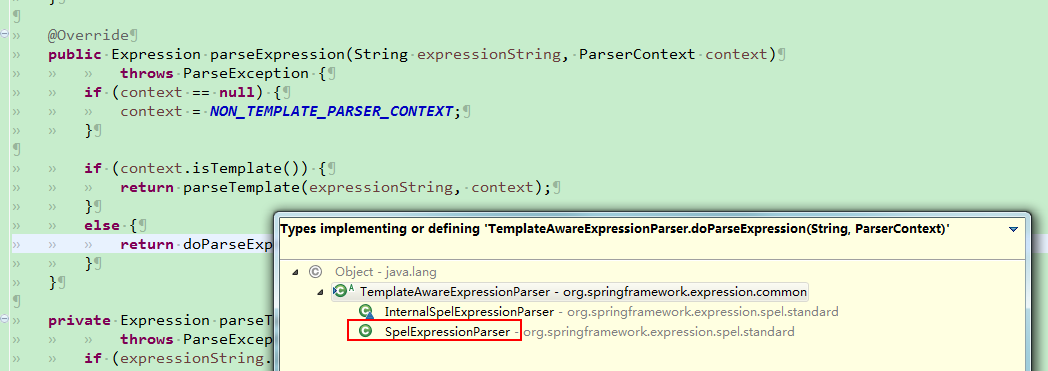
EL对应的解析器:StandardBeanExpressionResolver
要将配置文件给Spring管理的话,一般会使用如下配置:
<bean id="propertyConfigurer"

    class="org.springframework.beans.factory.config.PropertyPlaceholderConfigurer">

    <property name="locations">

        <list>

            <value>classpath:/props/jdbc.properties</value>

        </list>

    </property>

</bean>
这样我们就能在Spring环境下来使用它了。
@Value
@Value的值有两类:
- ① ${ property : default_value }
- ② #{ obj.property? : default_value }
就是说,第一个注入的是参数对应的property,第二个则是SpEL表达式对应的内容。 那个 default_value,就是前面的值为空时的默认值。注意二者的不同。
${key}
取properties文件中key对应的value。本质上是取PropertyPlaceholderConfigurer这个bean中的key对应的value。
#{object.field}
#是SpEl表达式,它取的是对象的属性。注意,这个对象object必需是Spring的Bean。
#{'${key}'}
$与#可以结合起来一起使用。可以参看例子:com.cn.kvn.framework.property_test.spel.SpelDomain.java
SpEL、PropertyPlaceholderConfigurer与@Value、#{}、${}的更多相关文章
- Spring 使用介绍(四)—— SpEL
一.SpEL介绍 Spring表达式语言全称为“Spring Expression Language”,缩写为“SpEL”,可在运行时构建复杂表达式 使用步骤: 1)创建解析器:ExpressionP ...
- Spring学习记录(七)---表达式语言-SpEL
SpEL---Spring Expression Language:是一个支持运行时查询和操作对象图表达式语言.使用#{...}作为定界符,为bean属性动态赋值提供了便利. ①对于普通的赋值,用Sp ...
- PropertiesFactoryBean PropertyPlaceholderConfigurer 区别
正如 stackoverflow上说的,PropertiesFactoryBean 是PropertiesLoaderSupport 直接的实现类, 专门用来管理properties文件的工厂bean ...
- Spring PropertyPlaceholderConfigurer数据库配置
pom.xml中添加依赖 <!-- mysql-connector-java --> <dependency> <groupId>mysql</groupId ...
- spring-表达式语言-SpEL【转】
Spring表达式语言(Spring Expression Language)简称:SpEL 课程概要: Spring表达式语言的入门介绍 Spring表达式语言的操作范围 Spring表达式语言的运 ...
- spring的多个PropertyPlaceholderConfigurer实例装配的问题
1. 默认情况下,使用PropertyPlaceholderConfigurer多实例装配出现异常 在项目中尝试 在不同的spring的配置文件中分别引入相应的properties文件,这样会在spr ...
- Spring中的SPEL
src\dayday\Person.java package dayday;/** * Created by I am master on 2016/11/28. */public class Per ...
- Spring里PropertyPlaceholderConfigurer类的使用
1. PropertyPlaceholderConfigurer是个bean工厂后置处理器的实现,也就是 BeanFactoryPostProcessor接口的一个实现.PropertyPlaceho ...
- spring spel
•Spring 表达式语言(简称SpEL):是一个支持运行时查询和操作对象图的强大的表达式语言. •语法类似于 EL:SpEL 使用 #{…} 作为定界符,所有在大框号中的字符都将被认为是 SpE ...
随机推荐
- html5的UI框架
http://www.idangero.us/framework7/ http://goratchet.com/ http://cnratchet.com/ http://amazeui.org/ h ...
- hadoop3.0.0测验
下载地址: hadoop: http://mirrors.hust.edu.cn/apache/hadoop/common/hadoop-3.0.0/ 准备工作: 1.master节点与其他节点需要建 ...
- add new row to data.frame/dataframe
df<-NULL new_row<-data.frame(colA="xxx",colB=123) df<-rbind(df,new_row)
- Chrome 各版本下载集合
Windows平台: Chrome 在线安装包: 最新稳定版(Stable Channel)Chrome在线安装: [点击这里] 最新测试版(Beta Channel)Chrome在线安装: [点击这 ...
- 使用 pv 命令监控 linux 命令的执行进度
如果你是一个 linux 系统管理员,那么毫无疑问你必须花费大量的工作时间在命令行上:安装和卸载软件,监视系统状态,复制.移动.删除文件,查错,等等.很多时候都是你输入一个命令,然后等待很长时间直到执 ...
- Linux之查看切换Shell
1.查看存在的shell cat /etc/shells 2.查看使用的shell echo $SHELL 3.切换shell 切换bash chsh -s /bin/bash 切换zsh chsh ...
- OpenGL 阴影之Shadow Mapping和Shadow Volumes
先说下开发环境.VS2013,C++空项目,引用glut,glew.glut包含基本窗口操作,免去我们自己新建win32窗口一些操作.glew使我们能使用最新opengl的API,因winodw本身只 ...
- e770. 确定按钮租中已选的单选按钮
When you ask a button group for the currently selected radio button, it returns the selected radio b ...
- Cisco交换机配置VLAN
Cisco IOS中有两种方式创建vlan,在全局模式下使用vlan vlanid命令,如switch(config)#vlan 10; 在vlan database 下创建vlan ,如 switc ...
- HTTP 错误 500.19 配置文件错误 ( 0x8007000d,0x80070032)
HTTP 错误 500.19 - Internal Server Error无法访问请求的页面,因为该页的相关配置数据无效. 详细错误信息模块 IIS Web Core 通知 未知 处理程序 尚未确定 ...