
Spring(AbstractRoutingDataSource)实现动态数据源切换
转自: http://blog.51cto.com/linhongyu/1615895
一、前言
近期一项目A需实现数据同步到另一项目B数据库中,在不改变B项目的情况下,只好选择项目A中切换数据源,直接把数据写入项目B的数据库中。这种需求,在数据同步与定时任务中经常需要。
那么问题来了,该如何解决多数据源问题呢?不光是要配置多个数据源,还得能灵活动态的切换数据源。以spring+hibernate框架项目为例(引用:http://blog.csdn.net/wangpeng047/article/details/8866239博客的图片):

单个数据源绑定给sessionFactory,再在Dao层操作,若多个数据源的话,那不是就成了下图:
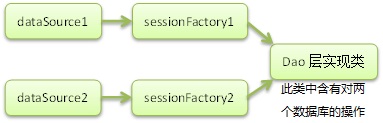
可见,sessionFactory都写死在了Dao层,若我再添加个数据源的话,则又得添加一个sessionFactory。所以比较好的做法应该是下图:
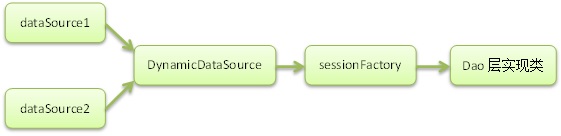
接下来就为大家讲解下如何用spring来整合这些数据源,同样以spring+hibernate配置为例。
二、实现原理
1、扩展Spring的AbstractRoutingDataSource抽象类(该类充当了DataSource的路由中介, 能有在运行时, 根据某种key值来动态切换到真正的DataSource上。)
从AbstractRoutingDataSource的源码中:
public abstract class AbstractRoutingDataSource extends AbstractDataSource implements InitializingBean
我们可以看到,它继承了AbstractDataSource,而AbstractDataSource不就是javax.sql.DataSource的子类,So我们可以分析下它的getConnection方法:
 public Connection getConnection() throws SQLException {

     return determineTargetDataSource().getConnection();

 }

 public Connection getConnection(String username, String password) throws SQLException {

      return determineTargetDataSource().getConnection(username, password);

 }
获取连接的方法中,重点是determineTargetDataSource()方法,看源码:
 /**

      * Retrieve the current target DataSource. Determines the

      * {@link #determineCurrentLookupKey() current lookup key}, performs

      * a lookup in the {@link #setTargetDataSources targetDataSources} map,

      * falls back to the specified

      * {@link #setDefaultTargetDataSource default target DataSource} if necessary.

      * @see #determineCurrentLookupKey()

      */

     protected DataSource determineTargetDataSource() {

         Assert.notNull(this.resolvedDataSources, "DataSource router not initialized");

         Object lookupKey = determineCurrentLookupKey();

         DataSource dataSource = this.resolvedDataSources.get(lookupKey);

         if (dataSource == null && (this.lenientFallback || lookupKey == null)) {

             dataSource = this.resolvedDefaultDataSource;

         }

         if (dataSource == null) {

             throw new IllegalStateException("Cannot determine target DataSource for lookup key [" + lookupKey + "]");

         }

         return dataSource;

     }
上面这段源码的重点在于determineCurrentLookupKey()方法,这是AbstractRoutingDataSource类中的一个抽象方法,而它的返回值是你所要用的数据源dataSource的key值,有了这个key值,resolvedDataSource(这是个map,由配置文件中设置好后存入的)就从中取出对应的DataSource,如果找不到,就用配置默认的数据源。
看完源码,应该有点启发了吧,没错!你要扩展AbstractRoutingDataSource类,并重写其中的determineCurrentLookupKey()方法,来实现数据源的切换:
 package com.datasource.test.util.database;

 import org.springframework.jdbc.datasource.lookup.AbstractRoutingDataSource;

 /**

  * 获取数据源(依赖于spring)

  * @author linhy

  */

 public class DynamicDataSource extends AbstractRoutingDataSource{

     @Override

     protected Object determineCurrentLookupKey() {

         return DataSourceHolder.getDataSource();

     }

 }
DataSourceHolder这个类则是我们自己封装的对数据源进行操作的类:
 package com.datasource.test.util.database;

 /**

  * 数据源操作

  * @author linhy

  */

 public class DataSourceHolder {

     //线程本地环境

     private static final ThreadLocal<String> dataSources = new ThreadLocal<String>();

     //设置数据源

     public static void setDataSource(String customerType) {

         dataSources.set(customerType);

     }

     //获取数据源

     public static String getDataSource() {

         return (String) dataSources.get();

     }

     //清除数据源

     public static void clearDataSource() {

         dataSources.remove();

     }

 }
2、有人就要问,那你setDataSource这方法是要在什么时候执行呢?当然是在你需要切换数据源的时候执行啦。手动在代码中调用写死吗?这是多蠢的方法,当然要让它动态咯。所以我们可以应用spring aop来设置,把配置的数据源类型都设置成为注解标签,在service层中需要切换数据源的方法上,写上注解标签,调用相应方法切换数据源咯(就跟你设置事务一样):
 @DataSource(name=DataSource.slave1)

 public List getProducts(){
当然,注解标签的用法可能很少人用到,但它可是个好东西哦,大大的帮助了我们开发:
 package com.datasource.test.util.database;

 import java.lang.annotation.*;

 @Target({ElementType.METHOD, ElementType.TYPE})

 @Retention(RetentionPolicy.RUNTIME)

 @Documented

 public @interface DataSource {

     String name() default DataSource.master;

     public static String master = "dataSource1";

     public static String slave1 = "dataSource2";

     public static String slave2 = "dataSource3";

 }
三、配置文件
为了精简篇幅,省略了无关本内容主题的配置。
项目中单独分离出application-database.xml,关于数据源配置的文件。
 <?xml version="1.0" encoding="UTF-8"?>

 <!-- Spring 数据库相关配置 放在这里 -->

 <beans xmlns="http://www.springframework.org/schema/beans"

        xmlns:xsi="http://www.w3.org/2001/XMLSchema-instance"

        xmlns:aop="http://www.springframework.org/schema/aop"

        xmlns:tx="http://www.springframework.org/schema/tx"

        xsi:schemaLocation="http://www.springframework.org/schema/beans

        http://www.springframework.org/schema/beans/spring-beans.xsd

        http://www.springframework.org/schema/aop

         http://www.springframework.org/schema/aop/spring-aop-3.0.xsd

         http://www.springframework.org/schema/tx

         http://www.springframework.org/schema/tx/spring-tx-3.0.xsd">

     <bean id = "dataSource1" class = "com.mysql.jdbc.jdbc2.optional.MysqlDataSource">

         <property name="url" value="${db1.url}"/>

         <property name = "user" value = "${db1.user}"/>

         <property name = "password" value = "${db1.pwd}"/>

         <property name="autoReconnect" value="true"/>

         <property name="useUnicode"  value="true"/>

         <property name="characterEncoding" value="UTF-8"/>

     </bean>

     <bean id = "dataSource2" class = "com.mysql.jdbc.jdbc2.optional.MysqlDataSource">

         <property name="url" value="${db2.url}"/>

         <property name = "user" value = "${db2.user}"/>

         <property name = "password" value = "${db2.pwd}"/>

         <property name="autoReconnect" value="true"/>

         <property name="useUnicode"  value="true"/>

         <property name="characterEncoding" value="UTF-8"/>

     </bean>

     <bean id = "dataSource3" class = "com.mysql.jdbc.jdbc2.optional.MysqlDataSource">

         <property name="url" value="${db3.url}"/>

         <property name = "user" value = "${db3.user}"/>

         <property name = "password" value = "${db3.pwd}"/>

         <property name="autoReconnect" value="true"/>

         <property name="useUnicode"  value="true"/>

         <property name="characterEncoding" value="UTF-8"/>

     </bean>

     <!-- 配置多数据源映射关系 -->

     <bean id="dataSource" class="com.datasource.test.util.database.DynamicDataSource">

         <property name="targetDataSources">

             <map key-type="java.lang.String">

         <entry key="dataSource1" value-ref="dataSource1"></entry>

                 <entry key="dataSource2" value-ref="dataSource2"></entry>

                 <entry key="dataSource3" value-ref="dataSource3"></entry>

             </map>

         </property>

     <!-- 默认目标数据源为你主库数据源 -->

         <property name="defaultTargetDataSource" ref="dataSource1"/>

     </bean>

     <bean id="sessionFactoryHibernate" class="org.springframework.orm.hibernate3.LocalSessionFactoryBean">

         <property name="dataSource" ref="dataSource"/>

         <property name="hibernateProperties">

             <props>

                 <prop key="hibernate.dialect">com.datasource.test.util.database.ExtendedMySQLDialect</prop>

                 <prop key="hibernate.show_sql">${SHOWSQL}</prop>

                 <prop key="hibernate.format_sql">${SHOWSQL}</prop>

                 <prop key="query.factory_class">org.hibernate.hql.classic.ClassicQueryTranslatorFactory</prop>

                 <prop key="hibernate.connection.provider_class">org.hibernate.connection.C3P0ConnectionProvider</prop>

                 <prop key="hibernate.c3p0.max_size">30</prop>

                 <prop key="hibernate.c3p0.min_size">5</prop>

                 <prop key="hibernate.c3p0.timeout">120</prop>

                 <prop key="hibernate.c3p0.idle_test_period">120</prop>

                 <prop key="hibernate.c3p0.acquire_increment">2</prop>

                 <prop key="hibernate.c3p0.validate">true</prop>

                 <prop key="hibernate.c3p0.max_statements">100</prop>

             </props>

         </property>

     </bean>

     <bean id="hibernateTemplate" class="org.springframework.orm.hibernate3.HibernateTemplate">

         <property name="sessionFactory" ref="sessionFactoryHibernate"/>

     </bean>

     <bean id="dataSourceExchange" class="com.datasource.test.util.database.DataSourceExchange"/>

     <bean id="transactionManager" class="org.springframework.orm.hibernate3.HibernateTransactionManager">

         <property name="sessionFactory" ref="sessionFactoryHibernate"/>

     </bean>

     <tx:advice id="txAdvice" transaction-manager="transactionManager">

         <tx:attributes>

             <tx:method name="insert*" propagation="NESTED" rollback-for="Exception"/>

             <tx:method name="add*" propagation="NESTED" rollback-for="Exception"/>

             <tx:method name="update*" propagation="NESTED" rollback-for="Exception"/>

             <tx:method name="modify*" propagation="NESTED" rollback-for="Exception"/>

             <tx:method name="edit*" propagation="NESTED" rollback-for="Exception"/>

             <tx:method name="del*" propagation="NESTED" rollback-for="Exception"/>

             <tx:method name="save*" propagation="NESTED" rollback-for="Exception"/>

             <tx:method name="send*" propagation="NESTED" rollback-for="Exception"/>

             <tx:method name="get*" read-only="true"/>

             <tx:method name="find*" read-only="true"/>

             <tx:method name="query*" read-only="true"/>

             <tx:method name="search*" read-only="true"/>

             <tx:method name="select*" read-only="true"/>

             <tx:method name="count*" read-only="true"/>

         </tx:attributes>

     </tx:advice>

     <aop:config>

         <aop:pointcut id="service" expression="execution(* com.datasource..*.service.*.*(..))"/>

         <!-- 关键配置,切换数据源一定要比持久层代码更先执行(事务也算持久层代码) -->

         <aop:advisor advice-ref="txAdvice" pointcut-ref="service" order="2"/>

         <aop:advisor advice-ref="dataSourceExchange" pointcut-ref="service" order="1"/>

     </aop:config>

 </beans>
四、疑问
多数据源切换是成功了,但牵涉到事务呢?单数据源事务是ok的,但如果多数据源需要同时使用一个事务呢?这个问题有点头大,网络上有人提出用atomikos开源项目实现JTA分布式事务处理。你怎么看?
五、dataSourceExchange 是怎样写的?
dataSourceExchange对应的类可以实现接口org.aopalliance.intercept.MethodInterceptor的invoke方法|@|@Override|@|public Object invoke(MethodInvocation invocation) throws Throwable {|@| DataSource dataSource = invocation.getMethod().getAnnotation(DataSource.class); |@| DataSourceHolder.setDataSource(dataSource.name());|@| try {|@| invocation.proceed();|@| } catch (Exception ex) { |@| }|@| return null;|@|}|@|pointcut的expression也可以写成@annotation(com.xxx.DataSource)|@|使用的时候,只需要在方法上加上注解@DataSource就行了|@|@DataSource(name = DataSource.slave1)|@|public void insert(String name) {|@|}
Spring(AbstractRoutingDataSource)实现动态数据源切换的更多相关文章
- Spring(AbstractRoutingDataSource)实现动态数据源切换--转载
原始出处:http://linhongyu.blog.51cto.com/6373370/1615895 一.前言 近期一项目A需实现数据同步到另一项目B数据库中,在不改变B项目的情况下,只好选择项目 ...
- spring AbstractRoutingDataSource实现动态数据源切换
使用Spring 提供的 AbstractRoutingDataSource 实现 创建 AbstractRoutingDataSource 实现类,负责保存所有数据源与切换数据源策略:public ...
- SpringMVC 利用AbstractRoutingDataSource实现动态数据源切换
SpringMVC 利用AbstractRoutingDataSource实现动态数据源切换 本文转载至:http://exceptioneye.iteye.com/blog/1698064 Spri ...
- AbstractRoutingDataSource 实现动态数据源切换原理简单分析
AbstractRoutingDataSource 实现动态数据源切换原理简单分析 写在前面,项目中用到了动态数据源切换,记录一下其运行机制. 代码展示 下面列出一些关键代码,后续分析会用到 数据配置 ...
- dubbo服务+Spring事务+AOP动态数据源切换 出错
1:问题描述,以及分析 项目用了spring数据源动态切换,服务用的是dubbo.在运行一段时间后程序异常,更新操作没有切换到主库上. 这个问题在先调用读操作后再调用写操作会出现. 经日志分析原因: ...
- AbstractRoutingDataSource实现动态数据源切换 专题
需求:系统中要实现切换数据库(业务数据库和his数据库) 网上很多资料上有提到AbstractRoutingDataSource,大致是这么说的 在Spring 2.0.1中引入了AbstractRo ...
- 利用AbstractRoutingDataSource实现动态数据源切换
需求:系统中要实现切换数据库(业务数据库和his数据库) 网上很多资料上有提到AbstractRoutingDataSource,大致是这么说的 在Spring 2.0.1中引入了AbstractRo ...
- Spring 实现动态数据源切换--转载 (AbstractRoutingDataSource)的使用
[参考]Spring(AbstractRoutingDataSource)实现动态数据源切换--转载 [参考] 利用Spring的AbstractRoutingDataSource解决多数据源的问题 ...
- 【Spring】使用Spring的AbstractRoutingDataSource实现多数据源切换
最近因为项目需要在做两个项目间数据同步的需求,具体是项目1的数据通过消息队列同步到项目2中,因为这个更新操作还涉及到更新多个库的数据,所以就需要多数据源切换的操作.下面就讲讲在Spring中如何进行数 ...
随机推荐
- ApiPost接口调试工具模拟Post上传文件(中文版Postman)
ApiPost简介: ApiPost是一个支持团队协作,并可直接生成文档的API调试.管理工具.它支持模拟POST.GET.PUT等常见请求,是后台接口开发者或前端.接口测试人员不可多得的工具 . A ...
- 五校联考R1 Day1T3 平面图planar(递推 矩阵快速幂)
题目链接 我们可以把棱柱拆成有\(n\)条高的矩形,尝试递推. 在计算的过程中,第\(i\)列(\(i\neq n\))只与\(i-1\)列有关,称\(i-1\)列的上面/下面为左上/左下,第\(i\ ...
- jni的一些基础知识和概念
11.1基础知识 JNI(Java Native Interface,JAVA原生接口) 使用JNI可以使Java代码和其他语言写的代码(如C/C++代码)进行交互. 问:为什么要进行交互? |- ...
- 【BZOJ-3672】购票 树分治 + 斜率优化DP
3672: [Noi2014]购票 Time Limit: 30 Sec Memory Limit: 512 MBSubmit: 1177 Solved: 562[Submit][Status][ ...
- Hystrix简单介绍
Netflix的Hystrix是一个帮助解决分布式系统交互超时处理和容错的类库,同样拥有保护系统的能力. 服务隔离 服务降级 1.服务隔离 在一个系统中,一个业务通常会依赖多个服务,且这若干个服务的调 ...
- .babelrc文件的一些简单的配置
首先现在根目录先生存.babelrc文件 这个文件是用来设置转码的规则和插件的 如果想使用es6语法,必须安装插件 npm install babel-preset-es2015 { "pr ...
- ELASTIC 5.2部署并收集nginx日志
elastic 5.2集群安装笔记 设计架构如下: nginx_json_log ->filebeat ->logstash ->elasticsearch ->kiban ...
- 完全卸载oracle11g步骤(转)
转自:http://blog.csdn.net/machinecat0898/article/details/7792471 完全卸载oracle11g步骤:1. 开始->设置->控制面板 ...
- centos 7.2 安装mysql 修改 初始密码
# /etc/init.d/mysqld stop # mysqld_safe --user=mysql --skip-grant-tables --skip-networking &# my ...
- Elasticsearch 实现自定义排序插件
插件入口: package ttd.ugc.plugin; import org.elasticsearch.plugins.Plugin;import org.elasticsearch.scrip ...