
浅析python中socketserver模块使用
虽然说用python编写简单的网络程序很方便,但是复杂一点的网络程序还是用现成的框架比较好,这样就可以专心事物逻辑,而不是套接字的各种细节。Socketserver模块简化了编写网络服务程序,同时socketserver模块也是python标准库中很多服务器框架的基础。
socketserver模块类介绍
SocketServer内部使用 IO多路复用 以及 “多线程” 和 “多进程” ,从而实现并发处理多个客户端请求的Socket服务端。即:每个客户端请求连接到服务器时,Socket服务端都会在服务器是创建一个“线程”或者“进 程” 专门负责处理当前客户端的所有请求。
socketserver模块可以简化网络服务器的编写,python把网络服务抽象成两个主要的类,一个是server类,用于处理连接相关的网络操作,另一个是RequestHandler类,用于处理数据相关的操作。并且提供两个Mixln类,用于扩展server,实现多进程或者多线程。
Server类
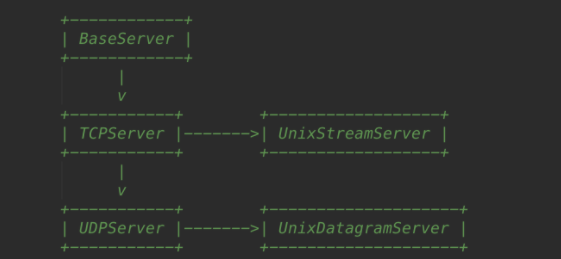
它包含了五种server类,分别是 Baseserver(不直接对外服务);TCPServer(使用TCP协议) ;UDPServer(使用UDP协议),UinixStreamServer 和UnixDatagramServer(后面两个仅仅在unix环境下游泳,一般不常用)
他们五个的关系如下:
BaseServer的源码:
class BaseServer:

    """Base class for server classes.

    Methods for the caller:

    - __init__(server_address, RequestHandlerClass)

    - serve_forever(poll_interval=0.5)

    - shutdown()

    - handle_request()  # if you do not use serve_forever()

    - fileno() -> int   # for select()

    Methods that may be overridden:

    - server_bind()

    - server_activate()

    - get_request() -> request, client_address

    - handle_timeout()

    - verify_request(request, client_address)

    - server_close()

    - process_request(request, client_address)

    - shutdown_request(request)

    - close_request(request)

    - service_actions()

    - handle_error()

    Methods for derived classes:

    - finish_request(request, client_address)

    Class variables that may be overridden by derived classes or

    instances:

    - timeout

    - address_family

    - socket_type

    - allow_reuse_address

    Instance variables:

    - RequestHandlerClass

    - socket

    """

    timeout = None

    def __init__(self, server_address, RequestHandlerClass):

        """Constructor.  May be extended, do not override."""

        self.server_address = server_address

        self.RequestHandlerClass = RequestHandlerClass

        self.__is_shut_down = threading.Event()

        self.__shutdown_request = False

    def server_activate(self):

        """Called by constructor to activate the server.

        May be overridden.

        """

        pass

    def serve_forever(self, poll_interval=0.5):

        """Handle one request at a time until shutdown.

        Polls for shutdown every poll_interval seconds. Ignores

        self.timeout. If you need to do periodic tasks, do them in

        another thread.

        """

        self.__is_shut_down.clear()

        try:

            while not self.__shutdown_request:

                # XXX: Consider using another file descriptor or

                # connecting to the socket to wake this up instead of

                # polling. Polling reduces our responsiveness to a

                # shutdown request and wastes cpu at all other times.

                r, w, e = _eintr_retry(select.select, [self], [], [],

                                       poll_interval)

                if self in r:

                    self._handle_request_noblock()

                self.service_actions()

        finally:

            self.__shutdown_request = False

            self.__is_shut_down.set()

    def shutdown(self):

        """Stops the serve_forever loop.

        Blocks until the loop has finished. This must be called while

        serve_forever() is running in another thread, or it will

        deadlock.

        """

        self.__shutdown_request = True

        self.__is_shut_down.wait()

    def service_actions(self):

        """Called by the serve_forever() loop.

        May be overridden by a subclass / Mixin to implement any code that

        needs to be run during the loop.

        """

        pass

    # The distinction between handling, getting, processing and

    # finishing a request is fairly arbitrary.  Remember:

    #

    # - handle_request() is the top-level call.  It calls

    #   select, get_request(), verify_request() and process_request()

    # - get_request() is different for stream or datagram sockets

    # - process_request() is the place that may fork a new process

    #   or create a new thread to finish the request

    # - finish_request() instantiates the request handler class;

    #   this constructor will handle the request all by itself

    def handle_request(self):

        """Handle one request, possibly blocking.

        Respects self.timeout.

        """

        # Support people who used socket.settimeout() to escape

        # handle_request before self.timeout was available.

        timeout = self.socket.gettimeout()

        if timeout is None:

            timeout = self.timeout

        elif self.timeout is not None:

            timeout = min(timeout, self.timeout)

        fd_sets = _eintr_retry(select.select, [self], [], [], timeout)

        if not fd_sets[]:

            self.handle_timeout()

            return

        self._handle_request_noblock()

    def _handle_request_noblock(self):

        """Handle one request, without blocking.

        I assume that select.select has returned that the socket is

        readable before this function was called, so there should be

        no risk of blocking in get_request().

        """

        try:

            request, client_address = self.get_request()

        except OSError:

            return

        if self.verify_request(request, client_address):

            try:

                self.process_request(request, client_address)

            except:

                self.handle_error(request, client_address)

                self.shutdown_request(request)

    def handle_timeout(self):

        """Called if no new request arrives within self.timeout.

        Overridden by ForkingMixIn.

        """

        pass

    def verify_request(self, request, client_address):

        """Verify the request.  May be overridden.

        Return True if we should proceed with this request.

        """

        return True

    def process_request(self, request, client_address):

        """Call finish_request.

        Overridden by ForkingMixIn and ThreadingMixIn.

        """

        self.finish_request(request, client_address)

        self.shutdown_request(request)

    def server_close(self):

        """Called to clean-up the server.

        May be overridden.

        """

        pass

    def finish_request(self, request, client_address):

        """Finish one request by instantiating RequestHandlerClass."""

        self.RequestHandlerClass(request, client_address, self)

    def shutdown_request(self, request):

        """Called to shutdown and close an individual request."""

        self.close_request(request)

    def close_request(self, request):

        """Called to clean up an individual request."""

        pass

    def handle_error(self, request, client_address):

        """Handle an error gracefully.  May be overridden.

        The default is to print a traceback and continue.

        """

        print('-'*)

        print('Exception happened during processing of request from', end=' ')

        print(client_address)

        import traceback

        traceback.print_exc() # XXX But this goes to stderr!

        print('-'*)
RequestHandler类
所有requestHandler都继承BaseRequestHandler基类。
请求的基类是baserequesthandler,其中一般需要重写的方法就是handle方法,主要就是如何处理接下里的请求,在这个类中,主要有三个方法,分别是setup ,handle ,finish方法,在调用这个类的时候,先调用setup进行一些初始化的工作,然后调用handle方法进行处理请求,然后调用finish方法,做一些关闭连接什么的,在这个里面最主要的参数就是self.request,也就是请求的socket对象,其中可以发送消息sendall或者send,接受消息就是recv
在请求处理的子类中有两个,一个是SreamRequestHandle和DatagramRequestHandle,在这个里面重写了基类的setup方法和finish方法,handle方法没有重写,因为这个是留给用户做处理请求的方法
requestHandler源码:
class BaseServer:

    """Base class for server classes.

    Methods for the caller:

    - __init__(server_address, RequestHandlerClass)

    - serve_forever(poll_interval=0.5)

    - shutdown()

    - handle_request()  # if you do not use serve_forever()

    - fileno() -> int   # for select()

    Methods that may be overridden:

    - server_bind()

    - server_activate()

    - get_request() -> request, client_address

    - handle_timeout()

    - verify_request(request, client_address)

    - server_close()

    - process_request(request, client_address)

    - shutdown_request(request)

    - close_request(request)

    - service_actions()

    - handle_error()

    Methods for derived classes:

    - finish_request(request, client_address)

    Class variables that may be overridden by derived classes or

    instances:

    - timeout

    - address_family

    - socket_type

    - allow_reuse_address

    Instance variables:

    - RequestHandlerClass

    - socket

    """

    timeout = None

    def __init__(self, server_address, RequestHandlerClass):

        """Constructor.  May be extended, do not override."""

        self.server_address = server_address

        self.RequestHandlerClass = RequestHandlerClass

        self.__is_shut_down = threading.Event()

        self.__shutdown_request = False

    def server_activate(self):

        """Called by constructor to activate the server.

        May be overridden.

        """

        pass

    def serve_forever(self, poll_interval=0.5):

        """Handle one request at a time until shutdown.

        Polls for shutdown every poll_interval seconds. Ignores

        self.timeout. If you need to do periodic tasks, do them in

        another thread.

        """

        self.__is_shut_down.clear()

        try:

            while not self.__shutdown_request:

                # XXX: Consider using another file descriptor or

                # connecting to the socket to wake this up instead of

                # polling. Polling reduces our responsiveness to a

                # shutdown request and wastes cpu at all other times.

                r, w, e = _eintr_retry(select.select, [self], [], [],

                                       poll_interval)

                if self in r:

                    self._handle_request_noblock()

                self.service_actions()

        finally:

            self.__shutdown_request = False

            self.__is_shut_down.set()

    def shutdown(self):

        """Stops the serve_forever loop.

        Blocks until the loop has finished. This must be called while

        serve_forever() is running in another thread, or it will

        deadlock.

        """

        self.__shutdown_request = True

        self.__is_shut_down.wait()

    def service_actions(self):

        """Called by the serve_forever() loop.

        May be overridden by a subclass / Mixin to implement any code that

        needs to be run during the loop.

        """

        pass

    # The distinction between handling, getting, processing and

    # finishing a request is fairly arbitrary.  Remember:

    #

    # - handle_request() is the top-level call.  It calls

    #   select, get_request(), verify_request() and process_request()

    # - get_request() is different for stream or datagram sockets

    # - process_request() is the place that may fork a new process

    #   or create a new thread to finish the request

    # - finish_request() instantiates the request handler class;

    #   this constructor will handle the request all by itself

    def handle_request(self):

        """Handle one request, possibly blocking.

        Respects self.timeout.

        """

        # Support people who used socket.settimeout() to escape

        # handle_request before self.timeout was available.

        timeout = self.socket.gettimeout()

        if timeout is None:

            timeout = self.timeout

        elif self.timeout is not None:

            timeout = min(timeout, self.timeout)

        fd_sets = _eintr_retry(select.select, [self], [], [], timeout)

        if not fd_sets[0]:

            self.handle_timeout()

            return

        self._handle_request_noblock()

    def _handle_request_noblock(self):

        """Handle one request, without blocking.

        I assume that select.select has returned that the socket is

        readable before this function was called, so there should be

        no risk of blocking in get_request().

        """

        try:

            request, client_address = self.get_request()

        except OSError:

            return

        if self.verify_request(request, client_address):

            try:

                self.process_request(request, client_address)

            except:

                self.handle_error(request, client_address)

                self.shutdown_request(request)

    def handle_timeout(self):

        """Called if no new request arrives within self.timeout.

        Overridden by ForkingMixIn.

        """

        pass

    def verify_request(self, request, client_address):

        """Verify the request.  May be overridden.

        Return True if we should proceed with this request.

        """

        return True

    def process_request(self, request, client_address):

        """Call finish_request.

        Overridden by ForkingMixIn and ThreadingMixIn.

        """

        self.finish_request(request, client_address)

        self.shutdown_request(request)

    def server_close(self):

        """Called to clean-up the server.

        May be overridden.

        """

        pass

    def finish_request(self, request, client_address):

        """Finish one request by instantiating RequestHandlerClass."""

        self.RequestHandlerClass(request, client_address, self)

    def shutdown_request(self, request):

        """Called to shutdown and close an individual request."""

        self.close_request(request)

    def close_request(self, request):

        """Called to clean up an individual request."""

        pass

    def handle_error(self, request, client_address):

        """Handle an error gracefully.  May be overridden.

        The default is to print a traceback and continue.

        """

        print('-'*40)

        print('Exception happened during processing of request from', end=' ')

        print(client_address)

        import traceback

        traceback.print_exc() # XXX But this goes to stderr!

        print('-'*40)
混合类(并发类)
两个混合类,一个是ForkingMixin,主要是用fork的,产生一个新的进程去处理;一个是ThreadingMixin,产生一个新的线程,主要是用来提供异步处理的能力,其余tcpserver和udpserver组合,又产生了新的四个类,从而提供异步处理的能力。
(在使用混合类和服务器类的时候,注意混合类需要写在前面,因为混合类重写了服务器类的方法,从而需要放在第一个位置。)
 class socketserver.ForkingTCPServer

 class socketserver.ForkingUDPServer

 class socketserver.ThreadingTCPServer

 class socketserver.ThreadingUDPServer
下面主要举例说一下socketserver服务器端和客户端的代码
scoketserver服务器端
在socketserver模块中,主要就是使用一些服务器类,从而简化socket网络编程的方法,先上一段基本的服务器代码:
 import socketserver

 ip_port = ('127.0.0.1',)

 class Myhandler(socketserver.BaseRequestHandler):

     def handle(self):

         while True:

             data = self.request.recv()

             print(data,self.client_address)

             if data == 'exit':

                 break

 if __name__ == '__main__':

     s =socketserver.ThreadingTCPServer((ip_port),Myhandler)

     s.serve_forever()
在上述代码中,首先定义了一个类,也就是处理请求的类,从基类baserequesthandler继承,主要就是重写了其中的handle方法,告知服务器如何来处理客户端的请求。然后建立了一个线程的TCP服务器类,也就是通过多线程来进行应答客户端,然后通过使用一直运行的方法就是serve_forever
scoketserver客户端
 import socket

 ip_port = ('127.0.0.1',)

 sk = socket.socket()

 sk.connect(ip_port)

 print ("客户端启动:")

 while True:

     inp = input('>>>')

     sk.sendall(bytes(inp,"utf8"))

     server_response=sk.recv()

     print (str(server_response,"utf8"))

     if inp == 'exit':

         break

 sk.close()
客户端的代码和socket编程的代码基本相同,因为在socketserver模块中,主要是创建socke的服务端,而不涉及到客户端,从而客户端不需要修改代码即可进行运行。
class socketserver.ForkingTCPServer


class socketserver.ForkingUDPServer


class socketserver.ThreadingTCPServer


class socketserver.ThreadingUDPServer
socketserver内部调用程序
- 启动服务端程序
- 执行 TCPServer.init 方法,创建服务端Socket对象并绑定 IP 和 端口
- 执行 BaseServer.init 方法,将自定义的继承自SocketServer.BaseRequestHandler 的类 - MyRequestHandle赋值给 self.RequestHandlerClass
- 执行 BaseServer.server_forever 方法,While 循环一直监听是否有客户端请求到达 ...
当客户端连接到达服务器 - 执行 ThreadingMixIn.process_request 方法,创建一个 “线程” 用来处理请求
- 执行 ThreadingMixIn.process_request_thread 方法
- 执行 BaseServer.finish_request 方法,执行 self.RequestHandlerClass() 即:执行 自定义 MyRequestHandler 的构造方法(自动调用基类BaseRequestHandler的构造方法,在该构造方法中又会调用 MyRequestHandler的handle方法)
浅析python中socketserver模块使用的更多相关文章
- 【转】浅析Python中的struct模块
[转]浅析Python中的struct模块 最近在学习python网络编程这一块,在写简单的socket通信代码时,遇到了struct这个模块的使用,当时不太清楚这到底有和作用,后来查阅了相关资料大概 ...
- 深入浅析python中的多进程、多线程、协程
深入浅析python中的多进程.多线程.协程 我们都知道计算机是由硬件和软件组成的.硬件中的CPU是计算机的核心,它承担计算机的所有任务. 操作系统是运行在硬件之上的软件,是计算机的管理者,它负责资源 ...
- 浅析JS中的模块规范(CommonJS,AMD,CMD)////////////////////////zzzzzz
浅析JS中的模块规范(CommonJS,AMD,CMD) 如果你听过js模块化这个东西,那么你就应该听过或CommonJS或AMD甚至是CMD这些规范咯,我也听过,但之前也真的是听听而已. ...
- Python中optionParser模块的使用方法[转]
本文以实例形式较为详尽的讲述了Python中optionParser模块的使用方法,对于深入学习Python有很好的借鉴价值.分享给大家供大家参考之用.具体分析如下: 一般来说,Python中有两个内 ...
- python中threading模块详解(一)
python中threading模块详解(一) 来源 http://blog.chinaunix.net/uid-27571599-id-3484048.html threading提供了一个比thr ...
- 【转】关于python中re模块split方法的使用
注:最近在研究文本处理,需要用到正则切割文本,所以收索到了这篇文章,很有用,谢谢原作者. 原址:http://blog.sciencenet.cn/blog-314114-775285.html 关于 ...
- Python中的模块介绍和使用
在Python中有一个概念叫做模块(module),这个和C语言中的头文件以及Java中的包很类似,比如在Python中要调用sqrt函数,必须用import关键字引入math这个模块,下面就来了解一 ...
- python中导入模块的本质, 无法导入手写模块的解决办法
最近身边一些朋友发生在项目当中编写自己模块,导入的时候无法导入的问题. 下面我来分享一下关于python中导入模块的一些基本知识. 1 导入模块时寻找路径 在每一个运行的python程序当中,都维护了 ...
- Python中time模块详解
Python中time模块详解 在平常的代码中,我们常常需要与时间打交道.在Python中,与时间处理有关的模块就包括:time,datetime以及calendar.这篇文章,主要讲解time模块. ...
随机推荐
- oralce11g导出dmp然后导入Oracle10g
一次Oracle11g数据库导入 Oracle10g数据库操作笔记 11g备份导入10g的时候会抛错直接阻止导入. 但是有时候还必须得把11g的数据库导入到10g我今天就遇到了这种情况. 一开始 ...
- netty详解之io模型
提起IO模型首先想到的就是同步,异步,阻塞,非阻塞这几个概念.每个概念的含义,解释,概念间的区别这些都是好理解,这里深入*nix系统讲一下IO模型. 在*nix中将IO模型分为5类. Blocking ...
- SpringMVC上传图片并压缩及剪切demo
/** * */ package com.up.controller; import java.awt.Image; import java.awt.image.BufferedImage; impo ...
- Ubuntu下errno值
Ubuntu下errno值 每当一个Unix函数(如socket函数)中错误发生时,全局变量errno将被设置成一个指示错误类型的正整数,假设函数不返回错误,errno的值就未 ...
- 【SqlServer】【问题收集】必须声明标量变量
1 问题概述 在DAL层,通过标量给变量赋值时,出现如下异常 我们来看看在数据访问层的SQL语句: //根据EmployeeName条件获取数据 public DataTable GetEmplo ...
- C#基础知识 简单说明泛型的优点
有关泛型的优缺点在网上有很多篇文章,也足以说明问题,我就不去复制粘贴了(而且内容有些多),由于记性不太好,所以自己做个简单明了的总结. 泛型的优点主要有两个: "性能" " ...
- Eclipse 使用小结
代码智能提示 Java智能提示 Window -> Preferences -> Java -> Editor -> Content Assist -> Auto Act ...
- chrome调试,打完断点后关于JS的几个控制介绍
打完断点之后,关于JS的几个控制介绍. 快捷键:F8 "逐过程执行",继续执行代码,直到遇到下一个断点. 详细解释: 暂停和开始.当设置了断点之后,js的执行就暂停了,如果我们想要 ...
- Swagger文档添加file上传参数写法
想在swagger ui的yaml文档里面写一个文件上传的接口,找了半天不知道怎么写,终于搜到了,如下: /tools/upload: post: tags: - "tool" s ...
- Centos7安装配置Xhgui
XhProf是Facebook出品的一个PHP性能监控工具,只包含基本的界面和图形来分析数据.后来Paul Reinheimer在此基础上开发了Xhgui,提供了更好的界面和功能,其主页在https: ...